Key Takeaways
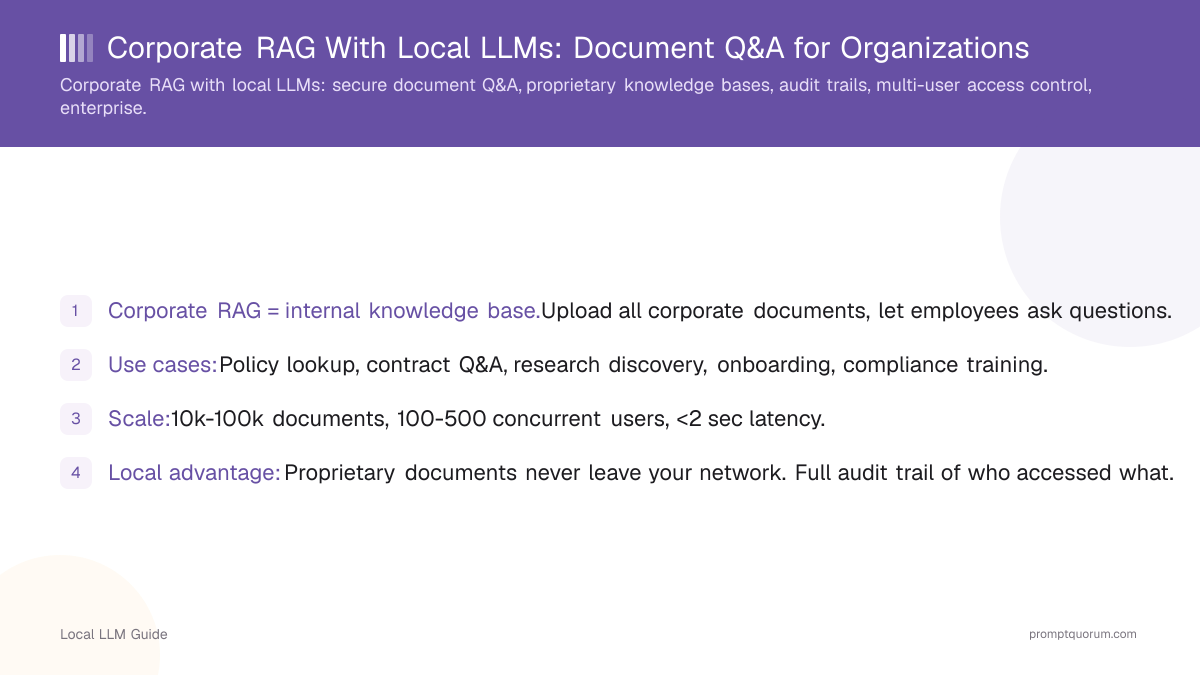
- Corporate RAG = internal knowledge base. Upload all corporate documents, let employees ask questions.
- Use cases: Policy lookup, contract Q&A, research discovery, onboarding, compliance training.
- Scale: 10k-100k documents, 100-500 concurrent users, <2 sec latency.
- Local advantage: Proprietary documents never leave your network. Full audit trail of who accessed what.
- Corporate RAG saves companies $500k-5M annually in employee productivity.
📍 In One Sentence
Corporate RAG applies retrieval-augmented generation to internal documents -- policies, contracts, wikis, research papers -- keeping proprietary content on-premises, eliminating per-query API costs, and providing a full audit trail of what was retrieved and answered.
💬 In Plain Terms
This is the enterprise version of asking an AI questions about your own files, except the files are company policies, contracts, and internal wikis instead of personal documents. Running it locally means sensitive internal knowledge never has to leave the company's own servers, and every retrieval and answer can be logged for compliance.
What Documents Can Corporate RAG Handle?
Document Type | RAG Use | Typical Users |
|---|---|---|
| Employee handbook | Policy lookup ("How much PTO do I have?") | All employees |
| Contracts | Clause search ("What's the termination clause?") | Legal, procurement |
| Technical docs | API reference, code examples | Engineers |
| Research papers | Knowledge discovery ("Papers on quantum ML?") | R&D teams |
| Compliance docs | Regulatory lookup ("GDPR requirements for data retention?") | Compliance, legal |
| Customer docs | Product documentation, FAQ | Support, sales |
How Do You Ingest Documents at Scale?
Ingestion pipeline converts documents to embeddings and stores in vector DB.
- 1Extract documents: From file servers, SharePoint, Jira, Confluence, etc.
- 2Parse: Convert PDFs, Word docs, HTML to text. Handle tables, images.
- 3Chunk: Split into 500-1000 token chunks with 20% overlap.
- 4Embed: Convert chunks to vectors using local embedding model (nomic-embed-text).
- 5Index: Store vectors in Qdrant, Milvus, or Weaviate with metadata (source, date, author).
- 6Refresh: Weekly or monthly re-ingest to capture updates.
How Do You Design Multi-User Corporate RAG?
Typical stack:
- Frontend: Web interface or Slack bot.
- API: REST endpoint for RAG queries.
- LLM: Local Llama 13B (quality) or 7B (speed).
- Embeddings: Local nomic-embed-text (or cloud for speed).
- Vector DB: Qdrant (distributed) for 10k+ documents.
- Document storage: Encrypted file server for PDFs and sources.
- Access control: LDAP/AD integration for user permissions.
How Do You Ensure Retrieval Quality?
Poor retrieval = poor answers. Quality depends on:
- Chunking strategy: Semantic chunks (by topic) outperform fixed-size chunks.
- Embedding model: Use domain-specific embeddings if available. Generic embeddings may miss domain terminology.
- Retrieval parameters: k=5-10 (how many chunks to retrieve). Too low = missing context. Too high = noise.
- Reranking: Use cross-encoder to re-rank chunks by relevance (small quality boost).
- User feedback: "Feedback" button on answers. Use to tune retrieval parameters.
How Do You Implement Governance and Access Control?
Corporate RAG must track access for compliance:
- Access logs: Who queried what documents, when, from where.
- Retention: Keep logs for 3-7 years (regulatory requirement).
- Access control: Restrict documents by role (e.g., only legal sees contracts).
- Audit: Quarterly review of access logs for unusual activity.
- Data classification: Mark documents as public, internal, confidential, restricted.
Common Corporate RAG Mistakes
- Ingesting without cleaning. Old documents, duplicates, test files = retrieval noise. Clean before ingesting.
- Not chunking intelligently. Fixed-size chunks split topics mid-sentence. Use semantic chunking.
- No access control. If all documents are visible to all employees, confidential info leaks.
- Ignoring retrieval quality. Test with real employees before wide rollout. 50% of issues are retrieval, not generation.
- Not re-ingesting updates. Document database becomes stale. Schedule weekly/monthly re-ingest.
What Are Common Questions About Corporate RAG?
How many documents can corporate RAG handle?
Depends on average document size and latency. Typical range: 10k-100k documents. Retrieval latency should be <1 second. If slower, optimize chunking or embeddings. Test with your actual document set.
Which embedding model should we use?
Open-source options: all-MiniLM-L6-v2 (fast, good), BAAI/bge-base-en-v1.5 (better quality). Proprietary: OpenAI text-embedding-3-small. For local deployment, use open-source. Quality difference matters: better embeddings = better retrieval.
How do we update documents without losing chat history?
Store chat history separately from document embeddings. Update embeddings on a schedule (weekly/monthly). Old chats still reference old document versions, which is fine--just document the version date.
Can we use RAG for confidential documents?
Yes--local RAG is ideal. Documents stay on-premises, queries are not logged externally, and you control access via role-based permissions. This satisfies HIPAA and GDPR.
What is semantic vs fixed-size chunking?
Fixed-size (e.g., 512 tokens) is simpler but splits topics mid-sentence. Semantic chunking uses sentence/paragraph boundaries, preserving meaning. Semantic is better for RAG quality but slower to set up.
How do we measure RAG quality?
Metrics: retrieval@k (right document in top k results), latency (should be <1 sec), user satisfaction (survey employees). Test with domain experts--they know what "correct" answers look like.
Sources
- LlamaIndex Documentation -- docs.llamaindex.ai
- Qdrant Vector Database -- qdrant.tech
- Retrieval Evaluation -- arxiv.org (search "RAG evaluation metrics")