Key Takeaways
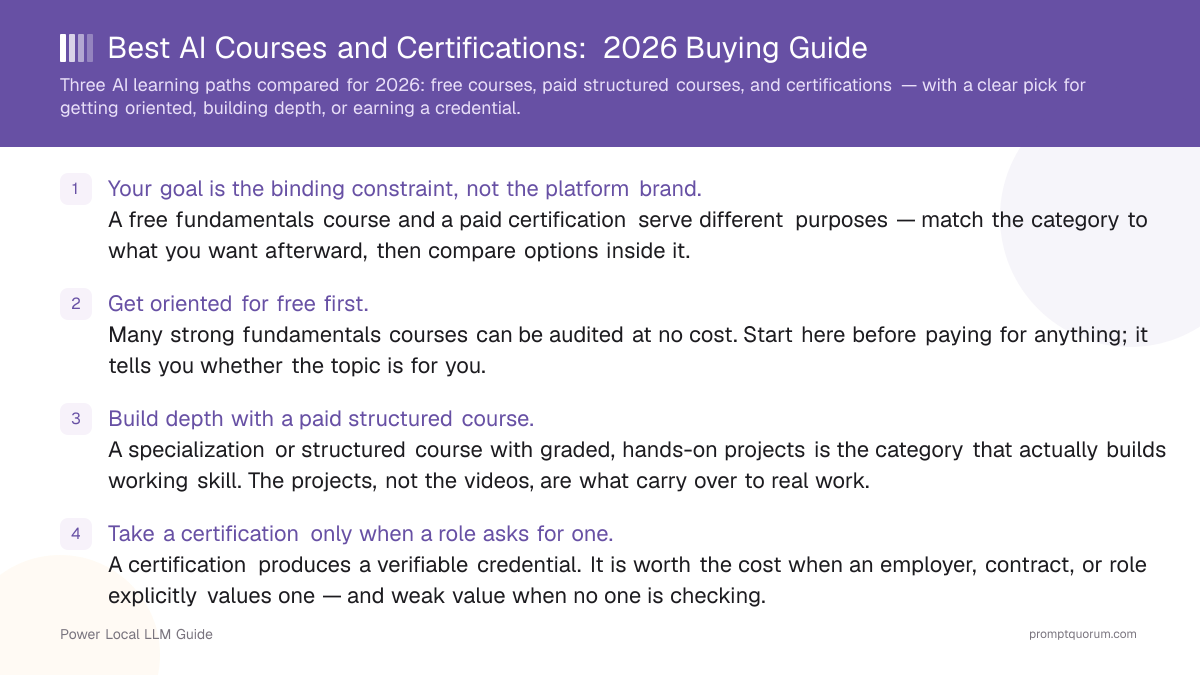
- Your goal is the binding constraint, not the platform brand. A free fundamentals course and a paid certification serve different purposes — match the category to what you want afterward, then compare options inside it.
- Get oriented for free first. Many strong fundamentals courses can be audited at no cost. Start here before paying for anything; it tells you whether the topic is for you.
- Build depth with a paid structured course. A specialization or structured course with graded, hands-on projects is the category that actually builds working skill. The projects, not the videos, are what carry over to real work.
- Take a certification only when a role asks for one. A certification produces a verifiable credential. It is worth the cost when an employer, contract, or role explicitly values one — and weak value when no one is checking.
- Prompt engineering is its own track. General AI courses underweight prompt writing. If your work centers on getting good output from existing models, a dedicated prompt engineering course is the direct path.
- Audit before you pay. Most paid platforms let you preview or audit course material before purchase. Use that to confirm the level and teaching style fit before committing money.
- Watch the subscription-versus-one-time math. Some platforms charge a monthly subscription, others a one-time course fee — the cheaper option depends entirely on how fast you finish.
- Prices shown are approximate. Course platform pricing moves with promotions and subscription changes — check the current price on the platform before enrolling.
Quick Facts
- Free courses: fundamentals and orientation, often auditable at no cost — the right starting point.
- Paid structured courses: specializations and structured tracks with graded projects — the category that builds working skill.
- Certifications: issue a verifiable credential — worth it when a role or employer specifically asks for one.
- Prompt engineering courses: a focused track for getting good output from existing models.
- Pricing models vary: monthly subscription, one-time course fee, or free audit — the cheapest depends on how fast you finish.
- Verifiable certificate: check whether a course issues a credential with a shareable verification link before paying for the certificate option.
- Time commitment: structured specializations commonly run several weeks to a few months at a few hours per week — confirm the estimate before enrolling.
Sponsored
Editor's Choice: A Paid Structured Course With Graded Projects
For most learners moving past the basics, a paid structured course or specialization with graded, hands-on projects is the pick that turns AI knowledge into working skill. The deciding feature is the projects: videos transfer information, but graded projects force you to apply it, which is what carries over to real work. A structured course also sequences topics so you do not skip prerequisites, and many issue a verifiable certificate on completion. If you only want to find out whether AI is for you, start with a free fundamentals course first — it costs nothing and answers that question. If a specific job or contract requires a named credential, choose a certification track instead. Course prices change with promotions and subscription tiers, so check the current price on the platform before enrolling.
📌Note: This Editor's Choice reflects fit-for-purpose only. PromptQuorum is not enrolled in any affiliate program and the links below carry no affiliate tags — they are plain reference links that earn no commission.
How the Four AI Learning Categories Compare in 2026
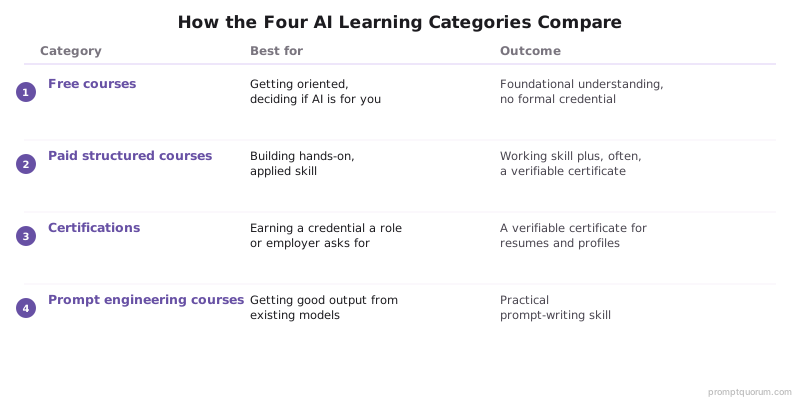
The "best for" column reflects learning goal, not a single course. Pricing below is expressed qualitatively, not as fixed figures — course platform pricing changes with promotions and subscription tiers, so confirm the current price on the platform before enrolling.
📍 In One Sentence
For AI learning, your goal — getting oriented, building hands-on depth, or earning a recognized credential — decides which category of course is right, not the platform brand.
💬 In Plain Terms
Think of AI courses like tools in a toolbox. A free course is the one you reach for to see if you even like the work. A paid structured course is the one that actually builds the skill. A certification is the one you use to prove the skill to someone else. Picking the wrong tool for the job wastes money and time.
Category | Best for | Outcome | Cost |
|---|---|---|---|
| Free courses | Getting oriented, deciding if AI is for you | Foundational understanding, no formal credential | Free to audit; check current price |
| Paid structured courses | Building hands-on, applied skill | Working skill plus, often, a verifiable certificate | Subscription or one-time fee; check current price |
| Certifications | Earning a credential a role or employer asks for | A verifiable certificate for resumes and profiles | One-time fee; check current price |
| Prompt engineering courses | Getting good output from existing models | Practical prompt-writing skill | Free to mid-range; check current price |
Which AI Course Should You Take?
Your goal decides the category; your budget and timeline decide which option inside it. Find the row that matches your situation.
Your situation | Take this |
|---|---|
| I want to find out whether AI work is for me | A free fundamentals course, audited at no cost |
| I understand the basics and want real, applied skill | A paid structured course or specialization with graded projects |
| A job posting or my employer asks for an AI credential | A certification track that issues a verifiable certificate |
| My work is about writing prompts for existing models | A dedicated prompt engineering course |
| I have no budget at all right now | Free courses and free prompt engineering material |
| I am unsure where to begin | A free fundamentals course — it costs nothing and clarifies the next step |
Free AI Courses: Where to Get Oriented
Free AI courses are the right starting point because they let you build a foundation and decide whether the topic is for you before spending anything. Many strong fundamentals courses can be audited at no cost — you get the lectures and readings, usually without the graded certificate.
- Why take one: zero cost, zero risk, and enough material to learn the core concepts and judge whether you want to go deeper.
- Take a free course if you are new to AI, exploring a career change, or want to confirm the topic fits before committing money or time.
- Where to look: DeepLearning.AI publishes short focused courses; Coursera lets you audit many full courses for free; major universities and AI labs post open course material.
- Why this is not the end point: free audits usually omit graded projects and a verifiable certificate. To build applied skill, you move to a paid structured course next.
- Avoid the trap: free does not mean low quality — some of the best-regarded AI fundamentals material is free. Judge by the syllabus and the instructor, not the price.
💡Tip: Audit a free course to confirm a topic before you pay for the structured version. The free material and the paid track often share the same lectures — the paid tier adds graded projects and a certificate.
Paid Structured Courses: Where Skill Actually Builds
A paid structured course or specialization is the category that builds working AI skill, because graded hands-on projects force you to apply what the lectures teach. The projects — not the videos — are what carry over to real work.
- Why take one: a sequenced syllabus so you do not skip prerequisites, graded projects that prove you can apply the material, and usually a verifiable certificate on completion.
- Take a paid structured course if you already understand the basics and want applied, portfolio-grade skill rather than passive familiarity.
- Where to look: DeepLearning.AI and Coursera host structured AI and machine learning specializations; Udemy offers one-time-purchase project courses; DataCamp focuses on interactive, hands-on data and AI tracks.
- Pricing models to compare: subscription platforms charge monthly, so finishing fast is cheaper; one-time-purchase courses cost the same regardless of pace. Pick the model that matches your schedule.
- Why this is the default: for most learners past the fundamentals, this is the category that turns knowledge into skill. Choose it unless your specific goal is only orientation or only a credential.
📌Note: On a subscription platform, the real cost depends on your pace — a learner who finishes a specialization in one month pays far less than one who takes six. Estimate your finish time before choosing subscription versus one-time purchase.
AI Certifications: When a Credential Is Worth Paying For
An AI certification is worth its cost specifically when a role, employer, or contract asks for a recognized credential — and weak value when no one is checking. A certification issues a verifiable certificate you can attach to a resume or professional profile.
- Why take one: a verifiable credential, a structured curriculum, and an external signal of completed study that some employers and contracts explicitly require.
- Take a certification if a job posting names a credential, your employer funds or rewards certification, or you are entering a field where the credential is a known checkbox.
- Where to look: Coursera hosts professional certificate programs; DeepLearning.AI offers structured specializations that issue completion certificates; cloud and software vendors run their own AI certification exams.
- Why skip it: if no employer or role is asking, the credential adds cost without a clear payoff — a paid structured course builds the same skill and often issues a certificate too.
- Verify before you buy: confirm the certificate is verifiable with a shareable link, and check whether the issuer is one your target employers actually recognize.
⚠️Warning: A certification proves you completed a curriculum, not that you can do the job. Treat it as a credential to satisfy a specific requirement — not as a substitute for the hands-on projects in a structured course.
Prompt Engineering Courses: The Underweighted Track
A dedicated prompt engineering course is the direct path if your work centers on getting good output from existing models rather than training new ones. General AI courses underweight prompt writing — they teach how models work, not how to write the inputs that make them useful.
- Why take one: prompt engineering is a distinct, applied skill — structuring inputs, using few-shot examples, and controlling output format — that a general machine learning course barely touches.
- Take a prompt engineering course if you use AI models day to day, build with model APIs, or want better, more reliable output without learning to train models.
- Where to look: DeepLearning.AI publishes focused short courses on prompting; many are free or low cost. PromptQuorum also publishes a free, structured prompt engineering library.
- Why it pairs with the others: prompt skill complements a fundamentals or structured course rather than replacing it — take it alongside, or first if prompting is your immediate need.
- Cost note: prompt engineering courses skew free to mid-range, so this is a low-risk track to add. Check the current price before enrolling.
💡Tip: If your day-to-day need is better output from models you already use, start with a prompt engineering course before a full machine learning specialization — it delivers usable skill faster and at lower cost.
How Do You Evaluate an AI Course Before Enrolling?
Evaluate an AI course on its syllabus, its hands-on projects, its pricing model, and whether it issues a verifiable certificate — not on its marketing. Use this checklist before you pay.
📍 In One Sentence
Evaluate an AI course on its syllabus, its graded hands-on projects, its pricing model, and whether it issues a verifiable certificate — the marketing copy tells you nothing useful.
💬 In Plain Terms
Before paying, read what the course actually teaches and check whether you build things or just watch videos. Building things is what makes a skill stick. Then work out whether a monthly subscription or a one-time fee is cheaper for how fast you will finish.
- Read the full syllabus: confirm it covers what you actually need and that the prerequisites match your current level. A mismatch in level is the most common reason a course fails a learner.
- Check for graded, hands-on projects: a course that is only videos transfers information but not skill. Projects are what carry over to real work — prioritize courses that include them.
- Compare the pricing model: a monthly subscription rewards fast finishers; a one-time fee is pace-independent. Estimate your finish time, then pick the cheaper model for that pace.
- Confirm the certificate is verifiable: if you need a credential, check that the course issues a certificate with a shareable verification link, and that target employers recognize the issuer.
- Audit or preview first: most platforms let you sample material before buying. Use that to confirm the teaching style and depth fit before committing money.
- Choose a project-heavy course if you want applied skill; accept a video-only course if you only need orientation and the price is free or near-free.
Decision Flowchart: Pick Your AI Course in Three Questions
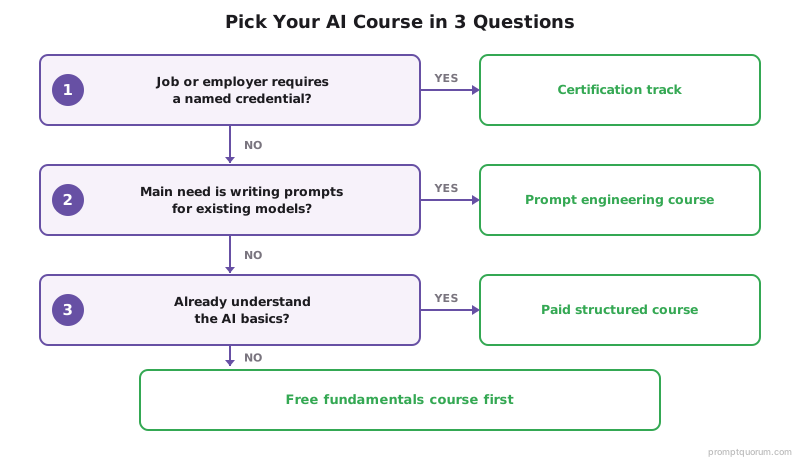
Three questions, in order, route most learners to one category.
📍 In One Sentence
Pick an AI course by answering whether a credential is required first, whether prompt writing is the goal second, and whether you already know the basics last.
💬 In Plain Terms
Start with whether someone is going to ask for a certificate — if yes, get a certification. If your real goal is writing better prompts, take a prompt course. Otherwise, learn the basics free first, then pay for a structured course to build real skill.
- 1. Does a job or employer require a named credential? Yes: a certification track. No: continue.
- 2. Is your main need writing prompts for existing models? Yes: a prompt engineering course. No: continue.
- 3. Do you already understand the AI basics? Yes: a paid structured course with graded projects. No: a free fundamentals course first.
Where to Enroll in an AI Course
The major learning platforms each lean toward a different category, so where you enroll should follow which category you picked. The links below are plain platform links; they carry no affiliate tags and earn no commission.
- Coursera: broad catalog of auditable courses, structured specializations, and professional certificate programs — strong across all three paid categories.
- DeepLearning.AI: focused AI and machine learning courses and short courses, including prompt engineering — many are free or low cost.
- Udemy: one-time-purchase project courses across AI and prompt engineering — good when you prefer paying per course over a subscription.
- DataCamp: interactive, hands-on data and AI tracks — strong for learners who want to practice in the browser rather than watch lectures.
- Enroll during a promotion if you can wait — platform pricing moves with sale events and subscription offers, so timing affects the cost.
⚠️Warning: Every price reference in this guide is approximate. Course platform pricing changes with promotions and subscription tiers — always open the current platform listing before enrolling.
Common Mistakes When Choosing an AI Course
- Paying for a certificate before auditing the course. Most platforms let you preview or audit the material. Confirm the level and teaching style fit before you spend anything.
- Buying a certification when no one is asking for one. A certification is worth its cost when a role or employer requires it. Without that requirement, a paid structured course builds the same skill and often issues a certificate too.
- Choosing a video-only course expecting to build skill. Lectures transfer information; graded projects build skill. A course with no hands-on work leaves you with familiarity, not capability.
- Ignoring the subscription-versus-one-time math. A monthly subscription is cheap if you finish fast and expensive if you stall. Estimate your finish time before picking a pricing model.
- Starting with an advanced course because it sounds impressive. A level mismatch is the top reason learners abandon a course. Match the prerequisites to your current level honestly.
- Treating a general AI course as a prompt engineering course. General courses teach how models work, not how to write good prompts. If prompting is your goal, take a dedicated prompt engineering course.
- Skipping free material and overpaying. Some of the best-regarded AI fundamentals content is free. Audit the free option before assuming a paid course is better.
Sources
- Coursera course catalog — reference for auditable courses, specializations, and professional certificate program structures.
- DeepLearning.AI courses — reference for AI and machine learning courses and prompt engineering short courses.
- Udemy course platform — reference for one-time-purchase project course pricing models.
- DataCamp learning platform — reference for interactive, hands-on data and AI track structures.
Frequently Asked Questions
What is the best AI course to take in 2026?
There is no single best AI course — the best one depends on your goal. To get oriented at zero cost, take a free fundamentals course. To build hands-on skill, take a paid structured course or specialization with graded projects. To earn a credential, take a certification track. If your work centers on writing prompts, take a dedicated prompt engineering course. Match the category to your goal first, then compare options inside it.
Are free AI courses good enough, or should I pay?
Free AI courses are good enough to get oriented and learn the core concepts — many highly regarded fundamentals courses can be audited at no cost. They are the right starting point. Where free courses fall short is graded hands-on projects and a verifiable certificate. To build applied skill or earn a credential, move to a paid structured course or a certification after the free foundation.
Is an AI certification worth it?
An AI certification is worth its cost when a specific role, employer, or contract asks for a recognized credential. In that case it satisfies a concrete requirement. When no one is checking, a certification adds cost without a clear payoff — a paid structured course builds the same skill and often issues a completion certificate too. Decide based on whether a credential is actually being asked for.
Should I take a machine learning course or a prompt engineering course?
It depends on what you want to do. A machine learning course teaches how models are built and trained — take it if you want to develop or fine-tune models. A prompt engineering course teaches how to get good, reliable output from existing models — take it if your work is using models rather than building them. If you only need better output day to day, the prompt engineering course delivers usable skill faster.
How long does an AI course take to complete?
It varies by category. A free short course can take a few hours. A structured specialization commonly runs several weeks to a few months at a few hours per week. A certification track depends on the program. Always check the course page for its time estimate before enrolling — and on a subscription platform, your finish time directly affects the cost.
Do I need a technical background to take an AI course?
Not for every course. Beginner fundamentals courses and many prompt engineering courses assume no prior technical background. Structured machine learning specializations usually expect some programming and math comfort. The single most important step is reading the prerequisites on the course page and matching them honestly to your current level — a level mismatch is the top reason learners abandon a course.
What is the difference between a subscription and a one-time course fee?
A subscription charges a recurring monthly fee for access to a platform or specialization, so finishing fast is cheaper and stalling is expensive. A one-time course fee is paid once and is pace-independent. The cheaper option depends entirely on how fast you finish — estimate your completion time, then pick the model that costs less for that pace.
Where can I learn prompt engineering for free?
Free prompt engineering material is widely available. DeepLearning.AI publishes focused short courses on prompting, several at no cost. PromptQuorum publishes a free, structured prompt engineering library covering techniques such as few-shot prompting and structured output. Because prompt engineering courses skew free to low cost, it is a low-risk track to start before paying for a full machine learning specialization.