关键要点
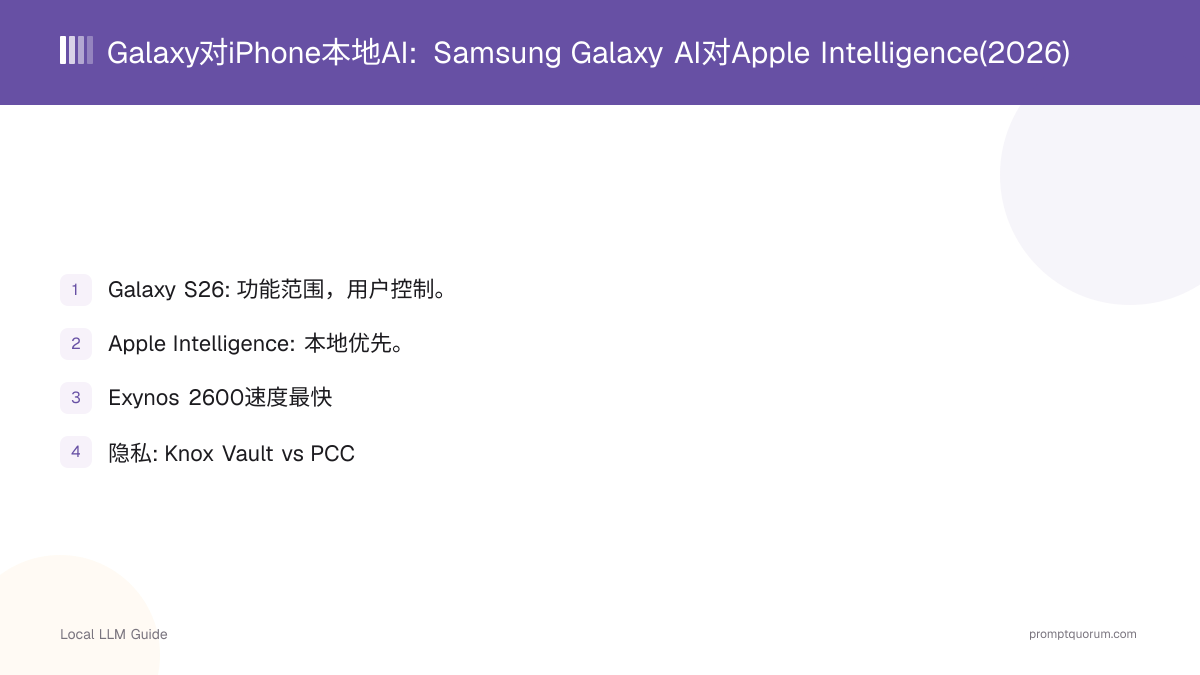
- Galaxy S26 philosophy: pack in features, let users control privacy. Galaxy AI is hybrid on-device + cloud (Call Screening, Now Nudge, Now Brief on-device; Creative Studio, Gemini cloud). Users toggle "Process data only on device" to block cloud fallback.
- Apple Intelligence philosophy: on-device-first by design. AFM 3 (3B on-device, 20B sparse on-device, cloud PCC for advanced reasoning). No data stored after processing. All servers auditable by independent researchers.
- On-device speed: Exynos 2600 (Galaxy S26 global) > Snapdragon 8 Elite Gen 5 (Galaxy S26 US/China/Japan, S26 Ultra globally) > Apple A18 Pro. For Stable Diffusion: Exynos 2600 is 2.4x faster than Exynos 2500; A18 Pro not benchmarked.
- Privacy models diverge: Samsung Knox Vault (hardware enclave) + user-chosen toggle (default: local). Apple on-device-first + optional PCC with cryptographic auditability. Different trust models: Samsung trusts the user to make choices; Apple trusts privacy engineering.
- Cloud strategy: Samsung proactively offers cloud features (Creative Studio requires network + Samsung account). Apple cloud is tier 3 (complex reasoning), not required for most tasks, and uses Private Cloud Compute (no data storage, open to audit).
- For running your own LLMs: Galaxy S26 wins. Exynos 2600 + LPDDR5X 85.6 GB/s reaches ~24 tokens/sec (Q4 7B). Android tooling (Ollama, MLC Chat) is stronger. iPhone better for simplicity and privacy guarantees, not for DIY LLM inference.
Galaxy AI vs Apple Intelligence: Core Philosophy
Samsung Galaxy AI (S26): "Everything, everywhere, user choice." The platform emphasizes breadth—more features at launch, more AI integrations, more user control. The Personal Data Engine learns locally by default, but users can opt into cloud features for more power. The philosophy: AI should be available at the moment of need, and the user decides where processing happens.
Apple Intelligence (iOS 27, WWDC 2026): "On-device first, auditable cloud." The platform emphasizes depth—fewer features, implemented with exceptional polish, open to scrutiny. On-device models (AFM 3 Core 3B, Core Advanced 20B sparse) handle most tasks. Cloud is tier 3 (PCC on NVIDIA/Google Cloud) for only the most complex reasoning. The philosophy: privacy should not require choices; it should be the default.
In practice: Galaxy AI asks you to manage privacy (toggle on/off). Apple Intelligence assumes privacy and offers cloud only when on-device can't handle the task. Neither approach is "better"—they reflect different trust models and user expectations.
Feature count at launch (June 2026): Galaxy S26 ships with 10+ Galaxy AI features on day one. iOS 27 ships with Siri AI (agentic), Writing Tools, Image Playground, Genmoji, Photo Assist. Apple's feature set is narrower but more mature.
📍 简单一句话
Samsung's philosophy: features + user control (hybrid on-device/cloud, users choose). Apple's philosophy: privacy by default (on-device-first, cloud optional and auditable).
💬 简单来说
Samsung says: "Here are all the AI things—use what you want, and toggle privacy." Apple says: "Here are a few AI things, and they're private by default."
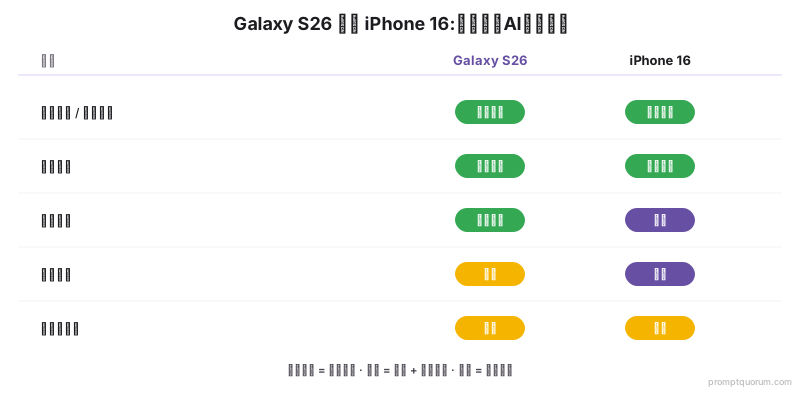
On-Device AI Feature Comparison
| Feature | Galaxy S26 | iPhone 16 (iOS 27) | On-Device Processing? |
|---|---|---|---|
| Call screening / Call filtering | Call Screening (yes, NPU) | Phone filtering (yes, A18) | Both on-device, no cloud needed |
| Suggested actions / Smart replies | Now Nudge (reads screen, suggests actions) | Smart Replies in Messages | Both on-device by default |
| Personal digests / Proactive notifications | Now Brief (calendars, reservations) | Siri Intelligence (travel, events) | Galaxy on-device; Siri may use PCC |
| Fraud detection | Scam Detection (on-device Gemini model) | Scam Detection (on-device machine learning) | Both on-device |
| Image generation | Creative Studio (cloud-only, requires network) | Image Playground + Genmoji (on-device + PCC) | Galaxy cloud; Apple hybrid (local + PCC) |
| Photo editing (advanced) | Photo Assist (hybrid: segment local, edit cloud) | Photo Assist (Reframe, Cleanup, Extend on PCC) | Galaxy hybrid; Apple PCC (auditable) |
| Writing tools (proofreading, rewriting) | Galaxy AI Writing Assist (on-device) | Writing Tools (on-device AFM 3) | Both on-device |
| Multi-step task automation (agents) | Gemini agents (cloud, Google-powered) | Siri AI agents (Extended PCC on Nvidia/Google) | Both cloud, but Apple's is auditable |
Privacy Architecture: Knox vs PCC
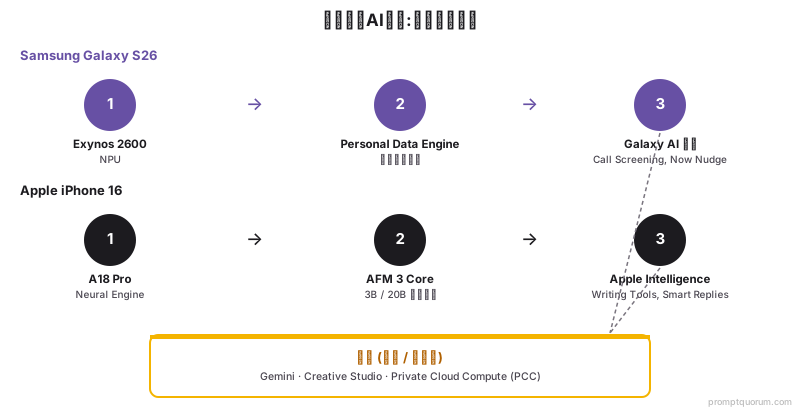
Samsung Knox Vault + User Toggle: Knox Vault is a hardware-isolated enclave (separate processor, separate OS) where sensitive data (biometrics, payment credentials, health records) lives. The Personal Data Engine learns on your device by default, never sending anything to Samsung. Users control cloud opt-in with a single toggle: "Process data only on device" blocks cloud fallback for supported features. The burden is on the user to manage privacy settings, but the defaults are reasonable.
Apple Private Cloud Compute (PCC) + On-Device First: On-device models (AFM 3 Core 3B, Core Advanced 20B sparse) handle most tasks without any cloud. For tasks that exceed on-device capacity, Apple uses PCC on Google Cloud / NVIDIA GPUs. The innovation: PCC uses cryptographic attestation—third-party researchers can audit the code running on Apple's servers and verify that Apple cannot read your data, even if they wanted to. No data is stored after processing. The user doesn't toggle anything; privacy is assumed.
Key Differences: Samsung requires active user management (toggle on/off). Apple assumes privacy and makes exceptions only when necessary. Samsung's model is transparent but places burden on users. Apple's model is invisible but requires trust that Apple's engineering is correct.
For GDPR/Compliance: Apple's PCC auditability is stronger for enterprise use. Samsung's on-device defaults are competitive, but cloud features (Creative Studio, Gemini agents) do send data externally. Both platforms support data deletion; neither stores data indefinitely.
Cross-Device Sync: Samsung Knox Matrix uses end-to-end encryption; Samsung sees only encrypted blobs. Apple iCloud sync is encrypted on-transit; Apple holds decryption keys (trust model issue for some). Knox Matrix is more transparent about what Samsung cannot access.
Cloud AI: Samsung Hybrid vs Apple Three-Tier
Samsung Hybrid Model: Galaxy AI splits at the feature level. Call Screening, Now Nudge, Now Brief stay 100% on-device. Creative Studio (image generation) and Gemini agents (multi-step tasks) require cloud. Users can toggle local-only processing for compatible features, but some features have no alternative. Cloud services are tied to Samsung account and Google Gemini integration.
Apple Three-Tier Model (AFM 3): Tier 1 (on-device, all devices): AFM 3 Core 3B + Core Advanced 20B sparse. Tier 2 (Apple PCC, macOS/iOS): AFM 3 Cloud + ADM 3 Cloud Image. Tier 3 (Extended PCC on Google Cloud / NVIDIA): AFM 3 Cloud Pro for agentic reasoning. Each tier is automatically chosen by a "System Orchestrator"—users don't route manually. The innovation: Tier 2 and Tier 3 use cryptographically auditable PCC, meaning Apple cannot extract your data even if forced.
Scaling Philosophy: Samsung adds cloud features proactively (Creative Studio is the flagship). Apple adds cloud only when on-device hits a hard limit. Samsung is "cloud-first for power." Apple is "on-device-first, cloud as last resort."
Data Handling: Samsung cloud features require internet + account login. Apple PCC requires internet but never stores data after processing. Crucially, Apple publishes PCC code for security researchers to audit; Samsung does not.
Chip Performance for On-Device AI
| Metric | Exynos 2600 (Global S26/S26+) | Snapdragon 8 Elite Gen 5 (US/China/Japan S26, All S26 Ultra) | Apple A18 Pro (iPhone 16) |
|---|---|---|---|
| Fab / Node | 2nm GAA (Samsung) | 3nm FinFET (TSMC) | 3nm (TSMC, custom design) |
| AI Gen-over-Gen Improvement | +113% vs Exynos 2500 | +39% vs Snapdragon 8 Gen 1 | +30% vs A17 Pro |
| Stable Diffusion Speed | 2.4x faster than Exynos 2500 | Not published; likely between Snapdragon 8 Gen 1 and Exynos 2600 | Not published; proprietary Neural Engine |
| Memory Bandwidth | LPDDR5X 85.6 GB/s | LPDDR5X 84.8 GB/s | LPDDR5X ~120 GB/s (estimated) |
| For Running Open-Weight LLMs | Best choice (fastest + Android tools) | Competitive (similar memory bandwidth) | Limited tooling (iOS sandbox restricts LLM inference) |
Which Should You Choose?
Choose Galaxy S26 (Exynos) if: You want maximum on-device AI features at launch. You want control over privacy (on/off toggle). You want to run your own quantized LLMs (Ollama, MLC Chat). You prefer Android ecosystem. You want the fastest hardware for Stable Diffusion (2.4x vs Exynos 2500). You are comfortable managing permissions.
Choose iPhone 16 if: You want privacy to be automatic (no toggles to manage). You want cryptographically auditable cloud processing (PCC). You value simplicity over feature breadth. You trust Apple's hardware security (Secure Enclave) and software engineering. You don't plan to run your own LLMs. You want a closed ecosystem (predictable, less fragmentation).
Specific use cases: For a privacy-first organization → iPhone 16 (PCC auditability is unique). For a startup building AI features → Galaxy S26 (more tooling, more flexibility). For a developer exploring mobile LLM inference → Galaxy S26 (Exynos 2600, Ollama, MLC Chat). For someone who just wants AI and doesn't want to think → iPhone 16 (on-device-first by default).
Hybrid approach: Neither platform is "perfect." Galaxy S26 is more powerful but requires user vigilance on privacy. iPhone 16 is more secure but less feature-rich and more restrictive for advanced use cases. The right choice depends on your threat model, use case, and tolerance for user-facing settings.
- Use Galaxy S26 if you want feature breadth, chip performance, and user control.
- Use iPhone 16 if you want privacy by default and simplicity.
- For running local LLMs: Galaxy S26 (Exynos 2600 is faster + Android has better tooling).
- For enterprise/GDPR: iPhone 16 (PCC auditability is valuable for compliance).
- For feature experimentation: Galaxy S26 (more features + user toggles = faster iteration).
FAQ
Is Galaxy AI better than Apple Intelligence?
Depends on priorities. Galaxy AI has more features at launch and user control; Apple Intelligence has stronger privacy guarantees and polish. For on-device LLM running: Galaxy S26 is better (faster hardware). For privacy-first use: iPhone 16 is better (auditable PCC).
Can I run Ollama or MLC Chat on iPhone?
Not practically. iOS sandboxing is very restrictive. You can run lightweight inference apps, but not full Ollama/MLC Chat. Android (Galaxy S26) has much better support for DIY LLM inference. iPhone 16's A18 Pro is fast, but the OS prevents self-hosted LLMs.
Does Apple read my data in Private Cloud Compute?
No. PCC uses cryptographic attestation: you can download and audit the code running on Apple's servers. Apple cannot decrypt your data without breaking the cryptographic guarantee. This is the main advantage of PCC over traditional cloud services.
Does Samsung send my data to Google?
Only for features using Gemini (agents, Circle to Search). Call Screening, Now Nudge, Now Brief, Scam Detection stay in Samsung's infrastructure. Enable "Process data only on device" to prevent cloud fallback for compatible features.
Which hardware is faster for on-device AI?
Exynos 2600 (Galaxy S26 global) > Snapdragon 8 Elite Gen 5 (Galaxy S26 US/China/Japan) for Stable Diffusion. Apple A18 Pro is not benchmarked against Stable Diffusion. For quantized 7B LLMs: Exynos 2600 reaches ~24 tokens/sec (Q4); A18 Pro unknown.
Can I disable Galaxy AI cloud features?
Yes. Disable Creative Studio, Gemini agents, Circle to Search in Settings > Galaxy AI. Enable "Process data only on device" to block cloud fallback for compatible features. On-device features (Call Screening, Now Nudge) continue working.
Is Apple Intelligence available on all iPhones?
No. Only iPhone 16 and later (A18 Pro chip). iPhone 15 cannot run the new AFM 3 models. Some older features (Writing Tools, Smart Replies) rollout to iPhone 15/14 via iOS updates.
Is Galaxy S26 available globally?
Yes, but with regional chip splits: Exynos 2600 (global S26/S26+), Snapdragon 8 Elite Gen 5 (US/China/Japan S26, all S26 Ultra). For best on-device AI performance, buy the Exynos variant (Europe/Korea/India).
Can I audit Apple's PCC servers?
Yes. Apple publishes the code and threat model for PCC. Independent security researchers can audit it. This is unique to Apple and rare in the cloud AI space.
Which platform is better for privacy?
Both strong but different. Apple: privacy by default, auditable cloud. Samsung: user-controlled toggle, hardware Knox Vault. Apple is better if you trust Apple's engineering. Samsung is better if you want to decide per-feature.