Quick Facts
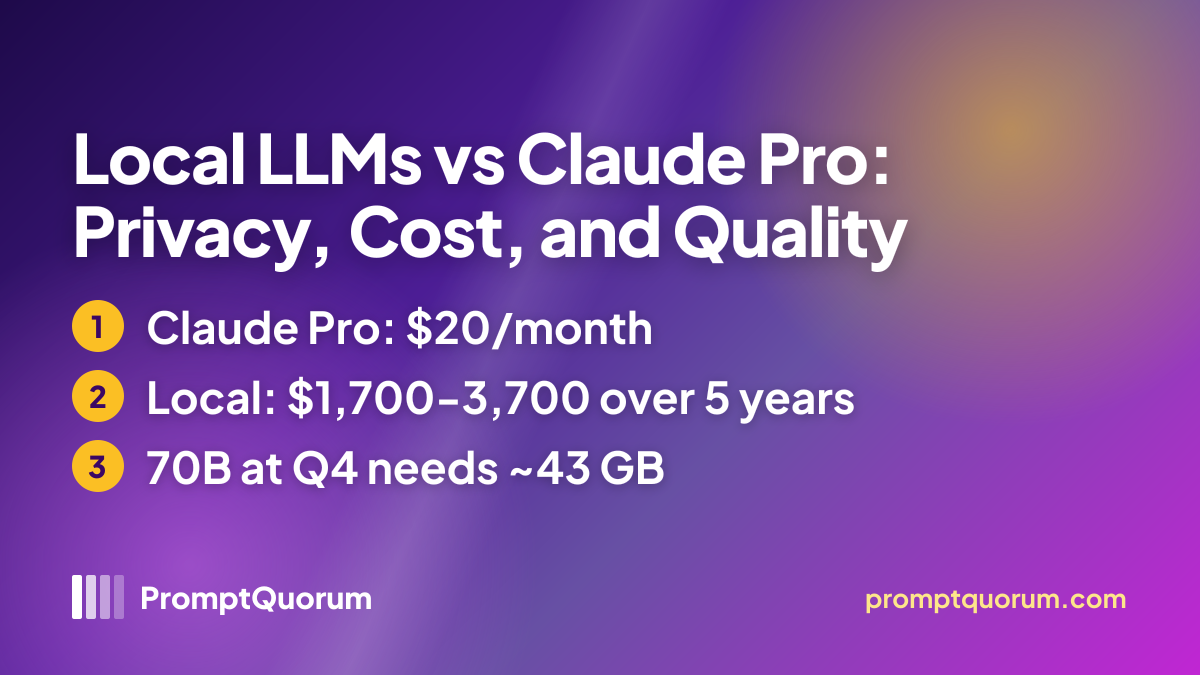
- Claude Pro price: $20/month ($240/year), no hardware needed
- Local hardware (used, US): RTX 3090 $1,400-1,550; RTX 4090 $2,575-3,010 (median sold $2,860; MSRP $1,599, new listings $2,000-3,000)
- Llama 3.3 70B at Q4: about 43 GB of weights; fits two 24 GB GPUs (48 GB) with limited context headroom, not one 24 GB card
- 5-year TCO: Claude Pro $1,200 vs local $1,700-3,700 depending on setup (electricity assumed at $60/year per GPU)
- Context window: Llama 3.3 70B 128K tokens; Claude Pro varies by model (up to 1M tokens per Anthropic's pricing page)
- Break-even: none within 5 years in any scenario; roughly 8-9 years for one RTX 3090 if Claude Pro stays at $20/month
What Is the Price Difference Between Claude Pro and Local LLMs?
Claude Pro lists at $20/month with no hardware; a local setup costs $1,400 to $3,100 up front in used GPUs, plus roughly $60/year of electricity per GPU (an assumption; your usage and tariff vary). On cost alone, Claude Pro is cheaper in year 1 and year 5.
Scenarios (used US prices in USD from the InsiderLLM tracker, eBay sold listings, updated 2026-10-15; prices in your country vary with tax and import costs): (A) one RTX 3090, 24 GB, $1,400-1,550, runs roughly 32B-class models at Q4; (B) one RTX 4090, 24 GB, $2,575-3,010 (median sold $2,860), same model class but faster; (C) two RTX 3090s, 48 GB, $2,800-3,100, can hold Llama 3.3 70B at Q4.
Totals including electricity: Year 1: Claude Pro $240 vs A $1,460-1,610, B $2,635-3,070, C $2,920-3,220. Year 3: Claude Pro $720 vs A $1,580-1,730, B $2,755-3,190, C $3,160-3,460. Year 5: Claude Pro $1,200 vs A $1,700-1,850, B $2,875-3,310, C $3,400-3,700. The totals use the $20/month monthly-billing price; Anthropic's pricing page also lists $17/month with annual billing ($200 up front), which would put the 5-year Claude Pro total at $1,000.
Best GPUs for Local LLMs has detailed hardware options and current market pricing.
•⚠️ Warning: RTX 4090 prices are elevated: the tracker lists MSRP $1,599, new listings at $2,000-3,000 and used sold prices of $2,575-3,010, and describes new stock as dwindling. Prices are US-market and change quickly.
•💡 Pro Tip: Used GPUs can be resold, which lowers the net cost; resale value is not included in these totals.
How Do Privacy Models Differ Between Claude Pro and Local LLMs?
Claude Pro (Anthropic): according to Anthropic's consumer terms update, chats on Free, Pro and Max plans are used for model training only if you allow it in the model-training setting; check which option is selected in your account. If you do not allow it, the existing 30-day retention period applies; if you do, data may be kept for five years. Settings can change, so check your Privacy Settings. Anthropic is US-based and subject to US law.
Local LLMs: inference runs on your own hardware, so prompts do not have to be sent to a third-party AI provider. Runtimes may still make network calls such as update checks or model downloads, so check each tool's settings. Llama 3.3 is an open-weights model released under Meta's custom Llama 3.3 Community License.
Keeping inference on your own hardware can simplify some data-transfer questions in regulated work such as healthcare (HIPAA), payment data (PCI-DSS) or legal privilege. Whether a workflow is compliant depends on your legal basis, contracts and security controls. This is not legal, compliance or financial advice; consult a qualified professional.
•📌 Key Point: Anthropic: according to Anthropic's consumer terms update, consumer chats are used for model training only if you allow it in the model-training setting (check which option is selected in your account); if you do not, the existing 30-day retention period applies.
•🛡️ Compliance: Local inference keeps prompts on your own hardware, which can simplify some data-transfer questions; compliance depends on your legal basis, contracts and controls. Not legal advice.
How Do Claude Sonnet 5 and Llama 3.3 70B Compare in Quality?
Claude Sonnet 5 (Anthropic) is a proprietary cloud model suited to complex analysis, writing and code review, with native image input. It has no local fine-tuning and no offline use, and plan rate limits apply. Anthropic publishes its own benchmark results; PromptQuorum did not run independent tests for this page.
Llama 3.3 70B (Meta, released December 6, 2024) is an open-weights model under the Llama 3.3 Community License with a 128K-token context. It is text-only, supports fine-tuning (LoRA or full), runs offline and has no provider rate limits. Image input needs a separate vision model or adapter. Output quality varies by task, quantization and prompt, and Q4 trades some quality for memory.
On everyday tasks such as summarization, Q&A, data extraction and coding, 70B-class open-weights models can come close to cloud assistants, depending on the prompts, while nuanced analysis, creative writing and ambiguous multi-step reasoning may still favor the proprietary model. Test both on your own prompts. How Much VRAM Do You Need for Local LLMs? covers memory needs: a 70B model needs about 43 GB at Q4, and a 32B-class model roughly 20 GB (check each model's Ollama page).
📍 In One Sentence
Llama 3.3 70B can run offline on your own hardware with about 43 GB of memory at Q4, while Claude Sonnet 5 is a cloud model; which one is better depends on your tasks, so test both.
•💡 Pro Tip: Public benchmarks such as MMLU and HumanEval vary by version and setup, so treat them as a rough guide only and run your own task set before deciding.
How Much Can Each Handle Long Documents?
Claude Pro's context window varies by model; Anthropic's pricing page lists up to 1M tokens for paid plans. Check the current limits for your plan and model.
Llama 3.3 70B supports 128K tokens (roughly 96,000 words). A long context also needs extra VRAM for the KV cache, so on 24 to 48 GB setups the practical limit is often lower than the maximum.
For very long inputs in a single query, such as large codebases or long contracts, Claude Pro's larger window is an advantage. For typical Q&A and summaries of shorter documents either works, and retrieval (RAG) or splitting documents narrows the gap.
•📌 Key Point: Both windows are large; only very long inputs reach Llama 3.3's 128K limit, and local VRAM often limits it first.
What Is the 5-Year Total Cost of Ownership Comparison?
Claude Pro: $20 × 60 months = $1,200.
Scenario A, one used RTX 3090 (roughly 32B-class models): $1,400-1,550 + $300 electricity (5 years × $60) = $1,700-1,850.
Scenario B, one used RTX 4090 (roughly 32B-class models, faster): $2,575-3,010 + $300 electricity = $2,875-3,310. Median sold price: $2,860.
Scenario C, two used RTX 3090s (Llama 3.3 70B at Q4, about 43 GB): $2,800-3,100 + $600 electricity (2 GPUs × 5 years × $60) = $3,400-3,700.
Break-even: none within 5 years. One RTX 3090 would need roughly 8-9 years ($1,400-1,550 ÷ ($20 − $5 electricity per month)), assuming Claude Pro stays at $20/month and ignoring resale value.
💬 In Plain Terms
Over 5 years Claude Pro costs $1,200, while one used RTX 3090 costs $1,700-1,850, one used RTX 4090 $2,875-3,310 and two RTX 3090s for Llama 3.3 70B $3,400-3,700, so local LLMs are chosen for privacy and offline use rather than savings.
•💡 Pro Tip: These totals are illustrative: they assume $60/year of electricity per GPU and constant prices, and ignore resale value, your time and cloud price changes. Not financial advice.
Cost & Privacy FAQ
•🔍 Did You Know?: A single 24 GB card cannot hold Llama 3.3 70B at Q4 (about 43 GB); heavy CPU offload works but is much slower.
Can I use Claude Pro offline?
No. Claude Pro requires an internet connection and Anthropic servers. Llama 3.3 inference runs offline once the model is downloaded (disable update checks in your runtime).
Does Anthropic use my Claude Pro conversations for training?
According to Anthropic's consumer terms update, chats on Free, Pro and Max plans are used for model training only if you allow it in the model-training setting; check which option is selected in your account. If you do not allow it, the existing 30-day retention period applies; if you do, data may be kept for five years. Check your Privacy Settings for the current state.
Is Llama 3.3 70B actually free to use?
The weights are free to download under Meta's Llama 3.3 Community License, a custom license with an acceptable use policy and conditions for very large services (see the model card). It is open-weights rather than open source in the OSI sense. You still pay for hardware and electricity.
Can I fine-tune Claude Pro or local Llama differently?
Claude Pro: no fine-tuning available. Local Llama 3.3: fine-tuning is possible (LoRA, or full-parameter tuning with far more VRAM). Local offers more customization.
What if my local GPU fails?
You lose compute until it is replaced (about $1,400-1,550 for a used RTX 3090 or $2,575-3,010 for a used RTX 4090, per the tracker). Claude Pro degrades gracefully (rate limiting). Local setups need redundancy planning (backup GPU, cloud failover).
Can Llama 3.3 handle images like Claude Pro?
Llama 3.3 is text-only. You can add separate vision models (such as CLIP or LLaVA, each under its own license) as a workaround, but it is not as seamless as Claude.
Is Claude Pro better than Llama 3.3 at any specific task?
Possibly. Claude Sonnet 5 may be stronger at nuanced narrative analysis, multi-step reasoning with ambiguous context and creative writing, and it accepts images natively. Results depend on the task, so compare both on your own prompts.
Can I switch from Claude Pro to a local LLM without losing my workflows?
Often yes for Q&A, summarization and coding. Install Ollama and pick a model that fits your memory: llama3.3:70b needs about 43 GB (two 24 GB GPUs), while a single 24 GB card suits a 32B-class model. Then point API integrations from the Anthropic API to localhost:11434.
Common Mistakes When Comparing Claude Pro and Local LLMs
- Assuming local is cheaper. At the costs above, no local scenario beats $20/month within 5 years; choose local for privacy, offline use or customization.
- Expecting one 24 GB GPU, or two 12 GB GPUs, to run Llama 3.3 70B at Q4. It needs about 43 GB; heavy CPU offload is much slower. Use a 32B-class model or two 24 GB cards.
- Expecting Llama 3.3 to match Claude's image understanding. Llama 3.3 is text-only; add a separate vision model.
- Forgetting Claude Pro's larger context window for single-query document work. For average Q&A, Llama 3.3 is fine.
- Not accounting for setup effort. Running local models needs some technical skill (drivers, runtimes such as Ollama); Claude Pro is turnkey.
Sources
- Anthropic: Updates to consumer terms and privacy policy — Anthropic
- Claude pricing — Anthropic
- Meta Llama 3.3 70B Instruct model card — Meta, December 2024
- InsiderLLM: NVIDIA GPU price tracker — InsiderLLM, updated 2026-10-15
- Ollama library: llama3.3 — Ollama