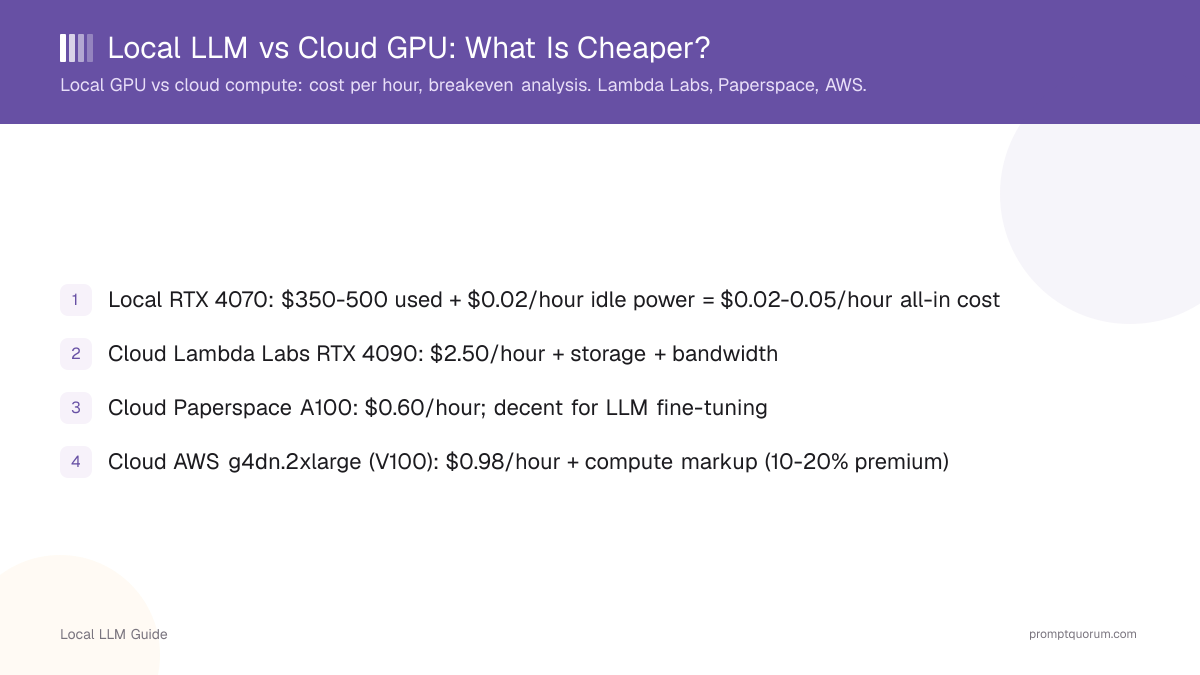
What Is the Hourly Cost: Local vs Cloud?
A local GPU costs its electricity per hour plus its purchase price spread over the hours you use it. Electricity per hour = power draw in kW × your price per kWh.
Example inputs (replace with your own): an RTX 4090 draws 450 W (NVIDIA total graphics power), at $0.14/kWh that is 0.45 × 0.14 = $0.063/hour. An RTX 4070 draws 200 W, which is $0.028/hour. The $2,000 purchase price is the low end of the new RTX 4090 listings tracked by InsiderLLM ($2,000-3,000 against a $1,599 MSRP; source updated 2026-10-15); used sold listings were $2,575-3,010. Break-even hours grow in proportion to the price you actually pay.
Cloud: RunPod lists the RTX 4090 (24 GB) at $0.34/hour on Community Cloud and $0.89/hour on Secure Cloud, read on 2 November 2026.
Lambda lists an A6000 (48 GB) at $1.09/hour and an A100 (40 GB) at $1.99/hour, per GPU on demand, read on 2 November 2026.
Cloud prices change without notice, so check the provider page before you decide.
When Does a Local GPU Break Even with Cloud Compute?
Break-even hours = purchase price ÷ (cloud price per hour − local electricity per hour).
RTX 4090 bought for $2,000 vs RunPod Community Cloud RTX 4090 ($0.34/hour): 2,000 ÷ (0.34 − 0.063) = about 7,200 hours, or about 361 weeks at 20 hours a week.
The same card vs RunPod Secure Cloud RTX 4090 ($0.89/hour): 2,000 ÷ (0.89 − 0.063) = about 2,400 hours, or about 121 weeks at 20 hours a week.
Running 24/7, those figures become about 301 days (Community) and about 101 days (Secure).
The result ignores resale value, the PC that hosts the card and your time. It also assumes the rented GPU has the same 24 GB of memory as the card you would buy.
How Do Cloud GPU Providers Compare?
Prices below are on-demand list prices per GPU-hour, read from the provider pages on 2 November 2026, before tax.
RunPod (Community / Secure): RTX 4090 24 GB $0.34/hour / $0.89/hour; A100 PCIe 80 GB $1.19/hour / $1.79/hour; L40S 48 GB $0.79/hour / $1.09/hour; RTX A6000 48 GB $0.33/hour / $0.59/hour.
Lambda (single-GPU instances): A6000 48 GB $1.09/hour; A100 40 GB $1.99/hour; H100 PCIe 80 GB $3.29/hour; H100 SXM 80 GB $4.29/hour.
DigitalOcean GPU Droplets: RTX 6000 Ada 48 GB $1.57/hour; L40S 48 GB $1.57/hour; H100 80 GB $4.41/hour.
AWS EC2 g4dn.2xlarge (one NVIDIA T4, 16 GiB): $0.752/hour on demand, $0.474/hour with a 1-year reservation and $0.311/hour spot, as listed by the third-party index Vantage. A T4 has less memory and lower throughput than an RTX 4090 (see NVIDIA spec pages), so this is not a like-for-like comparison.
What Is the 1-Year and 24/7 Cost?
At 20 hours a week (1,040 hours a year), the example RTX 4090 costs $2,066 in year one ($2,000 + 1,040 × $0.063), against $354 on RunPod Community Cloud and $926 on Secure Cloud.
Cumulatively, the local card becomes cheaper after about 6.9 years against Community Cloud and about 2.3 years against Secure Cloud.
At 24/7 load (8,760 hours a year), electricity for the example card is about $552 a year, against $2,978 on Community Cloud and $7,796 on Secure Cloud.
For a one-off 10-hour fine-tuning job, an A100 40 GB at Lambda ($1.99/hour) costs $19.90 and needs no purchase.
Frequently Asked Questions
Can I use cloud GPUs for 24/7 continuous inference?
Yes, but this is where renting costs most. A rented RTX 4090 running 8,760 hours costs $2,978 a year on RunPod Community Cloud or $7,796 on Secure Cloud (read 2 November 2026); the example local card costs about $552 a year in electricity after the purchase.
Is a cloud GPU always cheaper for occasional use?
For a few hours a month, yes: 10 hours on a Lambda A100 40 GB costs $19.90 and needs no hardware purchase. Break-even only matters once you use a GPU for hundreds of hours.
Which cloud price should I compare my GPU against?
Compare against a GPU with the same memory. For an RTX 4090 (24 GB) that is RunPod's RTX 4090 at $0.34/hour (Community) or $0.89/hour (Secure). An AWS T4 at $0.752/hour has 16 GiB and lower throughput (see NVIDIA spec pages).
Are cloud GPU prices fixed?
No. Providers change list prices, and DigitalOcean's own pricing page says prices are subject to change. Check the provider page on the day you decide.
What if my local GPU fails mid-inference?
You have downtime until it is replaced. Cloud capacity can serve as a fallback, which is a common reason to keep a small cloud budget next to a local GPU.
What about EU customers with GDPR requirements?
Compliance changes which providers you can use. The EU GDPR cloud GPU comparison → covers Hetzner, Scaleway and OVHcloud.
Common Mistakes When Comparing Local and Cloud GPU Costs
- Treating the example inputs as facts: purchase price, wattage and electricity rate change the result several times over.
- Ignoring the host PC: a GPU needs a machine, power supply and cooling that are not in the card price.
- Comparing different memory sizes: a 16 GiB T4 and a 24 GB RTX 4090 do not run the same models.
- Using one tier only: the same RunPod RTX 4090 costs about 2.6 times more on Secure Cloud than on Community Cloud.
- Assuming local is always cheaper: below about 2,400 to 7,200 hours the rented card costs less in this example.
Sources
- RunPod GPU pricing, read 2 November 2026
- Lambda GPU pricing, read 2 November 2026
- DigitalOcean GPU Droplet pricing, read 2 November 2026
- AWS EC2 g4dn.2xlarge price listing (Vantage), third-party index, read 2 November 2026
- NVIDIA GeForce RTX 4090 specifications and RTX 4070
- InsiderLLM: NVIDIA GPU Prices Are Rising, RTX 4090 new and used price ranges for the purchase-price example (updated 2026-10-15)