Quick Facts
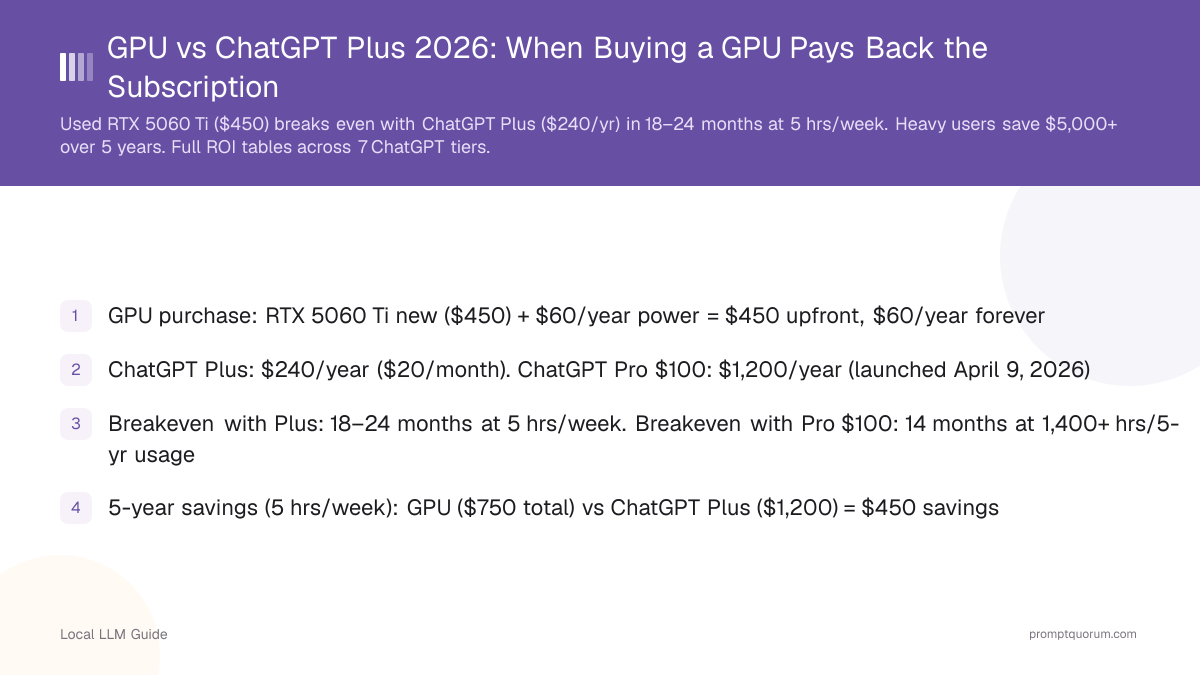
- GPU upfront cost: about $618 (RTX 5060 Ti 16 GB new, lowest asking price per BuySellRAM, 2026-10-11) to $2,575-3,010 (RTX 4090 used, sold listings, InsiderLLM tracker updated 2026-10-15)
- GPU annual operating cost: about $6-13/year electricity at US rates (illustrative)
- Subscription cost: $240/year ($20/month) for ChatGPT Plus; Claude Pro is $20/month with monthly billing
- Breakeven point: about 31-32 months for a $618 GPU vs ChatGPT Plus; about 29 months for a used RTX 4090 vs Pro $100
- 5-year totals (5 hrs/week): GPU $649 vs ChatGPT Plus $1,200, excluding resale value
- Electricity: many countries pay more than the US rate used here, which lengthens the breakeven
What Is the Cost Structure of Each Model?
ChatGPT price points used on this page (US list prices; check the OpenAI pricing page for current prices):
Tier | Monthly | Annual | Notes |
|---|---|---|---|
| Free | $0 | $0 | Limited access |
| Plus | $20 | $240 | Standard paid tier |
| Pro $100 | $100 | $1,200 | Higher-priced tier; check OpenAI's pricing page |
| Pro $200 | $200 | $2,400 | Higher-priced tier; check OpenAI's pricing page |
•📌 Key Point: ChatGPT Pro $100 costs $1,200/year and is the figure used for the heavy-user comparison on this page. Usage limits differ by tier and change over time; check the vendor page.
•💡 Pro Tip: Claude Pro is $20/month with monthly billing ($240/year) on the Anthropic pricing page; compare it on the same terms.
GPU Purchase Options
RTX 4070 used (12 GB): price varies (check recent sold listings), runs 7B-13B models
RTX 5060 Ti 16 GB new: about $618 (lowest asking price, BuySellRAM, 2026-10-11), runs models up to about 14B comfortably
RTX 4090 used (24 GB): $2,575-3,010 sold (InsiderLLM tracker, updated 2026-10-15), runs ~32B-class models at Q4
RTX 5090 new (32 GB): about $4,500 new (InsiderLLM tracker, updated 2026-10-15; NVIDIA launch MSRP $1,999), runs ~32B-class models at Q5-Q6
70B models: at Q4 they need about 43 GB for weights (the Ollama llama3.3:70b download is 43 GB), so a single 24 GB or 32 GB card cannot hold one. Two 24 GB cards or a 48 GB-class setup can.
Annual operating cost: about $6-13/year electricity at US rates ($0.12/kWh). Use your own local rate.
•💡 Pro Tip: Used cards can be cheaper, but prices move quickly. Check recent sold listings, not asking prices.
•📌 Key Point: Electricity cost depends on your local tariff. Use your own rate in the breakeven formula.
When Does a GPU Break Even with Subscriptions?
RTX 5060 Ti ($618) vs ChatGPT Plus ($240/year): $618 / $240 = 2.6 years (about 31 months) on purchase price, about 32 months with about $6/year of electricity (5 hours a week).
A subscription costs the same whether you use it 2 or 40 hours a week, so hours matter mainly through electricity and through whether a local model can replace the paid tier.
Against Pro $100 ($1,200/year): a used RTX 4090 at the $2,860 median sold price breaks even in about 29 months on purchase price alone (about 26-30 months across the $2,575-3,010 range).
A new RTX 5090 at $4,500 breaks even against Pro $100 in about 45 months on purchase price alone.
These breakevens assume a local model of up to about 32B parameters is good enough for your work. They exclude resale value, hardware failure and your setup time.
•🔍 Did You Know?: Most people misjudge their own usage. Track it for a month before deciding.
•⚠️ Warning: Usage limits of paid tiers change over time. Check each vendor's current plan page instead of assuming a limit.
What Is the 5-Year ROI Comparison?
Light user (2 hrs/week): GPU $618 + $13 power = $631 vs ChatGPT Plus $1,200. A free tier may be enough, in which case the subscription costs $0.
Casual user (5 hrs/week): GPU $618 + $31 power = $649 vs ChatGPT Plus $1,200. The GPU is $551 cheaper.
Regular user (10 hrs/week): GPU $618 + $63 power = $681 vs ChatGPT Plus $1,200. The GPU is $519 cheaper.
Power user (20 hrs/week): GPU $618 + $125 power = $743 vs ChatGPT Plus $1,200. The GPU is $457 cheaper.
Heavy user (40+ hrs/week): GPU $618 + $250 power = $868. If you would otherwise need Pro $100 ($1,200/year × 5 = $6,000), the GPU is $5,132 cheaper, but only if a local model meets your needs.
•💡 Pro Tip: Power is estimated at about 200 W under load: 0.2 kW × $0.12/kWh = $0.024 per hour, so about $1.25/year per weekly hour of use (× 52 weeks; for example 5 hrs/week ≈ $6/year, 40 hrs/week ≈ $50/year). Five-year power = hours per week × $1.25 × 5 (illustrative; your GPU load and tariff vary; NVIDIA lists total graphics power on each product page, lower than 200 W for the RTX 5060 Ti and higher for the RTX 4090). Resale value is not included.
•⚠️ Warning: These figures compare cost only, not quality. A 16 GB card runs smaller models than the cloud tiers, so results will differ.
Should I Buy a GPU or Keep a Subscription?
Buy a GPU if:
- You would otherwise pay for a subscription for 2+ years and a local model is good enough for your tasks
- You need offline capability
- You handle sensitive data and want fewer third parties processing it (this alone does not ensure compliance)
- You want to avoid vendor-imposed usage limits
- You are comfortable with technical setup and troubleshooting
Keep a subscription if:
- You use AI about 2 hours a week or less (a free tier may suffice)
- You need frontier cloud model quality
- You want a managed service without maintaining hardware
- You need multimodal features (images, audio, video) as a core feature
Hybrid approach (both) if:
- You use AI heavily but occasionally need a stronger cloud model
- You can route routine tasks to a local model and hard tasks to the cloud
•🛠️ Best Practice: Hybrid suits heavy users: local for routine tasks, a subscription for the hardest ones.
•📌 Key Point: Cloud and local model quality differ by task. Run your own prompts through both before buying.
Regional Context: Electricity & Data Protection
Electricity prices: the $6-13/year operating cost assumes US rates ($0.12/kWh). Many countries in Europe and Asia have higher residential rates, which lengthens the breakeven; use your own tariff. For US reference data, see the EIA average retail price table.
Currency and prices: all prices on this page are US dollars at US list or market prices. Prices in your country differ because of taxes, import duties and availability.
Data protection: if you process personal or confidential data, your obligations depend on your jurisdiction (for example GDPR in the EU, APPI in Japan, PIPL and the Data Security Law in China). Running a model locally can reduce the number of third parties that receive the data, but it does not by itself make a setup compliant. This page is not legal, tax or financial advice; consult a qualified adviser.
•📌 Key Point: Higher electricity prices lengthen the breakeven. Use your own tariff.
•📌 Key Point: Local inference reduces third-party data sharing but is not a compliance guarantee.
Frequently Asked Questions
Here are the most common questions about GPU vs subscription ROI and how to decide:
What if electricity costs are much higher in my region?
At twice the US rate (about $0.24/kWh), a $6/year electricity cost (5 hours a week) becomes about $12.50/year, which moves the Plus breakeven from about 32 to about 33 months. Use your own tariff.
Does GPU price volatility affect ROI?
Yes. Used RTX 4090 sold listings were $2,575-3,010 in the InsiderLLM tracker (updated 2026-10-15), so payback depends heavily on when you buy. Prices can move quickly in either direction.
Can I depreciate a GPU as a business expense?
Tax treatment depends on your country and situation. Hardware used for business may be depreciated over several years, while subscriptions are usually an operating expense. Ask a qualified tax adviser; this is not tax advice.
What if I buy a GPU and stop using it?
Used GPUs usually keep some resale value, but it varies with the market and this page does not include it in its figures. A subscription can be cancelled at any time.
Does cloud GPU rental fit this analysis?
Cloud GPUs are billed per hour and suit burst workloads. For constant daily use, compare current hourly prices from providers with your breakeven (see the cloud GPU rental comparison under Related Reading).
Will future models justify keeping subscriptions?
Possibly. Frontier cloud models may stay ahead of local ones on some tasks, so a hybrid setup (local plus subscription) is a reasonable hedge.
Should I buy ChatGPT Pro $100 instead of a GPU?
ChatGPT Pro $100 costs $1,200/year, so a used RTX 4090 (median sold price $2,860) pays back against it in about 29 months on purchase price alone. A single 24 GB card cannot hold a 70B model at Q4 (about 43 GB), so this assumes a model up to about 32B. If you need the strongest cloud model and no hardware work, Pro $100 may fit better. Compare both on your own tasks.
Does Apple's 2026 Mac mini refresh change the GPU vs subscription math?
Apple announced new Mac mini models in 2026 (Mac mini M6 with up to 32 GB unified memory, Mac mini M5 Pro with up to 64 GB). This page does not include independent tok/sec benchmarks or verified prices for the new chips. By memory alone: a 64 GB configuration has enough memory for a 70B model at Q4 (about 43 GB), while a 32 GB configuration fits smaller models. Verify current specs and prices at apple.com, then apply the breakeven formula from this page (price divided by the yearly subscription cost).
Common Mistakes in GPU vs Subscription ROI Analysis
These 5 mistakes undermine GPU ROI calculations; avoid them when making your decision:
- Underestimating usage. Many people expect 2 hrs/week and use more. Track actual usage for 1-3 months before deciding.
- Forgetting resale value. Used GPUs usually keep some value; include a conservative estimate.
- Ignoring cooling and power-supply costs for high-end cards.
- Not planning for downtime. A local GPU failure means no local inference until replacement; keep a cloud fallback.
- Assuming electricity is negligible. A 100 W draw 24/7 is about $105/year at $0.12/kWh.
•⚠️ Warning: Track your real usage before deciding.
•💡 Pro Tip: Include a conservative resale value in your 5-year calculation.
Sources
- EIA: Electric Power Monthly, Table 5.6.A average retail price of electricity
- InsiderLLM: NVIDIA GPU Prices Are Rising -- RTX 4090 sold-listing range and RTX 5090 new price (updated 2026-10-15).
- BuySellRAM: NVIDIA Consumer GPU Market Update -- RTX 5060 Ti 16 GB lowest asking price on 2026-10-11 (asking prices, not completed sales).
- NVIDIA GeForce RTX 5090 -- launch MSRP.
- OpenAI: ChatGPT pricing
- Anthropic: Claude plans and pricing
- NVIDIA GeForce RTX 40 Series
- Ollama: llama3.3 model library -- 70B download size 43 GB.
- Apple: Mac mini
- Cost per token matters, but so does output quality per query. Temperature and top-p shows how parameter tuning improves results without more hardware.