Key Takeaways
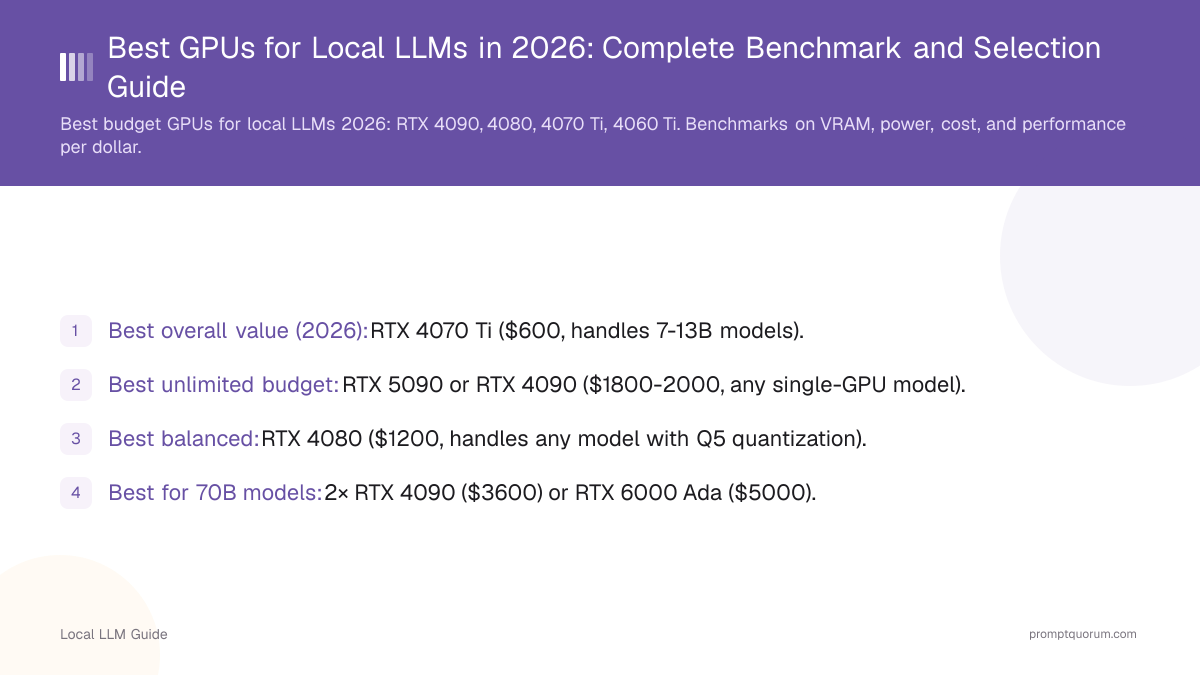
- Best overall value (2026): RTX 4070 Ti ($600, handles 7-13B models).
- Best unlimited budget: RTX 5090 or RTX 4090 ($1800-2000, any single-GPU model).
- Best balanced: RTX 4080 ($1200, handles any model with Q5 quantization).
- Best for 70B models: 2× RTX 4090 ($3600) or RTX 6000 Ada ($5000).
- NVIDIA dominates. AMD and Intel trail significantly.
📍 In One Sentence
The best GPU for local LLMs depends on your budget and desired speed: the RTX 4090 is the top pick with unlimited budget, the RTX 4070 Ti offers the best value, and the RTX 4080 is a balanced middle option, with NVIDIA dominating the market overall.
💬 In Plain Terms
There's no single best GPU -- it depends on how much you want to spend. If money's no object, get the RTX 4090 for maximum speed and VRAM. If you want the best bang for your buck, the RTX 4070 Ti hits a sweet spot. If you want something in between, the RTX 4080 balances price and performance. NVIDIA cards are the safe default since almost all local LLM software is built and tested against them first.
GPU Tiers by Price and Performance
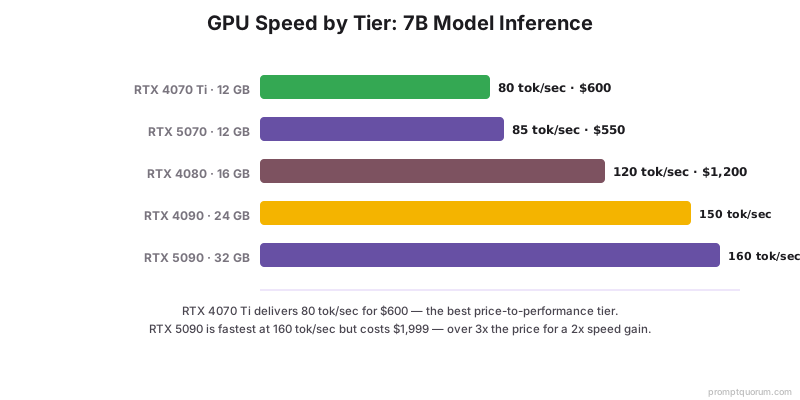
Tier | GPU | VRAM | Speed (7B) | Price |
|---|---|---|---|---|
| Budget | RTX 4070 Ti | 12 GB | 80 tok/sec | $600-700 |
| Mid-budget | RTX 5070 | 12 GB | 85 tok/sec | $550 |
| Mid | RTX 4080 | 16 GB | 120 tok/sec | $1200 |
| Premium | RTX 4090 | 24 GB | 150 tok/sec | $1800 |
| Premium | RTX 5090 | 32 GB | 160 tok/sec | $1999 |
Budget Tier ($400-700)
RTX 4070 Ti (recommended): $600, 12 GB VRAM, 80 tok/sec. Best value for personal use.
RTX 5070 (new, early 2026): $550, 12 GB. Slight speed improvement over 4070 Ti.
RTX 4070 (older): $400, 12 GB. Slightly slower, not recommended for new builds.
Mid Tier ($800-1500)
RTX 4080 ($1200): 16 GB VRAM, 120 tok/sec. Good for any 7-13B model.
RTX 5080 (new, early 2026): $1199, 16 GB. ~15% faster than 4080.
RTX 4080 Super: Essentially 4080, same price.
High End ($1600+)
RTX 4090 ($1800): 24 GB VRAM, 150 tok/sec. Fastest consumer GPU. Can run any model on single GPU.
RTX 5090 ($1999): 32 GB VRAM, 160 tok/sec. Latest flagship. Marginal speed gain over 4090.
RTX 6000 Ada ($5000): Server GPU, 48 GB. For production deployments.
Which Local LLM Model Fits Your GPU
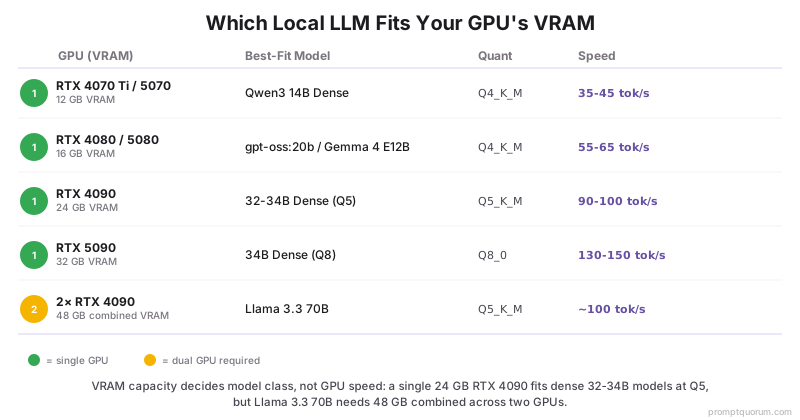
GPU tier decides which model size runs — not the other way around. The table below maps each GPU's VRAM to the largest model that fits comfortably at Q4_K_M, using the same model families referenced across our GPU guides (Qwen3, Gemma 4, DeepSeek, Llama).
GPU (VRAM) | Best-Fit Model | Quant | Speed | Notes |
|---|---|---|---|---|
| RTX 4070 Ti / RTX 5070 (12 GB) | Qwen3 14B (dense) | Q4_K_M | ~35-45 tok/sec | Same 12 GB tier as a budget RTX 3060, 3-4x faster. Also runs Qwen3 8B at 60+ tok/sec. |
| RTX 4080 / RTX 5080 (16 GB) | gpt-oss:20b or Gemma 4 E12B | Q4_K_M | ~55-65 tok/sec | 16 GB is the minimum for gpt-oss:20b (21B total / 3.6B active MoE); leaves headroom for longer context windows. |
| RTX 4090 / RX 7900 XTX (24 GB) | Dense 32-34B at Q5, or Llama 4 Scout at 1.78-bit | Q5_K_M / IQ1_S | ~90-100 tok/sec (34B) / ~20 tok/sec (Scout) | Llama 4 Scout (17B-active / 109B-total MoE) needs ~55 GB at Q4 — it only fits 24 GB at an aggressive sub-2-bit quant. |
| RTX 5090 (32 GB) | Dense 34B at Q8, or Llama 4 Scout at ~2-bit | Q8_0 / IQ2_XS | ~130-150 tok/sec (34B) | The extra 8 GB over the RTX 4090 mainly buys higher-fidelity quantization on the same model sizes, not a jump to a bigger model class. |
| 2× RTX 4090 (48 GB combined) | Llama 3.3 70B | Q5_K_M | ~100 tok/sec | The practical entry point for 70B-class models. A single RTX 6000 Ada (48 GB) is the professional alternative. |
AMD and Intel GPUs: Status in August 2026
AMD (ROCm): Improving and competitive on price — RX 7900 XTX matches RTX 4080. ROCm driver support requires more configuration effort than CUDA (ROCm 6.x) — check the current compatibility list before buying. A strong option if you prefer the AMD ecosystem.
Best model for RX 7900 XTX (24 GB): The same tier as an RTX 4090 — dense 32-34B models at Q5, or Llama 4 Scout at an aggressive 1.78-bit quant — but through ROCm instead of CUDA, and typically 10-20% slower at the same VRAM tier.
Intel Arc A770: Too slow for practical LLM use. Not recommended.
Recommendation: Stay with NVIDIA for stability and ecosystem maturity.
Historical Comparison: How GPU Power Has Grown
Context: How fast GPU performance has advanced:
GPU | VRAM | Speed (7B) | Price |
|---|---|---|---|
| RTX 2080 (2019) | 8 GB | 10 tok/sec | $700 |
| RTX 3090 (2020) | 24 GB | 25 tok/sec | $1500 |
| RTX 4070 (2022) | 12 GB | 60 tok/sec | $600 |
| RTX 4090 (2022) | 24 GB | 150 tok/sec | $1800 |
| RTX 5090 (2026) | 32 GB | 160 tok/sec | $2000 |
Common GPU Selection Mistakes
- Buying RTX 3090 in 2026. Old and slower. Not worth it at any price. Only buy current generation (40/50 series).
- Assuming higher VRAM = faster. VRAM size does not affect speed. RTX 4080 (16GB) is faster than RTX 3090 (24GB).
- Thinking you need RTX 6000 for personal use. Massive overkill. RTX 4090 handles any personal model easily.
- Buying for future-proofing beyond 2 years. GPU tech evolves fast. Buy for today's needs, upgrade in 2 years.
Frequently Asked Questions
How much VRAM do I need for local LLMs?
12 GB VRAM handles 7B and 13B models comfortably (Q5 quantization). 16 GB handles up to 20B models. 24 GB (RTX 4090) runs any single-GPU model including 34B at Q5. For 70B models, you need 2× 24 GB GPUs or aggressive quantization to Q2–Q3 with severe quality loss.
Is the RTX 4090 worth the price for local LLMs?
Yes, if you regularly run 13B–34B models or need maximum inference speed. At $1,800, the RTX 4090 provides 24 GB VRAM and 150 tok/sec on 7B models. If you only run 7B models, the RTX 4070 Ti at $600 delivers 80 tok/sec — 80% of the performance at 33% of the cost.
Should I buy an AMD GPU for local LLMs?
AMD is viable for LLMs in 2026, especially if you prefer the AMD ecosystem. Most LLM frameworks (vLLM, llama.cpp, Ollama) are optimized for CUDA first, and ROCm driver support requires more configuration effort than CUDA (ROCm 6.x) — check the current compatibility list before buying. AMD's RX 7900 XTX competes well on price.
What is the best GPU for running 70B models locally?
Two RTX 4090 GPUs ($3,600 total, 48 GB combined VRAM) is the best consumer option. This runs Llama 3.3 70B at Q5 quantization at ~100 tok/sec. A single RTX 6000 Ada ($5,000, 48 GB) is the professional alternative. Avoid attempting 70B on a single consumer GPU — Q2 quantization required degrades quality severely.
How does VRAM size affect local LLM performance?
VRAM size determines which model sizes you can run — more VRAM = larger models. VRAM size does not directly affect inference speed for models that fit. An RTX 4080 (16 GB, 120 tok/sec) is faster than an RTX 3090 (24 GB, 25 tok/sec) despite less VRAM, because memory bandwidth and compute architecture matter more.
Do I need a new GPU generation for local LLMs?
Yes — buy RTX 40-series or newer (50-series in 2026). RTX 30-series (3090, 3080) are significantly slower: a 3090 achieves 25 tok/sec vs 150 tok/sec on a 4090 at the same price point today. The RTX 2080 (8 GB) is impractical for anything beyond 3B models. Only current-generation hardware is recommended for new builds.
What GPU has 32 GB VRAM for local LLMs in 2026?
The RTX 5090 (32 GB, ~$1,999) is currently the only mainstream consumer GPU with 32 GB VRAM. The extra 8 GB over the 24 GB RTX 4090 mainly buys higher-fidelity quantization on the same model sizes — Q8 instead of Q5 on 34B dense models — rather than access to a larger model class. Llama 4 Scout (17B-active/109B-total MoE) still needs an aggressive ~2-bit quant to fit 32 GB. For uncompressed 70B-class models you still need 48 GB total (2× RTX 4090 or an RTX 6000 Ada).
Is the AMD RX 7900 XTX good for local LLM inference?
Yes, for the same model sizes as an RTX 4090 — its 24 GB VRAM fits dense 32-34B models at Q5 and Llama 4 Scout at an aggressive 1.78-bit quant. The tradeoff is software: ROCm requires more driver and framework configuration than CUDA (check the current llama.cpp/Ollama/vLLM compatibility list before buying), and inference throughput on ROCm typically trails CUDA by 10-20% at the same VRAM tier.
Sources
- NVIDIA GPU Specifications -- nvidia.com/en-us/geforce
- TechPowerUp GPU Database -- techpowerup.com/gpu-specs
- LLM Performance Benchmarks -- github.com/vllm-project/vllm/tree/main/benchmarks