Key Takeaways
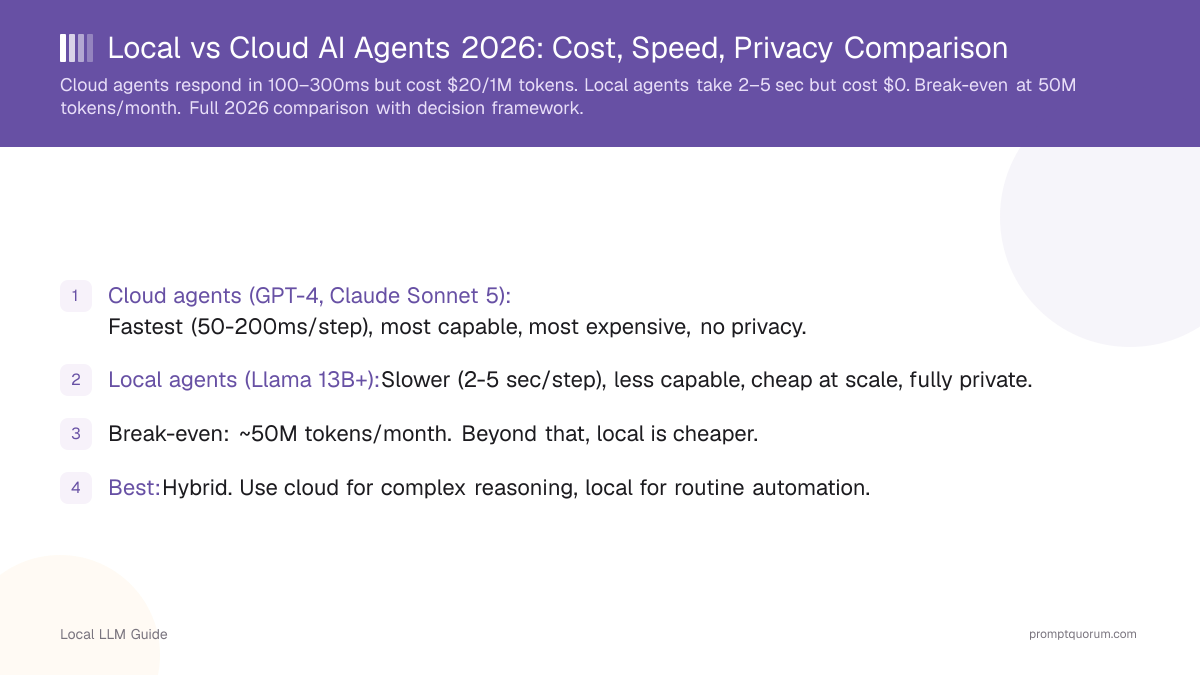
- Cloud agents (GPT-5.6, Claude Sonnet 5): Fastest (50-200ms/step), most capable, most expensive, no privacy.
- Local agents (Llama 13B+): Slower (2-5 sec/step), less capable, cheap at scale, fully private.
- Break-even: ~50M tokens/month. Beyond that, local is cheaper.
- Best: Hybrid. Use cloud for complex reasoning, local for routine automation.
- Most businesses today use a hybrid approach.
📍 In One Sentence
Cloud agents (GPT-5.6, Claude Sonnet 5) respond in 100-300ms per step but cost $10 per 1M tokens; local agents (Llama 13B+, Qwen 32B) take 2-5 seconds per step but cost $0 after hardware, with the break-even around 50M tokens/month.
💬 In Plain Terms
An AI agent is a program that uses an AI model in a loop to complete multi-step tasks. Running that model in the cloud (like GPT or Claude) is fast and pay-per-use; running it locally on your own GPU is slower per step but free once you own the hardware. Most businesses end up using both: cloud for hard reasoning tasks, local for routine, high-volume, or sensitive work.
How Fast Are Local vs Cloud Agents?
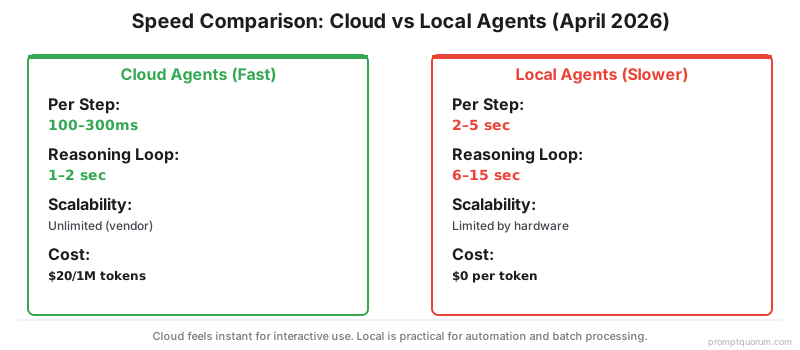
Cloud agents are 10–50× faster per step than local agents. The gap is in API latency vs local inference time. For interactive chat, cloud feels instant; local feels like a 2–5 second pause.
Agent Type | Per Step | Per Reasoning Loop | Scalability |
|---|---|---|---|
| GPT-5.6 API | 100–200ms | 1–2 sec | Unlimited |
| Claude Sonnet 5 API | 150–300ms | 1–2 sec | Unlimited |
| Local Llama 13B (RTX 4090) | 2–3 sec | 6–10 sec | Limited by hardware |
| Local Qwen 32B (RTX 4090) | 3–5 sec | 10–15 sec | Limited by hardware |
What Does Each Approach Cost?
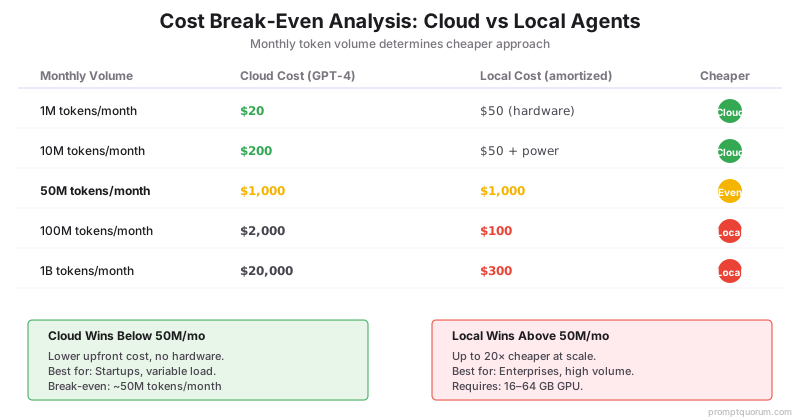
Cloud is cheaper below 50M tokens/month. Local is cheaper above. Local "amortized" includes GPU cost ($2,000–$2,600 RTX 4090 EOL) spread over 3 years plus electricity (~$200/year). The hardware guide covers exact GPU costs.
Monthly Volume | Cloud (GPT-5.6) | Cloud (Claude) | Local (amortized) |
|---|---|---|---|
| 1M tokens/month | $10 | $10 | $50 (hardware cost) |
| 10M tokens/month | $100 | $100 | $50 |
| 100M tokens/month | $1,000 | $1,000 | $50 + electricity |
| 1B tokens/month | $10,000 | $10,000 | $300 |
Which Is Better for Privacy and Compliance?
Local agents win on privacy — no data leaves your machine. Cloud agents send every prompt and response to vendor servers (OpenAI, Anthropic) subject to their data retention policies.
GDPR Article 28 requires a data processing agreement for cloud AI — local agents eliminate this requirement entirely. HIPAA-regulated healthcare data and financial data under SOC2 are best served by local agents.
Cloud compromise: Anthropic Claude does not train on your data (per their policy). OpenAI offers enterprise plans with data isolation. Neither eliminates the data transfer itself.
What Can Each Type of Agent Do?
Cloud agents are stronger at complex reasoning and tool use. Local agents offer more control over memory and customization. Here is how they compare by task:
Task | Cloud Agents | Local Agents |
|---|---|---|
| Multi-step reasoning | Excellent (GPT-5.6, Claude) | Good (13B+, DeepSeek-R1) |
| Code generation | Excellent | Good (Qwen2.5-Coder 32B) |
| Web search/browsing | Native (built-in) | DIY via LangGraph |
| Document processing | Excellent | Good (via local RAG) |
| Tool usage | Native function calling | Works via Ollama tool API |
| Long-term memory | Limited (vendor-managed) | Full control (custom DB) |
When Should You Choose Cloud Agents?
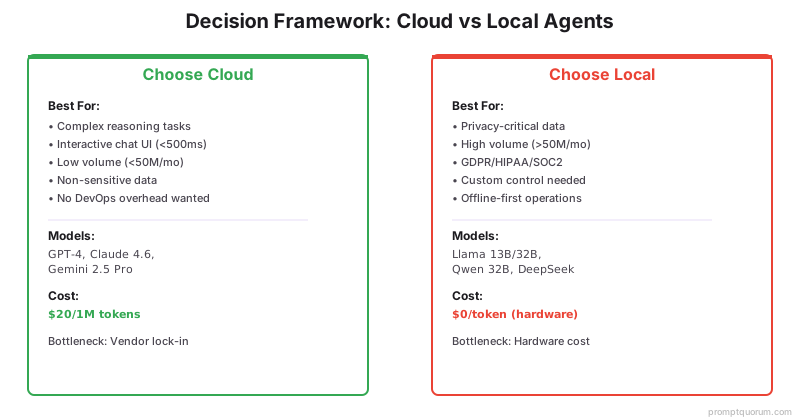
Choose cloud if speed and reasoning quality matter more than cost and privacy:
- Task requires complex multi-step reasoning or world knowledge (GPT-5.6/Claude excel here).
- Low latency is critical — under 500ms per step for interactive UX.
- Volume is below 50M tokens/month — cloud is cheaper at this scale.
- Data is non-sensitive and no regulatory constraints apply.
- You want managed infrastructure with zero DevOps overhead.
When Should You Choose Local Agents?
Choose local if privacy, cost at scale, or customization are your priorities:
- Data is sensitive — healthcare, finance, legal, or proprietary business data.
- GDPR, HIPAA, or SOC2 compliance requires data to stay on-premises.
- Volume exceeds 50M tokens/month — local is 10–60× cheaper at this scale.
- You need full customization of agent behavior, tools, and memory.
- You want zero vendor lock-in — switch models anytime without API changes.
What Is the Hybrid Approach?
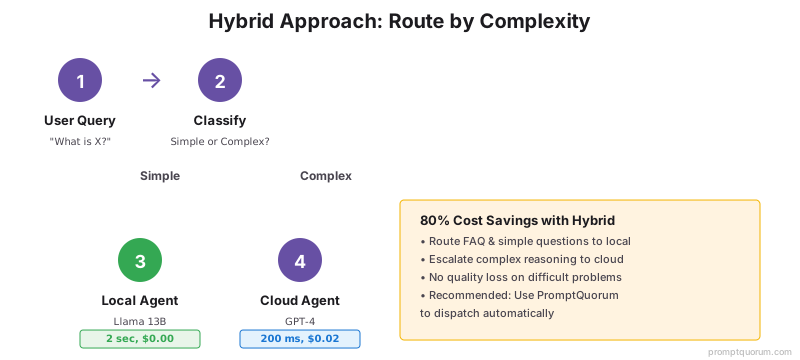
Best practice in 2026: Route simple queries to local agents, complex queries to cloud. This gives you speed + privacy for routine work and accuracy for hard problems.
Example workflow: A support agent routes FAQ-type questions to local Llama 13B (2 sec, free) and escalates complex issues to GPT-5.6 (200ms, $0.02). Result: 80% cost reduction with no quality loss on complex queries.
Tools like PromptQuorum dispatch to multiple models and compare results — ideal for hybrid setups.
Regional Considerations
EU/DACH: GDPR Article 28 and BSI-Grundschutz requirements strongly favor local agents for processing EU citizen data. Cloud agents require Standard Contractual Clauses for cross-border transfer to US providers.
Japan: APPI requirements favor local agents for sensitive business data. Japanese enterprises in banking and healthcare increasingly deploy local agents for compliance.
China: Cloud agents from US providers (OpenAI, Anthropic) are not directly available. Local agents running Qwen3 or DeepSeek comply with China's 2021 Data Security Law.
Frequently Asked Questions
Are local AI agents as good as cloud agents in 2026?
For routine tasks (Q&A, summarization, simple automation): yes, local Llama 13B+ matches cloud quality. For complex multi-step reasoning, code generation with context, and tool use: cloud agents (GPT-5.6, Claude Sonnet 5) are still significantly better. The gap narrows annually.
What is the break-even point for local vs cloud?
Approximately 50M tokens/month. Below that, cloud is cheaper (no hardware cost). Above, local saves 60–90% — you pay only electricity (~$200/year) after the initial GPU investment ($2,000–$2,600 for RTX 4090 EOL).
Can I run a local agent on consumer hardware?
Yes. A Llama 13B agent runs on RTX 4090 (24GB VRAM) at 2–3 sec per step. For 7B agents, RTX 4070 Ti (12GB) is sufficient. See the hardware guide for exact specs.
Do local agents support tool use and function calling?
Yes, via Ollama's tool calling API (supported since Ollama 0.4+). LangGraph and LangChain integrate with local models for multi-step tool use. Setup is more complex than cloud but fully functional.
Is hybrid deployment worth the complexity?
Yes, for most businesses processing 10M+ tokens/month. The routing logic is simple: classify query difficulty, send easy queries local, hard queries cloud. PromptQuorum handles this automatically.
Which local model is best for agents?
Llama 3.3 70B for quality (needs dual RTX 4090), Qwen3 32B for balanced speed/quality (single RTX 4090), Llama 13B for cost-effective agents on RTX 4070 Ti. DeepSeek-R1 7B for reasoning-heavy tasks on budget hardware.
How do I handle agent failures locally?
Local agents crash or hang if VRAM overflows. Set OLLAMA_KEEP_ALIVE for persistent model loading, implement health checks, and add fallback to cloud API for critical workflows. Production local agents need monitoring (Prometheus, Grafana).
Will local agents match cloud quality by 2027?
For 70B models: likely within 90% of GPT-5.6 quality by late 2027. For 13B models: not yet. The practical gap is narrowing but cloud maintains an edge on novel reasoning and broad world knowledge.
Sources
- OpenAI API Pricing — Official OpenAI API pricing per token
- Anthropic Claude Pricing — Claude Sonnet 5, Sonnet, and Haiku API pricing
- Ollama Tool Calling Documentation — Local model function calling API reference
- LangGraph Documentation — Multi-agent orchestration framework for local and cloud LLMs
- Multimodal input opens new workflows, but image prompting requires different techniques. Learn how to caption, structure, and prompt images: beyond text: prompting with images covers vision-language prompting.