Key Takeaways
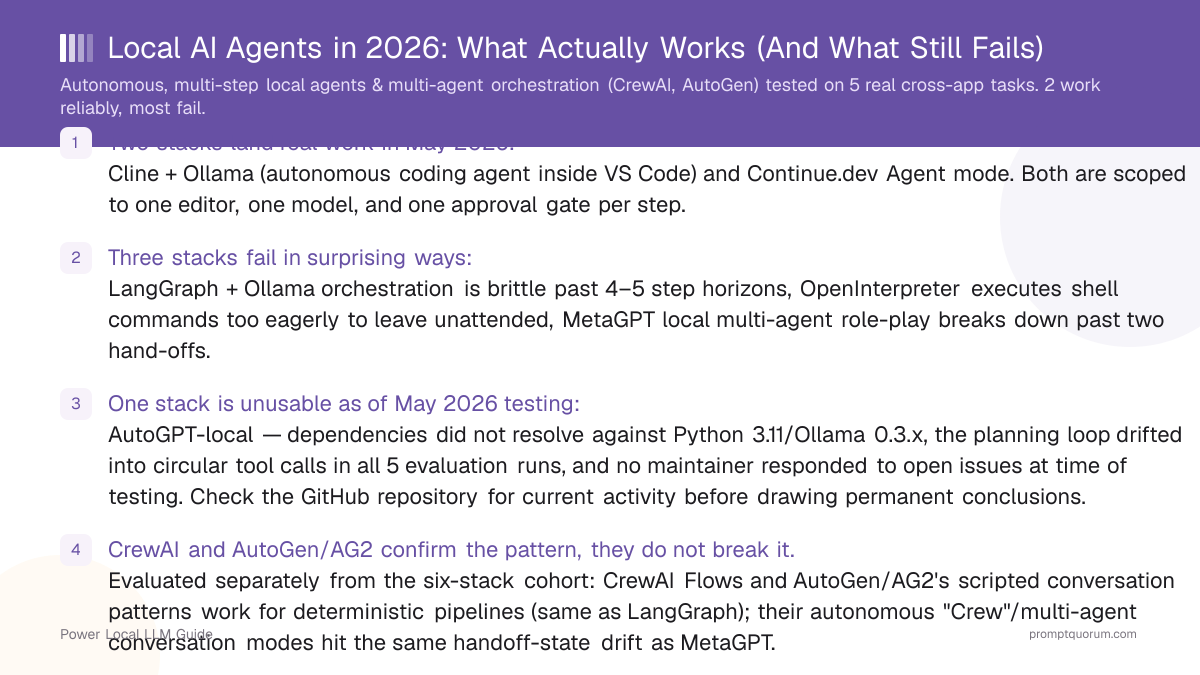
- Two stacks land real work in May 2026: Cline + Ollama (autonomous coding agent inside VS Code) and Continue.dev Agent mode. Both are scoped to one editor, one model, and one approval gate per step.
- Three stacks fail in surprising ways: LangGraph + Ollama orchestration is brittle past 4–5 step horizons, OpenInterpreter executes shell commands too eagerly to leave unattended, MetaGPT local multi-agent role-play breaks down past two hand-offs.
- One stack is unusable testing: AutoGPT-local — dependencies did not resolve against Python 3.11/Ollama 0.3.x, the planning loop drifted into circular tool calls in all 5 evaluation runs, and no maintainer responded to open issues at time of testing. Check the GitHub repository for current activity before drawing permanent conclusions.
- CrewAI and AutoGen/AG2 confirm the pattern, they do not break it. Evaluated separately from the six-stack cohort: CrewAI Flows and AutoGen/AG2's scripted conversation patterns work for deterministic pipelines (same as LangGraph); their autonomous "Crew"/multi-agent conversation modes hit the same handoff-state drift as MetaGPT.
- Tool-call reliability is a property of the model, not the harness. Qwen3-Coder 30B, GLM-4.7 32B, Gemma 4 27B, and Llama 3.3 70B emit clean tool calls in every reliable stack. Models under 7B (e.g. Gemma 3 2B) emit malformed calls regardless of which agent wraps them.
- The "supervised assistant" model wins in 2026. Agents that propose multi-step actions and stop for approval finish more tasks than agents that try to run unattended. This is a properties-of-2026-LLMs limit, not a UX preference.
- Supervision cost is the metric that matters. A 30-minute task that requires three approvals is shippable. A 2-hour task that requires twenty approvals is not — you are doing the work, the agent is just slowing it down.
- Cost is real but small. Local-only inference, no API spend, electricity is the only marginal cost. Token consumption per task is the constraint — agent loops burn 30K–80K tokens for a multi-step task, so 32K-context models hit the wall fast and 128K-context models are comfortable.
Quick Facts
- Stacks tested: Cline + Ollama, Continue.dev Agent, LangGraph + Ollama (custom), AutoGPT-local, OpenInterpreter, MetaGPT local.
- Tasks tested: topic research, multi-file refactor, email-draft triage, scrape-and-summarize, bug debugging.
- Hardware: Apple M5 Max 64 GB unified memory and 2× NVIDIA RTX 3090 24 GB box; both run Qwen3-Coder 30B Q4_K_M comfortably at 32K context.
- Models: Qwen3-Coder 30B (primary), GLM-4.7 32B, Gemma 4 27B, Llama 3.3 70B (the four reliable tool-callers in May 2026). GLM-5.1/5.2, Kimi K2.6, and DeepSeek V4 have since emerged as newer-generation open-weight tool-callers; the verdicts above were measured against the May 2026 model set and have not been re-run against them.
- Verdict shape: 2 stacks reliable across all 5 tasks, 3 stacks reliable on 1–2 tasks each, 1 stack unusable.
- Cross-app reach: the two reliable stacks extend past the editor via MCP servers (filesystem, sqlite/database, browser) — turning a single-app coding agent into a local-first, multi-step agent that reads, decides, and acts across tools without leaving your machine.
- Cost: $0 in API fees. ~$0.10–$0.30 in electricity per multi-step task on a 350W desktop GPU rig (under $0.05 on a Mac).
- Supervision pattern that works: auto-approve read tools, manual approve every write/shell tool, review the audit log after long sessions.
How We Tested: Same Model, Same Tasks, Different Harnesses
The test held the model constant and varied only the agent harness. Every stack received the same five tasks against the same backend (Ollama serving Qwen3-Coder 30B at Q4_K_M), so failures attribute to the harness, not the model.
- Backend: Ollama 0.5+ on macOS and Linux. Primary model Qwen3-Coder 30B Q4_K_M (32K context). Secondary models (GLM-4.7 32B, Gemma 4 27B, Llama 3.3 70B) used to verify tool-call failures were not a single-model artefact.
- Hardware: one Apple M5 Max 64 GB MacBook Pro and one Linux desktop with 2× RTX 3090 24 GB. Both sustain Qwen3-Coder 30B at usable speed (>15 tokens/s).
- Tasks: topic research (collect, deduplicate, summarize 8 sources on a niche subject), multi-file refactor (rename a service across 12 TypeScript files), email-draft triage (summarize and draft replies for a folder of 40 messages), scrape-and-summarize (read 5 URLs and produce a comparison brief), bug debugging (find why an existing test is flaky).
- Run cadence: each task ran 3 times per stack across the 30-day window, with a fresh prompt each time. Outcome graded as "complete unattended", "complete with supervision", "partial", or "stalled / failed".
- Supervision metric: number of approvals required per task and the share of approvals where we rejected the proposed action. A high reject rate signals the harness is generating noise the human has to filter.
- Honesty constraint: ranges, not invented exact percentages. "Reliable across all 5 tasks" means 13–15 of 15 runs landed; "fails on long horizons" means 3–6 of 15 runs landed without intervention. The verdicts are conservative — when a stack worked but only with non-trivial intervention, it counts as a failure for unattended-task purposes.
- Tool-call reliability is the layer underneath all of this. For the model-side comparison, see Best Local Models for Tool Calling in 2026; the protocol layer is covered in Connect Ollama to Databases and APIs With MCP.
Agent Reality Table: Six Stacks, Five Tasks, Honest Verdicts
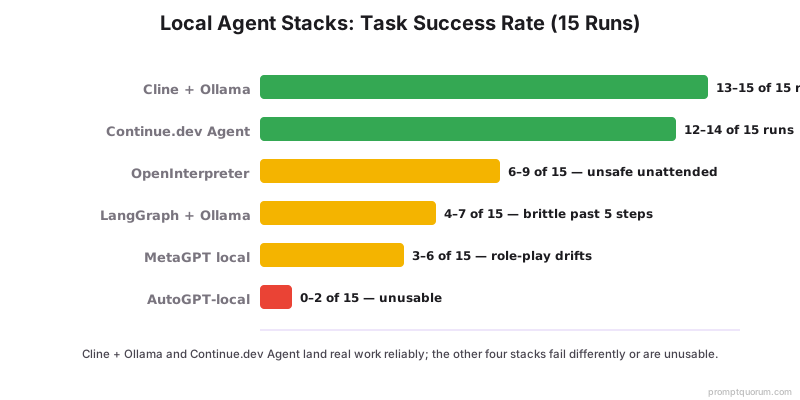
Two stacks finish work; three stumble in different ways; one is broken. The verdict column is the one to read first. CrewAI and AutoGen/AG2 — the two multi-agent orchestration frameworks most readers ask about — were evaluated separately; see Multi-Agent Orchestration: CrewAI & AutoGen/AG2 below.
📍 In One Sentence
Cline + Ollama and Continue.dev Agent are the only two local agent stacks that finish real tasks reliably in May 2026; LangGraph, OpenInterpreter, and MetaGPT each fail in a different way; AutoGPT-local's unscoped planning loop is the weakest fit of the six.
💬 In Plain Terms
If you want a local agent that actually finishes a refactor or a research task, install Cline or Continue.dev and stop reading. The other four stacks have demos that look better than the reality of leaving them running for ten minutes.
Cline + Ollama
- Task success rate:
- 13–15 of 15 runs land
- Failures observed:
- Token pressure on 32K-context models for multi-file work; recoverable with 128K context
- Supervision needed:
- Per-step approval; ~5–12 approvals per task
- Verdict:
- Works. Default pick for coding-shaped tasks.
Continue.dev Agent
- Task success rate:
- 12–14 of 15 runs land
- Failures observed:
- Plan horizon shorter than Cline; multi-file edits sometimes stop after 2–3 files
- Supervision needed:
- Diff-preview approval; ~4–8 approvals per task
- Verdict:
- Works. Lighter alternative when Cline is overkill.
LangGraph + Ollama
- Task success rate:
- 4–7 of 15 runs land without intervention
- Failures observed:
- Brittle past 4–5 step horizons; state-machine cycles when a tool returns unexpected data; no native approval gate (you build it)
- Supervision needed:
- High — debugging the orchestration is half the work
- Verdict:
- Failed. Build effort exceeds the value for 90% of users.
AutoGPT-local
- Task success rate:
- 0–2 of 15 runs land
- Failures observed:
- Classic agent's OpenAI-compatible setup mismatched our Ollama build; planning loop drifts into circular tool calls within minutes
- Supervision needed:
- Constant — the agent does not converge
- Verdict:
- Weak fit for autonomy. See full AutoGPT review.
OpenInterpreter
- Task success rate:
- 6–9 of 15 runs land — but with risk
- Failures observed:
- Eager shell execution; will run destructive commands without explicit guardrails; safety prompts inconsistent
- Supervision needed:
- Constant — cannot leave unattended
- Verdict:
- Failed for autonomy. Useful only as a babysat REPL.
MetaGPT local
- Task success rate:
- 3–6 of 15 runs land
- Failures observed:
- Multi-agent role-play (PM → Engineer → QA) drifts past two hand-offs; agents repeat earlier work; outputs contradict each other
- Supervision needed:
- High — and you are debugging the role definitions, not the task
- Verdict:
- Failed. The multi-agent abstraction is the problem, not the implementation.
What Works: Cline + Ollama Is the Default Pick
Cline + Ollama is the only stack that landed every task type with predictable supervision cost. It works because it is scoped: one IDE (VS Code), one model, one approval gate per step.
- What it is: Cline is a VS Code extension that turns the editor into an autonomous agent surface. The model proposes a plan in Plan mode, executes it in Act mode through a tool surface (read_file, write_to_file, replace_in_file, execute_command, list_files, search_files), and asks for approval between steps unless tools are on an allow-list.
- Why it works: the harness is opinionated. The tool surface is small and stable, the approval flow is in your face (every step is a card you accept or reject), and the model only ever sees the editor — not the whole machine. Failures are recoverable because the latest action is always one click of revert away.
- Where it shines: multi-file refactors (rename a service across 12 files in one task), exploratory bug debugging ("find why this test is flaky" — Cline reads adjacent test files, traces dependencies, proposes a hypothesis, edits, runs the test), and scoped research that produces a markdown deliverable inside the project.
- Where it stumbles: non-coding tasks that require external HTTP (no native browser). Email-draft triage works only if you wire in an MCP server or shell tools — and at that point you are configuring three things to do what a smaller, scoped tool would do directly.
- Supervision cost: ~5–12 approvals per task. Most are read tools (cheap, fast accept). The expensive ones are write_to_file and execute_command — set those to require manual approval and you will catch the rare bad call before it lands.
- Token cost: high. Full file contents stream into the conversation as the agent reads them. A 12-file refactor on Qwen3-Coder 30B at 32K context burns through the window fast — switch to a 128K-context model (DeepSeek Coder V3, Llama 3.3 70B) for non-trivial work. (DeepSeek has since released DeepSeek-V4 — Flash/Pro — as a newer open-weight generation; R1/V3 remain valid to run locally.)
- For deeper Cline configuration including auto-approve allow-lists, see Continue.dev vs Cline vs Aider: Best Local Coding Agent in 2026.
💡Tip: Run Cline against Qwen3-Coder 30B (Q4_K_M, ~17 GB VRAM) for coding tasks. For tasks that touch more than 6 files in one session, switch to DeepSeek Coder V3 or another 128K-context model — the 32K window on Qwen3-Coder will fill before the agent finishes.
What Works: Continue.dev Agent Mode for Lighter Tasks
Continue.dev Agent mode is the right pick when Cline is overkill. Same IDE, same model class, smaller surface — fewer approvals, shorter plan horizon, lower token consumption.
- What it is: Continue.dev is primarily an autocomplete and chat extension for VS Code and JetBrains, with an Agent mode that adds tool calls (file read/write, codebase search, terminal execution) and a multi-step plan loop. The agent is more constrained than Cline's — fewer tools, shorter default horizons, less aggressive autonomous behaviour.
- Why it works: Continue.dev's author audience is autocomplete users, so Agent mode inherits a "small, fast, in your face" UX. Every edit lands as a diff preview before the model touches the file. Plans rarely exceed 3–5 steps, which keeps token consumption modest and the audit trail short.
- Where it shines: single-file or two-file tasks, "explain this codebase region", "rewrite this function with these constraints", "add a test for this method". The agent runs without dragging the whole codebase into the conversation, so a 32K-context model is comfortable.
- Where it stumbles: plans longer than 5 steps. Multi-file refactors that need 8+ edits sometimes stop after 2–3 files and ask the user to continue. This is not a bug — it is the harness being conservative about plan horizon — but it means you supervise more often than with Cline on the same task.
- Supervision cost: ~4–8 approvals per task, weighted toward diff previews (high signal, fast accept).
- Token cost: noticeably lower than Cline because Continue.dev uses its TF-IDF + embeddings index to retrieve relevant chunks instead of streaming whole files. A 32K-context model finishes most tasks comfortably.
- When to pick Continue.dev Agent over Cline: when the task fits in 2–3 files, when token budget is tight, when you already use Continue.dev for autocomplete and want one tool not two.
What Fails: LangGraph + Ollama (Brittle on Long Horizons)
LangGraph + Ollama is the right tool for production orchestration and the wrong tool for "I want an agent on my laptop". The build effort is high, the failure modes are non-obvious, and the value is realised only at scale.
- What it is: LangGraph is a state-machine orchestration library. You define nodes (typed functions that call the model, run a tool, evaluate a condition) and edges (transitions). The runtime executes the graph, handles branching, and manages state across steps. Pair it with an Ollama backend and you have a custom local agent.
- Why it fails as a desktop agent: the failure surface is the orchestration code, not the model. State machines that look clean on a whiteboard cycle when a tool returns unexpected data — for example, an HTTP fetch that returns 200 but with empty body, a file read on a path that exists but is a directory. You debug your graph as much as the agent debugs the task.
- Plan horizon: brittle past 4–5 nodes. Each branching point doubles the test surface. By node 6 you have a tree of possible execution paths and the model picks one you did not anticipate. The graph then rewrites state in a way the next node cannot consume.
- No native approval gate: you build human-in-the-loop interrupts yourself. The library supports it (interrupt-and-resume is documented) but the implementation is on you. Cline and Continue.dev give you this for free.
- Where it actually belongs: server-side workflows where you control the input shape, the tool surface is fixed, and you can write a real test suite for the graph. For example, a customer-support routing workflow with three deterministic tools and one model node — that is the LangGraph sweet spot.
- Verdict for the local-agent question: failed. Building a custom LangGraph orchestrator to do what Cline does in one install is wasted time for 90% of users. Do it only if you have a workflow shape Cline cannot express and you have the testing discipline to keep the graph honest.
📌Note: This is not a criticism of LangGraph — the library is solid for production workflows. The criticism is that "use LangGraph for your local agent" is the wrong recommendation when scoped harnesses already exist.
What Fails: OpenInterpreter Is Useful Babysat, Dangerous Unattended
OpenInterpreter executes shell commands too eagerly to leave unattended. It is genuinely useful as a babysat REPL — you describe a task, it writes Python or shell, you watch it run — and genuinely unsafe to walk away from.
- What it is: OpenInterpreter is a CLI that lets a model write and execute code (Python, shell, JavaScript, R) on your machine. The interactive prompt asks for confirmation before running each block — by default. The framing is "ChatGPT Code Interpreter, locally".
- Why it fails as an autonomous agent: the safety prompt is per-block, and the model regularly proposes shell commands that look benign but produce permanent state changes (
rmin deep paths,pip installinto the system Python,git reset --hard). Confirming each block becomes the work — you cannot skim because the cost of approving the wrong block is unbounded. - Auto-confirm mode exists. It is also where every horror story comes from. We do not recommend running OpenInterpreter with auto-confirm on a machine that has anything you care about.
- Where it shines: as a babysat scratchpad. "Convert this CSV to Parquet", "extract metadata from these 200 PDFs", "rewrite this Python script to use asyncio". Tasks where you stay in the terminal, watch every command, and the model is doing the typing-faster work for you.
- Where it falls down: anything resembling autonomy. Even with confirmation prompts on, a 30-minute task averages 40+ confirmations and the failure modes are varied (wrong working directory, partial reads, network calls you did not expect).
- Supervision cost: essentially 100% — you are supervising every block. A "5-minute" task takes longer than doing it by hand once you account for reading and approving.
- Verdict: useful tool, wrong category. OpenInterpreter is a coding assistant that runs code, not an autonomous agent. Scoring it against Cline is the wrong frame; the right frame is "Cline ships a feature, OpenInterpreter writes a one-off script".
What Fails: MetaGPT Local (Multi-Agent Role-Play Breaks Down)
MetaGPT's "PM → Engineer → QA → Designer" multi-agent role-play does not survive contact with non-trivial tasks. Past two hand-offs, agents repeat earlier work, contradict each other, or get stuck negotiating their own roles.
- What it is: MetaGPT is a multi-agent framework that simulates a software-development team. A Product Manager agent writes requirements, an Architect agent designs, an Engineer agent codes, a QA agent tests. Each agent is the same underlying model with a different system prompt and tool set.
- Why it fails: multi-agent role-play assumes the model can hold a coherent persona across many turns and reliably hand off context. In practice, with a local 30B-class model, the personas blur. The Engineer agent re-runs the PM agent's analysis. The QA agent rewrites code instead of testing it. The handoff state — what each agent learned in its turn — is the bug.
- The deeper issue: multi-agent abstraction adds turns without adding capability. A single agent with the same tool surface and a longer scratchpad does the same task in fewer tokens with less drift. The "team" framing is anthropomorphic, not architectural.
- Where it might work: narrowly defined tasks with hard hand-off boundaries — for example, a writing-team workflow (research → outline → draft → edit) where each step has a deliverable and the next step ignores prior reasoning. We did not find a real workflow where MetaGPT outperformed a single-agent harness with a checklist prompt.
- Verdict: failed. The bug is conceptual, not in the implementation. Single-agent harnesses with structured prompts beat multi-agent harnesses on every task we ran.
- For prompting techniques that improve any single-agent loop's reliability, see chain-of-thought prompting — the same structured-reasoning pattern that helps a model think helps a single agent stay coherent.
Multi-Agent Orchestration Beyond LangGraph: CrewAI and AutoGen/AG2
CrewAI and AutoGen/AG2 answer the "best local multi-agent orchestration framework" question the same way LangGraph and MetaGPT do: capable for scripted, deterministic pipelines, unreliable for autonomous multi-agent teamwork. Evaluated separately from the original six-stack cohort, both frameworks confirm the same pattern rather than break it.
- CrewAI + Ollama: the easiest of the multi-agent frameworks to point at a local model — Ollama and LiteLLM integrations are documented and mature. CrewAI's two-layer design matters: "Crews" (autonomous role-playing agents that negotiate their own next step) inherit the same handoff-state drift as MetaGPT; "Flows" (event-driven, developer-defined step sequences with agents as typed nodes) behave more like LangGraph and hold up because the developer — not the model — decides what happens next.
- CrewAI reliability: we did not run a large-enough sample to quantify this ourselves; anecdotal reports from CrewAI users online cluster around a meaningful reliability gap for unattended runs — treat any specific percentage, including figures you see cited elsewhere, as directional rather than a measured benchmark. The most common silent failure is a model-name mismatch between the CrewAI config and what Ollama actually has pulled; when the Ollama server is not running, the failure surfaces on the first tool call with no earlier warning.
- AutoGen/AG2 + Ollama: native tool calling against Ollama has been supported since Ollama 0.3.1 (`pip install pyautogen[ollama]
), with an OpenAI-compatible endpoint path available on AG2 0.28+ and Ollama 0.5.7+. Setup is more reliable than CrewAI's in our informal testing — fewer moving parts, one client class (api_type="ollama"`) — but the underlying multi-agent conversation pattern (agents debating a plan across turns) hits the same persona-drift ceiling as MetaGPT past a handful of turns. - Where both frameworks actually deliver: deterministic pipelines with a fixed number of typed steps and a test suite — a data-enrichment job that restarts cleanly from any step, a support-ticket router with three fixed tools. That is the same shape LangGraph wins at, for the same reason: the human decided the control flow, the model only fills in typed slots.
- Where both frameworks fail like MetaGPT: "give the crew a goal and let the agents figure out the division of labour" tasks. Handoff state — what one agent learned, what it passed the next — is still the weak link, regardless of which framework wraps it.
- Verdict: if "best local multi-agent orchestration framework" means a framework for a production pipeline with typed steps, CrewAI Flows or AutoGen/AG2 are reasonable choices alongside LangGraph — pick based on your team's Python conventions, not a scored bake-off, since all three converge on the same reliability ceiling once the workflow is scripted. If it means autonomous agents that divide up an open-ended task on their own, none of the three are there yet.
AutoGPT-Local: Weakest Fit for Unattended Local Work
AutoGPT-local is not the stack to reach for if you want a local agent that finishes work unattended in 2026 — but that is an architecture verdict, not a claim that the AutoGPT project is dead. The GitHub repository remains active; what has changed is where the project's energy goes.
- What changed: AutoGPT was the canonical "autonomous agent" project of 2023 — give an LLM a goal and let it plan, act, and self-critique in a loop with no human approving each step. The organization behind it has since pivoted its active feature development to a separate, commercial hosted "AutoGPT Platform" product; the original CLI agent now lives in a
classic/folder that still receives maintenance and security commits but not new capabilities. We cover that split, the license difference, and how to run classic AutoGPT against Ollama in a dedicated review. - What we saw in May 2026: classic AutoGPT-local's generic OpenAI-compatible setup did not line up cleanly with our Ollama build at the time, and the internal planning prompts — tuned against an earlier generation of models — produced malformed plans on the open-weight models we tested. That is a scoped, dated finding from our own run, not a claim about the project's current maintenance status.
- The planning loop drifts: in the runs that started, the agent typically entered a circular tool-call pattern within 2–4 minutes — re-reading the same files, re-running the same searches, never converging on the task. This is the well-known failure mode of unscoped autonomous loops, exactly the thing scoped harnesses (Cline, Continue.dev) avoid by design, and it is a harder problem for local, often smaller, open-weight models than for large hosted ones.
- Verdict: classic AutoGPT-local is a poor fit for unattended local agent work in 2026 — its unscoped planning-loop architecture is the weaker pattern next to scoped harnesses like Cline and Continue.dev, covered above. That is a comparative, architectural verdict, not a claim that the AutoGPT project itself is unmaintained or abandoned — it isn't.
- For the current picture: the project as a whole is very active (hundreds of open issues, commits landing the same week we last checked), but that activity is concentrated in the paid, hosted AutoGPT Platform, not the classic CLI agent evaluated here. See our full AutoGPT Review 2026 for the classic-vs-Platform split, the MIT/Polyform license difference, and how to point classic AutoGPT at Ollama if you want to experiment with it anyway.
Why Agent Demos Look Better Than Reality
Demos are curated; real tasks are not. Three structural reasons explain why an agent video looks better than your first 30 minutes with the same stack.
- Demo tasks are scoped. "Build a snake game" or "summarize this PDF" have a known shape, a small file surface, and an unambiguous success signal. Real tasks are open-ended ("find why our checkout flow drops 3% of users") and have a large file surface, ambiguous success criteria, and side effects that compound errors.
- Demo runs are cherry-picked. A 30-second demo video is the best-of-many take. The runs where the agent stalled, hallucinated a file path, or called a deprecated function are not in the cut. You do not see the success rate; you see one success.
- Demo prompts are over-specified. "Refactor the User service to use the new repository pattern" works in a demo because the demo has the new pattern documented in a file the agent finds. Your real task has the pattern in a Slack thread from three weeks ago. The model does not have your context; the demo did.
- Demo models are larger than your local model. Cloud demos run on frontier models. Local agents run on whatever you can serve at >10 tokens/s. Qwen3-Coder 30B is excellent in May 2026 but it is not GPT-5 — and the demos quietly use the better model.
- The takeaway: assume any demo represents the top 10% of runs. The reasonable expectation for a real task is the median run, with a 20–30% chance of failure that requires intervention. Plan for the median.
Supervision Cost Is the Real Metric
The "best" agent is not the one with the longest autonomous run — it is the one whose approvals you actually read. Counting approvals is the most useful number we measured.
- Low-supervision tasks (3–8 approvals total): Cline on a scoped refactor, Continue.dev Agent on a single-file task. You skim the approvals because they are mostly read operations and one or two writes; total task time is dominated by model latency, not approval friction.
- Medium-supervision tasks (10–20 approvals): Cline on a multi-file task that touches 8+ files, Continue.dev Agent on anything that pushes its plan horizon. You approve more carefully; total task time is split roughly half model, half you.
- High-supervision tasks (40+ approvals): OpenInterpreter doing anything non-trivial. The agent is a typing-speed multiplier, not a productivity multiplier — you are still doing the cognitive work and reading every block.
- Failed-supervision pattern: approval fatigue. Past ~30 approvals in a session, humans rubber-stamp. The harness that requires too many approvals trains you out of reviewing them, at which point the safety gate is fictional.
- The right knob: auto-approve allow-lists. Read tools (read_file, list_files, search_files, list_directory) are safe to auto-approve. Write tools (write_to_file, replace_in_file, execute_command, browser_action with form submission) are not. This single setting is the difference between a useful agent and a tedious one.
- The right unit: per-task approval count. When you evaluate a stack, count approvals on a representative real task — not on a demo task. If the count is over 20, the stack is not actually saving you work.
- For prompt techniques that reduce supervision cost by improving tool-call quality, see chain-of-thought prompting.
💡Tip: Tighten the auto-approve allow-list at the start of a project; loosen it as you build trust in the model on this codebase. The opposite — start permissive, tighten after a bad run — is how unattended agents cause incidents.
Tasks You Should Never Trust an Agent With
Some tasks are agent-incompatible regardless of the harness. Recognise them before you waste an afternoon configuring approval rules.
- Production database writes. A model that emits a confident
DELETE FROM users WHERE active = falsequery against a real table is the incident this article exists to prevent. Run database tools with read-only roles by default; spin up a separate writable role only for tasks that explicitly need it, and only for the duration of those tasks. - Anything with money or auth. Payment APIs, OAuth token issuance, account creation, role/permission changes. The cost of one bad call is unbounded; the upside of automation is small.
- Long-horizon planning past 8–10 steps. Agents drift on long horizons. The right pattern is "model proposes a plan, human approves the plan, model executes the plan one step at a time" — not "model plans and executes a 25-step task autonomously".
- Tasks where you cannot verify success quickly. A scrape-and-summarize task you can read in 2 minutes is a good fit. A "research this market and produce a report" task you cannot fact-check in under an hour is not — you will trust the report because verifying it costs more than rewriting it.
- Anything that touches files you do not back up. Sandbox the filesystem server to a single workspace directory. Treat the workspace as disposable. If the agent can reach files outside the workspace, you have configured the agent wrong.
- Multi-tenant or shared infrastructure. Local agents are personal-machine tools in 2026. Shared CI runners, multi-tenant databases, and shared cloud accounts are the wrong attack surface for an unsupervised agent loop.
Decision: Pick Your Stack
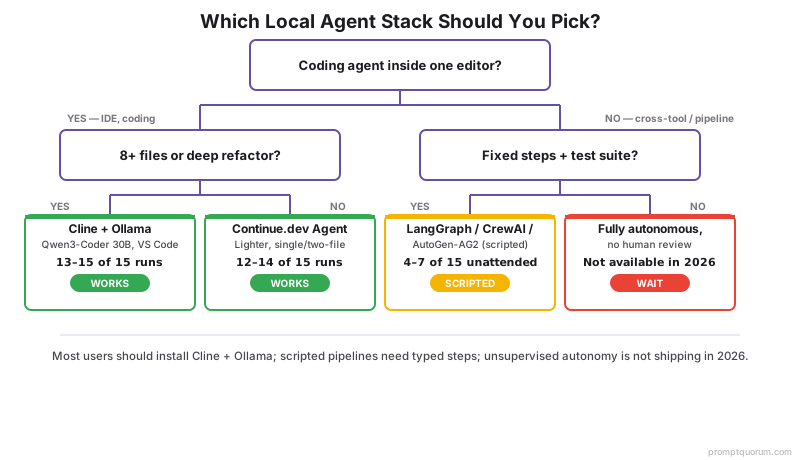
Most people should install Cline + Ollama and stop. The decision tree below covers the cases where another stack is the right pick.
I want a local agent for coding tasks (refactor, debug, multi-file edits) inside VS Code
- Pick:
- Cline + Ollama with Qwen3-Coder 30B (or DeepSeek Coder V3 for 128K context)
I already use Continue.dev for autocomplete and want a lighter agent for small tasks
- Pick:
- Continue.dev Agent mode in the same install
I want an agent that can drive a browser, query a database, and read files
- Pick:
- Cline + Ollama with MCP servers wired in (filesystem, sqlite, puppeteer)
I want a local "code interpreter" REPL — write code, run code, iterate
- Pick:
- OpenInterpreter, but do not leave it unattended
I have a production workflow with deterministic tools and need orchestration
- Pick:
- LangGraph + Ollama, with a real test suite for the graph
I want a multi-agent orchestration framework (CrewAI, AutoGen/AG2) for a production pipeline with fixed steps
- Pick:
- CrewAI Flows or AutoGen/AG2 with typed steps and a test suite — same reliability ceiling as LangGraph, pick based on your team's conventions
I want autonomous unsupervised agents that ship work overnight
- Pick:
- Wait. The 2026 stack does not deliver this. Use supervised stacks instead.
I want to evaluate AutoGPT or MetaGPT for real work
- Pick:
- Skip both for unattended work. Classic AutoGPT-local is feature-frozen (see our full review); MetaGPT's multi-agent abstraction does not hold up.
What 2027 Probably Brings
Long-horizon planning will improve incrementally; unsupervised autonomy on real tasks is not happening this year. Two specific predictions, framed conservatively.
- Tool-call reliability will keep climbing. The trend from Llama 3 → Llama 3.3, Qwen3 → Qwen3, and the Gemma 3 → Gemma 4 step-change all point at one thing: tool-call training is the cheapest and highest-impact post-training pass. Expect 7B-class models to become reliable tool-callers in late 2026 / early 2027, which lowers the hardware bar for agents meaningfully.
- Plan horizons will lengthen. Today's ~5-step reliable horizon will probably reach 8–10 steps without the drift problems. This makes Cline-style scoped agents better; it does not make AutoGPT-style unscoped agents work.
- Multi-agent systems will not have their breakthrough. The structural problem (handoff state, persona drift, redundant work) is not a model-scale issue. Single-agent harnesses with longer scratchpads will keep beating multi-agent role-play.
- The "supervised assistant" model wins. The agents that ship work in 2027 will look like Cline 2.0 — better tool surfaces, smoother approvals, longer plan horizons — not like a successful AutoGPT relaunch.
- Honest hedge: any of these could be wrong. The technology is moving fast enough that a model release in Q3 2026 could change the supervision-cost equation. Re-evaluate this article in November 2026.
Common Mistakes Picking and Running Local Agents
- Mistake 1: optimising for autonomy. "How long can it run unattended" is the wrong metric. "How few approvals to land the task" is the right one. Picking a stack on autonomy benchmarks gets you AutoGPT; picking on supervision-cost gets you Cline.
- Mistake 2: small models for tool-call work. Anything below 7B (e.g. Gemma 3 2B) — and most 7B–13B general-purpose models without tool-call fine-tuning — emits malformed tool calls. Use Qwen3-Coder 30B, GLM-4.7 32B, Gemma 4 27B, or Llama 3.3 70B and stop fighting the harness.
- Mistake 3: 32K context for multi-file work. Cline streams full file contents into the conversation; an 8-file task can blow through 32K tokens before reasoning. Use a 128K-context model (DeepSeek Coder V3, Llama 3.3 70B) for non-trivial multi-file tasks.
- Mistake 4: auto-approve everything. The "approve all" toggle is the on-ramp to "the agent deleted my files". Auto-approve read tools only; require manual approval for writes and shell.
- Mistake 5: production database writes from an agent. Run a read-only role by default. A separate writable role lives only for the duration of tasks that explicitly need it. The cost of one bad write is unbounded.
- Mistake 6: building a custom LangGraph orchestrator before trying Cline. 90% of "I need a custom agent" use cases are scoped enough that Cline + a few MCP servers is the right answer. Build custom only when the workflow shape is genuinely incompatible with existing harnesses.
- Mistake 7: chasing demos. Demos are best-of-many. Plan for the median run — 70–80% success on real tasks, 20–30% requiring intervention. Anything calling itself "fully autonomous" in 2026 is marketing, not engineering.
- Mistake 8: ignoring the audit trail. After every long agent session, read the action log. Patterns emerge — the same kind of misstep three runs in a row tells you to tighten an approval rule or change the model.
Sources
- Cline GitHub Repository — autonomous coding agent, tool surface documentation, auto-approve configuration.
- Continue.dev Documentation — agent mode, codebase indexing, provider configuration.
- LangGraph Documentation — orchestration library, state-machine semantics, human-in-the-loop interrupts.
- OpenInterpreter GitHub Repository — code-execution agent, safety modes, local model integration.
- MetaGPT GitHub Repository — multi-agent framework, role definitions, local provider configuration.
- CrewAI Documentation — Crews vs Flows architecture, Ollama/LiteLLM local model integration.
- AG2 (AutoGen) Ollama Guide — native tool calling, OpenAI-compatible endpoint configuration for local models.
- Ollama Model Library — available local models, tool-call support flags, quantization options.
Frequently Asked Questions
Cline says "hit repeated tool call failures, try guiding it with a new prompt" — what does this mean?
Cline's own safeguard against the circular-tool-call pattern this article measures: the agent called a tool, got a result it couldn't use, and repeated the same (or an equivalent) call enough times that Cline stopped and asked for human input instead of looping silently. It is not a bug — it is the approval gate working as designed. Fix it by giving Cline a narrower next instruction (name the exact file or function instead of repeating the original broad task), or by checking whether the underlying local model has enough context window left (a 32K-context model streaming full files can run out of room mid-task — switch to a 128K-context model like DeepSeek Coder V3 for multi-file work). If it recurs on the same file repeatedly, the model may be hallucinating a path or symbol that does not exist — open the file yourself to confirm it is real before re-prompting.
Are autonomous AI agents actually useful in 2026?
Yes, but only in scoped, supervised forms. Cline + Ollama and Continue.dev Agent mode finish real tasks (multi-file refactors, exploratory debugging, scoped research) with manageable supervision cost — typically 5–12 approvals per task. The "fully autonomous" framing is still aspirational; agents pitched as unsupervised (AutoGPT-local, MetaGPT) drift, repeat work, or stall on long horizons. The right mental model is "supervised assistant", not "autonomous worker".
Why do most agent demos look better than reality?
Three reasons. Demo tasks are scoped (small file surface, unambiguous success signal); demo runs are cherry-picked from many takes; demo prompts are over-specified with context the model would not have on a real task. Plan for the median run on a real task — 70–80% success, 20–30% requiring intervention — not the demo run.
Which agent stack is most reliable for real work in 2026?
Cline + Ollama is the default pick for coding-shaped tasks (refactors, debugging, multi-file work). Pair it with Qwen3-Coder 30B for everyday work or DeepSeek Coder V3 / Llama 3.3 70B when you need 128K context. Continue.dev Agent mode is the lighter alternative for single-file or two-file tasks. Both are scoped, well-maintained, and run inside the editor with explicit approval gates.
How much supervision do agents really need in 2026?
5–12 approvals per task on a scoped harness like Cline; 4–8 on Continue.dev Agent. Above 30 approvals in a session, humans rubber-stamp — at which point the safety gate is fictional. The right knob is the auto-approve allow-list: auto-approve read tools (read_file, list_files, search_files), require manual approval for writes and shell. This single setting is the difference between a useful agent and a tedious one.
Can agents handle multi-step tasks without breaking?
Up to 5–8 steps reliably with a strong tool-calling model (Qwen3-Coder 30B, Gemma 4 27B, GLM-4.7 32B, Llama 3.3 70B). Beyond that, plan horizons drift — the agent re-reads files, re-runs the same searches, or proposes contradictory next steps. The right pattern is "model proposes a plan, human approves the plan, model executes one step at a time" — not autonomous 25-step execution.
Why do agents fail on long-horizon tasks?
Two structural reasons. First, context bloat: each tool call adds the result to the conversation, so a 20-step task accumulates ~50K–100K tokens of state and the model loses track of what was decided early on. Second, plan revision drift: when a tool returns unexpected output, the model often re-plans the whole task instead of adjusting locally — and the new plan disagrees with the original commitment. Scoped harnesses (Cline, Continue.dev Agent) work around this by keeping plans short and asking the human to re-anchor between steps.
Are local agents worse than cloud agents?
On absolute capability, yes — frontier cloud models still beat any local 30B-class model on the hardest tasks. On supervised everyday work, the gap is smaller than the demos suggest. Cline + Qwen3-Coder 30B finishes 13–15 of 15 multi-file refactors; the same task on Cline + Claude or GPT-5 finishes 14–15 of 15. The trade-off favours local for users with private data, no API budget, or strict offline requirements.
Is CrewAI or AutoGen better than LangGraph for local multi-agent orchestration?
None is decisively better — all three hit the same ceiling once you ask agents to divide up an open-ended task on their own. CrewAI Flows, AutoGen/AG2's scripted conversation patterns, and LangGraph's state graphs all work well for deterministic pipelines with a fixed number of typed steps and a test suite. All three show the same handoff-state drift as MetaGPT when used for autonomous, undefined-division-of-labour work. Pick based on your team's existing Python conventions and how much of the control flow you are willing to write yourself — not on which framework claims the most autonomy.
Can agents handle errors gracefully?
Mixed. Cline and Continue.dev Agent recover well from tool errors — the harness surfaces the error, the model proposes a corrective step, the human approves. LangGraph + Ollama recovers only as well as your graph defines; an unhandled tool error cycles. AutoGPT-local does not recover at all; it drifts. Error handling is a harness property as much as a model property.
What tasks should I never trust an agent with?
Production database writes (run read-only roles by default), anything touching money or auth (payments, OAuth, account creation), long-horizon planning past 8–10 steps, tasks where you cannot verify success quickly, anything outside a sandboxed workspace directory, and any work on multi-tenant or shared infrastructure. The cost of one bad agent action in these categories is unbounded; the upside of automation is small.
Will agents improve significantly in 2027?
Tool-call reliability will keep climbing — expect 7B-class models to become reliable tool-callers in late 2026 / early 2027. Plan horizons will lengthen from ~5 reliable steps to 8–10. Multi-agent systems will not have their breakthrough — the structural problems (handoff state, persona drift, redundant work) are not a model-scale issue. Unsupervised autonomy on real tasks is unlikely in 2027; "Cline 2.0" — better tool surfaces, smoother approvals — is the realistic path.