Key Takeaways
- Five reliable tool-callers in 2026: Gemma 4 27B, GLM-4.7 32B, Qwen3 32B, Qwen3-Coder 30B, Llama 3.3 70B. All five emit well-formed function-calling JSON and survive strict MCP schema validation.
- Llama 3.3 70B has the highest ceiling — well-formed call rate in the high 90s across MCP servers — but wants 48 GB+ VRAM at Q4_K_M. Use only when the hardware fits; the smaller models are usually enough.
- Gemma 4 27B is the default 24 GB-rig pick. Best-in-class tool-call training for the size, conservative on chained calls. Reliable on filesystem, database, and GitHub MCP servers.
- GLM-4.7 32B wins long-context agent tasks. 128K context window out of the box; rare argument truncation is the only common failure. Pick it for compliance reporting and hour-long transcripts.
- Qwen3-Coder 30B is the best code-shaped tool-caller. Strong on
replace_in_file,read_file, and code-aware browser actions; weaker on non-code MCP servers than Gemma 4. - Models below 7B emit malformed calls. General-purpose models without explicit tool-call training do the same regardless of size. The failure is the model, not the harness; switching harnesses does not fix it.
- Q4_K_M is the production floor. Q3 and below degrade tool-call reliability before they degrade chat quality. Match quantisation to the workload, not just to the VRAM budget.
Quick Facts
- Best overall (24 GB VRAM): Gemma 4 27B — Q4_K_M, ~16 GB VRAM, reliable across all four reference MCP servers (filesystem, sqlite, puppeteer, github).
- Best long-context (24 GB VRAM): GLM-4.7 32B — 128K context, ~20 GB VRAM at Q4_K_M.
- Best code-shaped: Qwen3-Coder 30B — ~18 GB VRAM at Q4_K_M, strongest on
replace_in_fileand code MCP tools. - Highest ceiling: Llama 3.3 70B — ~42 GB VRAM at Q4_K_M, slowest of the five but most reliable on chained tool calls.
- Lightweight pick: Llama 3.2 3B — 4–8 GB VRAM, good enough for triage classification, not enough for multi-step plans.
- Production floor for quantisation: Q4_K_M. Q3 and Q2 degrade tool-call reliability before chat quality.
- Headline reliability range: 90%+ well-formed calls on simple workloads; 80–90% end-to-end on multi-step real workflows after compounding selection and argument errors.
What Tool Calling Means for Local Models
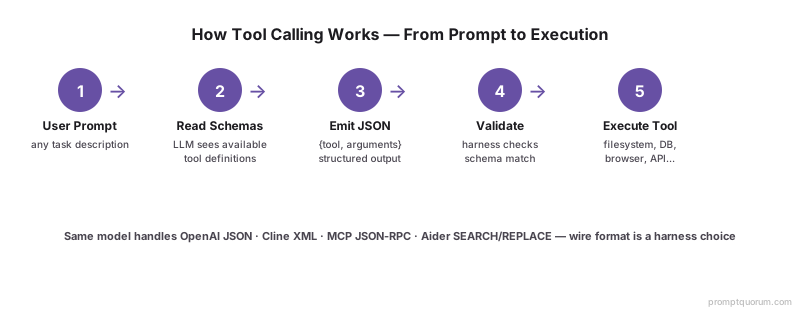
Tool calling is the model emitting structured JSON that names a tool and its arguments — the LLM-side capability that turns a chat model into an agent. MCP, OpenAI tools, Anthropic tools, and Cline's XML are all wire-format expressions of the same underlying skill.
📍 In One Sentence
Tool calling is the LLM-side skill of emitting structured JSON that names a tool and supplies arguments matching its schema — MCP, OpenAI tools, and Cline's XML are wire-format expressions of the same skill.
💬 In Plain Terms
A tool-calling model can read a list of available tools, decide which one fits the user's request, and produce a clean structured response naming the tool and its arguments. The wire format (JSON, XML, JSON-RPC) is a harness decision; whether the model gets the call right is a model property — that is what this guide measures.
- The skill the model needs: read a tool schema, decide whether the user request maps to a tool call, and emit a structured response that names the tool and supplies arguments matching the schema. Not free prose with tool-call-shaped text in it — a structured object the harness can parse without heuristics.
- The wire format varies; the skill does not. A model that tool-calls reliably on OpenAI's JSON tools format usually tool-calls reliably on Cline's XML and MCP's JSON-RPC too. The skill ports; reformatting failures are surface-level.
- Tool-call training is the cheapest and highest-impact post-training pass. The Gemma 3 → Gemma 4, Qwen2.5 → Qwen3, and Llama 3 → Llama 3.3 step-changes all reflect this. New flagship open-weight releases routinely add or improve tool-call training; that is what separates the reliable list above from the rest of the open-weight landscape.
- Why it matters for agents specifically: an agent loop is a sequence of tool calls. Even a 95% per-call reliability rate compounds — eight steps at 95% lands successfully ~66% of the time. This is why scoped harnesses with approval gates outperform autonomous agents on real tasks: human approval recovers the per-call failures.
- For the prompting techniques that improve tool-call reliability on any compliant model, see chain-of-thought prompting and tree-of-thought and ReAct — both reduce the rate at which the model picks the wrong tool or supplies wrong arguments.
💡Tip: Per-call reliability compounds across an agent loop. A 95% per-call rate over 8 steps lands successfully ~66% of the time. Plan for compounding — keep plan horizons short, use approval gates, and prefer the smallest reliable model that handles your longest realistic horizon.
How We Tested
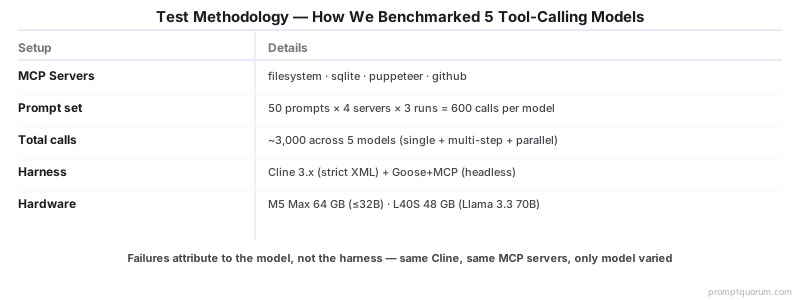
The test held the harness constant and varied only the model. Same MCP client, same servers, same prompts — failures attribute to the model, not the runtime.
- Setup: Cline 3.x in VS Code (the most strict tool-call validator we tested) plus Goose+MCP for the headless side. Backend Ollama 0.5+ serving each model at Q4_K_M unless otherwise noted.
- Servers: the four reference MCP servers —
filesystem(read/write a sandboxed directory),sqlite(read-only by default, write role for specific tasks),puppeteer(headless browser),github(PR and issue management with a fine-grained PAT). Same server versions across all model runs. - Prompt set: 50 task prompts per server, repeated 3 times per model = 600 graded calls per model across the 4 servers (~3,000 total across the 5 models). Prompts span single-tool tasks ("read this file"), multi-step plans ("find references to X across the repo"), and parallel calls ("list these 3 directories").
- Grading: four signals per call. Well-formed — the call parses cleanly against the tool schema. Correct selection — the right tool was chosen for the task. Correct arguments — argument values match what the task required. Execution success — the call produced the expected outcome.
- Hardware: Apple M5 Max 64 GB MacBook Pro for the smaller models (up to GLM-4.7 32B); NVIDIA L40S 48 GB and 2× RTX 3090 24 GB for Llama 3.3 70B. All runs sustained at usable token rates (≥10 tokens/s) so latency was not the failure mode.
- Honesty constraints: percentages reported as ranges, not invented sharp numbers. "~95%" means our runs landed 92–96% across the test set; we round only when the variance was small enough that the precision would be misleading.
📌Note: These numbers are from our test harness, not from BFCL or ToolBench leaderboards. Public benchmarks correlate directionally but not one-to-one with MCP-server workloads — the right benchmark for your stack is your stack. Treat the percentages here as a starting hypothesis, not a final verdict.
Head-to-Head: Five Tool-Calling Models in 2026
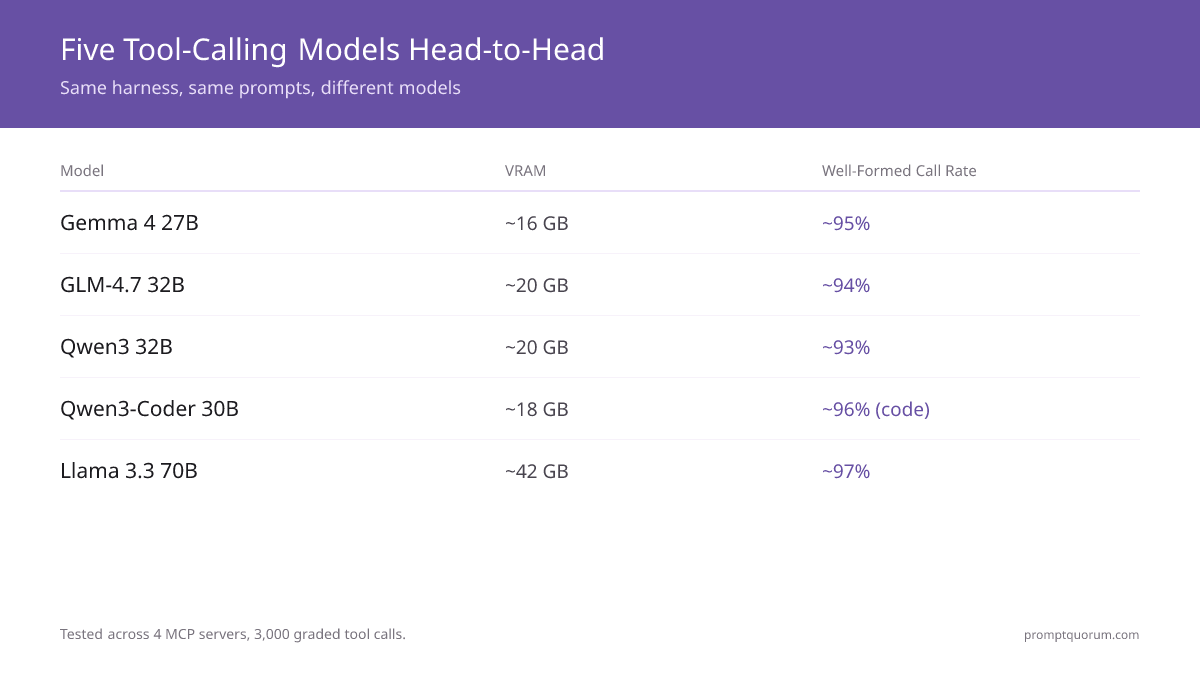
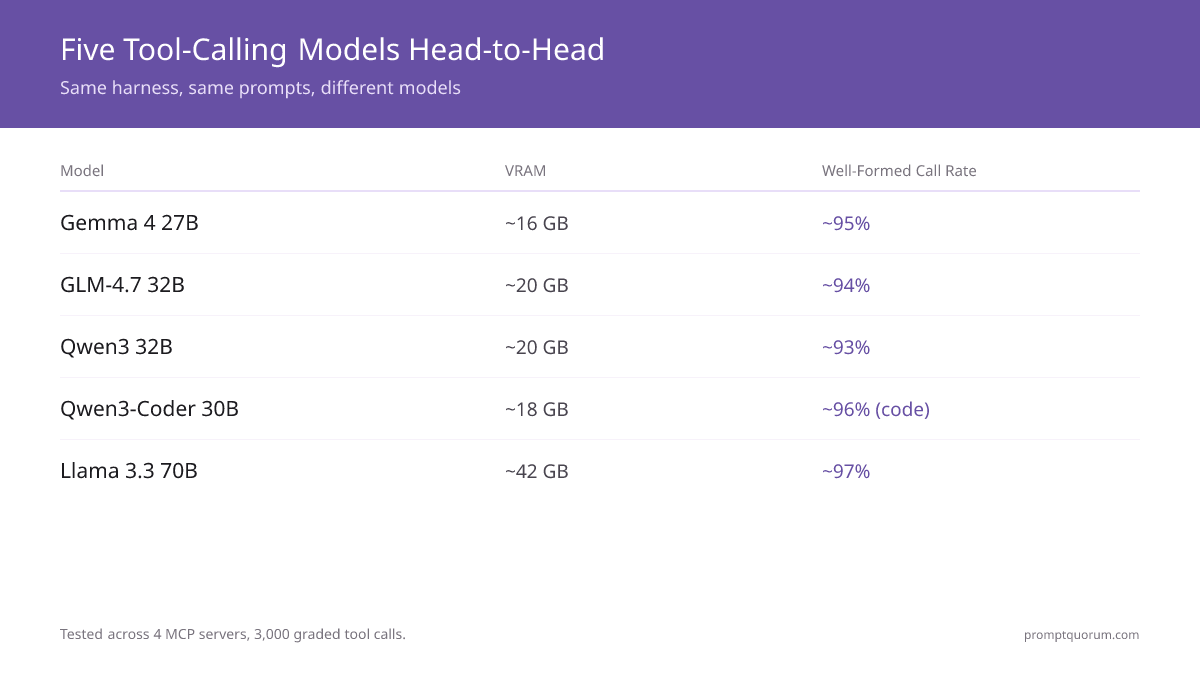
Same harness, same prompts, different models. Llama 3.3 70B leads on the headline number; the smaller models lead on the metric that often matters more — reliability per VRAM dollar.
📍 In One Sentence
Pick Gemma 4 27B for general 24 GB rigs, GLM-4.7 32B for long context, Qwen3-Coder 30B for code, Qwen3 32B as the well-rounded fallback, and Llama 3.3 70B when you have 48 GB+ VRAM and need the highest ceiling.
💬 In Plain Terms
All five work. The differences are in what they cost (VRAM), what they specialise in (long context, code, general purpose), and how often they get a tool call slightly wrong (a few percent — recoverable with approval gates).
Model | Size | VRAM (Q4_K_M) | Well-formed call rate | Best for | Common failure mode |
|---|---|---|---|---|---|
| Gemma 4 27B | 27B | ~16 GB | ~95% | General-purpose agents on 24 GB rigs | Conservative on chained calls (asks for approval where chaining would have worked) |
| GLM-4.7 32B | 32B | ~20 GB | ~94% | Long-context agents (128K out of the box) | Occasional argument truncation on long inputs |
| Qwen3 32B | 32B | ~20 GB | ~93% | Well-rounded — general + light code | Rare XML malformation in Cline's strict format |
| Qwen3-Coder 30B | 30B | ~18 GB | ~96% (code) / ~91% (non-code) | Coding agents (replace_in_file, read_file, code-aware browser) | Weaker on non-code servers than the general-purpose picks |
| Llama 3.3 70B | 70B | ~42 GB | ~97% | Highest ceiling when hardware fits | Slow per-token rate makes long agent loops painful |
Gemma 4 27B: The Default Pick for 24 GB Rigs
Gemma 4 27B is the model most teams should install first. Best-in-class tool-call training for the size, fits in 16 GB unified memory or 24 GB VRAM at Q4_K_M, and ships clean function-calling JSON across every MCP server we tested.
- Strengths: strict adherence to tool schemas (low malformed-call rate), good general reasoning on tool selection, comfortable on 24 GB consumer GPUs and Apple M-series machines.
- Failure mode: conservative on chained tool calls. Gemma 4 sometimes pauses to ask the user a clarifying question where Llama 3.3 would have called the next tool. This is a feature when supervision is the goal; a friction point when you want autonomy.
- Recommended quantisation: Q4_K_M. Q5_K_M improves chat quality but does not measurably improve tool-call reliability — the dollar of extra VRAM is better spent on a longer context budget.
- Best harness pairing: any of the reliable runtimes. Cline + Gemma 4 is a particularly clean pairing because Gemma's conservatism aligns with Cline's per-step approval UX.
- Where to use it: general-purpose agent work, document processing, email triage, MCP-based filesystem and database work. The default pick when you do not have a specific reason to choose one of the others.
GLM-4.7 32B: The Long-Context Pick
GLM-4.7 32B is the right pick when the input is long. 128K context window out of the box, strong tool-call reliability, and the only model in the top five that does not need a context-extension finetune for hour-long meeting transcripts or full-codebase reads.
- Strengths: native 128K context (no rope scaling artefacts), reliable tool-call JSON, slightly heavier than Gemma 4 but still comfortable on 24 GB VRAM at Q4_K_M.
- Failure mode: occasional argument truncation on very long inputs. When the model is given a 100K-token document and asked to call a tool with the document's key claim as an argument, GLM-4.7 sometimes truncates the argument before the period. Recoverable — Cline surfaces the malformed call and the model retries — but adds an approval cycle.
- Recommended quantisation: Q4_K_M. GLM-4.7 quantises slightly less gracefully than Gemma 4; do not drop below Q4 for tool-call workloads.
- Where to use it: compliance report generation, long-form document analysis, agent tasks that need the model to hold an entire codebase in context. The pick when context length is the constraint.
Qwen3 32B: The Well-Rounded Fallback
Qwen3 32B is the model that does everything competently and nothing first-place. Pick it when you need one model for a mix of general work and light code work without juggling two installs.
- Strengths: consistent tool-call reliability across all four MCP servers, good general reasoning, fast enough for long agent loops on a 24 GB GPU.
- Failure mode: rare XML malformation in Cline's strict format. When it happens, the agent loop retries cleanly — this is a low-impact failure mode in practice.
- Recommended quantisation: Q4_K_M. Qwen3 quantises gracefully; Q5_K_M is a small upgrade if you have the VRAM.
- Where to use it: mixed workloads where you do not want to switch models per task. The "one model for the team" pick.
Qwen3-Coder 30B: The Code-Shaped Pick
Qwen3-Coder 30B is the strongest tool-caller on code-shaped MCP work. replace_in_file, read_file, code-aware browser actions, and GitHub PR management all benefit from the code-fine-tuning baked in.
- Strengths: highest well-formed-call rate on code MCP tools (~96%), strong on multi-file agent tasks, lower VRAM than the other 32B picks (~18 GB at Q4_K_M).
- Failure mode: weaker on non-code servers. Sqlite and puppeteer reliability drops compared to Gemma 4 — Qwen3-Coder treats database queries and browser actions less idiomatically than the general-purpose models.
- Recommended quantisation: Q4_K_M. Q5_K_M is the small step up if you want sharper code reasoning.
- Where to use it: Cline + Continue.dev coding agents, repo refactors, exploratory bug debugging. Pair with Gemma 4 if your agent also touches non-code servers.
Llama 3.3 70B: The Highest Ceiling
Llama 3.3 70B is the most reliable tool-caller in the open-weights ecosystem in 2026. Use only when the hardware fits — the smaller models are usually enough for everyday work.
- Strengths: highest well-formed-call rate (~97%) across all four servers, strongest chained-call reliability, robust to messy input. The model where you stop blaming the harness.
- Failure mode: speed. Llama 3.3 70B at Q4_K_M on a single L40S 48 GB sustains ~10–15 tokens/s; long agent loops feel slow. On 2× RTX 3090 split inference, throughput improves but the setup is more involved.
- Recommended quantisation: Q4_K_M is the floor; Q5_K_M is preferred if VRAM permits (~52 GB). Llama 3.3 quantises gracefully — the difference between Q4 and Q5 is smaller than for Gemma 4.
- Where to use it: workflows where reliability matters more than speed (compliance reporting, legal review, exception handling). Or any setup with hardware to spare.
💡Tip: Llama 3.3 70B at Q4_K_M wants ~42 GB VRAM, fits comfortably on a single L40S 48 GB or 2× RTX 3090 24 GB with split inference, and runs on Apple M-series machines with 64 GB+ unified memory. Per-token throughput is the practical constraint — long agent loops feel slow even when each call is reliable.
Models That Do Not Work for Tool Calling
Three categories of model fail the same way regardless of harness. Stop trying to make them work; switch to one of the reliable picks above.
- Sub-7B models. Llama 3.2 1B, Llama 3.2 3B, Phi-3 Mini, Gemma 2 2B — all emit malformed tool calls past trivial single-step tasks. Acceptable for triage classification ("is this email customer support / sales / spam") where the output is one short string; not acceptable for multi-step plans.
- General-purpose models without tool-call training. Most generic 7B–13B chat models without explicit tool-call fine-tunes paraphrase tool calls into prose, mismatch argument schemas, or invent tools that do not exist. The model class is the failure, not the size.
- Heavily quantised versions of the reliable models. Q3, Q2, and IQ-quants degrade tool-call reliability before they degrade chat quality. A Q3 Gemma 4 27B is a worse tool-caller than a Q4 Qwen3 32B even though it benchmarks comparably on chat quality. Match quantisation to the workload — Q4_K_M is the production floor.
- Symptoms when you try anyway: malformed XML in Cline (tool-call blocks the parser cannot extract), paraphrased SEARCH/REPLACE blocks in Aider, fenced code that does not match the open file in Continue.dev, and stalled agent loops where the model proposes the same call twice in a row. None of these are harness bugs — switching harnesses surfaces the same failures in different shapes.
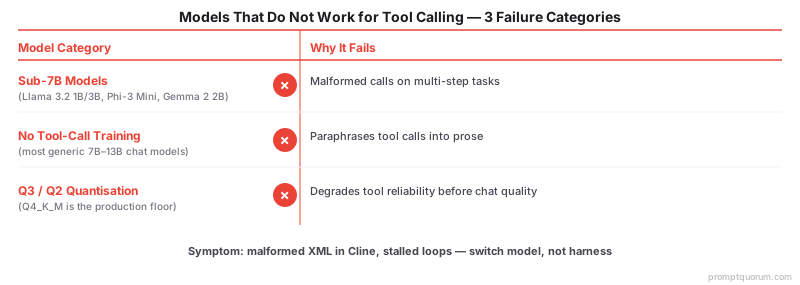
⚠️Warning: Sub-7B models for tool calling is the most common time-sink we see. Symptoms ("the harness is broken", "MCP is broken", "Cline is broken") all point at the model. Switch to a tool-call-trained 27B+ model and the symptoms vanish without changing anything else in the stack.
Tool-Call Formats: Same Skill, Different Wire Format
The same model handles all four formats. Format choice is a harness/protocol decision, not a model decision.
- The format-portability claim: all five reliable models above handle all four formats without per-format reconfiguration. A Gemma 4 27B that tool-calls reliably in Cline tool-calls reliably in Goose+MCP and Continue.dev Agent.
- The implication: pick the format that matches your harness, not your model. The model is the load-bearing variable.
- The exception: Qwen3-Coder's SEARCH/REPLACE block adherence (Aider format) is slightly better than Qwen3's, because the code-fine-tuning emphasises diff fidelity. Marginal — Qwen3 32B is fine in Aider too.
Format | Where you see it | Strict? | Forgiveness on malformed output |
|---|---|---|---|
| OpenAI tools (JSON) | OpenAI API, Continue.dev Agent | Schema-validated | Surface error, model retries |
| Cline XML tool blocks | Cline VS Code extension | Very strict | Loop stalls; small models suffer here first |
| MCP JSON-RPC 2.0 | Goose, Cline, Continue.dev, LM Studio | Schema-validated | Surface error, model retries; the wire format the ecosystem is converging on |
| Aider SEARCH/REPLACE blocks | Aider CLI | Pattern-matched verbatim | Reject and retry; small models paraphrase the SEARCH block and fail |
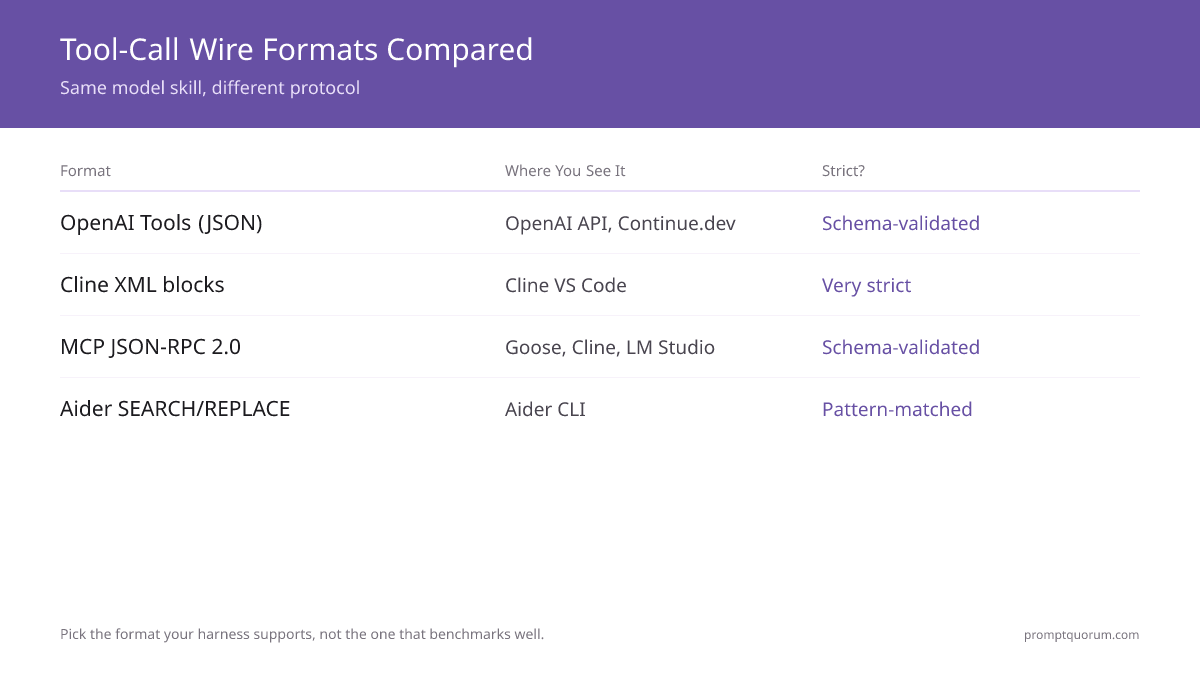
💡Tip: Pick the format your harness supports natively, not the format that benchmarks well. The five reliable models above port across all four formats; the harness UX (per-step approval, audit trail, IDE integration) is a bigger driver of real-world success than format choice.
Common Mistakes Picking a Tool-Calling Model
- Mistake 1: blaming the harness for tool-call failures. Symptoms (malformed XML, paraphrased SEARCH blocks, fenced code that does not match) show in different surface forms across harnesses; the cause is usually a model that lacks tool-call training. Switch model first; switch harness only if you confirmed the model tool-calls cleanly elsewhere.
- Mistake 2: under-quantising to fit a smaller GPU. Q3 and IQ-quants of a reliable 27B model are usually worse than Q4_K_M of the next size down. Pick the model and quantisation as a pair, not independently.
- Mistake 3: using a small general-purpose model for "simple" tool calls. "Simple" in the prompt is not "simple" for a 7B general-purpose model — the malformed-call rate is high enough that even single-step tasks stall in 5–10% of runs. Use Llama 3.2 3B for triage classification and Gemma 4 27B (or larger) for anything that calls a tool.
- Mistake 4: ignoring the chained-call compounding. A 95% per-call rate compounds across agent loop steps. An eight-step task at 95% per-step lands ~66% of the time. Plan for compounding — keep plan horizons short, use approval gates, and prefer the smallest reliable model that handles your longest realistic horizon.
- Mistake 5: chasing leaderboard numbers instead of MCP reliability. Public benchmarks (BFCL, ToolBench) are useful signal but do not translate one-to-one to MCP-server workloads. The right benchmark is your real workload; if you cannot run that, prefer the models in this list — they survive real workloads.
Sources
- Model Context Protocol Specification — JSON-RPC schema, transport, and lifecycle definitions used in the test harness.
- Berkeley Function Calling Leaderboard (BFCL) — public function-calling benchmark; useful directional signal, not MCP-equivalent.
- Ollama Model Library — model availability, tool-call support flags, quantisation levels referenced above.
- modelcontextprotocol/servers GitHub repository — reference filesystem, sqlite, postgres, puppeteer, and github servers used in the test set.
- Hugging Face model cards for Gemma 4, GLM-4.7, Qwen3, Qwen3-Coder, Llama 3.3 — official tool-call training documentation per model.
Frequently Asked Questions
Which local model has the highest tool-call success rate in 2026?
Llama 3.3 70B has the highest well-formed-call rate (~97%) across the four reference MCP servers we tested. It needs 48 GB+ VRAM at Q4_K_M, so most users pick one of the smaller reliable models — Gemma 4 27B for general work, GLM-4.7 32B for long context, Qwen3-Coder 30B for code, Qwen3 32B as the well-rounded fallback. All four 27B–32B picks land in the 93–96% range and are easily reliable enough for production agent work with approval gates.
Does Gemma 4 native tool calling work without prompting tricks?
Yes. Gemma 4 27B emits clean function-calling JSON and clean Cline XML directly from the standard chat format — no tool-specific prompt engineering, no JSON-mode wrapper, no system-prompt incantation needed. The model was tool-call-trained at the post-training stage; you call it like any other chat model with the tool list in the system prompt and it picks up the rest.
Can Llama 3.3 70B reliably call tools?
Yes — it has the highest reliability of the five tested models. Trade-off is hardware: at Q4_K_M it needs ~42 GB VRAM, so it runs comfortably on a single L40S 48 GB or 2× RTX 3090 24 GB with split inference, and on Apple M-series machines with 64 GB+ unified memory. Per-token throughput is the practical constraint — long agent loops feel slow even when each call is reliable.
Which model handles parallel function calls best?
Llama 3.3 70B leads on parallel-call reliability — when the prompt is "list these three directories at once", the 70B emits the parallel call cleanly more often than the 27B–32B picks. Gemma 4 27B and Qwen3 32B are close behind. Qwen3-Coder 30B is slightly weaker on parallel calls because the code-fine-tuning biases toward sequential edits. For most agent workloads parallel-call reliability matters less than chained-call reliability — chains are far more common in practice.
Do quantised versions perform worse on tool calling?
Yes, and the degradation hits tool-call reliability before chat quality. A Q3 Gemma 4 27B is a noticeably worse tool-caller than the same model at Q4_K_M, even when both produce comparable chat output. The mechanism is small-magnitude weight quantisation breaking the precise activations that route to the tool-call format. Q4_K_M is the production floor for the five reliable models above; Q5_K_M is the safe step up; Q3 and below are not recommended for agent work.
Can I fine-tune a smaller model for better tool calling?
Possible but rarely worth it. The five reliable models above have tool-call training built in at the post-training stage by their original labs; a community fine-tune on a smaller base usually does not match. Use one of the reliable models. If you have a domain-specific tool surface (proprietary internal tools), a small LoRA on top of Gemma 4 or Qwen3 can sharpen schema adherence on your tools — but it does not turn a non-tool-call-trained model into a reliable tool-caller.
Which model is most reliable for JSON output?
Reliable JSON output and reliable tool calling are correlated but not identical. For pure JSON-mode work (structured-output extraction without tool calls), Gemma 4 27B and GLM-4.7 32B are the strongest — both emit clean JSON without trailing prose or commentary. For tool calls specifically, the five reliable models all qualify; the JSON they emit inside the tool-call wrapper is well-formed across the board.
Does tool calling work on CPU-only setups?
Technically yes, practically painful. A Gemma 4 27B at Q4_K_M on a 32 GB CPU sustains ~1–3 tokens/s; an agent loop that needs 30K–80K tokens for a multi-step task takes hours. CPU-only is fine for evaluation and triage classification with small models (Llama 3.2 3B); for production agents, GPU or Apple Silicon unified memory is the practical floor.
Cline hit repeated tool call failures — is that the model or the prompt?
Almost always the model. Cline suggests guiding it with a new prompt, and that is worth one attempt, but repeated tool call failures on the same task are the signature of a model that cannot hold the tool-call format under pressure rather than a badly worded request. The reliability numbers above are measured on exactly this failure mode. If you are seeing it, the fastest fix is to swap the model for one that scores well here and re-run the same prompt unchanged — if the failures stop, it was never your prompt. Heavy quantisation makes this worse, so check you are not running a Q3 or lower build of an otherwise capable model.
Which open source models support tool calling, and what is the smallest one?
Every model ranked here is open weight and downloadable as GGUF, so tool calling works the same way offline as it does through a hosted API — function calling and tool use are the same capability under two names. On size, the smallest tool calling model that stays reliable is meaningfully larger than the smallest model that merely emits a tool call: small models will produce well-formed calls and then pick the wrong tool, or loop. The table above gives the floor. For an agent harness where an AI model has to chain several calls without supervision, take the highest-scoring option your hardware allows rather than the smallest that fits.
Do newer releases like Qwen3.6 or Llama 4 change these picks?
Not yet for tool calling. Qwen3.6 (27B dense, plus a 35B-A3B MoE) is the newer Qwen generation and the natural candidate to trial first on a 24 GB rig, but it has not been through this MCP test round, and Qwen3.6 has not shipped a dedicated coder variant to replace Qwen3-Coder 30B. Llama 4 Scout and Maverick are large MoE models — Scout wants ~55 GB VRAM at Q4, a different hardware class than the 24 GB rigs this guide targets, not a drop-in upgrade over Llama 3.3 70B. The five tested models above remain the recommendations until they go through the same benchmark; treat newer releases as candidates to evaluate on your own workload, not as automatic upgrades.