What Is Prompt Caching for Local LLMs?
Prompt caching stores the intermediate computation (the KV cache) for a prompt's prefix so a repeated or extended prompt doesn't have to reprocess that prefix from scratch. It speeds up any workload where requests share a common beginning — a fixed system prompt, a long document reused across questions, or the earlier turns of an ongoing conversation — but does nothing for requests with no shared content.
Quick Answer
Prompt caching stores the computed key-value (KV) cache for a prompt's prefix so it doesn't need to be recomputed when a later request shares that same prefix — a fixed system prompt, a reused document, or earlier conversation turns. It cuts prompt-processing time significantly for repeated-prefix workloads, but provides no benefit when every request is unrelated.
- ▸Caches the KV cache for a prompt prefix, not the model's output
- ▸Biggest win: long fixed system prompts, reused documents, multi-turn conversations
- ▸No benefit for one-off requests with no shared prefix across calls
Key Takeaways
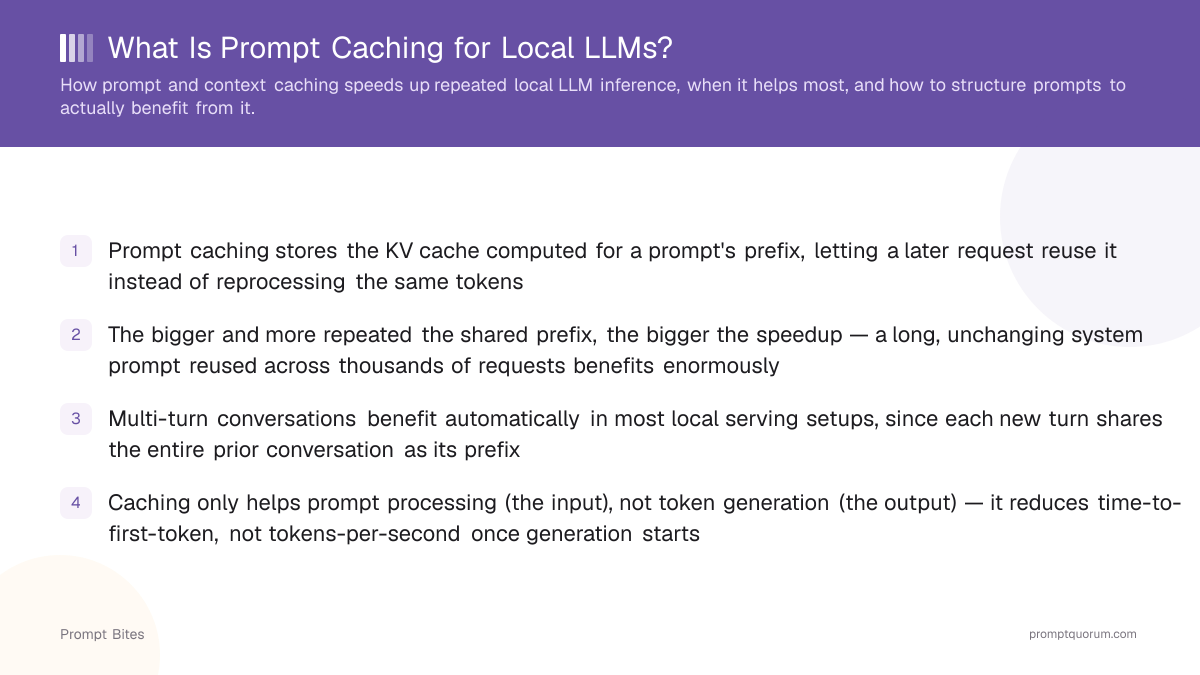
- ✓Prompt caching stores the KV cache computed for a prompt's prefix, letting a later request reuse it instead of reprocessing the same tokens
- ✓The bigger and more repeated the shared prefix, the bigger the speedup — a long, unchanging system prompt reused across thousands of requests benefits enormously
- ✓Multi-turn conversations benefit automatically in most local serving setups, since each new turn shares the entire prior conversation as its prefix
- ✓Caching only helps prompt processing (the input), not token generation (the output) — it reduces time-to-first-token, not tokens-per-second once generation starts
How Caching Actually Speeds Things Up
Processing a prompt means the model computes a key-value (KV) representation for every input token before it can start generating a response. This step — prompt processing — happens before generation begins, and its cost scales with prompt length. Without caching, a 2,000-token system prompt gets fully reprocessed on every single request, even if it's byte-for-byte identical each time.
Caching stores that computed KV representation for a given prefix, keyed to the exact token sequence. When a new request starts with the same tokens, the cached KV values are reused directly, and only the new, non-cached portion of the prompt needs processing. The practical effect is that time-to-first-token drops sharply for cache hits, since most of the input no longer needs recomputation.
This is why multi-turn conversations benefit almost automatically: turn 3 of a conversation includes turns 1 and 2 as its prefix, so a caching-aware serving setup only processes the newly added turn, not the entire conversation history over again.
Structuring Prompts to Actually Benefit
- ▸Put shared, unchanging content first. System prompts, instructions, and reference documents that stay identical across requests should come before the variable, request-specific content — caching only works on an exact-match prefix, so anything before the first point of difference is what gets reused.
- ▸Keep the shared prefix byte-identical across requests. Even a single-character difference in a system prompt (a timestamp, a random ID) breaks the prefix match and forces full reprocessing — move any per-request variation to the end of the prompt, after the reusable content.
- ▸Don't expect caching to help unrelated, one-off requests. If your workload is mostly single-shot questions with no shared setup, there's nothing for caching to reuse — the technique's value is proportional to how much of your traffic actually shares a common prefix.
- ▸Long-running conversations benefit most from cache retention settings. Check how long your serving setup keeps cached prefixes before evicting them — a cache that's evicted too aggressively won't help conversations with gaps between turns.
Frequently Asked Questions
Does prompt caching change the model's output?▾
Does prompt caching help token generation speed, or just the initial response time?▾
How much VRAM does caching use?▾
Does every local serving tool support prompt caching?▾
Related Prompt Bites