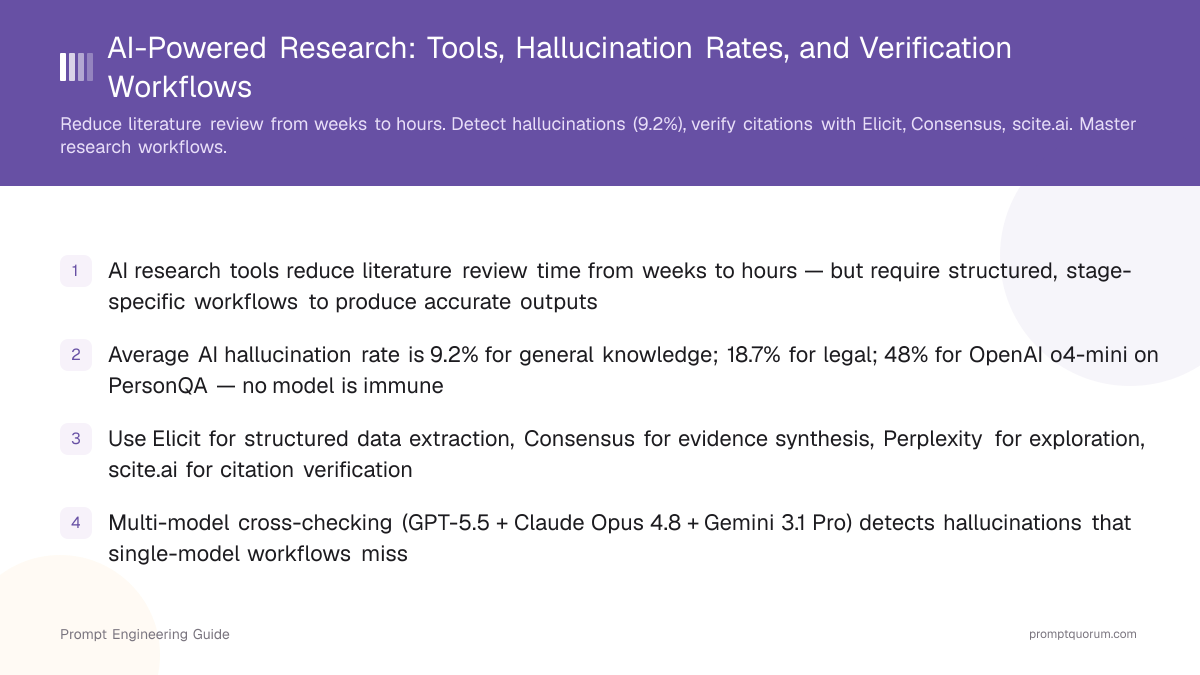
⚡ Quick Facts
📍 In One Sentence
AI research tools differ from general chatbots by searching indexed literature semantically and returning citations you can open, rather than generating plausible-sounding references from memory.
💬 In Plain Terms
A chatbot answers from what it half-remembers; a research tool goes and looks. That is the whole difference, and it is why one can invent a paper that does not exist while the other hands you a link you can click.
- Elicit covers 138M+ papers and 545,000 clinical trials with semantic (not keyword) search
- Average AI hallucination rate: 9.2% for general knowledge, 18.7% for legal, 48% for o4-mini on PersonQA
- 100+ hallucinated citations passed peer review at NeurIPS 2025 (top ML conference, 24.52% acceptance rate)
- GPT-5.6, Claude Opus 5, and Gemini 3.1 Pro all share a 1M-token context window, processing ~800 academic pages per session
- Temperature 0.0–0.1 for citation generation; 0.7–0.9 only for hypothesis brainstorming
- Multi-model cross-checking detected hallucinations in 8 of 30 test citations in PromptQuorum testing
What AI-Powered Research Actually Does
📍 IN ONE SENTENCE AI-powered research uses RAG-connected LLMs and semantic search to accelerate literature discovery, synthesis, and verification — but requires multi-model cross-checking to catch hallucinated citations.
💬 IN PLAIN TERMS A standard LLM is a closed book exam. A RAG-powered research tool is an open book — it looks up sources before answering. But even open-book answers can be wrong, so you cross-check with a second model and verify citations manually.
How it works: Retrieval-Augmented Generation (RAG) is the core architecture behind most research AI tools. RAG connects an LLM to an external knowledge base — academic databases, uploaded PDFs, or live web indices — so the model grounds its answers in retrieved documents rather than relying solely on training data. Without RAG, models can only recall facts they were trained on; with RAG, they answer from sources you provide.
The Right Tool for Each Research Stage
No single AI research tool handles every research stage well — the highest-quality workflows route each task to the tool best designed for it.
Elicit (elicit.com) uses semantic search across 138M+ academic papers and 545,000 clinical trials to extract structured data directly from PDFs — methodologies, sample sizes, outcomes — without requiring keyword matches. Consensus (consensus.app) searches ~200 million papers and returns a "Consensus Meter" summarizing scientific agreement (Yes / No / Possibly) on a specific question. Perplexity AI provides the fastest general-purpose cited answers across both the open web and academic literature, making it optimal for exploratory phases.
- Discovery — Use Perplexity to map the topic landscape and define your research question
- Literature gathering — Use Elicit to find specific papers and extract data tables
- Evidence validation — Use Consensus to check whether the scientific community agrees on your core hypothesis
- Citation checking — Use scite.ai to verify that your key references have not been widely contradicted
Tool | Database | Primary Function | Free Tier |
|---|---|---|---|
| Elicit | 138M+ papers + 545K trials | Structured data extraction from PDFs | Yes (5,000 credits/month) |
| Consensus | ~200M papers | Evidence synthesis with Consensus Meter | Yes (limited) |
| Semantic Scholar | 200M+ papers | Paper discovery, citation graphs, TLDR summaries | Fully free |
| Perplexity AI | Web + academic | Real-time cited answers, broad exploration | Yes (limited) |
| scite.ai | 1.2B+ citation statements | Supporting / contradicting / mentioning analysis | Yes (limited) |
| NotebookLM (Google) | Uploaded documents | Source-grounded Q&A on your own files | Free / Plus tier |
The Hallucination Problem in Research AI
AI systems hallucinate citations and fabricate statistics — and these errors survive peer review. GPTZero analyzed 4,841 papers accepted by NeurIPS 2025 (the top machine learning conference, acceptance rate 24.52%) and found 100+ confirmed hallucinated citations across 53 papers, all of which had passed multi-reviewer peer review.
Hallucination rates vary sharply by domain and task complexity:
In plain terms: An AI research assistant with a 9.2% hallucination rate will fabricate approximately 1 citation in every 11 it generates. In a 40-citation paper, that is 3—4 invented references — enough to retract a publication. The core failure mode is confidence. LLMs do not express uncertainty proportional to their accuracy. A hallucinated citation reads identically to a real one — same formatting, plausible journal names, coherent author combinations.
Domain | Hallucination Rate |
|---|---|
| General knowledge questions | 9.2% (average across models) |
| Legal information | 18.7% (top models) |
| Medical / healthcare queries | 15.6% (overall average) |
| Text summarization (best models) | 1.3—4.1% |
| OpenAI o4-mini on PersonQA benchmark | 48% |
🔍 The Confidence Problem
LLMs do not express uncertainty proportional to their accuracy. A hallucinated citation reads identically to a real one — same formatting, plausible journal names, coherent author combinations. There is no visual signal that a citation is fabricated. Verification is the only defence.
How to Verify AI Research Outputs: Multi-Model Cross-Checking
Multi-model cross-checking — running the same research question through GPT-5.6, Claude Opus 5, and Gemini 3.1 Pro simultaneously — detects hallucinations that single-model workflows miss, because independent models rarely fabricate the same specific false claim.
The verification logic is statistical: when three independently trained models agree on a citation, the probability that all three hallucinated the same author, journal, volume, and year is negligible. When they disagree, that divergence is an explicit signal to verify manually.
PromptQuorum is a multi-model AI dispatch tool that sends one prompt to multiple AI providers simultaneously and returns all responses side-by-side. For research workflows, this means running a citation or factual claim through GPT-5.6 (OpenAI), Claude Opus 5 (Anthropic), and Gemini 3.1 Pro (Google DeepMind) in one dispatch — and reviewing where the three models converge or conflict.
Tested in PromptQuorum — 30 research citation prompts across three models: All three models (GPT-5.6, Claude Opus 5, Gemini 3.1 Pro) agreed on the same citation format and DOI in 22 of 30 cases. In 8 cases, at least one model produced a different author name or journal volume — all 8 cases were confirmed hallucinations upon manual verification against Google Scholar.
- Generate — Ask one model (e.g., Claude Opus 5) to produce a literature summary with citations
- Cross-check — Dispatch the same question to GPT-5.6 and Gemini 3.1 Pro via PromptQuorum
- Flag divergence — Any citation where models disagree on author, year, or journal requires manual verification
- Verify converging claims — Use scite.ai to confirm that agreed-upon citations have not been retracted or contradicted
🔍 Why Cross-Checking Works
Three independently trained models rarely fabricate the same specific false claim — same author, same journal, same volume, same year. When all three agree, the citation is almost certainly real. When they disagree, that divergence is your hallucination alarm.
Prompt Engineering for Research Tasks
Structured prompts produce more accurate and verifiable research outputs than open-ended questions — the difference is in specificity of scope, output format, and explicit instructions to cite sources.
The key mistake most researchers make is asking a research question exactly as they would type it into a search engine. Search engines rank documents; LLMs predict tokens. They require different input structures.
For the complete library of prompt structuring techniques — role assignment, output formatting, and constraint specification — see the prompt engineering guide.
The Research Prompt Framework
Use this structure for any AI research task:
- Role — "You are a systematic review researcher specializing in field."
- Scope — "Analyze only peer-reviewed papers published between 2020 and 2026."
- Objective — "Summarize the current scientific consensus on topic."
- Citation requirement — "Cite every claim with author, year, and journal. If you cannot find a verified citation, say 'unverified' rather than generating one."
- Output format — "Return results as a structured table: Claim | Source | Year | Confidence (High/Medium/Low)."
Bad Prompt: Open-ended questions without role or citation requirements produce hallucinated statistics:
What is the research on AI hallucinations?
Good Prompt Example
Good Prompt: The structured version below produces a verifiable output table. The open prompt above produces a confident paragraph that may contain fabricated statistics.
You are a systematic review researcher. Summarize the current scientific consensus on AI hallucination rates across domains (medical, legal, general knowledge). Cite only peer-reviewed papers or official model evaluation reports published 2023—2026. Format results as: Domain | Hallucination Rate | Study | Year. If a specific rate is not verified, label it 'estimated' and flag it.
Temperature Settings for Research
Set Temperature (T) to 0.0—0.2 for all research tasks that require factual accuracy. Temperature (T) is the hyperparameter applied to the softmax output distribution: at T = 0.0, the model selects the highest-probability token at every step, producing deterministic output. At T = 1.0, output becomes more varied — desirable for creative tasks, dangerous for citation generation where a single wrong token changes an author name or DOI.
Task | Recommended T | Reason |
|---|---|---|
| Citation generation | 0.0—0.1 | Deterministic output; minimize token variation |
| Summarization | 0.1—0.3 | Factual but naturally phrased |
| Hypothesis brainstorming | 0.7—0.9 | Diverse output increases ideation range |
| Literature review drafting | 0.2—0.4 | Balanced accuracy and readability |
🔍 One Wrong Token
At temperature 0.7, a single token variation can change "Smith 2024" to "Smith 2023" or "Nature" to "Nature Methods." For citation generation, even T = 0.2 introduces unnecessary risk. Use T = 0.0 unless you have a specific reason not to.
AI Research Tools by Model: Context Window Limits
The context window size determines how many research papers an LLM can process in a single session — this is the primary technical constraint for large-scale literature synthesis.
- GPT-5.6, Claude Opus 5, and Gemini 3.1 Pro currently all share a 1-million-token context window. For research tasks involving fewer than 20 papers, all three models handle the full context easily. For systematic reviews covering 50—200 papers, all three can now process the full corpus in a single session — though the "lost in the middle" effect still degrades retrieval accuracy for material buried mid-context, regardless of window size.
- For truly large corpora (500+ papers), a RAG pipeline — where papers are chunked, embedded in a vector database, and retrieved by semantic similarity — is the correct architecture, not direct context injection.
- For a deeper explanation of context windows and why models lose information mid-context, see context windows explained.
Model | Context Window | Approximate Page Capacity |
|---|---|---|
| GPT-5.6 (OpenAI) | 1M tokens | ~800 standard academic pages per session |
| Claude Opus 5 (Anthropic) | 1M tokens | ~800 standard academic pages per session |
| Gemini 3.1 Pro (Google DeepMind) | 1M tokens | ~800 standard academic pages per session |
🔍 Lost in the Middle
Even within a model's stated context window, retrieval accuracy degrades for information placed in the middle of long inputs. Front-load your most important papers and put reference material at the end. This is a known limitation documented in Anthropic and Google research.
Global and Regional Research AI Context
European research institutions increasingly require that AI-assisted research comply with the EU AI Act, which mandates transparency, traceability, and human oversight for high-risk AI applications including academic publishing. Mistral AI (France) is widely used in EU academic settings because its models are deployable on-premise, satisfying GDPR data residency requirements for sensitive research data.
Chinese research institutions use Qwen3 (Alibaba) and DeepSeek as primary research AI tools — both are open-source, locally deployable, and handle CJK-language academic literature with faster token processing than Western-trained models. China's Interim Measures for Generative AI (2023) requires AI-generated research content to be labelled as such, a policy now influencing academic publishing standards globally.
Japanese universities operating under METI data governance guidelines frequently deploy Ollama with Llama 4 8B locally — the model requires 8GB RAM for local inference, producing zero external API calls and meeting strict data residency standards for sensitive research.
Common Mistakes in AI-Assisted Research
Avoid these frequent errors when using AI tools for research:
- Choosing based on benchmark leaderboards (not actual task) — Fix: Choose models by task fit, not leaderboard rank. Benchmark winners (GPT-5.6) are overkill for summarization; Gemini 3.1 Pro's cost advantage dominates when you only need context processing.
- Assuming context window = quality (all three frontier models now at 1M; LLaMA 4 Scout offers 10M locally) — Fix: Context window is one dimension, not a quality proxy. A 1M-token window matters only once a corpus exceeds ~50 papers. For small literature reviews, price and task fit — not window size — should drive model choice, since GPT-5.6, Claude Opus 5, and Gemini 3.1 Pro are now equal on context.
- Using frontier model for every task (60× cost difference Gemini Flash vs GPT) — Fix: Route tasks by cost-efficiency: Gemini Flash for classification, Claude Opus 5 for writing, GPT-5.6 for code. Multi-model dispatch via PromptQuorum enables per-task model selection.
- Ignoring geography and data residency (EU GDPR, China) — Fix: EU research must use GDPR-compliant tools (Mistral on-premise, Ollama local). China-based institutions use Qwen3 or DeepSeek. Japan under METI guidelines uses Ollama with Llama 4 Scout locally.
- Locking into one provider SDK without abstraction layer — Fix: Use multi-model dispatch tools (PromptQuorum) to avoid vendor lock-in. A single API call routes to the best model per task; switching providers requires no code changes.
How to Conduct AI-Powered Research
- 1Map your research workflow by stage: discovery, gathering, synthesis, verification. Use Perplexity for exploratory discovery, Elicit for structured literature extraction, Consensus for evidence synthesis, and scite.ai for citation verification. Route each task to the tool designed for it.
- 2Set Temperature (T) to 0.0–0.1 for citation generation. Deterministic output minimizes hallucinations on author names, years, and DOIs. Use T = 0.7–0.9 only for hypothesis brainstorming, not for any fact-based claim.
- 3Structure research prompts with role, scope, objective, citation requirement, and output format. Example: 'You are a systematic review researcher. Analyze peer-reviewed papers 2020–2026 only. Summarize scientific consensus on topic. Cite every claim with author, year, journal. Return as table: Claim | Source | Year | Confidence.'
- 4Use multi-model cross-checking to detect hallucinated citations. Run the same research question through GPT-5.6, Claude Opus 5, and Gemini 3.1 Pro via PromptQuorum. Any citation where models disagree on author, year, or journal requires manual verification in Google Scholar or PubMed.
- 5Verify all citations manually before inclusion in academic work. Every AI-generated reference must be checked against the source database. Hallucinated citations have been confirmed in papers that passed peer review at top conferences like NeurIPS 2025.
Frequently Asked Questions
What is the best AI tool for academic research in 2026?
No single tool wins across all research stages. Elicit leads for structured literature reviews and PDF data extraction from its 138M+ paper database. Consensus leads for rapid evidence synthesis with its Consensus Meter (Yes/No/Possibly). Perplexity leads for fast, broadly cited exploratory research across both academic and web sources. The highest-quality workflow uses all three sequentially.
How accurate is AI-generated research output?
Accuracy varies by task and model. Best-case hallucination rates for text summarization are 1.3—4.1%. For general knowledge questions, the average across models is 9.2%. Legal and medical domains reach 18.7% and 15.6% respectively. In January 2026, GPTZero confirmed 100+ hallucinated citations in 53 NeurIPS 2025 papers that passed peer review — meaning AI errors are not always caught by expert reviewers.
How many academic papers can an AI process at once?
This depends on the model's context window. GPT-5.6 (OpenAI), Claude Opus 5 (Anthropic), and Gemini 3.1 Pro (Google DeepMind) currently all handle ~800 standard academic pages per session (1M-token context each). For corpora beyond that, a RAG (Retrieval-Augmented Generation) pipeline with a vector database is required.
Is it safe to cite AI-generated references in academic papers?
No — not without verification. AI models generate plausible-sounding citations that may have incorrect authors, wrong volumes, or incorrect DOIs. Every AI-generated citation must be verified against the source database (Google Scholar, PubMed, arXiv) before inclusion in academic work. Hallucinated citations have been found in papers at the top machine learning conferences, including NeurIPS 2025.
Does AI research assistance work differently outside the US?
Yes. European researchers must comply with EU AI Act transparency requirements for AI-assisted work. Chinese institutions primarily use Qwen3 (Alibaba) and DeepSeek, which have faster token processing for CJK-language literature. Japanese researchers under METI data governance guidelines often use Ollama-based local models — Llama 4 8B runs locally with 8GB RAM, with no data leaving the institution's infrastructure.
What temperature should I use for AI research tasks?
Set temperature to 0.0–0.1 for citation generation — deterministic output minimizes token variation that could corrupt an author name or DOI. Use 0.1–0.3 for summarization where natural phrasing matters. Reserve 0.7–0.9 only for hypothesis brainstorming where diverse output is the goal.
What is Elicit and how does it work?
Elicit is an AI research assistant that uses semantic search across 138M+ academic papers and 545,000 clinical trials. Unlike keyword search, it matches papers by conceptual similarity. Its core feature is structured data extraction — pulling methodology, sample size, and outcomes directly from PDF full text into a comparison table without requiring keyword matches.
Can AI research tools access papers behind paywalls?
Most AI research tools (Elicit, Consensus, Semantic Scholar) use open-access paper databases. They cannot access papers behind institutional paywalls unless you upload the PDFs directly. NotebookLM (Google) and Elicit both support PDF uploads for source-grounded Q&A on papers you have access to.
How do I detect a hallucinated citation?
Run the citation through Google Scholar or PubMed. Check that the author names, journal, volume, year, and DOI all match exactly. Use scite.ai to confirm the paper has citation activity — zero citations on a supposedly influential paper is a red flag. Cross-check with a second AI model: if it returns different author or journal details, both versions require manual verification.
Is Perplexity AI reliable for academic research?
Perplexity AI is reliable for exploratory research — mapping a topic, identifying key researchers, and finding relevant sources to investigate further. It is not reliable as a final citation source because it searches the web including non-peer-reviewed sources. Use Perplexity for discovery, then verify any specific claim using Elicit, Semantic Scholar, or direct database lookup before citing.
Sources & Further Reading
- Schulhoff et al., 2024. "The Prompt Report: A Systematic Survey of Prompting Techniques" — catalogues 58+ prompting techniques applicable to research workflows
- GPTZero, 2026. "GPTZero finds 100 new hallucinations in NeurIPS 2025 conference papers" — first documented cases of hallucinated citations entering top conference proceedings
- Federal Reserve Bank of St. Louis, 2025. "The Impact of Generative AI on Work Productivity" — workers using AI report 33% more productivity per AI-assisted hour
- Vectara Hallucination Evaluation Model (HHEM) — open-source model and leaderboard for measuring LLM hallucination rates across domains
- Elicit Research Documentation — technical documentation of Elicit's semantic search and structured extraction methodology