Key Takeaways
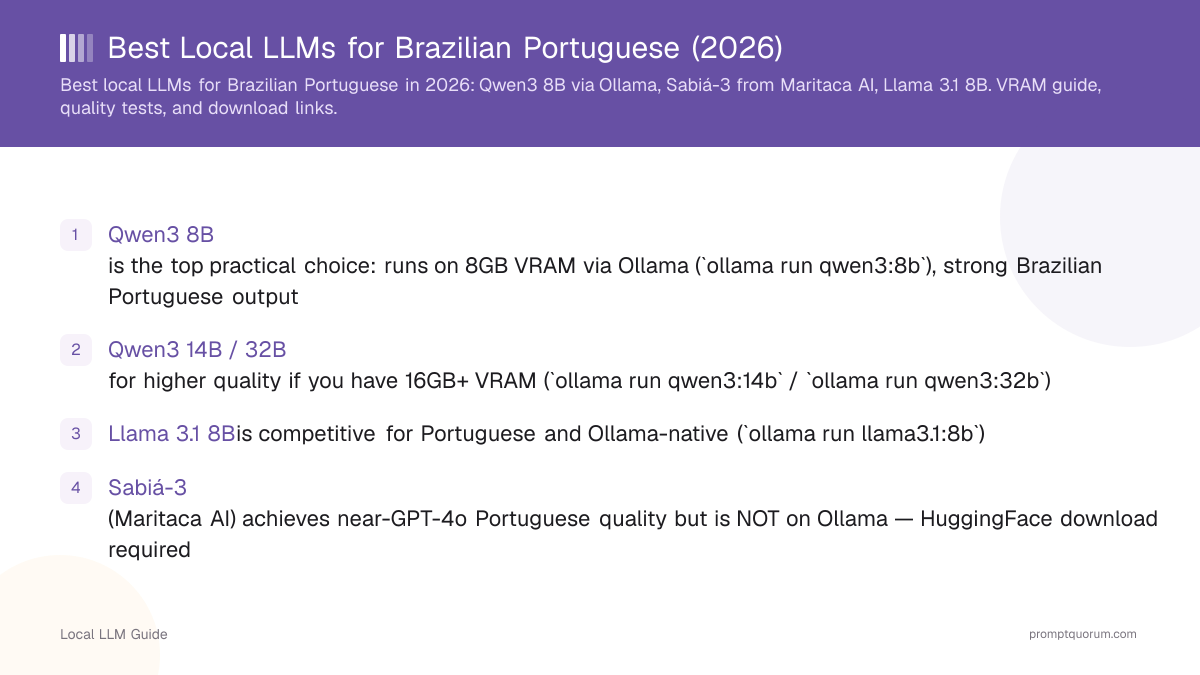
- Qwen3 8B is the top practical choice: runs on 8GB VRAM via Ollama (`ollama run qwen3:8b`), strong Brazilian Portuguese output
- Qwen3 14B for higher quality at 16GB+ VRAM (`ollama run qwen3:14b`); Qwen3.8-27B for the best available quality at 24GB VRAM (`ollama run qwen3.8:27b`)
- Llama 3.1 8B is competitive for Portuguese and Ollama-native (`ollama run llama3.1:8b`)
- Sabiá-3 (Maritaca AI) achieves near-GPT-4o Portuguese quality but is NOT on Ollama — HuggingFace download required
- Test PT-BR quality yourself: prompt in PT-BR, check você/tu usage, vocabulary, and grammar
- Avoid models trained primarily on English for PT-facing production use
Why Model Choice Matters for Brazilian Portuguese
Model choice has an outsized impact on Brazilian Portuguese output quality. Models trained primarily on English data produce grammatical errors, European Portuguese vocabulary (ficheiro instead of arquivo, ecrã instead of tela), and wrong pronoun forms (tu instead of você as the standard subject pronoun in Brazilian Portuguese).
Three factors determine PT-BR quality: the volume of Portuguese text in the training data, tokenization efficiency for Portuguese vocabulary, and whether the model was fine-tuned on Portuguese instructions. Models with less than 5% Portuguese training data typically produce stilted, translated-sounding output.
Qwen3 was trained on approximately 36 trillion tokens across 119 languages, giving it strong multilingual coverage. Sabiá-3 from Maritaca AI was purpose-built for Portuguese and achieves performance close to GPT-4o on Portuguese tasks.
📍 In One Sentence
For Brazilian Portuguese, choose a model with documented multilingual training data — Qwen3, Llama 3.1, or Sabiá-3 — to avoid European Portuguese vocabulary and incorrect pronoun forms.
💬 In Plain Terms
Portuguese has two main variants: Brazilian Portuguese (PT-BR) and European Portuguese (PT-PT). They differ in vocabulary, grammar, and pronoun usage. "Você" is standard in Brazil; "tu" is more common in Portugal. "Arquivo" (file) and "tela" (screen) are Brazilian; "ficheiro" and "ecrã" are European. A model that defaults to European Portuguese feels unnatural to Brazilian users and can cause errors in professional documents.
Best Local LLMs for Brazilian Portuguese 2026
The models below are ranked by a combination of Brazilian Portuguese output quality, VRAM efficiency, and ease of installation. All Ollama-compatible models can be pulled and run with a single command.
Model | Size | VRAM (Q4) | PT-BR Quality | On Ollama? | Best For |
|---|---|---|---|---|---|
| Qwen3 8B | 8B | ~7 GB | Very Good | Yes (ollama run qwen3:8b) | Best all-round local PT choice |
| Qwen3 14B | 14B | ~9 GB | Excellent | Yes (ollama run qwen3:14b) | Higher quality, more nuance |
| Qwen3.8-27B | 27B | ~24 GB | Excellent+ | Yes (ollama run qwen3.8:27b) | Best available quality, native vision-language |
| Llama 3.1 8B | 8B | ~7 GB | Good | Yes (ollama run llama3.1:8b) | General PT, competitive |
| Gemma 4 31B | 31B | ~19 GB | Good | Yes (ollama run gemma4:31b) | Wide language support (35+ languages) |
| Sabiá-3 | ~7B | ~7 GB | Near GPT-4o | No (HuggingFace only) | Best PT quality, harder to run |
Sabiá-3 is NOT available on Ollama. It must be downloaded from HuggingFace (https://huggingface.co/maritaca-ai) and run with llama.cpp or LM Studio. All other models can be installed with a single ollama pull command.
VRAM Guide for Brazilian Portuguese Users
Your available VRAM determines which models you can run. All recommendations assume Q4_K_M quantization via Ollama or llama.cpp.
- 8GB VRAM / 16GB RAM: Qwen3 8B (~7GB), Llama 3.1 8B (~7GB), Sabiá-3 (~7GB via llama.cpp with GGUF download)
- 12GB VRAM: All 8B models comfortably; Qwen3 14B at Q4_K_M (~9GB)
- 16GB VRAM: Qwen3 14B with headroom; Gemma 3 12B
- 24GB VRAM: Qwen3.8-27B (~24GB), Gemma 4 31B (~19GB)
- CPU-only (16GB RAM): Qwen3 8B at approximately 2–4 tokens/sec via Ollama; usable for batch tasks, slow for interactive chat
How to Run Sabiá-3 (Not on Ollama)
Sabiá-3 is developed by Maritaca AI, a Brazilian company specializing in Portuguese language models. It achieves performance close to GPT-4o on Portuguese tasks and is the strongest open-weight model for Brazilian Portuguese.
Sabiá-3 is not available in the Ollama model library. To run it locally, download the GGUF files from the Maritaca AI HuggingFace page at huggingface.co/maritaca-ai and run them with llama.cpp or LM Studio. LM Studio supports direct GGUF loading from HuggingFace with a built-in search interface — search for "maritaca" in the LM Studio model browser.
The first Sabiá generation (Sabiá-7B and Sabiá-65B) was based on the Llama architecture. Sabiá-3 continues this tradition of Portuguese-focused fine-tuning on a strong base model.
- Download path: huggingface.co/maritaca-ai
- Run with: llama.cpp (CLI) or LM Studio (GUI, recommended for beginners)
- VRAM requirement: approximately 7GB at Q4 quantization
- Note: No `ollama run sabia` command exists — Sabiá is not in the Ollama library
How to Test Brazilian Portuguese Quality
There is no single standardized Brazilian Portuguese benchmark equivalent to English benchmarks. PoETa v2 is a Portuguese-language evaluation benchmark, but the most reliable quality check is practical testing with real PT-BR tasks.
Signs of poor PT-BR output: using "tu" as subject pronoun (European Portuguese convention), using "ficheiro" instead of "arquivo", using "ecrã" instead of "tela", awkward phrasing that reads like a translation from English, incorrect verb conjugations.
- Business email test: Ask the model to write a formal business email in "português formal do Brasil" — check for você-form, "Prezado/a", Brazilian business vocabulary
- Vocabulary check: Ask "Como se chama um arquivo de computador em português do Brasil?" — a good model answers "arquivo"; a poorly tuned model may answer "ficheiro"
- Pronoun form: Prompt with "Como você está?" — check that follow-up responses use "você" consistently, not "tu"
- Legal/formal register: Ask for a brief contract clause in PT-BR — check for correct subjunctive forms and Brazilian legal vocabulary
- Regional awareness: Ask "Qual é a diferença entre português do Brasil e português de Portugal?" — the model should give accurate, confident distinctions
Frequently Asked Questions
What is the best local LLM for Brazilian Portuguese in 2026?
Qwen3 8B is the top practical choice: runs on 8GB VRAM via Ollama, trained on 36 trillion tokens across 119 languages. For maximum PT-BR quality, Sabiá-3 from Maritaca AI approaches GPT-4o performance but requires downloading from HuggingFace.
Can I run local LLMs on a standard Brazilian laptop?
Yes. Most modern laptops with 16GB RAM can run Qwen3 8B via Ollama at 2–4 tokens/sec on CPU only. With a dedicated GPU (8GB VRAM), speed increases to 15–20 tokens/sec.
What is Sabiá and where can I download it?
Sabiá-3 is a Portuguese-specialized model from Maritaca AI, a Brazilian company. Download GGUF files from huggingface.co/maritaca-ai and run with llama.cpp or LM Studio. It is not available in the Ollama library.
Does Qwen3 understand Brazilian Portuguese differently from European Portuguese?
Qwen3 handles both variants. When prompted in PT-BR (using "você" and Brazilian vocabulary), it responds in PT-BR. Prompt explicitly in the variant you want for best results.
Is Llama 3.1 good for Portuguese?
Yes, Llama 3.1 8B is among the top three local models for Portuguese in 2026. It is available via Ollama and produces good PT-BR output for general use.
How do I install Ollama for Brazilian Portuguese use?
Install Ollama from ollama.com (same process for all languages), then run: ollama run qwen3:8b. See the full Ollama installation guide at /local-llms/how-to-install-ollama.
Does using a local LLM help with LGPD compliance?
Yes. Running LLMs locally means data stays on your own infrastructure and is not sent to third-party cloud providers, which simplifies LGPD compliance. See the companion LGPD article for details.
What benchmark tests Portuguese LLMs?
PoETa v2 is a Portuguese-language evaluation benchmark. For practical use, manual testing with real PT-BR tasks is the most reliable quality check, as there is no single standardized Brazilian Portuguese benchmark equivalent to English benchmarks.
Can Qwen3 handle formal Brazilian Portuguese business writing?
Yes. Prompt with "escreva em português formal do Brasil" or "português brasileiro formal" to get consistently formal, você-form business output.
What is Tucano?
Tucano is an open-weight Portuguese language model from C4AI-USP (University of São Paulo). It is designed specifically for Portuguese and is efficient for resource-constrained settings. Available on HuggingFace.
Sources
- SiliconFlow (2026). "Best Open-Source LLM for Portuguese Language Tasks." — Top 3 models for Portuguese including Qwen3 and Llama 3.1 8B
- Maritaca AI. "Sabiá-3 Model Card." HuggingFace — huggingface.co/maritaca-ai
- Qwen Team (2024). "Qwen Technical Report." arXiv — Qwen3 training data: 36 trillion tokens, 119 languages
- Alibaba Qwen Team (2026). "Qwen3.8-27B Model Card." Hugging Face — huggingface.co/Qwen — dense 28B vision-language architecture, released 2026-08-14
- PoETa v2 benchmark — Portuguese Language Evaluation Toolkit for LLMs
- C4AI-USP. "Tucano: Open-weight Portuguese LLM." HuggingFace