Key Takeaways
- Newest release: Poolside Laguna XS 2.1 (July 2, 2026) -- agentic, long-horizon coding model, 33B total / 3B active MoE, SWE-bench Verified 70.9%.
- Top open-weights model: Z.ai GLM-5.2 (June 2026) -- 51 points on the independent Artificial Analysis Intelligence Index v4.1, #1 open-weights model and 4th overall; MIT licence.
- Best overall local model: Alibaba Qwen3.8-27B -- 89.2% GPQA Diamond, native vision-language, 262K context (to 1M), successor to Qwen3.6-27B.
- Best coding models: Kimi K2.6 (April 2026, SWE-Bench Pro 58.6, ties GPT-5.5 on SWE-bench Verified) and its successor Kimi K2.7 Code (June 2026), plus Laguna XS 2.1 for agentic long-horizon work.
- Best small-footprint reasoning: OpenAI gpt-oss:20b -- 21B total / 3.6B active MoE, runs in 16 GB, ~o3-mini level with adjustable reasoning.
- Biggest Q2 2026 release: Google Gemma 4 (June 2026) -- Gemma 4 26B-A4B (MoE, 89% AIME 2026) and Gemma 4 E2B (~2 GB RAM, runs on a Raspberry Pi 5) replace Gemma 3 as the current-generation family.
- Biggest Q1 2026 release: Google Gemma 3 (February 2026) -- 1B, 4B, 9B, and 27B variants, vision support on all sizes, Apache 2.0 licence.
- Best reasoning model release: DeepSeek-R1 (January 2025) -- chain-of-thought reasoning, 52% MATH at 7B scale, disrupted the 7B benchmark landscape.
- Largest quality jump in 2025: Llama 3.3 70B (December 2025) -- matches GPT-4 (2023) on MMLU, available via `ollama run llama3.3:70b`.
- The quality gap between locally-runnable models and frontier cloud models has narrowed to roughly 18-24 months of equivalent capability.
📍 In One Sentence
This page tracks every major open-weight local LLM release with its key specifications, benchmark scores, and Ollama availability, organized by quarter so you can see what shipped and when.
💬 In Plain Terms
New local AI models come out constantly, and it's hard to keep track of which one is actually new versus just a re-release. This page is a running log: each entry lists the model, when it shipped, and whether you can pull it with Ollama yet, so you can quickly check if you're missing something worth trying.
Which Local LLM Models Were Released in Q2–Q3 2026?
Eleven releases moved past the Q1 2026 wave and now define the current state of the art for locally-runnable models -- led by Qwen3.8-27B for best-overall use, GLM-5.2 for raw capability, Kimi K2.6 and Laguna XS 2.1 for coding, and gpt-oss:20b for small-footprint reasoning. See Best Local LLMs 2026 for full current rankings, Top Open Source Models on Ollama for the latest Ollama-library additions, and GLM-5.2: Open-Weights at the Frontier for the GLM-5.2 deep dive.
Model | Released | Developer | Key Feature | Ollama |
|---|---|---|---|---|
| Qwen3.8-27B | August 14, 2026 | Alibaba | Native vision-language, 89.2% GPQA Diamond, 262K context (expandable to 1M) -- supersedes Qwen3.6-27B as best-overall local model; RAM grew from ~17 GB to ~24 GB | ollama pull qwen3.8:27b |
| Laguna XS 2.1 | July 2, 2026 | Poolside | Agentic, long-horizon coding -- 33B total / 3B active MoE, 256K context, SWE-bench Verified 70.9%; OpenMDW-1.1 licence | ollama pull laguna-xs-2.1 |
| GLM-5.2 | June 2026 | Z.ai | Top-ranked open-weights model on the Artificial Analysis Intelligence Index v4.1 (51 pts, #1 open, 4th overall); MIT licence; ~744B parameters | Not yet in the Ollama library -- hosted API or community GGUF quantization required |
| Kimi K2.7 Code | June 2026 | Moonshot AI | Coding-focused agentic model built on Kimi K2.6, tuned for long-horizon coding sessions | ollama pull kimi-k2.7-code |
| Qwen3.6 27B | June 2026 | Alibaba | 84% MMLU, 262K context, 201 languages -- successor to Qwen3; superseded by Qwen3.8-27B in August 2026 | ollama pull batiai/qwen3.6-27b:q4 |
| Gemma 4 26B-A4B | June 2026 | MoE architecture (26B total, ~4B active), 89% AIME 2026 -- successor to Gemma 3 | ollama pull gemma4:26b | |
| Gemma 4 E2B | June 2026 | 2.3B effective params, ~2 GB RAM, 128K context, runs on a Raspberry Pi 5 | ollama pull gemma4:e2b | |
| DeepSeek V4 Pro | April 23, 2026 | DeepSeek | Algorithmic-coding specialist, 93.5% LiveCodeBench; MIT licence. Lighter sibling DeepSeek V4 Flash (13B active / 284B total MoE) for smaller GPUs | ollama pull deepseek-v4-pro |
| Kimi K2.6 | April 20, 2026 | Moonshot AI | Frontier coding model, SWE-Bench Pro 58.6, SWE-bench Verified 80.2% (ties GPT-5.5); MoE (32B active / 1T total); Modified MIT licence | ollama pull kimi-k2.6 |
| GLM-5.1 | April 7, 2026 | Z.ai | 744B total / 40B active MoE, MIT licence, SWE-Bench Pro 58.4 -- structured code generation leader before GLM-5.2 superseded it | ollama pull glm-5.1 |
| gpt-oss:20b / gpt-oss:120b | 2026 | OpenAI | Open-weight MoE: gpt-oss:20b (21B total / 3.6B active, runs in 16 GB, ~o3-mini level, adjustable reasoning); gpt-oss:120b needs 80 GB | ollama pull gpt-oss:20b |
Which Local LLM Models Were Released in Q1 2026?
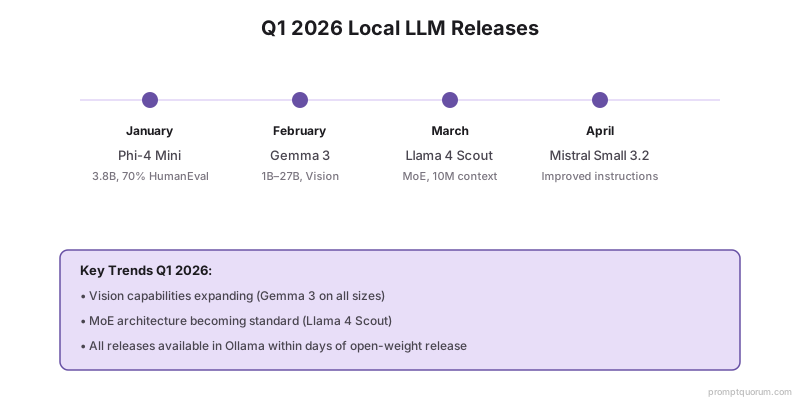
The notable open-weight model releases from January-April 2026. All models below are available in various quantization formats -- see quantization guide for details on Q4 vs Q5 tradeoffs:
Model | Released | Developer | Key Feature | Ollama |
|---|---|---|---|---|
| Gemma 3 (all sizes) | February 2026 | Vision on all sizes, 128K context, Apache 2.0 | ollama run gemma3:9b | |
| Llama 4 Scout (preview) | March 2026 | Meta | MoE architecture preview, 10M token context claimed | Fully available since June 2026 -- ollama pull llama4:scout |
| Mistral Small 3.2 | February 2026 | Mistral AI | Improved instruction-following over Small 3.1 | ollama run mistral-small3.2 |
| Phi-4 Mini | January 2026 | Microsoft | 3.8B, 70% HumanEval, 128K context | ollama run phi4-mini |
Which Q4 2025 Models Are Still the Most Important in 2026?
Model | Released | Key Specs | Still Relevant |
|---|---|---|---|
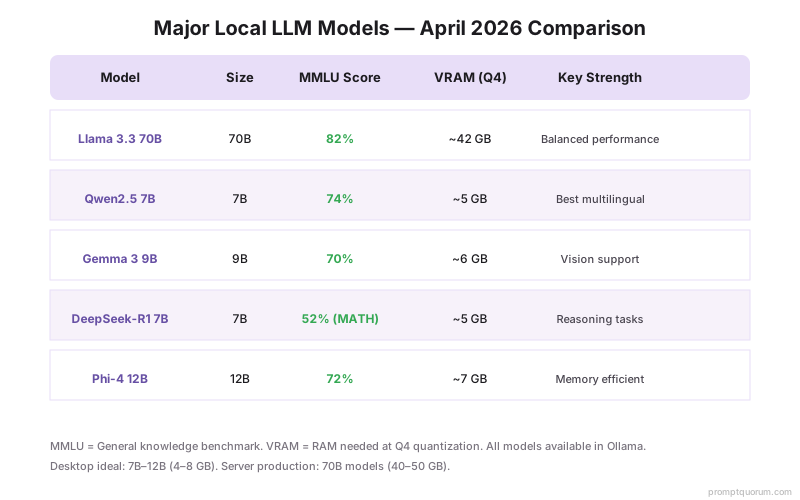
| Llama 3.3 70B | December 2025 | 82% MMLU, 88% HumanEval, 128K context | Yes -- best 70B option |
| Phi-4 14B | December 2024 | 84% MMLU -- above its size class | Yes -- strong 14B reasoning model |
| Qwen3 full family | September 2025 | 0.5B-72B range, 29 languages, Apache 2.0 | Yes -- current best multilingual family |
| DeepSeek-R1 | January 2025 | Reasoning model, 52% MATH at 7B, MoE at large scale | Yes -- best reasoning locally |
Which Q3 2025 Models Are Still Widely Used?
Several 2025 releases remain widely deployed in 2026 due to tool compatibility and community documentation:
- Llama 3.1 8B (July 2025) -- still the most documented 8B model, preferred by beginners for its extensive guides and tool integrations.
- Mistral Small v0.3 (May 2025) -- lower benchmark scores than current alternatives, but Apache 2.0 licence and Mistral EU provenance make it preferred in some European deployments.
- Llama 3.2 3B and 1B (September 2025) -- still the default first-install recommendation due to small size and widespread documentation.
How Much Has Local LLM Quality Improved from 2024 to 2026?
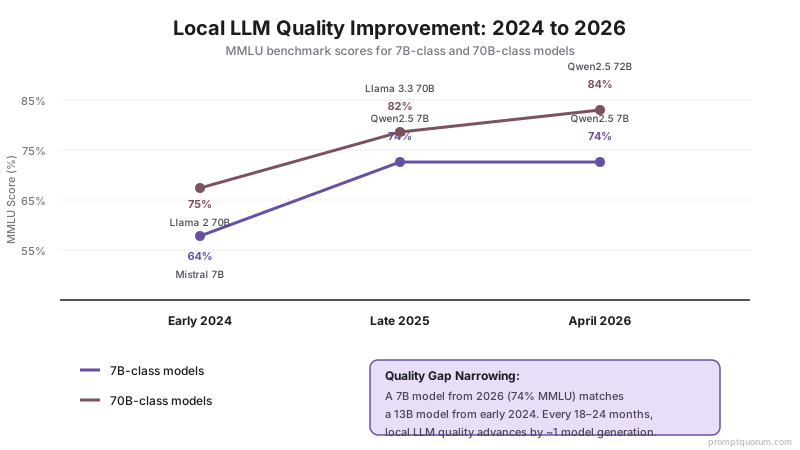
The two-year improvement in locally-runnable model quality is substantial. A 7B model (Qwen3 8B, 74% MMLU) matches the benchmark performance of a 13B model from early 2024. A 70B model (Llama 3.3 70B, 82% MMLU) matches GPT-4 (2023) performance -- a model that required billion-dollar server infrastructure 3 years ago now runs on a Mac Studio. For hardware recommendations matching each model class, see local LLM hardware guide 2026.
Year | Best 7B MMLU | Best Local 70B MMLU | Hardware Needed |
|---|---|---|---|
| Early 2024 | ~64% (Mistral Small) | ~75% (Llama 3.3 70B) | 7B: 8 GB RAM; 70B: 48 GB RAM |
| Late 2025 | ~74% (Qwen3 8B) | ~82% (Llama 3.3 70B) | 7B: 5 GB RAM; 70B: 40 GB RAM |
| April 2026 | ~74% (Qwen3 8B) | ~84% (Qwen3 72B) | 7B: 4.7 GB RAM; 70B: 43 GB RAM |
How Do You Stay Updated on New Local LLM Releases?
- Ollama blog (ollama.com/blog) -- announces new models added to the Ollama library, typically within days of open-weight releases.
- Hugging Face Open LLM Leaderboard (huggingface.co/spaces/open-llm-leaderboard) -- tracks benchmark scores for all newly released models.
- r/LocalLLaMA (reddit.com/r/LocalLLaMA) -- the most active community for local AI news, benchmarks, and hardware discussion.
- GitHub Releases: follow the repositories for llama.cpp (github.com/ggerganov/llama.cpp) and Ollama (github.com/ollama/ollama) to track engine updates that enable new models.
- PromptQuorum: this guide is updated when major model releases change the recommendations. Check the dateModified field for the most recent update.
Local LLM Model Updates 2026: Regional Context
EU / GDPR + AI Act: The EU AI Act (effective February 2025) introduced documentation requirements for AI systems used in regulated contexts. As new local models release in 2026, EU organizations should note: Mistral AI (France) remains the only major EU-based open-weight model developer. Mistral Small 3.2 (February 2026) and Mistral Small continue to carry Apache 2.0 licences -- the cleanest compliance choice for regulated sectors. German BSI and French CNIL both recommend local inference for high-risk AI applications. For non-EU models (Llama, Qwen, Gemma, DeepSeek): all are usable under GDPR for local inference since no data leaves the organization. The compliance difference is in supplier documentation, not data handling. When upgrading to a new model, update the AI tool documentation with the new model version, quantization level, and GGUF filename.
Japan (METI): METI AI Governance Guidelines require documenting model version changes in production AI systems. When upgrading from Llama 3.1 8B to a newer model, document: previous model tag, new model tag, upgrade date, and reason for change. The `ollama show <model>` command provides the exact version string for compliance records. For Japanese-language deployments, Qwen3 remains the recommended family in 2026 due to its native CJK tokenizer.
China: Under China's CAC Generative AI Interim Measures (2023), organizations providing AI services to the public must register models with regulators. Local deployments for internal use are outside this scope. For Chinese-language deployments, Qwen3 (Alibaba, Apache 2.0) and DeepSeek-R1 (DeepSeek, MIT) are the primary choices. Qwen3 received significant model family updates in Q3 2025 -- organizations still running Qwen2 should upgrade to Qwen3 for improved performance and the expanded 29-language support.
Common Mistakes When Tracking and Upgrading Local LLM Models
- Upgrading to every new release unnecessarily: New model releases happen monthly. If your current model satisfies your use case, upgrading is optional. Evaluate a new model only when you hit specific quality limits: poor reasoning on complex tasks, weak multilingual output, or coding failures. Downloading a 4-40 GB model for marginal benchmark gains is wasted time and disk space.
- Using the wrong slug when looking up models in Ollama after a release: Model names on Hugging Face differ from Ollama tags. Meta Llama 3.3 is `llama3.3` in Ollama, not `llama-3.3` or `meta-llama-3.3`. Always verify the exact Ollama tag at ollama.com/library before using in scripts.
- Not updating Ollama itself before pulling new models: New model support often requires an updated Ollama version. Before pulling a recently released model, update Ollama: macOS auto-updates; Linux: re-run `curl -fsSL https://ollama.com/install.sh | sh`; Windows: download the latest installer. Running an outdated Ollama version may cause a new model to fail silently.
- Assuming newer = better for your specific task: Gemma 3 9B (February 2026) scores higher than Llama 3.1 8B (July 2025) on most benchmarks, but Llama 3.1 8B has 18+ months of community fine-tunes, system prompts, and documented use cases. For established workflows with community resources, the older model may be the better practical choice.
Common Questions About Local LLM Model Updates in 2026?
How quickly do new models appear in Ollama after their open-weight release?
Typically 1-7 days for major model releases from Meta, Google, Mistral, and Alibaba. The Ollama team prioritizes high-profile releases -- Llama 3.3 70B appeared in the Ollama library 3 days after Meta's open-weight release. Smaller or community models may take 2-4 weeks.
Should I upgrade from Llama 3.1 8B to a newer model?
If you use Llama 3.1 8B for general tasks and are satisfied with quality, upgrading is optional. Qwen3 8B scores slightly higher on benchmarks and has better multilingual and coding support. For most English-focused general use, the practical quality difference is small. Upgrade if your current model struggles on specific tasks.
Will local models ever match current frontier cloud model quality?
The trend suggests yes -- with a lag of 18-24 months. GPT-4 (2023, estimated 1.7T parameters) is matched by Llama 3.3 70B (2025, locally runnable). GPT-5.5 (2024) will likely have a locally-runnable equivalent by late 2026 or 2027. The limiting factor is compute efficiency, not algorithmic capability.
What happened with DeepSeek and why was it significant?
DeepSeek-R1 (January 2025) demonstrated that a Chinese AI lab could produce reasoning-capable models competitive with OpenAI o1 at lower training cost. The open-weight release made a frontier-class reasoning model locally available for the first time. DeepSeek-R1 7B achieves 52% on MATH -- nearly double the 28% of Mistral Small -- specifically because of its chain-of-thought training methodology.
What is Llama 4 and is it available locally yet?
Llama 4 Scout is a mixture-of-experts model (17B active / 109B total parameters, 16 experts) with long-context (10M-token claimed) and multimodal support. It is available in the Ollama library via `ollama pull llama4:scout`, though it needs approximately 55 GB of VRAM at Q4 quantization -- out of reach for most consumer hardware.
What are Kimi K2.6, DeepSeek V4, GLM-5.1, and gpt-oss -- are they worth tracking too?
Yes -- all four released between April and June 2026 and are now part of the current best-in-class set. Kimi K2.6 (Moonshot AI, April 20, 2026) is a frontier coding model, SWE-Bench Pro 58.6, later followed by the coding-focused Kimi K2.7 Code (June 2026). DeepSeek V4 Pro (April 23, 2026) is an algorithmic-coding specialist at 93.5% LiveCodeBench, with a lighter DeepSeek V4 Flash sibling for smaller GPUs. GLM-5.1 (April 7, 2026) led structured code generation until GLM-5.2 superseded it two months later. OpenAI's gpt-oss:20b/120b (2026) are open-weight MoE models -- the 20b variant runs in 16 GB at roughly o3-mini reasoning level. See Top Open Source Models on Ollama for exact pull commands and benchmarks.
Are there any local models specifically for enterprise or regulated industries in 2026?
Mistral AI provides enterprise-grade support contracts for Mistral models. Their European origin is relevant for GDPR compliance (EU AI Act effective February 2025). For healthcare (HIPAA) or finance (SOC 2), any locally-deployed model can meet data residency requirements -- the model itself is data-neutral. The compliance work is in the deployment infrastructure, not the model selection.
Which model should a complete beginner start with in 2026?
Llama 3.2 3B or Gemma 3 4B are the best beginner choices. Both run on modest hardware (4-6 GB VRAM), have extensive documentation, and perform well on general tasks. Llama 3.2 3B has more community guides and tool integrations. Gemma 3 4B is newer, slightly faster, and supports vision capabilities. For non-technical users, LM Studio makes both easy to install and use without the command line.
Are new models worth the effort to update if my current model works well?
Only if you hit specific quality limits with your current model. If your 7B or 8B model satisfies your use cases, upgrading is optional. However, if you notice reasoning errors, poor multilingual support, or weak coding ability, testing a newer model is worthwhile. Qwen3 8B (2025) outperforms Llama 3.1 8B on most benchmarks, making it a safe upgrade target for users seeking incremental improvement.
Sources
- Hugging Face. (2026). "Open LLM Leaderboard." huggingface.co/spaces/open-llm-leaderboard/open_llm_leaderboard -- Real-time benchmark rankings for all open-weight model releases.
- Google DeepMind. (2026). "Gemma 3 Technical Report." storage.googleapis.com/deepmind-media/gemma/gemma-3-report.pdf -- Architecture, benchmarks, and vision capability data for all Gemma 3 variants.
- Meta AI. (2025). "Llama 3.3 Release." ai.meta.com/blog/llama-3-3/ -- Official announcement and specifications for Llama 3.3 70B.
- DeepSeek AI. (2025). "DeepSeek-R1 Technical Paper." arxiv.org/abs/2501.12948 -- Chain-of-thought architecture and MATH benchmark results for DeepSeek-R1.