Key Takeaways
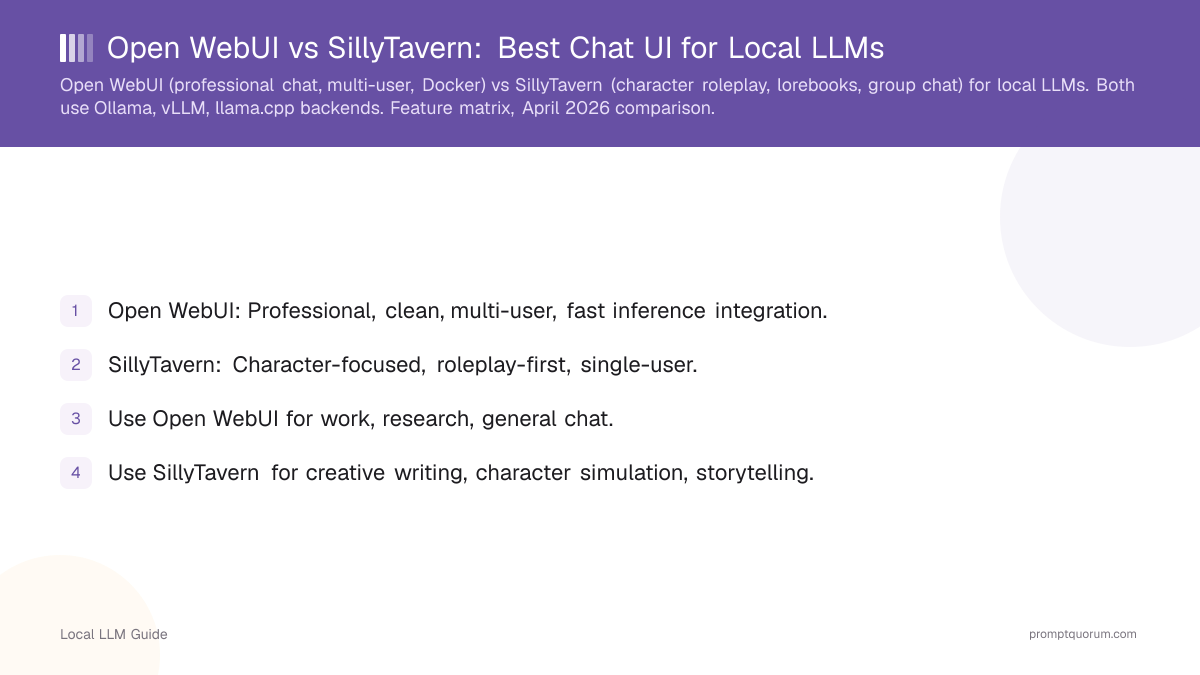
- Open WebUI: Professional, clean, multi-user, fast inference integration.
- SillyTavern: Character-focused, roleplay-first, single-user.
- Use Open WebUI for work, research, general chat.
- Use SillyTavern for creative writing, character simulation, storytelling.
- Both support local LLM backends (Ollama, vLLM, llama.cpp).
- Open WebUI (Python FastAPI + Svelte frontend) and SillyTavern (Node.js + browser) have similar UI performance. The inference backend (Ollama, vLLM, llama.cpp) is the bottleneck.
- Neither adds speed benefit--backend (Ollama, vLLM) is the bottleneck.
- Can run both simultaneously on different ports for different workflows.
📍 In One Sentence
Open WebUI is the professional choice for local LLM chat -- clean, multi-user, OpenAI-compatible -- while SillyTavern is built for roleplay and character-driven chat; both run on the same backends (Ollama, vLLM, llama.cpp).
💬 In Plain Terms
These are two free chat interfaces for AI models running on your own computer. Open WebUI looks and feels like ChatGPT and supports multiple users, so it fits work or team use. SillyTavern is built around character personas, lorebooks, and group chats, so it fits creative writing and roleplay. Pick based on what you want to do, not speed -- both use the same underlying AI engine.
Quick Decision: Which One to Use?
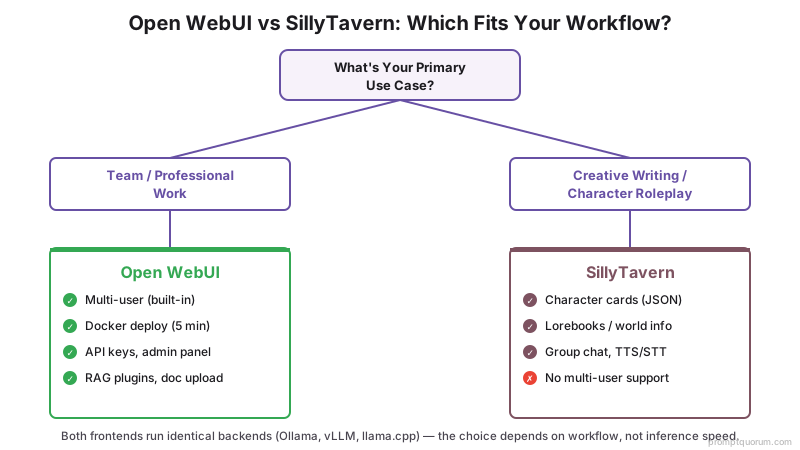
Choose based on workflow, not speed. Both frontends use the same backends.
Use Case | Recommended | Reason |
|---|---|---|
| Team / enterprise chat | Open WebUI | Multi-user, API keys, admin panel, Docker deploy |
| Creative writing / novels | SillyTavern | Character cards, lorebooks, persistent world-building |
| Character roleplay | SillyTavern | Group chat, TTS, Stable Diffusion integration |
| Research / Q&A | Open WebUI | RAG plugins, document upload, clean interface |
| Personal chat | Either | Both work; choose preferred style |
| D&D / TTRPG campaigns | SillyTavern | World info, NPC management, plugin ecosystem |
| Internal company tool | Open WebUI | Docker deploy, audit logs, per-user history |
Feature Comparison Table
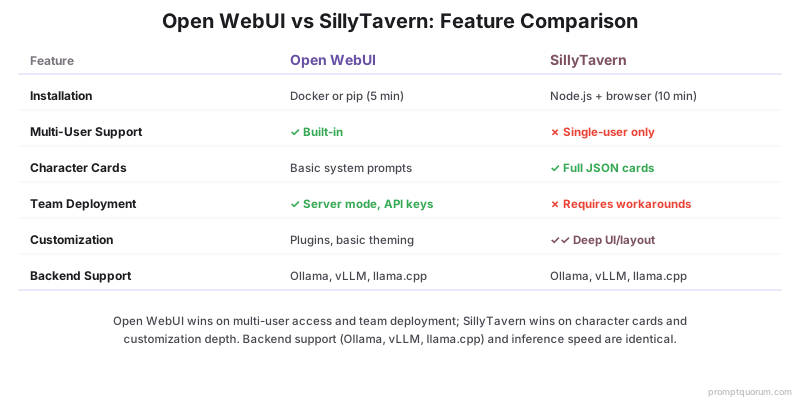
Open WebUI prioritizes professional chat and team collaboration. SillyTavern specializes in immersive roleplay with deep character customization. Both connect to the same local backends, so architecture and inference speed are comparable.
Feature | Open WebUI | SillyTavern |
|---|---|---|
| Installation | Docker or pip install (5 min) | Node.js required, then browser (10 min) |
| Interface Focus | Conversation threads, clean sidebar | Character avatars, world-building |
| Multi-User Support | ✓ (built-in) | ✗ (single-user only) |
| Character Cards | Basic system prompts | ✓ (full JSON cards with personality) |
| Team Deployment | ✓ (server mode, API keys) | ✗ (requires workarounds) |
| Customization | Plugins, basic theming | ✓✓ (deep UI/layout customization) |
| Deployment | Self-hosted web server (Python FastAPI) | Self-hosted Node.js server |
| Backend Support | ✓ (Ollama, vLLM, llama.cpp) | ✓ (Ollama, vLLM, llama.cpp) |
| Learning Curve | Easy (professional users) | Moderate (creative users) |
| Primary Use Case | Q&A, research, teams | Creative writing, roleplay |
Chat Experience Differences
Open WebUI: Conversation-focused. Clean sidebar, token counter, context window display. Professional chat interface.
SillyTavern: Character-focused. Character avatar, persona details, world-building context. Optimized for immersive roleplay.
For Q&A and research: Open WebUI.
For storytelling and character development: SillyTavern.
Multi-User & Team Use
Open WebUI: Built-in multi-user support. Each user has separate conversation history, API keys, settings. Deploy on server for team access.
SillyTavern: Single-user only. Share instance via localhost, but conversations overwrite each other.
For teams: Open WebUI is the only option.
For individuals: SillyTavern is fine.
Character/Roleplay Capabilities
Open WebUI: Basic system prompts. Good for setting tone, instructions. Not character-focused.
SillyTavern: Character cards (JSON format) store persona, appearance, speech patterns, relationships. Designed for roleplay.
SillyTavern supports "world info" (lore, context that persists across conversations).
For serious roleplaying: SillyTavern.
For work/research: Open WebUI.
SillyTavern-Only Features Not in Open WebUI
Open WebUI intentionally omits these features — its scope is professional chat, not immersive fiction. SillyTavern is the only local LLM frontend with this feature set.
- Lorebooks / World Info: Persistent lore injected into context when keywords appear in conversation. Essential for long-form roleplay continuity.
- Character Expressions: Avatar sprites change based on detected emotion in AI responses (happy, sad, angry). Requires per-character sprite sets.
- Group Chat: Multiple AI characters interact in one conversation thread. Each character has its own personality card and memory.
- Voice Integration (TTS/STT): Text-to-speech for AI responses, speech-to-text for user input. Supports ElevenLabs, Coqui, or local TTS models.
- Image Generation: Direct Stable Diffusion integration for generating character portraits and scene illustrations in-context.
- Personas: User defines their own character with name, appearance, and backstory — AI responds as if you are that character.
Customization & Theming
Open WebUI: Basic theming (dark/light mode). Plugins for extensions.
SillyTavern: Deep UI customization. Character artwork, UI layout tweaks, custom themes.
SillyTavern appeals to customization enthusiasts. Open WebUI prioritizes simplicity.
Common Mistakes
- Expecting SillyTavern to work as a team chat tool. Problem: SillyTavern is single-user by design. Conversations overwrite each other when shared. Fix: Use Open WebUI for teams (built-in multi-user, per-user conversation history).
- Thinking Open WebUI is slower due to being "more feature-rich." Problem: Both UIs sit on top of the same backends (Ollama, vLLM, llama.cpp). Speed difference is 0%. Fix: Choose based on workflow, not speed. Both are equally fast.
- Running both simultaneously expecting them to share models. Problem: Each needs its own backend instance or they compete for resources. Fix: Run two separate Ollama instances on different ports (11434 + 11435) or use vLLM with load balancing.
- Assuming you need to convert SillyTavern characters to Open WebUI. Problem: They use different formats (TavernAI cards vs system prompts). Conversion is lossy. Fix: Keep both tools--use each for what it's optimized for.
- Installing SillyTavern without backend already running. Problem: SillyTavern won't work without Ollama/vLLM/llama.cpp. Appears to hang. Fix: Start Ollama first (`ollama serve`), then launch SillyTavern.
Frequently Asked Questions
What is the best backend for SillyTavern?
There isn't a single best one — SillyTavern connects equally well to Ollama, vLLM, or llama.cpp, and the choice depends on your setup, not SillyTavern itself. Ollama is the simplest to install and manage day-to-day. vLLM gives the highest throughput if you're running multiple chats or characters concurrently. Raw llama.cpp offers the most manual control over quantization and runtime flags. For most roleplay users starting out, Ollama is the lowest-friction choice.
Should I use Open WebUI or SillyTavern?
Open WebUI for work/research. SillyTavern for creative writing/roleplay. Different tools, different jobs.
Can I use SillyTavern for team chat?
Not easily. Single-user design. For teams, use Open WebUI (built-in multi-user).
Is one faster than the other?
No. Both are UI layer on top of Ollama/vLLM. Backend speed is comparable.
Can I import SillyTavern characters into Open WebUI?
No. Different formats. SillyTavern uses character cards; Open WebUI uses system prompts.
Which one should a beginner start with?
Open WebUI. Simpler, cleaner, less overwhelming. SillyTavern if you like character-building.
Can I run both simultaneously?
Yes, on different ports. E.g., Ollama on 11434, Open WebUI on 3000, SillyTavern on 3001.
Can I run Open WebUI and SillyTavern simultaneously?
Yes. Run them on different ports sharing the same Ollama backend. Example: Ollama on 11434, Open WebUI on 3000, SillyTavern on 8000. Both can query the same Ollama instance simultaneously.
Sources
- Open WebUI GitHub — Official repository with Docker setup guide and API documentation.
- SillyTavern GitHub — Official repository with character card format and installation guides.
- TavernAI Character Card Format — Character card specification and JSON schema.
- Open WebUI Multi-User Setup — Official guide for deploying Open WebUI with team access.