Key Takeaways
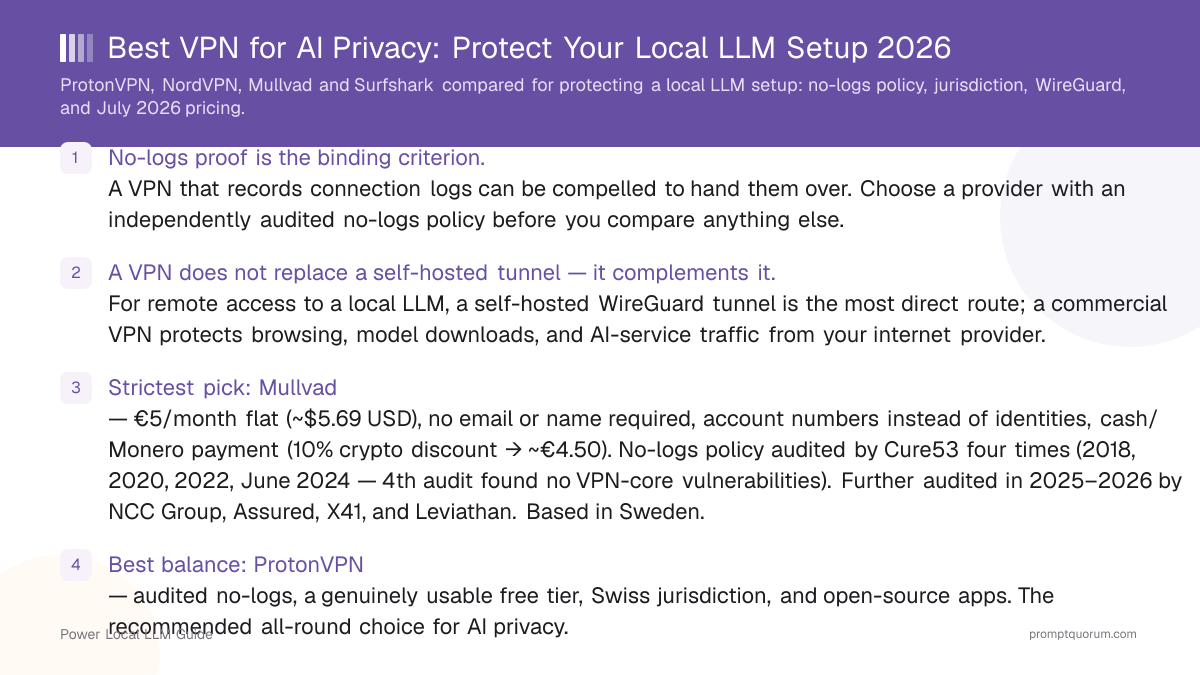
- No-logs proof is the binding criterion. A VPN that records connection logs can be compelled to hand them over. Choose a provider with an independently audited no-logs policy before you compare anything else.
- A VPN does not replace a self-hosted tunnel — it complements it. For remote access to a local LLM, a self-hosted WireGuard tunnel is the most direct route; a commercial VPN protects browsing, model downloads, and AI-service traffic from your internet provider.
- Strictest pick: Mullvad — €5/month flat (~$5.83 USD), no email or name required, account numbers instead of identities, cash/Monero payment (10% crypto discount → ~€4.50). No-logs policy audited by Cure53 four times (2018, 2020, 2022, June 2024 — 4th audit found no VPN-core vulnerabilities). Further audited in 2025–2026 by NCC Group, Assured, X41, and Leviathan. Based in Sweden.
- Best balance: ProtonVPN — five consecutive annual no-logs audits by Securitum (2022, 2023, 2024, August 2025, and April 2026), a genuinely usable free tier, Swiss jurisdiction, and open-source apps. The recommended all-round choice for AI privacy.
- Fastest: NordVPN — its NordLynx protocol (built on WireGuard) and large server network give the lowest latency for remote LLM access. Passed its sixth independent no-logs audit (Deloitte, December 2025). Based in Panama.
- Cheapest for many devices: Surfshark — unlimited simultaneous connections on one subscription, so it covers a whole team or household. Based in the Netherlands.
- WireGuard is the protocol to prefer. All four providers support WireGuard (or a WireGuard-based variant); it has a ~4,000-line codebase, far smaller than OpenVPN's 400,000+, which means a smaller attack surface.
- Pricing moves constantly. Long-term plans are heavily discounted and renew at higher rates. Treat every price here as an August 2026 snapshot and read the renewal terms.
Quick Facts
- Strictest no-logs: Mullvad — anonymous account numbers, no email, cash/Monero accepted.
- Best free tier: ProtonVPN — a free plan with no data cap, unusual among reputable VPNs.
- Fastest protocol path: NordVPN NordLynx, a WireGuard-based protocol tuned for throughput.
- Most devices per plan: Surfshark — unlimited simultaneous connections on a single subscription.
- Protocol to prefer: WireGuard — ~4,000 lines of code versus 400,000+ for OpenVPN, a smaller attack surface.
- Latency cost: A VPN typically adds 5-15 ms; LLM inference already takes 10-100 ms per token, so the impact on a remote session is usually under 5%.
- 2026 pricing reality: intro rates are heavily discounted and renew higher — read renewal terms, treat figures as an August 2026 snapshot.
Sponsored
Editor's Choice: ProtonVPN
For most people protecting a local LLM setup, ProtonVPN is the pick that balances proven privacy, usability, and price. Its no-logs policy has been independently audited, it is based in Switzerland (outside the 14 Eyes intelligence-sharing alliance), its apps are open source, and it offers a free tier with no data cap so you can verify the experience before paying. For the strictest possible anonymity — anonymous account numbers, cash payment, no email — Mullvad is the better pick. For the fastest remote LLM access, NordVPN wins on raw speed. Choose ProtonVPN when you want one provider that does the privacy job well without forcing a trade-off.
📌Note: This Editor's Choice reflects privacy-to-usability balance only. PromptQuorum is not enrolled in any affiliate program and the links below carry no affiliate tags — they are plain reference links that earn no commission.
How the Four VPNs Compare for AI Privacy in 2026
No-logs status, jurisdiction, and protocol support are taken from each provider's published documentation and public audit reports. Pricing is an August 2026 snapshot of long-term plan rates — intro discounts are steep and renewal rates are higher, so confirm the current figure and renewal terms on the provider site before subscribing.
📍 In One Sentence
For AI privacy, a VPN's no-logs policy and jurisdiction decide how much it actually protects you — buy for those first, then compare speed and price.
💬 In Plain Terms
A VPN is only as private as the records it keeps. If a provider stores who connected and when, that data can be requested by authorities. Pick a provider that has been independently checked to keep no such records, then worry about how fast it is.
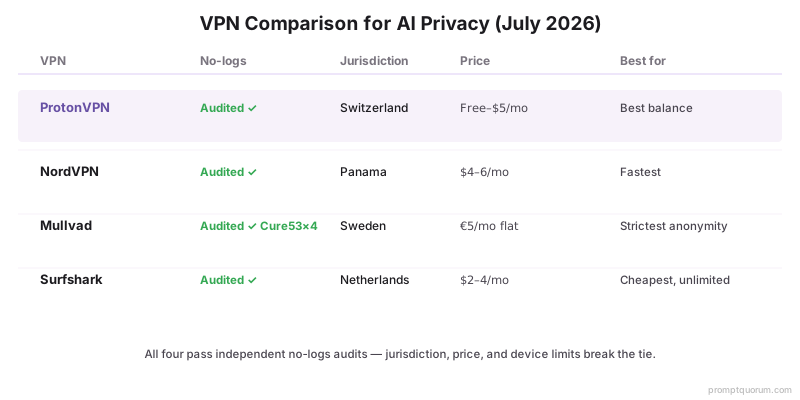
VPN | No-logs (audited) | Jurisdiction | WireGuard | Price (Aug 2026) | Best for |
|---|---|---|---|---|---|
| ProtonVPN | Yes — 5 annual Securitum audits (2022-2026) | Switzerland | Yes | Free tier; paid from ~$3/month on 2-yr plans | Best all-round AI-privacy pick |
| NordVPN | Yes — 6th audit by Deloitte (Dec 2025) | Panama | Yes (NordLynx) | ~$3.50-4.50/month on 2-yr plans | Fastest remote LLM access |
| Mullvad | Yes — Cure53 ×4 (2018-2024); NCC Group, Assured, X41, Leviathan (2025-26) | Sweden | Yes | €5/month flat (~$5.83 USD); 10% crypto discount → ~€4.50/month; no annual plan | Strictest anonymity, no account email, flat pricing |
| Surfshark | Yes — Deloitte (Jan 2023, June 2025); Cure53 Dausos audit (Feb-Mar 2026) | Netherlands | Yes | ~$2-2.50/month on long-term plans | Cheapest for unlimited devices |
Which VPN Should You Choose?
Your privacy threshold decides the provider; your device count and budget break ties. Find the row that matches your situation.
Your situation | Choose this |
|---|---|
| I want the strictest possible anonymity and will pay with cash or Monero | Mullvad |
| I want one solid provider for general AI privacy without trade-offs | ProtonVPN |
| I want to try a VPN before paying anything | ProtonVPN (free tier, no data cap) |
| I need the lowest latency for accessing my LLM server remotely | NordVPN |
| I need to cover a whole team or household on one subscription | Surfshark (unlimited devices) |
| I want jurisdiction outside the 14 Eyes alliance | ProtonVPN (Switzerland) or NordVPN (Panama) |
| I am unsure and want a safe default | ProtonVPN — start on the free tier, upgrade if you need more |
ProtonVPN: The Balanced AI-Privacy Pick
ProtonVPN is the best all-round choice for protecting a local LLM setup because it pairs a repeatedly audited no-logs policy with Swiss jurisdiction, open-source apps, and a free tier with no data cap. Switzerland sits outside the 14 Eyes intelligence-sharing alliance, and Proton publishes its app source code so the privacy claims can be inspected.
- No-logs policy: five consecutive annual audits by Securitum (2022, 2023, 2024, August 2025, and April 2026) found no evidence of activity logging, connection-metadata storage, or traffic inspection. Swiss data-protection law backs the claim.
- Jurisdiction: Switzerland — outside the 5/9/14 Eyes alliances, with strong privacy law.
- Free tier: a genuinely usable free plan with no data cap, rare among reputable VPNs — use it to verify speed and the apps before paying.
- WireGuard: supported on all major platforms, the protocol to prefer for a smaller attack surface.
- Why choose ProtonVPN: you want a single provider that handles AI-privacy needs well without trading away usability, speed, or transparency.
- Why skip ProtonVPN: if you need anonymous payment and no account email at all, Mullvad goes further; if raw speed is the only metric, NordVPN edges ahead.
💡Tip: Start on the ProtonVPN free tier before paying. It has no data cap, so you can confirm the apps work with your remote LLM workflow and the speed is acceptable before committing to a long-term plan.
NordVPN: The Fastest for Remote LLM Access
NordVPN is the pick when latency matters most — for example, when you connect to a local LLM server from outside the network and want the snappiest possible session. Its NordLynx protocol is built on WireGuard and tuned for throughput, and its large server network means a nearby endpoint is usually available.
- No-logs policy: passed its sixth independent no-logs audit, performed by Deloitte in December 2025.
- Jurisdiction: Panama — outside the 14 Eyes alliance, with no mandatory data-retention law.
- NordLynx: a WireGuard-based protocol; expect a VPN overhead in the typical 5-15 ms range, which is small next to per-token LLM inference time.
- Server network: large, so you can pick a server geographically close to the LLM host to minimize added latency.
- Why choose NordVPN: you regularly reach a self-hosted LLM remotely and want the lowest extra latency, or you want a fast general-purpose VPN.
- Why skip NordVPN: if your priority is anonymous payment or the smallest possible logging footprint, Mullvad is the stricter choice.
📌Note: For remote LLM access, a commercial VPN is one option; a self-hosted WireGuard tunnel into your own network is the most direct route. Use NordVPN when you also want to protect general browsing and AI-service traffic, not only the LLM connection.
Mullvad VPN: Pricing, No-Logs Audit Status, and AI Privacy
Mullvad is the strictest privacy choice because it does not ask for an email, a name, or any identifying detail — you get a random account number and can pay in cash or Monero. That removes the link between your identity and your VPN subscription, which is the cleanest model for AI-privacy work. No account creation means there is no identity record ever linked to your AI usage patterns — your ISP cannot see which AI services you access, and remote LLM connections are encrypted through the VPN tunnel.
- Mullvad VPN pricing: €5/month flat rate (~$5.83/month USD at current exchange rates). No annual plan, no long-term lock-in, no renewal-rate surprise — the price has been the same since 2009. Crypto payments (Bitcoin, Monero) receive a 10% discount → ~€4.50/month.
- Payment options: accepts cash, Monero, Bitcoin, bank transfer, and cards. Cash and Monero allow a fully anonymous purchase with no financial identity trail. No account creation required — a random account number is issued instead.
- No-logs audit status (2026): Cure53 has conducted four independent infrastructure audits of Mullvad — in 2018, 2020, 2022, and most recently June 2024 (4th audit). The June 2024 audit found two issues (one low severity, one medium severity); neither affected VPN core functionality or traffic anonymity. In 2025–2026 Mullvad was further audited by NCC Group (Android), Assured Security (web app, GotaTun WireGuard — no critical/high/medium issues), X41 D-Sec (account/payment), and Leviathan Security (Android MASA). Mullvad publishes all audit reports at mullvad.net/en/blog.
- Account model: random account numbers instead of email-and-password identities. No account creation means no identity record is ever associated with your subscription — and therefore no identity linkage to your AI usage patterns.
- Jurisdiction: Sweden — within the EU but with a published, independently audited no-logs stance. Note: Sweden is inside the 14 Eyes intelligence-sharing alliance.
- Why choose Mullvad: you want the minimum possible identity footprint, a flat predictable price, and audited no-logs confirmation for AI privacy work.
- Why skip Mullvad: there is no free tier to trial, and Sweden is inside the 14 Eyes alliance — if jurisdiction outside that alliance matters more to you, ProtonVPN (Switzerland) or NordVPN (Panama) fit better.
💡Tip: Mullvad's €5/month flat price (August 2026, ~$5.83 USD) does not change with plan length — it has been the same since 2009. Paying with Bitcoin or Monero yields a 10% discount (~€4.50/month). Confirm the current rate at mullvad.net before subscribing — pricing is set in EUR.
Surfshark: The Cheapest for Unlimited Devices
Surfshark is the value pick because one subscription covers an unlimited number of simultaneous connections — useful when a whole team or household needs to protect AI traffic. Long-term plans put it among the cheapest reputable VPNs.
- Device count: unlimited simultaneous connections on a single subscription, unlike per-device or 5-10 device caps elsewhere.
- Pricing: roughly $2-2.50/month on long-term plans as an August 2026 snapshot — the lowest of the four, though renewal rates are higher.
- No-logs policy: audited by Deloitte (January 2023, June 2025); its newer Dausos protocol was additionally audited by Cure53 (February-March 2026).
- Jurisdiction: the Netherlands — an EU country with no mandatory VPN data-retention law.
- Why choose Surfshark: you need to cover many machines or several people cheaply, and an audited no-logs policy is enough for your threat model.
- Why skip Surfshark: for the strictest anonymity (anonymous payment, no account email), Mullvad is the better fit.
⚠️Warning: Surfshark's lowest prices apply only to multi-year plans, which renew at a higher rate. Note the renewal price before subscribing — the headline figure is an intro rate, not the ongoing cost.
Decision Flowchart: Pick Your VPN in Four Questions
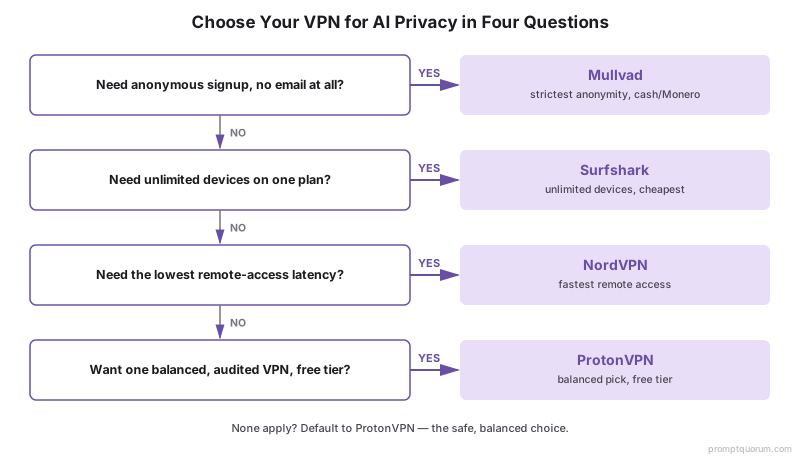
Four questions, in order, route most buyers to one provider.
📍 In One Sentence
Choose a VPN for AI privacy by deciding whether anonymous signup is essential first, device count second, remote-access latency third, and overall balance last.
💬 In Plain Terms
Start with the hard requirement. If you must sign up without giving an email, Mullvad is the answer. If you must cover many devices, Surfshark is. If speed is everything, NordVPN is. If none of those is a hard rule, ProtonVPN is the safe balanced default.
- 1. Is anonymous, identity-free signup essential? Yes: Mullvad — random account numbers and cash payment. No: continue.
- 2. Do you need to cover many devices on one plan? Yes: Surfshark — unlimited simultaneous connections. No: continue.
- 3. Is the lowest possible remote-access latency the priority? Yes: NordVPN — NordLynx is tuned for throughput. No: continue.
- 4. Want one balanced, audited, transparent provider with a free trial? ProtonVPN — Swiss jurisdiction, open-source apps, free tier with no data cap.
Where to Buy & Pricing
Buy a VPN directly from the provider's own website, never from a third-party reseller — resold VPN accounts cannot be trusted with privacy. The links below go straight to each provider's pricing page; they carry no affiliate tags and earn no commission.
- Buy direct: purchase only from protonvpn.com, nordvpn.com, mullvad.net, or surfshark.com. Resellers and key sites break the privacy chain.
- Read renewal terms: ProtonVPN, NordVPN, and Surfshark advertise discounted long-term rates that renew higher. Mullvad is the exception with a flat monthly price.
- Use the free path first: ProtonVPN's free tier has no data cap — trial it before paying for any provider.
- Payment privacy: Mullvad and (in part) other providers accept cash or cryptocurrency; pay anonymously if identity-free signup matters to you.
- Money-back window: most providers offer a 30-day refund window — use it to test speed against your real remote-LLM workflow.
⚠️Warning: VPN pricing is promotional and moves week to week. Every dollar figure in this guide is an August 2026 snapshot — open the provider's current pricing page before subscribing, and check the renewal rate, not just the intro rate.
Common Mistakes When Choosing a VPN for AI Privacy
- Choosing on advertised speed instead of no-logs proof. A fast VPN that records connection logs offers weak privacy. Confirm an independently audited no-logs policy first, then compare speed.
- Assuming a commercial VPN replaces a self-hosted tunnel. For remote access to your own LLM server, a self-hosted WireGuard tunnel is the most direct route. A commercial VPN protects browsing and AI-service traffic — the two are complements, not substitutes.
- Ignoring jurisdiction. A no-logs policy is weaker in a country with mandatory data retention. Check where the provider is based — Switzerland and Panama sit outside the 14 Eyes alliance.
- Anchoring on the intro price. Long-term VPN plans renew at higher rates. Read the renewal terms; Mullvad's flat pricing is the exception that avoids this trap.
- Buying from a reseller. A resold VPN account breaks the privacy chain. Purchase only from the provider's own website.
- Using OpenVPN when WireGuard is available. WireGuard's ~4,000-line codebase is far smaller than OpenVPN's 400,000+, giving a smaller attack surface. Prefer WireGuard unless a specific compatibility need forces OpenVPN.
- Skipping the free trial. ProtonVPN's free tier has no data cap, and most providers offer a 30-day refund. Test against your real workflow before committing.
Sources
- ProtonVPN — No-Logs Policy and Audits — Proton's published no-logs policy and its five consecutive annual Securitum audit summaries (2022–2026).
- Mullvad VPN — Privacy and Account Model — Mullvad's account-number model and no-logging documentation.
- Mullvad VPN — Security Audit Reports — four Cure53 infrastructure audits (2018, 2020, 2022, June 2024) plus NCC Group, Assured, X41, and Leviathan audits (2025–2026).
- WireGuard — Protocol Documentation — official WireGuard documentation, including the small-codebase design rationale.
- VPNs and Local AI: What You Need to Know — PromptQuorum guide to WireGuard versus OpenVPN, latency overhead, and remote LLM access.
- NordVPN — Independent Security Audits — NordVPN's published no-logs audit results, including its sixth audit by Deloitte (December 2025).
Frequently Asked Questions
Do I need a VPN if my LLM already runs locally?
Running an LLM locally keeps your prompts and documents off cloud servers, but it does not hide your network traffic. A VPN matters when you access the LLM remotely or when you browse for models, weights, and updates — it encrypts that traffic and hides which AI services you reach from your internet provider. The local LLM and the VPN solve different parts of the privacy problem.
What is the most private VPN for AI work?
Mullvad is the strictest privacy pick. It does not require an email, a name, or any identifying detail — you receive a random account number and can pay in cash or Monero, which removes the link between your identity and your subscription. No account creation means no identity record is ever linked to your AI usage patterns. Its no-logs policy has been independently audited by Cure53 four times (2018, 2020, 2022, and June 2024 — the 4th audit found no VPN-core vulnerabilities), and additionally by NCC Group, Assured, X41, and Leviathan in 2025–2026. Pricing is a flat €5/month (~$5.83 USD) with no annual plans; crypto payments receive a 10% discount (~€4.50/month). ProtonVPN is a close second, now backed by five consecutive annual Securitum no-logs audits, with Swiss jurisdiction and a free tier.
Does a VPN slow down a remote local-LLM session?
Only slightly. A VPN typically adds 5-15 ms of latency. Because LLM inference already takes 10-100 ms per token, the added VPN overhead is usually under 5% of the total — imperceptible in interactive use. Choose a VPN server geographically close to the LLM host to keep the overhead at the low end.
Should I use WireGuard or OpenVPN?
Prefer WireGuard. Its codebase is roughly 4,000 lines versus 400,000+ for OpenVPN, which means a much smaller attack surface and easier auditing. All four providers in this guide support WireGuard (NordVPN calls its variant NordLynx). Use OpenVPN only if a specific device or network forces it.
Is a commercial VPN enough to access my LLM server remotely?
A commercial VPN protects your general traffic, but for reaching your own LLM server the most direct route is a self-hosted WireGuard tunnel into your network. Use a commercial VPN alongside it to protect browsing and AI-service traffic. They are complementary: one secures the LLM connection, the other hides everything else.
Why does VPN jurisdiction matter?
Jurisdiction decides which laws can compel a provider to log or hand over data. A no-logs policy is stronger in a country without mandatory data-retention rules and outside intelligence-sharing alliances. ProtonVPN (Switzerland) and NordVPN (Panama) sit outside the 14 Eyes alliance; Mullvad (Sweden) and Surfshark (Netherlands) are inside the EU but maintain audited no-logs policies.
Which VPN is cheapest for a team?
Surfshark, because one subscription allows unlimited simultaneous connections — a whole team or household is covered by a single plan. As an August 2026 snapshot its long-term plans run roughly $2-2.50/month, the lowest of the four, though renewal rates are higher. Confirm the current price and renewal terms on surfshark.com.
Can I pay for a VPN anonymously?
Yes, with Mullvad most cleanly — it accepts cash and Monero and never asks for an email or name, so the purchase leaves no identity trail. Some other providers accept cryptocurrency too, but still tie the account to an email. If anonymous signup is a hard requirement, Mullvad is the pick.