Key Takeaways
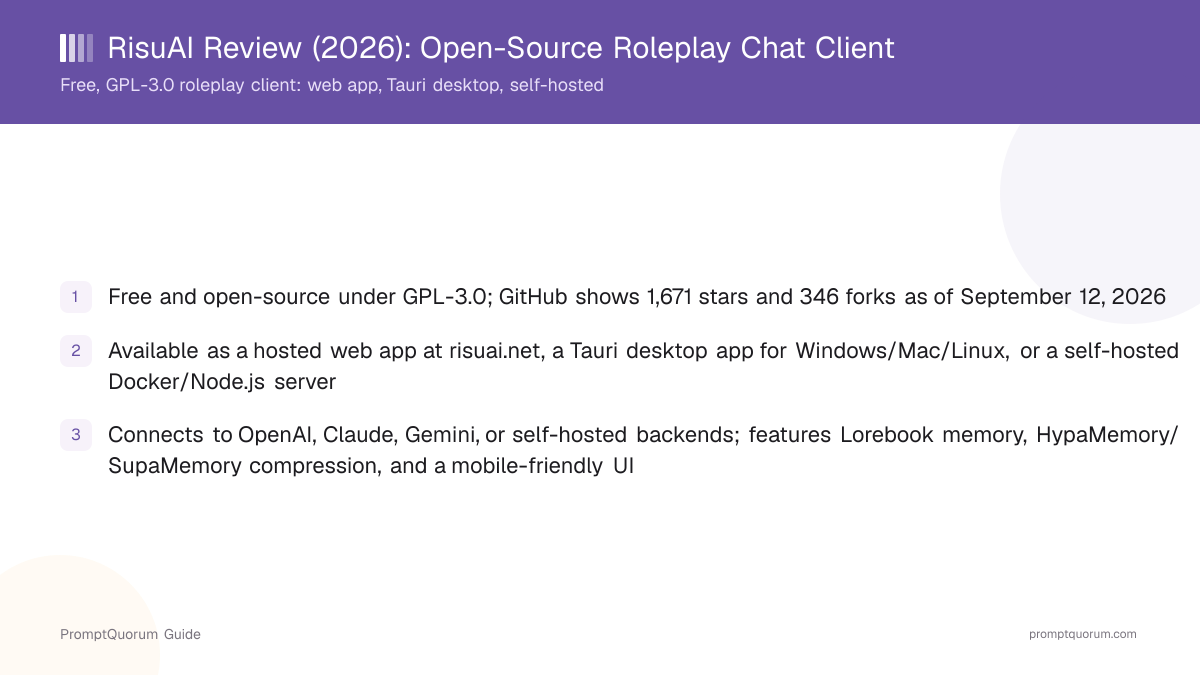
- RisuAI is free and open-source, licensed under the GNU General Public License v3.0 (GPL-3.0), per the repository's license metadata
- Available three ways: hosted web app at risuai.net, a Tauri-based desktop app for Windows, Mac, and Linux, and self-hosted via Docker or a Node.js source build
- It is a frontend, not a model provider — connects to OpenAI, Claude, Gemini, DeepInfra, and OpenRouter as hosted options, or to a self-hosted backend such as oobabooga's text-generation-webui
- Lorebook: a world-info system that injects background lore, character facts, and setting details into the model's context as relevant
- HypaMemoryV2/V3 and SupaMemory: built-in context-compression systems designed to keep long-running roleplay conversations coherent as they exceed a model's context window
- Deep prompt customization: reorderable prompt blocks, "impersonate" mode, and conditions/variables that can branch prompt content
- Mobile-friendly, customizable UI with text-to-speech output and multiple UI themes
- Developed by kwaroran as an open-source community project
📍 In One Sentence
RisuAI is a free, open-source (GPL-3.0) roleplay and character-chat client — a hosted web app, Tauri desktop app, and self-hostable server that connects to a model backend of your choice, with a Lorebook memory system and deep prompt customization.
💬 In Plain Terms
RisuAI is the app you chat inside of, not the AI model itself. You pick a character, tell RisuAI which model backend to talk to — a paid API like OpenAI, or a free self-hosted server — and RisuAI handles the character sheet, memory, and conversation formatting around that model.
📌Note: This review is the deep-dive companion to RisuAI's entry in the Local LLM Software Directory — see that page for how RisuAI compares at a glance to dozens of other roleplay and local AI tools.
What Is RisuAI?
RisuAI is an open-source chat client built specifically for AI roleplay and character-driven fiction. Its GitHub repository describes it with the tagline "Make your own story. User-friendly software for LLM roleplaying." Unlike an app that bundles its own AI model, RisuAI is purely a frontend: it manages characters, memory, and prompt formatting, and sends the resulting request to whichever model backend you connect it to.
- Core function: a character-chat and roleplay interface — character cards, group chats, a Lorebook memory system, and conversation formatting — that talks to a model backend you connect separately
- No bundled model: RisuAI does not ship or run its own language model; every conversation is served by whichever backend (hosted API or self-hosted server) you configure
- Distribution: a hosted web app, a Tauri (Rust-based) desktop app for Windows, Mac, and Linux, and self-hostable source code (Docker or Node.js) for running your own instance
- Developer: maintained on GitHub by kwaroran as an open-source project, with community contributions tracked in the repository's issues and pull requests
- Canonical repository: github.com/kwaroran/RisuAI, GPL-3.0 licensed per the repository's license metadata
What Can You Do With RisuAI?
RisuAI's feature set centers on long-running character consistency and fine-grained control over what gets sent to the model on every turn, per the project's own GitHub README.
- Lorebook (world info) — a database of background facts, character details, and setting lore that RisuAI automatically injects into the model's context when relevant keywords appear in the conversation, without you re-typing them every message
- HypaMemoryV2/V3 and SupaMemory — built-in memory-compression systems that summarize or condense older parts of a long conversation, aimed at keeping character and plot details consistent as a chat grows past a model's context window
- Prompt order editing — the sequence of system prompt, character description, chat history, and Lorebook entries sent to the model can be reordered and customized, rather than using one fixed template
- Impersonate mode — lets you write a message "as" the AI character to steer tone or continue a scene, rather than only replying as the human participant
- Conditions and variables — prompt content can branch based on variables and conditions defined in a character or scenario, letting a single character card behave differently depending on conversation state
- Group chats — multiple characters can participate in the same conversation thread rather than being limited to one-on-one chat
- Text-to-speech (TTS) — model responses can be converted to spoken audio through the app's TTS integration
- Regex scripting — user-defined regular-expression rules can post-process model output before it is displayed, useful for formatting or filtering
- Customizable, mobile-friendly UI — multiple UI themes and a layout designed to work on phone-sized screens, not just desktop
- Character expression images — characters can display different images tied to emotional states detected in the conversation
Get RisuAI: Web App, Desktop App, and Self-Hosted Server
RisuAI is available three ways: a hosted web app, a downloadable Tauri desktop app, and self-hosted source code. Links below are from the official GitHub repository and its homepage — always verify against those pages directly, since release assets and requirements can change between versions.
Hosted web app
- How to Get It:
- risuai.net — no install; runs in a browser and is the option listed first on the project's own homepage
Desktop app (Windows/Mac/Linux)
- How to Get It:
- Tauri-based installer from GitHub Releases
Self-hosted (Docker)
- How to Get It:
- Clone the repository and run its docker-compose file; the project documents this as the recommended route for web hosting your own instance
Self-hosted (Node.js source)
- How to Get It:
- Requires Node.js 20.19+ or 22.12+ with pnpm; clone the repository and follow the README's development-server instructions
RisuAI is GPL-3.0 licensed, a copyleft license: a self-hosted instance you modify and distribute to others must also make its source available under GPL-3.0. Read the repository's license file before building a modified public instance. None of these installation routes include a model — you connect a backend separately after installing.
RisuAI Pricing: Free App, Backend Costs Vary
RisuAI itself has no purchase price. It is free, open-source software under GPL-3.0, and the web app, desktop app, and self-hosted code are all free to use. What you pay, if anything, depends entirely on which model backend you connect to RisuAI — the app does not charge for anything on top of that.
RisuAI app (web/desktop/self-hosted)
- Cost:
- Free
- Notes:
- GPL-3.0 open-source software, no subscription or license fee for the client itself
Self-hosted backend (e.g. text-generation-webui)
- Cost:
- Free (your own hardware)
- Notes:
- Runs on hardware you already own; the only cost is your own electricity and hardware
Hosted API backend (OpenAI, Claude, Gemini, DeepInfra)
- Cost:
- Pay-as-you-go per provider
- Notes:
- Billed directly by the provider you connect, at that provider's own published rates — not by RisuAI
OpenRouter backend
- Cost:
- Pay-as-you-go, model-dependent
- Notes:
- A routing service offering many models; pricing varies per model and is set by OpenRouter and the underlying model providers
Because RisuAI does not run a model itself, there is no single "RisuAI subscription" to evaluate — budget for whichever backend you plan to use, and check that provider's own pricing page directly, since rates change independently of RisuAI's own release cycle.
RisuAI vs. SillyTavern
RisuAI and SillyTavern are two of the most commonly compared open-source roleplay frontends, since both are free, connect to a backend you choose, and center on Lorebook-style memory systems. The clearest differences are license terms and how much each project leans toward mobile use.
License
- RisuAI:
- GPL-3.0
- SillyTavern:
- AGPL-3.0 — a stricter copyleft variant that also covers network use
Distribution
- RisuAI:
- Hosted web app, Tauri desktop app, self-hosted Docker/Node.js
- SillyTavern:
- Self-hosted only (desktop-class Node.js server), no official hosted web app
Mobile support
- RisuAI:
- Mobile-friendly UI built into the main client
- SillyTavern:
- Usable on mobile through a self-hosted server plus a browser, not a dedicated mobile UI
Memory system
- RisuAI:
- Lorebook plus HypaMemoryV2/V3 and SupaMemory compression
- SillyTavern:
- Lorebook (World Info) plus community-built memory extensions
Backend connections
- RisuAI:
- OpenAI, Claude, Gemini, DeepInfra, OpenRouter, and self-hosted backends such as text-generation-webui
- SillyTavern:
- A wider list including KoboldCpp, Ollama, llama.cpp, text-generation-webui, and LM Studio
If a hosted web app or a native mobile-friendly interface matters to you, RisuAI's distribution options are the more direct fit. If you want the widest range of directly supported self-hosted backends and a large community extension ecosystem, evaluate SillyTavern directly. Both are free, open-source, and do not run a model themselves — verify current backend support on each project's own repository before deciding.
Who Should Use RisuAI?
Whether RisuAI fits depends on how you want to access it and how much you value a Lorebook-plus-memory-compression system for long-running character conversations.
Competitors and Alternatives
RisuAI sits in the same roleplay and character-chat client segment as several other frontends. Here is how it compares with the closest alternatives — see the Local LLM Software Directory for the full catalog of local AI tools.
- SillyTavern — the closest direct comparison: a free, self-hosted-only roleplay frontend with a wider list of directly supported inference backends and a large community extension ecosystem, at the cost of no official hosted web app.
- Backyard AI — a closed-source desktop app (Windows/Mac) built for point-and-click simplicity, with a built-in Character Hub, and an optional paid cloud tier — a lower-configuration alternative to RisuAI's open-source, backend-agnostic approach.
- Agnai — another open-source roleplay and character-chat client covering similar ground, worth comparing directly on license terms, hosted-vs-self-hosted options, and backend support.
Common Mistakes When Evaluating RisuAI
Most confusion about RisuAI comes from treating it like an all-in-one app that includes its own AI model, or mixing up its license terms with a more permissive one.
Frequently Asked Questions
What is RisuAI?
RisuAI (risuai.net, source at github.com/kwaroran/RisuAI) is a free, open-source chat client built for AI roleplay and character-driven storytelling. It manages characters, memory, and prompts, and connects to a separate model backend you choose.
Is RisuAI free?
Yes. RisuAI's web app, desktop app, and self-hosted source code are all free, with no purchase price and no subscription for the client itself. Any cost you incur depends on which model backend you connect — a paid hosted API, or a free self-hosted server on your own hardware.
What license does RisuAI use?
GPL-3.0 (GNU General Public License v3.0), confirmed via the repository's license metadata. This is a copyleft license, meaning modified versions distributed to others must also make their source code available under GPL-3.0.
Does RisuAI include its own AI model?
No. RisuAI is a frontend only — it does not bundle, train, or run its own language model. Every conversation is served by whichever backend you connect, such as a hosted API provider or a self-hosted inference server.
What model backends does RisuAI connect to?
Per the project's own documentation, RisuAI connects to hosted providers including OpenAI, Anthropic's Claude, Google's Gemini, DeepInfra, and OpenRouter, as well as self-hosted backends such as oobabooga's text-generation-webui.
Can I use RisuAI without installing anything?
Yes. RisuAI offers a hosted web app at risuai.net that runs in a browser with no install step, in addition to a downloadable Tauri desktop app and self-hostable source code.
Can I self-host RisuAI?
Yes. The project provides a Docker setup and a Node.js source build (Node.js 20.19+ or 22.12+ with pnpm) for running your own instance, documented in the GitHub repository. Because RisuAI is GPL-3.0 licensed, a modified instance you distribute to others must also share its source code.
Does RisuAI work on mobile devices?
RisuAI's interface is built to be mobile-friendly, with a layout and multiple UI themes designed to work on phone-sized screens, not only on desktop.
What is RisuAI's Lorebook?
Lorebook is a world-info memory system: a database of background facts, character details, and setting lore that RisuAI automatically inserts into the model's context when relevant keywords appear in the conversation, so you do not need to retype that information every message.
How does RisuAI compare to SillyTavern?
Both are free, open-source roleplay frontends that connect to a backend you choose. RisuAI additionally offers a hosted web app and a more mobile-oriented interface; SillyTavern documents a wider list of directly supported self-hosted backends and a larger community extension ecosystem. See the comparison section above for details.