Key Takeaways
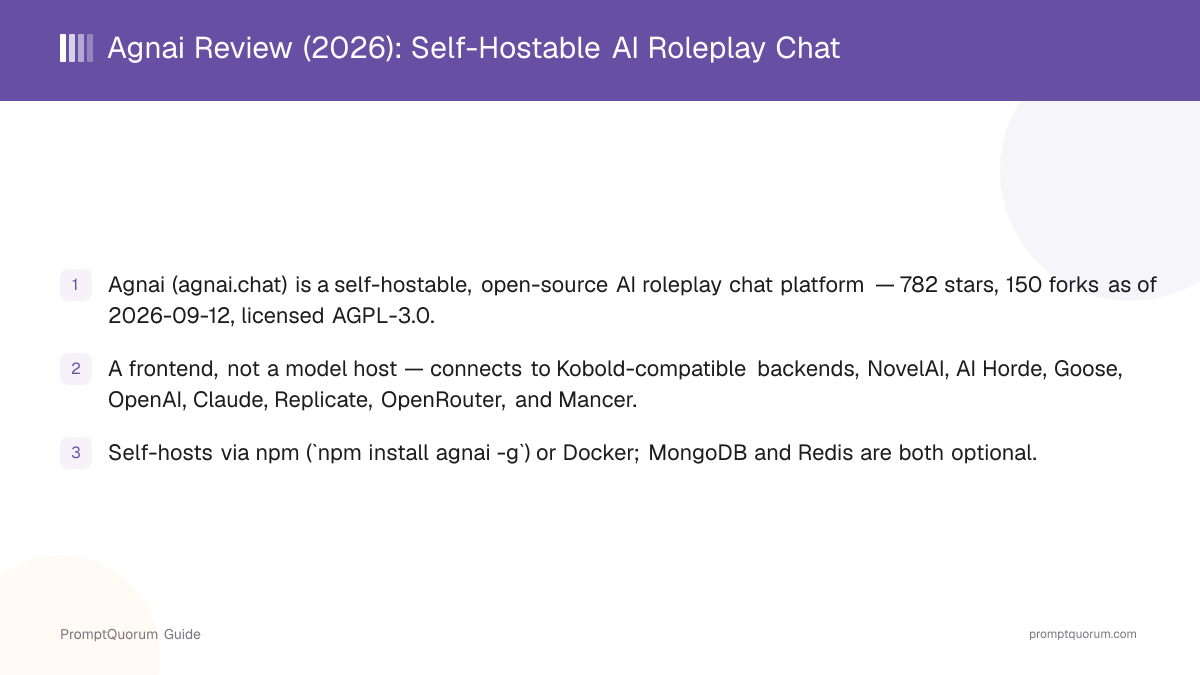
- Agnai (agnai.chat) is a self-hostable, open-source AI roleplay chat platform maintained at agnaistic/agnai on GitHub — 782 stars and 150 forks as of 2026-09-12, licensed under AGPL-3.0.
- Agnai is a frontend, not a model host — it connects to external AI services: Kobold-compatible backends (including KoboldCpp), NovelAI, AI Horde, Goose, OpenAI, Anthropic Claude, Replicate, OpenRouter, and Mancer.
- Self-hosting installs as an npm package (
npm install agnai -g) or via Docker; MongoDB and Redis are both optional — Agnai runs in a "Guest Only" anonymous mode without a database, storing data in the browser instead. - Core features: multi-user/multi-bot group conversations, character cards in four persona formats (W++, Square Bracket Format, Boostyle, plain text), Memory/Lore books, and AI-assisted character generation.
- The hosted version at agnai.chat needs no install and offers a free tier plus an optional paid subscription for priority access to Agnai's own hosted models.
- Agnai does not list Ollama as a native AI service — connecting an Ollama-served model works only through an OpenAI-compatible proxy layer, not a direct integration.
- Compare with SillyTavern, Backyard AI, and RisuAI — companion entry in the Local LLM Software Directory.
What Agnai Is
Agnai — described in its own GitHub repository as "AI Agnostic (Multi-user and Multi-bot) Chat with Fictional Characters, designed with scale in mind" — is licensed under the GNU Affero General Public License v3.0 (AGPL-3.0) and had 782 stars and 150 forks as of 2026-09-12.
The project traces its early work to Galatea-UI by PygmalionAI and has grown into a multi-tenant platform: user authentication, per-user AI-service settings, and per-user generation presets are built in — features aimed at hosting Agnai for more than one person, not just a single-player desktop workflow.
Agnai does not run its own language model. It is a chat frontend that dispatches conversation turns to whichever AI service you configure, which is why self-hosting it needs no dedicated GPU of its own — the GPU (or API budget) requirement depends entirely on the backend you connect, not on Agnai itself.
📍 In One Sentence
Agnai is an open-source, self-hostable AI roleplay chat platform that connects to multiple external AI services instead of running its own inference engine.
💬 In Plain Terms
Think of Agnai as a chat interface for AI characters, similar to SillyTavern, that you use either hosted at agnai.chat or self-hosted and plugged into a backend like KoboldCpp, OpenAI, or Anthropic Claude.
How to Get Agnai: Hosted or Self-Host
Agnai is available two ways: the free hosted site at agnai.chat, or self-hosted on your own machine or server. Self-hosting gives full control over data and AI-service configuration; the hosted version needs no installation at all.
Hosted (no install)
- How to get it:
- agnai.chat — sign up or use anonymously, then connect an AI service in Settings
Self-host via npm
- How to get it:
npm install agnai -gthen runagnai(addagnai --pipelinefor optional long-term-memory features)
Self-host via Docker (with MongoDB)
- How to get it:
docker compose -p agnai -f self-host.docker-compose.yml up -dafter cloning agnaistic/agnai
Self-host via Docker (no MongoDB)
- How to get it:
docker run -dt --restart=always -p 3001:3001 ghcr.io/agnaistic/agnaistic:latest, then openhttp://localhost:3001
Manual / developer build
- How to get it:
- Clone the repo, install Node.js, run
npm run deps, thennpm run build:allandnpm run start
MongoDB and Redis are both optional for self-hosting. Without MongoDB, Agnai runs in an anonymous "Guest Only" mode and stores data in the browser's local storage instead of a database — convenient for a quick test, but not shareable across devices or browsers. Verify current install commands against the GitHub README before running them, since package and Docker instructions can change between releases.
Which AI Services and Features Does Agnai Support?
Agnai connects to external AI services rather than bundling its own model — Kobold-compatible backends (including KoboldCpp), NovelAI, AI Horde, Goose, OpenAI, Anthropic Claude, Replicate, OpenRouter, and Mancer, per the project's own GitHub README. Reader-supplied API keys or endpoints configure each service per-user.
- Group conversations. Multiple users and multiple bots can share the same conversation — a multi-tenant feature most single-player roleplay apps do not offer.
- Character cards and persona formats. Agnai supports four persona schema formats: W++, Square Bracket Format (SBF), Boostyle, and plain text — readers can import existing character cards written in any of these.
- Memory/Lore books. Persistent world and character facts get injected into context automatically, the same mechanism SillyTavern calls lorebooks.
- AI-assisted character generation. Agnai can generate a character card from a prompt using whichever connected AI service is configured, instead of requiring the reader to write one from scratch.
- Multi-tenancy. User authentication, per-user AI-service selection, and per-user generation presets are built in — relevant mainly for readers self-hosting Agnai for more than one person.
- Optional pipeline features. Running with
agnai --pipelineenables long-term memory and Wikipedia-article/PDF embedding, per the project README — these require the additional Python-based pipeline service. - Image generation. Agnai can generate images through connected third-party image-generation services, configured the same way as text AI services.
Is Agnai Free?
Agnai's software is free and open-source under AGPL-3.0 — self-hosting costs nothing beyond your own server or machine and your own AI-service API keys. The hosted version at agnai.chat is also free to use with a connected AI service, and the project lists "Subscriptions" among its own features for readers who want priority access to Agnai's own hosted models instead of bringing an external API key.
Self-hosted software
- Cost:
- Free (AGPL-3.0)
- What you pay for:
- Nothing — you supply your own server/machine and your own AI-service API keys or a Kobold-compatible backend
Hosted agnai.chat, free tier
- Cost:
- Free
- What you pay for:
- Bring your own AI-service API key (OpenAI, Claude, OpenRouter, etc.) or use the free community-run AI Horde backend
Hosted agnai.chat, subscription
- Cost:
- Paid (price not published in the GitHub README)
- What you pay for:
- Priority access to Agnai's own hosted models without a separate external API key
Agnai's own documentation does not publish specific subscription prices for the hosted site. Check agnai.chat directly for current tiers before assuming a figure — this review does not repeat unverified third-party pricing claims.
Trade-Offs: Benefits vs. Limitations
Self-hostable and open source
- What it means in real use:
- Full control over data since Agnai runs on your own machine or server, and the code is open for audit under AGPL-3.0.
- Limitation / caveat:
- AGPL-3.0 requires that modified versions run publicly over a network also share their source.
Works without a database
- What it means in real use:
- MongoDB and Redis are optional; Agnai runs in an anonymous Guest Only mode using browser storage.
- Limitation / caveat:
- Guest data does not sync across devices or browsers and is lost if browser storage is cleared.
Multiple AI-service backends
- What it means in real use:
- Connect Kobold-compatible backends, NovelAI, AI Horde, Goose, OpenAI, Claude, Replicate, OpenRouter, or Mancer.
- Limitation / caveat:
- Ollama is not a listed native backend; using it requires an OpenAI-compatible proxy in front of it.
Group conversations
- What it means in real use:
- Multiple users and multiple bots can share one conversation.
- Limitation / caveat:
- Group chat and multi-tenancy add setup complexity a single-player roleplay app does not need.
Free hosted option
- What it means in real use:
- agnai.chat needs no install and works with your own API key or the free AI Horde backend.
- Limitation / caveat:
- Conversations on the hosted site pass through Agnai's own servers rather than staying strictly on your device.
AI-assisted character generation
- What it means in real use:
- Generate a character card from a prompt instead of writing one manually.
- Limitation / caveat:
- Generation quality depends entirely on whichever connected AI service produces it.
Optional pipeline features
- What it means in real use:
- Long-term memory and document/Wikipedia embedding via
agnai --pipeline. - Limitation / caveat:
- Requires an additional Python-based pipeline service, adding setup steps beyond the base install.
Agnai vs. Alternatives (Competitors and Alternatives)
Agnai sits in the same roleplay/chat-client segment as SillyTavern, Backyard AI, and RisuAI. The table below compares setup effort, backend flexibility, and source model.
Agnai
- Best for:
- Multi-user/multi-bot group roleplay across several AI-service backends
- Setup level:
- Low (hosted) or medium (self-host: npm or Docker)
- Backend / model access:
- Kobold-compatible, NovelAI, AI Horde, Goose, OpenAI, Claude, Replicate, OpenRouter, Mancer
- Key limitation:
- No native Ollama integration; hosted subscription pricing not published
SillyTavern
- Best for:
- Maximum customization, extensions, prompt-template control
- Setup level:
- High (separate backend + frontend)
- Backend / model access:
- Any GGUF via KoboldCpp, text-generation-webui, or Ollama backend
- Key limitation:
- Steepest learning curve of the group; no hosted option
Backyard AI
- Best for:
- Low-friction local character chat with a built-in Character Hub
- Setup level:
- Minimal (one installer)
- Backend / model access:
- Bundled local models plus optional Backyard Cloud
- Key limitation:
- No group chats; closed-source app; curated model list only
RisuAI
- Best for:
- Entry-level roleplay UI, web or self-hosted
- Setup level:
- Medium (web or self-hosted, backend still required)
- Backend / model access:
- Connected backend/GGUF via a linked service
- Key limitation:
- Smaller extension ecosystem than SillyTavern; still needs a separate backend
Who Should Use Agnai
- Reader who wants multi-user/multi-bot group roleplay. Agnai's multi-tenancy and group conversations are built in, unlike most single-player roleplay frontends.
- Reader who wants to self-host without a database. Guest Only mode runs without MongoDB or Redis, useful for a quick local test before committing to a full setup.
- Reader who wants a choice of AI-service backends. Kobold-compatible, NovelAI, AI Horde, Goose, OpenAI, Claude, Replicate, OpenRouter, and Mancer are all supported without switching frontends.
- Reader who wants AI-assisted character creation. Generate a character card from a prompt instead of writing W++ or Square Bracket Format by hand.
- Reader who wants a free hosted option with no install. agnai.chat works immediately with a reader-supplied API key or the free AI Horde backend.
Who Should Not Use Agnai
- Reader who specifically wants to connect Ollama. Ollama is not a native Agnai backend; readers standardized on Ollama should consider SillyTavern, which lists Ollama as a supported backend, or add an OpenAI-compatible proxy in front of Ollama first.
- Reader who wants the largest extension ecosystem. SillyTavern's community extension library is larger than Agnai's, based on each project's own repository activity.
- Reader who wants a single-player desktop app with zero configuration. Backyard AI's one-installer local mode needs less setup than self-hosting Agnai.
- Reader who needs published, fixed subscription pricing before committing. Agnai's hosted subscription tier pricing is not published in its own documentation; confirm current pricing directly on agnai.chat.
Common Mistakes When Setting Up Agnai
- Assuming Agnai runs its own model. It doesn't — every conversation is dispatched to whichever external AI service (Kobold-compatible, NovelAI, AI Horde, Goose, OpenAI, Claude, Replicate, OpenRouter, or Mancer) is configured.
- Assuming Ollama works out of the box. It is not one of Agnai's listed native services; connecting it requires an OpenAI-compatible proxy layer in front of Ollama, not a direct setting.
- Skipping MongoDB and expecting persistent, cross-device data. Guest Only mode without a database stores data in browser local storage only — it does not sync between devices or survive a cleared browser cache.
- Publicly hosting a modified instance without checking AGPL-3.0 obligations. AGPL-3.0 requires sharing source for modified versions made available over a network, which self-hosters running a public instance should account for.
Frequently Asked Questions
What is Agnai?
Agnai (also called Agnaistic) is an open-source AI roleplay chat platform, available hosted at agnai.chat or self-hosted from agnaistic/agnai on GitHub, licensed under AGPL-3.0. It connects to external AI services rather than running its own model.
Is Agnai free?
Yes. The self-hosted software is free and open-source under AGPL-3.0. The hosted site at agnai.chat is also free to use with your own AI-service API key or the free AI Horde backend; it additionally offers a paid subscription for priority access to Agnai's own hosted models, though specific pricing is not published in the project's documentation.
Does Agnai support Ollama?
Not directly. Agnai's README lists Kobold-compatible backends, NovelAI, AI Horde, Goose, OpenAI, Anthropic Claude, Replicate, OpenRouter, and Mancer as supported AI services — Ollama is not among them. Connecting Ollama requires routing it through an OpenAI-compatible proxy layer rather than a native integration.
How do I self-host Agnai?
Install it as an npm package with npm install agnai -g, then run agnai; or use Docker with docker compose -p agnai -f self-host.docker-compose.yml up -d (with MongoDB) or docker run -dt --restart=always -p 3001:3001 ghcr.io/agnaistic/agnaistic:latest (without MongoDB). MongoDB and Redis are both optional.
Do I need MongoDB to self-host Agnai?
No. MongoDB and Redis are both optional. Without MongoDB, Agnai runs in an anonymous "Guest Only" mode and stores your data in the browser's local storage instead of a database.
What persona/character formats does Agnai support?
Four persona schema formats: W++, Square Bracket Format (SBF), Boostyle, and plain text, per the project's GitHub README.
How does Agnai compare to SillyTavern?
Agnai supports multi-user/multi-bot group conversations and multi-tenancy that SillyTavern does not offer natively, but SillyTavern supports more backends (including Ollama) and has a larger extension ecosystem. See the full comparison in SillyTavern vs. Agnai vs. RisuAI.
Can Agnai generate images?
Yes, through connected third-party image-generation services, configured the same way as text AI services, per the project's own feature list.
Is Agnai's code actively maintained?
The agnaistic/agnai repository is not archived and is not a fork; check the repository's commit history directly for the latest activity before relying on that status, since it can change after this review's last-verified date.
Verdict
Agnai earns its place among self-hostable roleplay frontends by combining multi-user/multi-bot group conversations with support for nine external AI services — Kobold-compatible backends, NovelAI, AI Horde, Goose, OpenAI, Anthropic Claude, Replicate, OpenRouter, and Mancer — under an open-source AGPL-3.0 license. Self-hosting is genuinely low-friction: npm install agnai -g or a single Docker command, with MongoDB and Redis both optional. The trade-offs are specific, not vague: no native Ollama support (an OpenAI-compatible proxy is required instead), a smaller extension ecosystem than SillyTavern, and unpublished pricing for the hosted subscription tier. Readers who want group roleplay across multiple AI-service backends without configuring separate apps for each one get real value from Agnai; readers standardized on Ollama, or who want the deepest extension ecosystem, should compare it directly with SillyTavern first.
Sources
- Agnai on GitHub — README, install instructions, license, and feature list.
- Agnai hosted site — live version, sign-up, and subscription information.
- Agnai Discord — community and support channel referenced in the project README.