AI Model Knowledge Cutoff Dates 2026: Complete Cheat Sheet
A knowledge cutoff date is the date after which an AI model has no training data — events, product releases, or facts after that date are invisible to the model. Cloud models like ChatGPT and Gemini partially compensate with built-in web search. Local LLMs (Llama, Qwen, Gemma, Phi) have no search layer, so their cutoff is an absolute hard limit.
Quick Answer
Verified cutoffs: GPT-5.6 February 2026 (ChatGPT searches Bing by default; GPT-4o legacy Oct 2023; supersedes GPT-5.5); Claude Opus 5 May 2026 (reliable cutoff); Grok 4.6 February 2026 (searches X by default in the consumer app; supersedes Grok 4.3); Gemini 3.1 Pro January 2025 (native Google Search); DeepSeek-V3 July 2024; Gemma 3 27B August 2024; Phi-4 June 2024; Qwen2.5 December 2023. Several major models — including Mistral Large, Llama 4, and Qwen3 — have not publicly disclosed exact cutoff dates. Local LLMs have no web search and their cutoff is absolute. (DeepSeek has since released DeepSeek-V4 — Flash/Pro — as a newer open-weight generation; R1/V3 remain valid to run locally.)
- ▸GPT-5.6 (ChatGPT): Feb 2026 cutoff — partially offset by Bing search default
- ▸Claude (Opus 5): May 2026 reliable cutoff — web search requires explicit tool activation
- ▸Grok 4.6: Feb 2026 cutoff — searches X (Twitter) by default in the consumer app
- ▸Local LLMs (Llama, Qwen, Gemma, Phi): no search layer — cutoff is a hard frozen limit
Key Takeaways
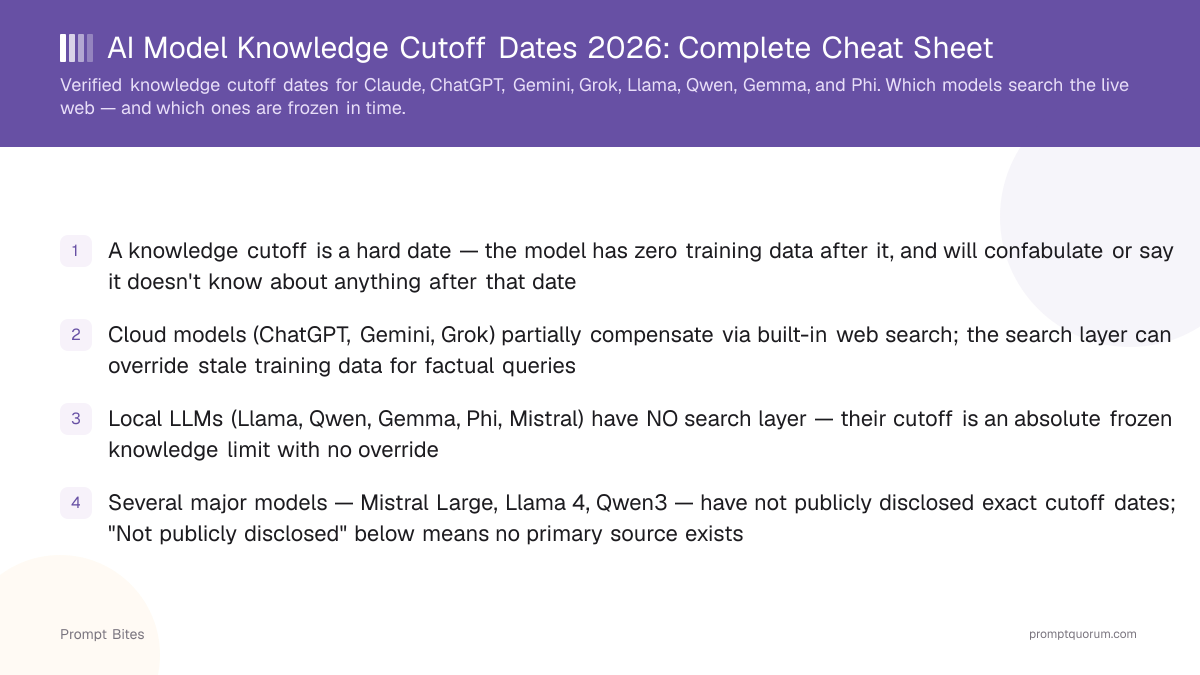
- ✓A knowledge cutoff is a hard date — the model has zero training data after it, and will confabulate or say it doesn't know about anything after that date
- ✓Cloud models (ChatGPT, Gemini, Grok) partially compensate via built-in web search; the search layer can override stale training data for factual queries
- ✓Local LLMs (Llama, Qwen, Gemma, Phi, Mistral) have NO search layer — their cutoff is an absolute frozen knowledge limit with no override
- ✓Several major models — Mistral Large, Llama 4, Qwen3 — have not publicly disclosed exact cutoff dates; "Not publicly disclosed" below means no primary source exists
- ✓For GEO strategy: appearing in cloud AI requires SEO/search optimization; appearing in local AI requires RAG pipelines built by the deployer
Cloud AI Models: Knowledge Cutoffs & Live Search Layers
These are the cloud models end users interact with. Where a search layer exists, the model can retrieve current information for some queries — but the underlying knowledge cutoff still matters for context not covered by search.
⚠️ "Default live search" means the model searches the web automatically for most queries, without any developer integration. "Tool-use only" means search must be explicitly wired by developers; end users without that setup see only the training cutoff.
| Model | Vendor | Cutoff Date | Default Live Search | Search Layer |
|---|---|---|---|---|
| Claude Opus 5 | Anthropic | 2026-05 | No (tool-use only) | Tool-use only |
| GPT-5.6 (ChatGPT) | OpenAI | 2026-02 | Yes | Bing |
| GPT-4o (legacy) | OpenAI | 2023-10 | Yes | Bing |
| Gemini 3.1 Pro | 2025-01 | Yes | ||
| Grok 4.6 | xAI | 2026-02 | Yes | X (Twitter) |
| Mistral Large 3 | Mistral AI | Not publicly disclosed | No | None |
| DeepSeek-V3 / R1 | DeepSeek | 2024-07 | No | None |
📍 In One Sentence
ChatGPT searches Bing by default, Gemini searches Google, and Grok searches X — but Claude requires explicit tool activation and DeepSeek has no search layer at all.
Local / Open-Weight LLMs: Hard Knowledge Cutoffs
Local LLMs run entirely on your device or a self-hosted server. They have no internet connection by default and no built-in search layer. Every entry in this table has "None" for search — because the only way to give a local LLM access to current information is to build a RAG pipeline yourself.
This means the cutoff dates below are HARD limits. Ask a locally-run Llama 4 Scout about something that happened after its training cutoff and it will either make something up or admit it doesn't know.
| Model | Vendor | Cutoff Date | Cutoff Verified | Search Layer |
|---|---|---|---|---|
| Llama 4 Scout / Llama 4 Maverick | Meta | Not publicly disclosed | Not disclosed | None — hard limit |
| Qwen3 14B / Qwen2.5 72B | Alibaba | 2023-12 | ✓ Primary source | None — hard limit |
| Mistral Small 3 / Mistral 7B | Mistral AI | Not publicly disclosed | Not disclosed | None — hard limit |
| DeepSeek-V3 (open weights) | DeepSeek | 2024-07 | ✓ Primary source | None — hard limit |
| Gemma 3 27B | 2024-08 | ✓ Primary source | None — hard limit | |
| Phi-4 | Microsoft | 2024-06 | ✓ Primary source | None — hard limit |
💬 In Plain Terms
Running a local LLM is like asking an expert who has been completely offline since a specific date — brilliant about everything before that date, completely blind to everything after.
Why Local LLMs Are Fundamentally Different
Cloud AI models and local LLMs handle knowledge cutoffs differently in one critical way: cloud models can search the live web; local models cannot.
When ChatGPT can't answer from training data, it silently queries Bing and augments its response with current results. When Gemini 3.1 Pro is asked about a recent event, it searches Google. These search layers hide the cutoff from casual users — you get a current-sounding answer even though the base model's training data is months or years old.
A locally-run Qwen3 or Llama 4 on your machine has no such safety net. Ask it about a product launched last month and it has two options: confabulate (hallucinate a plausible-sounding but fabricated answer), or say it doesn't know. There is no third option — it physically cannot reach the internet unless you build that capability yourself via a RAG pipeline.
This distinction matters for three groups: users who need accurate current-events answers; businesses deploying AI internally on local hardware; and companies that want to appear in AI answers (GEO strategy — see the full GEO analysis).
Frequently Asked Questions About AI Knowledge Cutoff Dates
What is a knowledge cutoff date in AI?▾
What is the difference between a knowledge cutoff and live search?▾
Do local LLMs ever update their knowledge?▾
Which AI models can see today's news and current events?▾
Is the ChatGPT cutoff date the same as what it knows right now?▾
Want the full breakdown?
Read the complete guide →Related Prompt Bites