Best Embedding Model for Local RAG?
nomic-embed-text is the best embedding model for local RAG via Ollama — it supports an 8,192-token context window (far longer than older embedding models) and runs efficiently on modest hardware. BGE-M3 is the best pick if your documents span multiple languages, since it was trained specifically for strong multilingual retrieval.
Quick Answer
nomic-embed-text is the best embedding model for local RAG via Ollama — 8,192-token context and efficient on modest hardware. BGE-M3 is the better pick for multilingual document collections.
- ▸nomic-embed-text: 8,192-token context window, runs via Ollama's embedding API, strong general-purpose choice.
- ▸BGE-M3: purpose-built for multilingual retrieval — the right pick if your documents span multiple languages.
- ▸mxbai-embed-large: a strong alternative general-purpose embedding model, slightly larger footprint than nomic-embed-text.
Key Takeaways
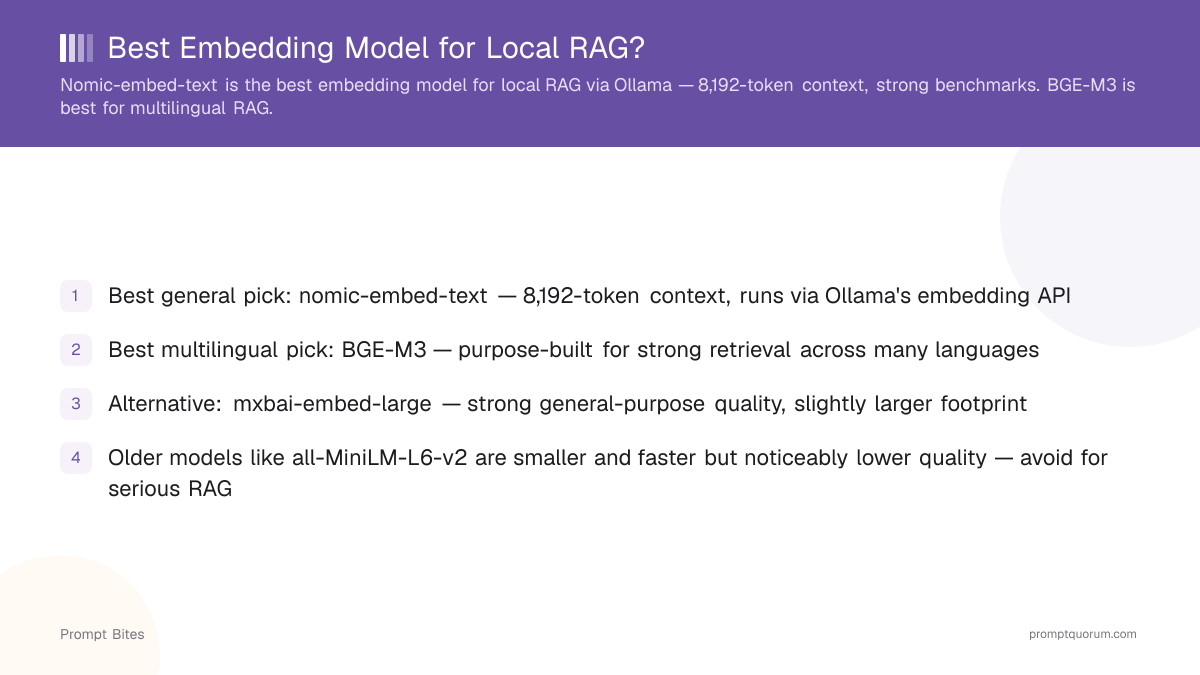
- ✓Best general pick: nomic-embed-text — 8,192-token context, runs via Ollama's embedding API
- ✓Best multilingual pick: BGE-M3 — purpose-built for strong retrieval across many languages
- ✓Alternative: mxbai-embed-large — strong general-purpose quality, slightly larger footprint
- ✓Older models like all-MiniLM-L6-v2 are smaller and faster but noticeably lower quality — avoid for serious RAG
Best Pick: nomic-embed-text
nomic-embed-text is the best embedding model for local RAG because it combines a genuinely long 8,192-token context window with efficient inference and native Ollama support through the embedding API. Older embedding models typically cap out around 512 tokens, forcing you to chunk documents more aggressively and losing context across chunk boundaries — nomic-embed-text's longer window reduces that problem.
If your document collection spans multiple languages, BGE-M3 is the better choice. It was trained specifically for strong multilingual retrieval performance, whereas nomic-embed-text and most other options are primarily English-optimized, with weaker performance on non-English text.
mxbai-embed-large is a solid alternative general-purpose pick if you want to compare results against nomic-embed-text — it has a somewhat larger footprint but competitive quality on English-language retrieval benchmarks.
Embedding Models Compared
Avoid older, smaller models like all-MiniLM-L6-v2 for serious RAG work — they are fast and lightweight but noticeably lower quality on retrieval accuracy compared to nomic-embed-text, BGE-M3, or mxbai-embed-large. The quality gap matters more than the speed gain for most RAG use cases.
All three recommended models run through Ollama's embedding API with minimal setup — pulling the model and calling the embeddings endpoint is the same workflow regardless of which one you choose.
Related Reading
- ▸Best Local LLM for Document Summarization — pairing retrieval with a long-context chat model
- ▸How Much VRAM Do You Need for a Local LLM? — sizing hardware for a full RAG pipeline
- ▸Best Sub-8B Model for Real-Time Chat — a fast chat model to pair with retrieval
- ▸Best Embedding Models for Local RAG (Full Comparison) — the complete benchmark across accuracy, speed, and multilingual support