Best Local LLM for Document Summarization?
Qwen3 14B and Llama 3.1 8B are the best local LLMs for document summarization — both support 128K+ context on Ollama, long enough to summarize most documents in a single pass without chunking. Qwen3 14B reaches up to 1M tokens of context in its extended configuration, useful for exceptionally long documents.
Quick Answer
Qwen3 14B and Llama 3.1 8B are the best local LLMs for document summarization — both support 128K+ context on Ollama, enough to summarize long documents without chunking.
- ▸Llama 3.1 8B supports 128K+ context on Ollama — a smaller, faster option for long-document summarization.
- ▸Qwen3 14B also supports 128K+ context, and reaches up to 1M tokens in its extended configuration for exceptional cases.
- ▸Full 128K context uses significantly more VRAM than the base model size alone — budget accordingly.
Key Takeaways
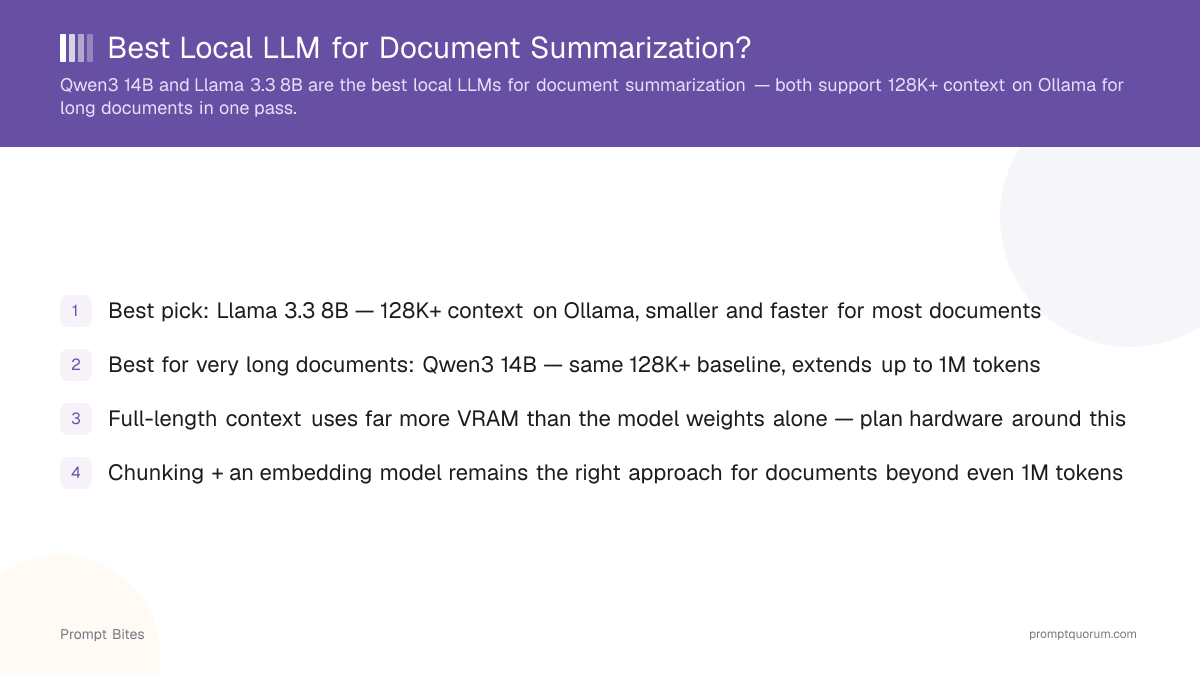
- ✓Best pick: Llama 3.1 8B — 128K+ context on Ollama, smaller and faster for most documents
- ✓Best for very long documents: Qwen3 14B — same 128K+ baseline, extends up to 1M tokens
- ✓Full-length context uses far more VRAM than the model weights alone — plan hardware around this
- ✓Chunking + an embedding model remains the right approach for documents beyond even 1M tokens
Best Pick: Llama 3.1 8B (or Qwen3 14B for Very Long Documents)
Llama 3.1 8B is the best local LLM for most document summarization tasks, since its 128K+ context window on Ollama covers the vast majority of real-world documents in a single pass, without splitting the document into chunks that risk losing cross-section context. Its smaller 8B size also keeps VRAM requirements and inference speed reasonable compared to larger models.
For exceptionally long documents that exceed even 128K tokens, Qwen3 14B is the better choice — it shares the same 128K baseline but can extend to 1M tokens in its extended configuration, covering book-length documents that Llama 3.1 8B's standard context cannot.
Keep in mind that running a model at its full advertised context length uses significantly more VRAM than the base model weights alone — the attention mechanism's memory use scales with context length, so a 128K-context summarization session needs meaningfully more VRAM headroom than a short chat exchange with the same model.
Full-Context Summarization vs Chunking
Feeding a whole document into a long-context model in one pass avoids the cross-chunk context loss that traditional chunk-and-summarize pipelines suffer from, at the cost of needing more VRAM for the longer context window.
For documents beyond even a 1M-token context ceiling, or when VRAM is tightly constrained, falling back to a chunking approach — splitting the document, summarizing each chunk, then summarizing the summaries — paired with an embedding model for relevant-section retrieval remains the practical alternative.
Related Reading
- ▸Which Ollama Models Support 128K Context? — the full list of long-context models
- ▸Best Embedding Model for Local RAG — a chunking-based alternative approach
- ▸How Much VRAM Do You Need for a Local LLM? — sizing hardware for long-context work
Frequently Asked Questions
Do I need extra VRAM to use the full 128K context?▾
Can a smaller model like Qwen3 4B handle long-document summarization?▾
Is chunking ever better than full-context summarization?▾
Does context length affect summarization quality, not just capacity?▾
Related Prompt Bites