Best Local LLM for a Customer Support Chatbot?
For a customer support chatbot, prioritize an instruction-tuned model with strong, consistent instruction-following over one optimized for raw benchmark scores — support use cases live or die on the model reliably staying within scope, refusing out-of-bounds requests, and following formatting constraints every single time, not just usually. A mid-sized well-instruction-tuned model that follows constraints reliably beats a larger model that occasionally drifts off-script.
Quick Answer
Prioritize consistent instruction-following over raw capability: the model needs to reliably stay within its defined scope, refuse requests it shouldn't handle (like promising refunds), and follow response formatting every time. Test candidate models against your actual system prompt and edge cases rather than picking based on general benchmark scores alone.
- ▸Consistent instruction-following matters more than raw parameter count for support use cases
- ▸Test against your actual system prompt and constraint list, not generic benchmarks
- ▸A model that reliably escalates to a human when it should is more valuable than one that never escalates but occasionally overreaches
Key Takeaways
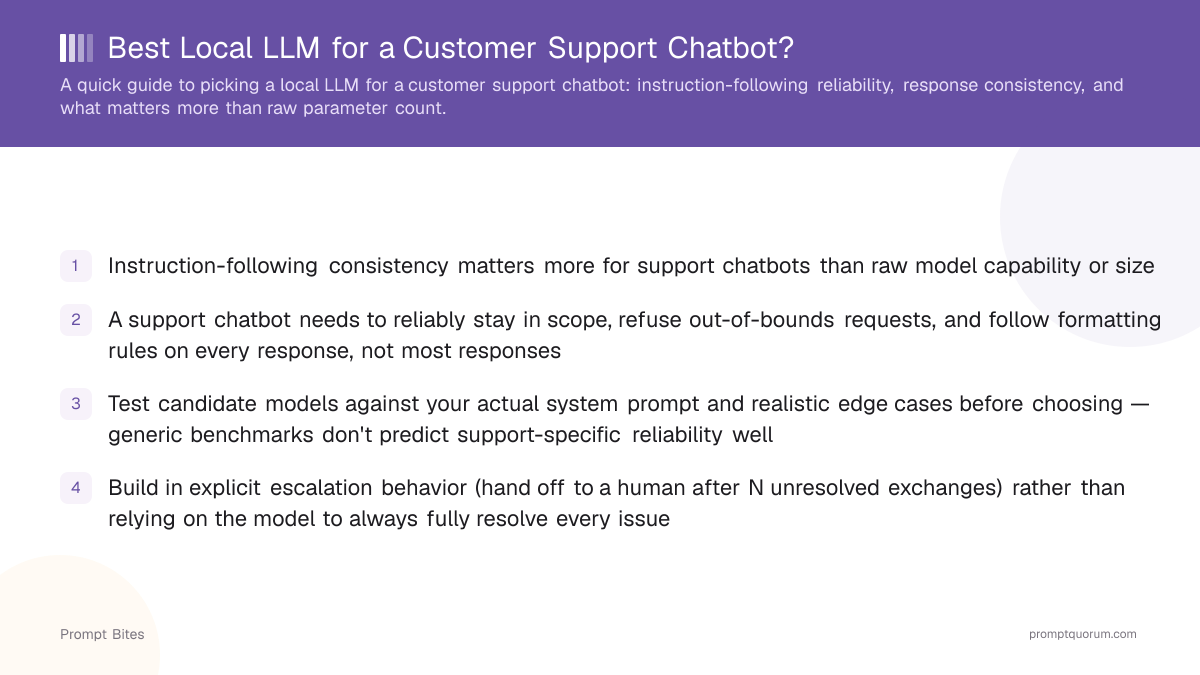
- ✓Instruction-following consistency matters more for support chatbots than raw model capability or size
- ✓A support chatbot needs to reliably stay in scope, refuse out-of-bounds requests, and follow formatting rules on every response, not most responses
- ✓Test candidate models against your actual system prompt and realistic edge cases before choosing — generic benchmarks don't predict support-specific reliability well
- ✓Build in explicit escalation behavior (hand off to a human after N unresolved exchanges) rather than relying on the model to always fully resolve every issue
Why Instruction-Following Beats Raw Capability Here
A support chatbot's system prompt typically encodes hard constraints: don't promise refunds, don't share internal documentation, escalate after a set number of unresolved exchanges, stay within a defined product scope. These constraints only provide value if the model follows them consistently — a model that respects them 95% of the time still creates real problems in the 5% it doesn't, since those failures are exactly the cases where a wrong answer matters most (an unauthorized refund promise, a scope violation).
This is why instruction-following reliability, not raw reasoning capability or general benchmark performance, is the deciding factor for this specific use case. A model that's slightly weaker on general knowledge but rock-solid on following its constraints will outperform a more capable model that occasionally drifts, because support quality is measured by consistency and predictability, not peak intelligence.
Formatting reliability matters too if your chatbot integrates structured elements (numbered troubleshooting steps, escalation triggers a system parses) — see our guide on getting reliable structured output from a local LLM if your support flow depends on consistent output formatting.
How to Actually Test Candidate Models
- ▸Test with your real system prompt, not a generic one. A model's instruction-following quality varies by how your specific constraints are phrased — evaluate candidates against the actual prompt you'll deploy, not a simplified stand-in.
- ▸Include adversarial and edge-case inputs in testing. Customers will ask for things outside scope, try to get refund promises, or push past intended boundaries — test explicitly for these, since normal-case testing won't reveal how a model handles them.
- ▸Check formatting consistency across many runs, not just one. If your flow depends on numbered steps or structured output, run the same type of request multiple times and confirm the format holds up consistently, not just on a lucky first try.
- ▸Verify escalation behavior actually triggers. If your system prompt specifies escalating to a human after N unresolved exchanges, explicitly test that the model actually does this rather than continuing to attempt resolution indefinitely.