Best Local LLM for Reliable Structured JSON Output?
Reliable structured JSON output from a local LLM comes mainly from grammar-constrained decoding at the inference layer, not from prompting technique alone. Grammar-based tools force the model's token choices to stay valid against a schema at every generation step.
Quick Answer
Use grammar-constrained decoding rather than relying on prompting alone. Local serving tools that support grammar or JSON-schema-constrained generation restrict which tokens the model is allowed to generate at each step, so the output is guaranteed to be valid JSON matching your schema.
- ▸Prompting alone ("respond only in JSON") reduces but does not eliminate malformed output.
- ▸Grammar-constrained decoding restricts token choices to only valid JSON at each generation step.
- ▸Most local serving tools support some form of JSON-schema-constrained generation, so any capable model can produce reliable output when paired with it.
Key Takeaways
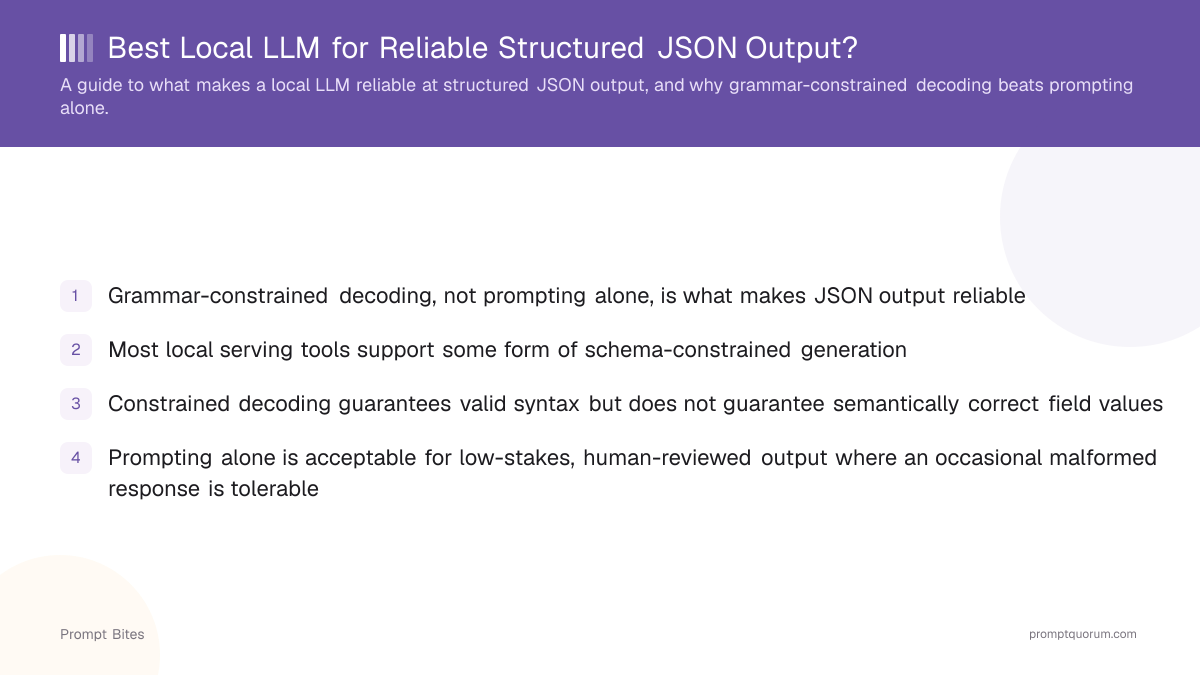
- ✓Grammar-constrained decoding, not prompting alone, is what makes JSON output reliable
- ✓Most local serving tools support some form of schema-constrained generation
- ✓Constrained decoding guarantees valid syntax but does not guarantee semantically correct field values
- ✓Prompting alone is acceptable for low-stakes, human-reviewed output where an occasional malformed response is tolerable
Best Approach: Constrained Decoding
Use grammar- or schema-constrained decoding whenever downstream code will automatically parse the model's output. This approach restricts the model's token choices at every generation step to only those that keep the output syntactically valid against your target schema — it does not rely on the model choosing to follow instructions correctly, so it guarantees well-formed syntax regardless of model size or prompt phrasing.
Best for production pipelines: schema-constrained decoding through your serving tool's native grammar support, paired with a downstream validation step that checks semantic correctness (not just syntax) before the data is used. Best for quick scripts or prototyping: prompting alone with a clear JSON example in the prompt, accepting the occasional retry when output is malformed.
Why Constrained Decoding Matters
Prompting a model to respond only in JSON reduces the rate of malformed output but does not eliminate it, since the model can still generate an invalid token at any step — a stray comma, an unescaped quote, or a truncated closing brace all break downstream parsing. Grammar-constrained decoding solves this at the source by restricting the set of tokens the model is allowed to sample from at each step to only those that keep the output valid against a JSON grammar or schema, which guarantees well-formed output regardless of model size.
Constrained decoding guarantees syntactic validity, not semantic correctness — the model can still put a wrong value in a correctly formatted field. Always pair schema-constrained generation with a downstream check that validates the actual field values make sense for your use case, not just that the JSON parses.
When Prompting Alone Is Enough
Skip constrained decoding when a human reviews every output before it is used, since an occasional malformed response is caught and can simply be regenerated. Skip it for quick prototyping when your serving stack does not yet support grammar constraints and adding that infrastructure isn't worth the setup time for a throwaway script.
Switch to constrained decoding if malformed-output rates from prompting alone are causing pipeline failures, or if the output feeds directly into an automated system with no human in the loop to catch parsing errors.