Best Local LLM for SQL and Data Analysis?
A local LLM suited to SQL and data analysis needs strong code-generation training and a large enough context window to hold a full schema alongside the question. Coding-tuned models generally outperform general-purpose chat models on SQL correctness.
Quick Answer
Coding-tuned local models with a large context window handle SQL generation and data analysis best, since they can hold an entire table schema in context alongside the question.
- ▸Coding-tuned models outperform general chat models on SQL syntax correctness.
- ▸A larger context window matters more here than for short chat tasks — full schemas take space.
- ▸Test against your own schema, since SQL dialect quirks vary by database engine.
Key Takeaways
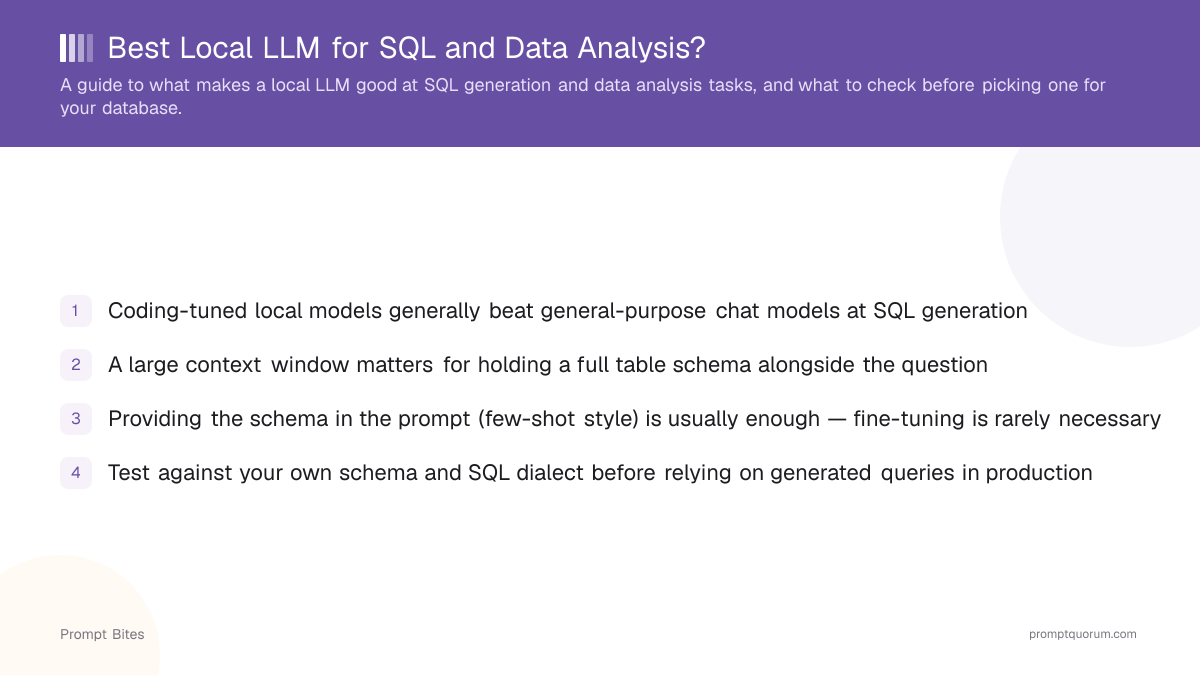
- ✓Coding-tuned local models generally beat general-purpose chat models at SQL generation
- ✓A large context window matters for holding a full table schema alongside the question
- ✓Providing the schema in the prompt (few-shot style) is usually enough — fine-tuning is rarely necessary
- ✓Test against your own schema and SQL dialect before relying on generated queries in production
Best Pick: Coding-Tuned Models
Use a coding-tuned local model over a general-purpose chat model for SQL generation — the coding-specific training data these models see includes far more structured query syntax, which translates directly into fewer syntax errors and better join logic. Among coding-tuned models, prioritize one with a context window comfortably larger than your schema's size, since truncated schema context is a common source of hallucinated column names.
Best for analysts on a laptop: a mid-size coding-tuned model (7B–14B class) that fits comfortably in available VRAM while still holding a moderate schema. Best for large, multi-table schemas: a larger coding-tuned model with a longer context window, even if it runs slower, since schema truncation causes more errors than slower generation.
What Matters for SQL Tasks
SQL generation is a code-generation task, so coding-tuned local models consistently produce more syntactically correct queries than general-purpose chat models. Context window size matters more here than for typical chat use, since a full schema plus sample rows can consume a large share of the available context — a model with a short context window is forced to work from a truncated or summarized schema, which increases the rate of hallucinated table or column names.
SQL dialect differences (PostgreSQL, MySQL, SQLite, and others each have their own syntax quirks for things like date functions and window functions) are not consistently handled the same way across models — the model's training data determines which dialects it produces correct syntax for. Always specify your database engine explicitly in the prompt rather than assuming the model will infer it correctly.
Who Should Use This
Analysts who need to write ad-hoc queries against a familiar schema benefit most, since providing the schema once and reusing it across a session avoids re-explaining table structure each time. Developers building a natural-language-to-SQL feature into an application should pair a coding-tuned model with schema validation on the output — never execute a generated query directly against a production database without a permissions layer and a syntax check.
Skip a general-purpose local chat model for this task if syntax correctness matters — the accuracy gap versus a coding-tuned model on multi-table joins and window functions is consistently noticeable in practice.