⚡ Quick Facts
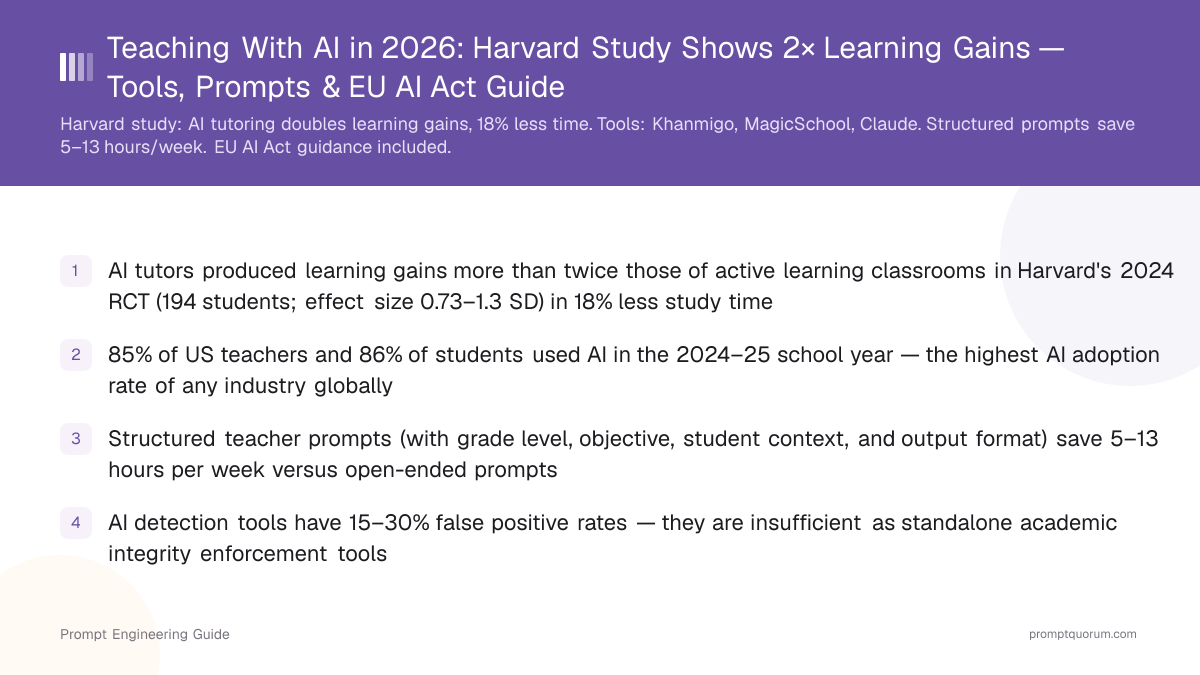
- Harvard RCT result: AI tutoring produced 0.73–1.3 SD learning gains vs active learning classrooms, in 18% less time (n=194, p < 10⁻⁸)
- Teacher adoption: 85% of US teachers used AI in 2024-25 school year
- Time saved: Structured prompts save teachers 5–13 hours/week on lesson planning and admin
- AI detection problem: 15–30% false positive rate — unreliable for standalone academic integrity decisions
- EU AI Act: Educational AI classified as high-risk (Annex III). Staff AI literacy training mandatory (Article 4, effective 2025). Emotion recognition banned in schools.
- Best tools: Khanmigo (tutoring), MagicSchool (lesson plans), ChatGPT/Claude (flexible content), NotebookLM (source-grounded research)
What AI Teaching Tools Actually Do
📍 In One Sentence
AI teaching tools include tutoring systems (Khanmigo), lesson planners (ChatGPT, Claude), and administrative assistants — each optimized for different classroom tasks.
AI teaching tools perform four distinct functions: personalized tutoring, lesson plan generation, automated assessment feedback, and administrative task reduction — each requiring a different tool and a different prompt structure.
Intelligent Tutoring Systems (ITS) — the technical category for tools like Khanmigo — adapt difficulty, provide immediate feedback, and guide students through Socratic questioning rather than supplying direct answers. General-purpose LLMs (Large Language Models) like GPT-5.6 (OpenAI) and Claude Sonnet 5 (Anthropic) handle lesson plan generation, rubric creation, and differentiated instruction materials. Administrative AI tools handle attendance summaries, parent communication drafts, and progress reports — the tasks teachers report as the most time-consuming.
In one sentence: prompt engineering for education is not one tool — it is a stack, where each layer serves a specific role in the teaching workflow.
Which AI Tools Should Teachers Use in 2026?
Khanmigo (Khan Academy), MagicSchool, and ChatGPT (OpenAI) each serve distinct classroom functions — choosing the wrong tool for the task wastes both time and opportunity.
Khanmigo is Khan Academy's AI teaching assistant powered by GPT-4. It uses Socratic questioning to guide students toward answers rather than providing them directly — a critical design distinction for learning retention. It integrates directly into Khan Academy courses, making it the strongest option for schools already using that platform.
MagicSchool offers the broadest educator toolset — lesson planning, classroom management templates, IEP draft assistance, and parent communication tools. ChatGPT (GPT-5.6) provides the most flexible general-purpose assistance with the highest autonomy, but requires structured prompts from the teacher to produce classroom-ready outputs.
Tool | Best For | Context | Free Tier |
|---|---|---|---|
| Khanmigo (Khan Academy) | Student tutoring; Socratic learning | K-12, Khan Academy ecosystem | $44/year |
| MagicSchool | Lesson planning; classroom management | K-12 teachers | Yes (limited) |
| ChatGPT / GPT-5.6 (OpenAI) | Flexible content creation; drafting | Any level, any subject | Yes (limited) |
| Claude Sonnet 5 (Anthropic) | Deep analysis, careful reasoning, writing quality | Post-secondary; complex tasks | Yes (limited) |
| NotebookLM (Google DeepMind) | Source-grounded Q&A on uploaded course materials | University; research contexts | Free / Plus tier |
| Gemini 3.1 Pro (Google DeepMind) | Large document analysis; policy review | District administrators | Yes (limited) |
🔍 Pro Tip
No single tool does everything. Most teachers use 2–3 tools in combination: Khanmigo for student tutoring, MagicSchool for planning, and ChatGPT for quick content generation.
AI in Education: Use Case to Tool Mapping
Not all tools fit all tasks. Choose the right tool for each specific use case — different models excel at different constraints (context window, temperature, cost, speed).
Use Case | Recommended Tool | Temperature | Time Saved |
|---|---|---|---|
| Lesson plan creation | MagicSchool / GPT-5.6 | 0.1–0.2 | 30–60 min/lesson |
| Differentiated reading levels | Claude Sonnet 5 | 0.1–0.2 | 15 min/passage |
| Student tutoring (Socratic) | Khanmigo | n/a (preset) | Asynchronous |
| Rubric-aligned feedback | Claude Sonnet 5 (1M context) | 0.2 | Hours per class set |
| Parent communication drafts | ChatGPT / GPT-5.6 | 0.3–0.5 | 5–10 min/message |
| Curriculum / policy review | Gemini 3.1 Pro (1M context) | 0.1 | Hours per document |
Private School AI: Local LLMs for Data Privacy
For schools with strict data privacy requirements — particularly EU schools under GDPR — local LLMs via Ollama provide a zero-data-egress alternative. A school laptop with 16 GB RAM runs Qwen3 8B or Llama 4 Scout locally, handling lesson plan generation and formative feedback without any student data leaving the device. Quality is lower than frontier cloud models but sufficient for routine planning tasks. See What Are Local LLMs? for setup guidance.
How to Write Prompts for Teaching Tasks
💬 In Plain Terms
Think of AI prompts like recipes: vague prompts ("make something tasty") produce inconsistent results; detailed prompts ("bake a chocolate cake at 350°F for 35 minutes with dark chocolate") produce reliable outcomes.
A structured teacher prompt — one that specifies grade level, subject, learning objective, prior knowledge, time constraints, and output format — produces classroom-ready materials without editing; an unstructured prompt produces a generic draft that requires 30+ minutes of revision.
Prompt engineering is the practice of crafting precise, structured instructions that guide AI output. For teachers, the difference between a usable and unusable AI output is almost always in the specificity of the prompt, not the capability of the model.
Bad vs. Good: Lesson Planning Prompts
Specific, context-rich prompts save teachers 5–13 hours per week on lesson planning when used consistently. The bad version requires 30+ minutes of revision; the good version produces classroom-ready output in one pass.
Bad prompt — generic output:
Make a lesson on adding fractions for 5th graders.
- This produces a vague outline with no time allocation, no alignment to standards, no differentiation, and no exit ticket. Most of the output gets discarded.
The Five-Component Teacher Prompt
Good prompt — five-component structure:
You are an experienced 5th-grade math teacher. Create a 45-minute lesson on adding fractions with unlike denominators. Students understand equivalent fractions but have not combined them yet. Include: a 10-minute warm-up using visual models, 15 minutes of direct instruction with three worked examples, 15 minutes of partner practice, and a 5-minute exit ticket. Align to Common Core 5.NF.A.1. Output only the lesson plan with section headers, time allocations, and a materials list.
- The structured version produces a document with rubric-aligned sections, time-boxed activities, and a materials list. Ready to use or refine — not rewrite.
🔍 Key Point
The five components are: (1) Role, (2) Objective, (3) Student context, (4) Constraints, (5) Output format. Using all five consistently saves 5–13 hours per week.
How Do You Prompt AI for Assessment Feedback?
For formative assessment, include your rubric criteria directly in the prompt so the AI understands your grading standards and applies them consistently across all student submissions.
Claude Sonnet 5's 1M-token context window handles full class sets of essays in a single session — approximately 800 standard pages — making batch feedback generation practical for teachers with large classes. GPT-5.6 handles ~800 pages per session (1M tokens), sufficient for any classroom workload.
You are an experienced 7th-grade English teacher. Analyze this student argumentative essay using this rubric: clear thesis (4 pts), three supporting arguments with evidence (12 pts), acknowledgment of counterargument (4 pts), formal transitions (3 pts), conclusion that reinforces thesis (3 pts). For each criterion: state the score, quote the relevant sentence, and write one specific improvement suggestion. Total score out of 26.
🔍 Warning
AI can't assess voice, originality, or subjective writing quality reliably — always use AI feedback for mechanics and structure, not for holistic rubric scores on subjective criteria. Keep the final summative grade human.
Does AI Tutoring Improve Learning Outcomes?
Students using AI tutoring systems outperform peers in traditional instruction by 15–35% on standardized assessments across 21 empirical studies.
The strongest evidence comes from a 2024 randomized controlled trial led by Gregory Kestin and Kelly Miller at Harvard University, involving 194 undergraduate physics students. The study used a crossover design where each student experienced both AI tutoring (via "PS2 Pal," powered by GPT-4) and traditional active learning across two topics. Key findings:
- AI-tutored students scored significantly higher on post-tests — effect size between 0.73 and 1.3 standard deviations
- Median study time: 49 minutes (AI group) vs. 60 minutes (classroom group)
- Students reported higher engagement and motivation in AI sessions
- Statistical significance: p < 10−8
- A 2025 systematic review of 21 empirical studies found AI-supported students outperformed control groups by 15–35% on assessments, r = 0.781. A 2025 Stanford study found 2–5 hours with an intelligent tutoring system reliably predicts end-of-year test performance.
🔍 Did You Know?
Students showed higher engagement and motivation in AI tutoring sessions. The effect size (0.73–1.3 SD) is equivalent to the learning gain from moving from a typical classroom to top-quartile instruction.
How Detectable Is AI Cheating in Schools?
Current AI detection tools have false positive rates of 15–30% in peer-reviewed studies, meaning they are unreliable for high-stakes academic integrity decisions — and many students use AI hallucinations strategically to evade detection.
Academic integrity is the central challenge in AI-assisted education. The scale of adoption has outpaced both policy and detection technology. Student adoption is widespread: surveys report 60–92% of students use AI for studies, though institutional policies vary widely on which uses are permitted.
The detection problem has three critical layers:
- False positives — Non-native English writers are flagged at disproportionately higher rates; structured academic writing styles (common in technical fields) consistently trigger detection tools
- Hybrid text — AI drafts that are substantially edited by students defeat most detection systems
- Policy gap — Universities in 2026 are moving from outright bans to transparency-and-disclosure frameworks, requiring students to cite AI assistance rather than prohibiting it
🔍 Warning
Non-native English speakers and students with structured writing styles are flagged at disproportionately higher rates. Accusing a student based solely on AI detection output carries a 15–30% risk of false accusation.
The emerging institutional consensus: AI detection tools are not final authorities. Universities increasingly require human-plus-automated review and enforce disclosure norms rather than prohibition norms.
How Does the EU AI Act Affect Schools?
The EU AI Act classifies AI systems used in education as "high-risk" — meaning tools that influence exam scoring, learning pathways, or student assessment are subject to mandatory transparency, human oversight, and bias-prevention requirements.
Under Annex III of the EU AI Act, educational AI tools that determine access to education or assess learning outcomes are classified as high-risk systems. Schools and universities operating within the EU are considered AI "deployers" under the Act, carrying legal obligations including:
- Ensuring staff AI literacy (Article 4 mandate — effective from 2025)
- Implementing human oversight for all high-risk AI decisions affecting students
- Maintaining audit logs of AI-influenced assessments
- Disclosing AI system data sources and model logic to students upon request
🔍 Key Point
EU schools must implement staff AI literacy training (Article 4, effective 2025) for all teachers and administrators working with AI systems. Non-compliance carries fines up to €30 million.
Global Educational AI Regulations
The EU AI Act bans emotion-recognition systems in educational settings outright — directly affecting tools that track student engagement via facial analysis. Chinese educational institutions deploy AI tools under China's Interim Measures for Generative AI (2023), which require AI-generated educational content to be labelled as such. Japan's Ministry of Education (MEXT) issued guidance in 2023 cautioning against AI use in certain assessment contexts, while acknowledging AI as a core student competency.
Common Mistakes When Using AI in Education
These five pitfalls cost teachers time and can create legal or ethical problems — all are easy to fix with the right process.
- Using AI as a grading replacement rather than a feedback tool: AI generates plausible rubric scores but cannot reliably assess originality, voice, or argumentation quality in extended writing. Use AI for formative feedback on low-stakes work; keep summative judgment human.
- Unstructured prompts for lesson planning: "Make a lesson on photosynthesis" produces a generic output requiring more editing time than writing from scratch. Always specify grade level, prior knowledge, time constraints, and output format.
- Over-relying on AI detection tools for academic integrity: False positive rates of 15–30% mean that accusing a student based solely on AI detection output carries a 15–30% chance of false accusation. Non-native English writers are flagged at disproportionately higher rates.
- Ignoring EU AI Act obligations for EU schools: Educational AI tools that influence learning pathways or assessment are high-risk under Annex III. EU schools that deploy these tools without Article 4 staff AI literacy training are non-compliant.
- Using high-temperature settings for educational content: Default temperature on most AI platforms (0.7–1.0) increases hallucination risk. For factual lesson content, assessment rubrics, and citation generation, set temperature to 0.1–0.2.
- Not teaching students how to prompt AI effectively: Students who type "write my essay on photosynthesis" learn nothing. Students who type "explain photosynthesis at a Grade 8 level, then quiz me on the three key concepts" learn actively. Create a classroom prompt template students must use for all AI interactions. Require them to specify their learning objective, what they already know, and what format they want the answer in. This turns AI from a shortcut into a learning tool.
🔍 Best Practice
Document all AI use: which tool, which settings (temperature, context), and what task. This creates an audit trail for compliance (EU AI Act Article 6) and helps you improve over time.
Step-by-Step: Integrating AI Into Your Teaching
Follow these five steps to integrate AI into your teaching without disrupting learning outcomes or violating academic integrity standards.
- 1Define learning objectives and assessments before introducing AI.
- 2Use AI for personalized practice and immediate feedback, not for grading judgment calls.
- 3Teach students how to verify AI outputs and detect hallucinations.
- 4Create a structured prompt template students use for all AI interactions.
- 5Set clear policies on AI use for specific tasks.
Frequently Asked Questions
Do AI tutors actually improve learning outcomes?
Yes — the evidence is strong. A 2024 Harvard RCT involving 194 undergraduate physics students found AI tutoring produced effect sizes of 0.73–1.3 standard deviations above active learning classrooms, with students reaching higher scores in 49 minutes vs. 60 minutes of classroom time (p < 10−8). A 2025 systematic review of 21 studies found AI-supported students outperform traditional instruction by 15–35% on assessments.
What is the best AI tool for teachers in 2026?
The answer depends on the task. Khanmigo (Khan Academy, powered by GPT-4) is the strongest for student tutoring via Socratic questioning at $44/year. MagicSchool leads for comprehensive teacher workflow tools (lesson plans, IEPs, parent communications). ChatGPT (GPT-5.6, OpenAI) provides the most flexible general-purpose content generation. For complex curriculum analysis, Claude Sonnet 5 (Anthropic) handles 1M tokens — approximately 800 standard pages — in a single session.
How much time can AI save teachers per week?
Specific, context-rich prompts save teachers 5–13 hours per week on lesson planning and administrative tasks when used consistently. The most common time-saving applications are: research and content gathering (44% of teachers), lesson plan creation (38%), information summarization (38%), and classroom material generation (37%).
Is AI in education legal under EU regulations?
AI systems that influence educational assessment or learning pathways are classified as high-risk under the EU AI Act (Annex III). EU schools must implement staff AI literacy training (Article 4, effective 2025), maintain human oversight for AI-influenced assessments, and ensure audit trails for any AI system affecting student outcomes. Emotion-recognition AI in educational settings is banned outright under the Act.
Does AI detection software reliably catch academic cheating?
No — current AI detection tools have false positive rates of 15–30% in peer-reviewed studies, meaning up to 30 of every 100 legitimate student submissions may be wrongly flagged. Non-native English speakers and students writing in structured academic styles are flagged at disproportionately higher rates. Universities in 2026 are shifting from prohibition policies to disclosure-and-citation frameworks, treating AI detection as one input among several rather than as definitive proof of misconduct.
What temperature setting should teachers use for AI lesson planning?
Set temperature to 0.1–0.2 for factual educational content — lesson plans, assessment rubrics, curriculum alignment. This produces consistent, low-variation output. Use 0.7–0.9 only when generating creative activity ideas where diverse options are the goal. Default temperature on most platforms (0.7–1.0) is designed for creative tasks and increases factual errors in educational content.
Can AI tools help with differentiated instruction?
Yes — this is one of AI's strongest educational use cases. LLMs can rewrite the same content at multiple reading levels (Flesch-Kincaid Grade 4, 8, and 12) in seconds. Prompt structure: "Rewrite this passage at a Grade N reading level. Preserve all factual content. Replace complex vocabulary with simpler equivalents. Keep the same paragraph structure." Claude Sonnet 5 produces the most consistent differentiation across reading levels.
How should schools handle AI literacy for staff under the EU AI Act?
Article 4 of the EU AI Act requires that AI deployers (including schools) ensure sufficient AI literacy for all staff working with AI systems — effective from 2025. This means training on: how AI makes decisions, what the error rates are for specific tools, when human oversight is required, and how to document AI-influenced decisions. Schools should document this training for audit purposes.
What is Khanmigo and how is it different from ChatGPT for students?
Khanmigo is Khan Academy's AI teaching assistant powered by GPT-4. Its defining feature is Socratic questioning — it guides students toward answers rather than providing them directly. When a student asks "what is the answer?", Khanmigo responds with a guiding question. This design promotes learning retention. ChatGPT provides direct answers by default, which is efficient but reduces the cognitive effort that produces long-term learning. For student-facing tutoring, Khanmigo's pedagogical design is superior; for teacher content generation, ChatGPT's flexibility wins.
How do I create an AI use policy for my school?
An effective school AI policy defines four things: (1) which tasks AI is permitted for (brainstorming, practice problems, draft feedback), (2) which tasks require disclosure (AI-assisted essays, presentations), (3) which tasks AI is prohibited for (final exam answers, plagiarism), (4) how AI-generated content must be attributed. The policy should be reviewed every 6 months given the pace of tool development. EU schools must additionally address EU AI Act Article 4 staff training requirements and Annex III high-risk system obligations in any policy document.
Sources & Further Reading
All statistics and findings in this article are sourced from peer-reviewed research, official government guidance, and publicly-documented institutional policies. Last fact-checked: 2026-05-04 (against current Claude Sonnet 5, GPT-5.6, Gemini 3.1 Pro models; current Khanmigo pricing at Khan Academy; current EU AI Act Article 4 guidance effective 2025).
- Kestin & Miller, 2024. "AI tutoring outperforms in-class active learning: an RCT" — randomized controlled trial with 194 students; effect size 0.73–1.3 SD
- Kwak, 2025. "The Effectiveness of AI-Driven Tools in Improving Student Learning Outcomes" — systematic review of 21 studies; 15–35% performance gains; r = 0.781
- EU AI Act, 2024. Annex III — High-Risk AI Systems in Education — classifies educational assessment AI as high-risk with mandatory oversight requirements