Key Takeaways
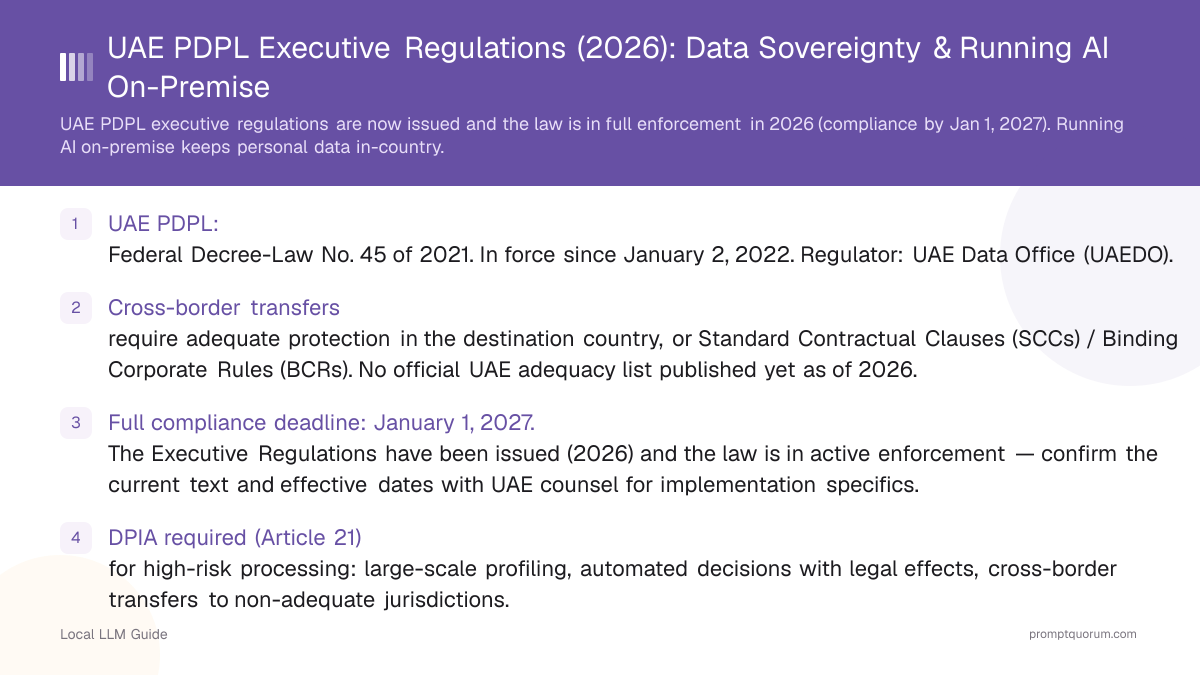
- UAE PDPL: Federal Decree-Law No. 45 of 2021. In force since January 2, 2022. Regulator: UAE Data Office (UAEDO).
- Cross-border transfers require adequate protection in the destination country, or Standard Contractual Clauses (SCCs) / Binding Corporate Rules (BCRs). No official UAE adequacy list published yet as of 2026.
- Full compliance deadline: January 1, 2027. The Executive Regulations have been issued (2026) and the law is in active enforcement — confirm the current text and effective dates with UAE counsel for implementation specifics.
- DPIA required (Article 21) for high-risk processing: large-scale profiling, automated decisions with legal effects, cross-border transfers to non-adequate jurisdictions.
- Data subjects can object to automated decisions that produce legal or significant effects. Organizations must disclose the logic of automated processing on access requests.
- On-premise local AI: inference happens inside UAE — personal data never crosses a border — reduces PDPL cross-border transfer exposure by design.
- DIFC (DIFC Data Protection Law No. 5 of 2020, amended July 2025) and ADGM operate separate data protection regimes; federal PDPL explicitly excludes free zones with their own laws.
- Sectors: CBUAE launched Sovereign Financial Cloud Services Infrastructure (SFCSI) February 25, 2026. Healthcare: DHA + ADHICS. All sector layers build on PDPL.
- *Not legal advice. Consult a qualified UAE legal counsel or DPO for your specific compliance obligations.*
📍 In One Sentence
Running AI inference on-premise in the UAE eliminates cross-border personal data transfer under Federal Decree-Law No. 45 of 2021 (UAE PDPL), because data never leaves national infrastructure.
💬 In Plain Terms
The UAE data protection law says you need approval to send personal data to other countries. If your AI runs locally inside the UAE, no data leaves — so the transfer rule does not apply.
UAE PDPL: Law, Regulator, and Timeline
The UAE Personal Data Protection Law (PDPL) is Federal Decree-Law No. 45 of 2021. It entered into force on January 2, 2022, making the UAE the first Gulf state to enact a comprehensive federal privacy law.
Regulator: UAE Data Office (UAEDO). The Data Office was established by Federal Decree-Law No. 44 of 2021, a companion instrument to the PDPL. It has authority to conduct audits, investigate complaints, and issue guidance.
Compliance deadline: January 1, 2027. Organisations must have full PDPL compliance programs in place by this date.
Executive Regulations: issued (2026). After a long wait, reporting in 2026 indicates the PDPL implementing/executive regulations — covering cross-border transfer safeguards, the adequacy framework, consent, and breach-notification procedures — have now been issued, moving the law into active enforcement ahead of the January 1, 2027 compliance deadline. Sources still cite different Cabinet Decision references, so confirm the current text and effective dates with a UAE-qualified DPO or legal counsel before relying on specifics.
- Law: Federal Decree-Law No. 45 of 2021 on the Protection of Personal Data
- Effective date: January 2, 2022
- Regulator: UAE Data Office (UAEDO), established by Federal Decree-Law No. 44 of 2021
- Full compliance target: January 1, 2027
- Executive Regulations: issued in 2026 — confirm current text/effective dates with UAE counsel
- Scope: applies to personal data processing of UAE residents by UAE entities and extraterritorial processors targeting UAE residents
How Cloud AI APIs Create Cross-Border Transfer Risk Under the PDPL
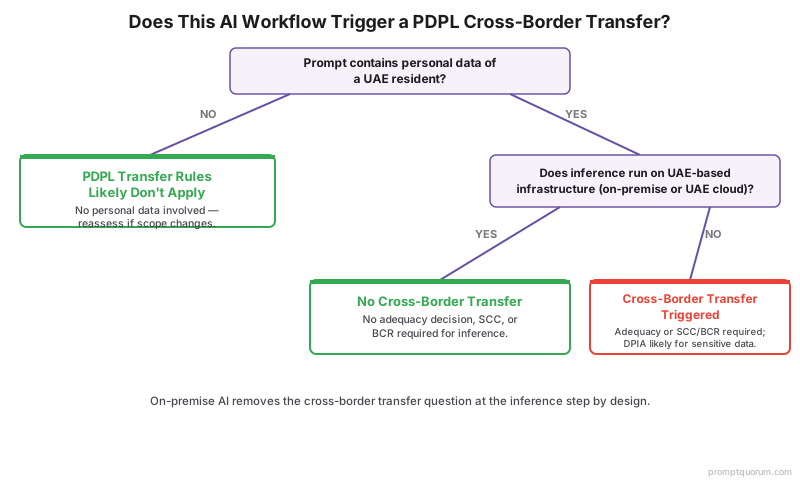
When you call a cloud AI API, personal data leaves the UAE. A typical enterprise workflow — sending a customer query to an API endpoint hosted in the US or EU — is a cross-border transfer under the PDPL, even if the data is transient.
The PDPL restricts cross-border transfers. Data may only flow to a destination country if it provides an adequate level of protection recognised by the UAE Data Office, or if specific contractual safeguards are in place (SCCs or BCRs). As of 2026, the UAE Data Office had not published a formal adequacy list.
DPIA may be required. When transferring to a non-adequate jurisdiction — which currently encompasses all countries pending the adequacy list — a Data Privacy Impact Assessment (Article 21) may be required before transfer.
Practical examples of risk:
- Sending customer support queries to GPT-4o (US-hosted): cross-border transfer of query content, which may contain personal identifiers
- Using a cloud-based document AI to process HR files: personal data of employees sent outside UAE
- API-based translation of medical records: sensitive special-category data leaving UAE without formal SCC framework in place
- Cloud LLM fine-tuning with proprietary customer data: substantial personal data transfer with no in-country copy retained
How On-Premise AI Addresses UAE Data Residency and Sovereignty
On-premise AI inference means: the model runs on hardware inside the UAE. Personal data is processed locally, answers are returned locally, and nothing crosses a border at inference time.
The cross-border transfer question disappears. If data never leaves UAE infrastructure, no adequacy decision, SCC, or BCR is needed for inference. Residency is maintained by design rather than by contract.
Local LLMs are the primary implementation. Open-weight models (Falcon 3, Llama 3.1, Qwen3, Jais, and others) can be deployed on UAE-based servers using Ollama, vLLM, or llama.cpp — all without sending data to an external API.
Sovereignty by design: the model weights, configuration, and all processing logs remain within UAE jurisdiction. This aligns with the UAE National AI Strategy 2031, which frames data as "the oil of the future" requiring domestic governance.
- ✅ Inference data stays in UAE — no cross-border transfer of personal data at runtime
- ✅ No adequacy decision or SCC required for the inference step
- ✅ DPIA scope is reduced — processing is local, not cross-border
- ✅ Aligns with UAE AI Strategy 2031 domestic data governance goals
- ✅ Audit logs and model outputs remain within UAE jurisdiction
- ❌ Requires in-country hardware (GPU server, NVMe storage, cooling) or UAE-based cloud GPU
- ❌ Model weights download from Hugging Face still requires internet access — airgap after initial pull
- ❌ Technical team must manage model updates, monitoring, and security
Cloud AI vs. On-Premise: PDPL Cross-Border Risk Comparison
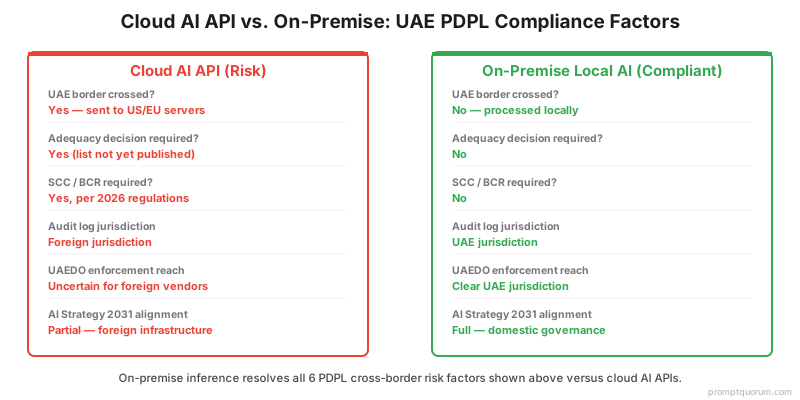
This table compares the PDPL compliance posture of cloud AI APIs versus on-premise local AI inference. Not legal advice — consult your DPO.
Factor | Cloud AI API | On-Premise Local AI |
|---|---|---|
| Data crosses UAE border? | Yes — sent to US/EU servers | No — processed locally |
| PDPL cross-border transfer obligation? | Yes — requires adequacy or SCCs | Not applicable (no transfer) |
| Adequacy decision required? | Yes (list not yet published) | No |
| SCC/BCR required? | Yes (per the 2026 Executive Regulations) | No |
| DPIA triggered by cross-border transfer? | Likely for sensitive data | Not by transfer (only if high-risk processing) |
| Audit logs jurisdiction? | Foreign jurisdiction | UAE jurisdiction |
| UAEDO enforcement reach? | Uncertain for foreign vendors | Clear UAE jurisdiction |
| UAE AI Strategy 2031 alignment? | Partial (foreign infrastructure) | Full (domestic data governance) |
Sovereign AI Deployment Options for UAE Organisations
These are the practical options for running AI within UAE borders:
- Option 1 — Self-hosted on-premise GPU server. Deploy an NVIDIA RTX 4090 or A100 server in your UAE data center. Run Ollama or vLLM with Falcon 3-7B, Llama 3.1-8B, or Qwen3-8B. Full sovereignty: your hardware, your jurisdiction.
- Option 2 — UAE-based cloud GPU. Use a cloud GPU provider with data centers physically located in the UAE (G42 Cloud, Microsoft Azure UAE North, AWS Middle East UAE). Data stays in-country. Check DPA scope carefully — Azure UAE North operates under Microsoft UAE terms, verify PDPL compliance with provider.
- Option 3 — Airgapped on-premise system. For maximum sovereignty (government, defence, financial regulators): pull model weights once, airgap the server, run offline. No outbound internet at inference time. See On-Prem Air-Gapped Local LLM.
- Option 4 — Hybrid: local inference, cloud fine-tuning. Fine-tune on anonymized or synthetic data (cloud acceptable for non-personal), deploy fine-tuned weights locally. Reduces transfer risk while leveraging cloud compute for model training.
- Recommended models for UAE sovereign deployment: Falcon 3 (1B–10B, TII Abu Dhabi — native UAE model), Jais (13B–30B, Core42/G42/MBZUAI — Arabic-English, Abu Dhabi), Llama 3.1 (8B–70B, Meta, Apache 2.0), Qwen3 (8B–32B, multilingual including Arabic).
DIFC and ADGM: Free Zone Data Protection Regimes
The UAE PDPL explicitly excludes free zones that already have their own data protection laws. Both DIFC and ADGM qualify.
DIFC (Dubai International Financial Centre): Operates under DIFC Data Protection Law No. 5 of 2020, a GDPR-modeled regime. In July 2025, Amendment Law No. 1 of 2025 came into force (effective July 15, 2025), aligning more closely with international best practices and introducing mandatory documented adequacy assessments for cross-border transfers. The DIFC Commissioner of Data Protection is the regulator.
ADGM (Abu Dhabi Global Market): Own GDPR-aligned data protection framework. Notably includes "legitimate interests" as a permitted legal basis — a basis not available under the federal PDPL, which relies more heavily on consent.
Three-layer compliance: Organisations operating in both mainland UAE and a free zone must manage compliance under both regimes. A UAE holding company with a DIFC subsidiary faces both federal PDPL and DIFC law.
- DIFC: DIFC Data Protection Law No. 5 of 2020 + Amendment Law No. 1 of 2025 (July 15, 2025)
- ADGM: ADGM Data Protection Regulations (GDPR-modeled, includes "legitimate interests" basis)
- Federal PDPL excludes free zones with own laws (DIFC, ADGM)
- Multi-entity groups: map each legal entity to its applicable regime separately
- On-premise AI advantage: in-zone hardware satisfies all three regimes simultaneously
UAE Sector-Specific AI Compliance Considerations
The federal PDPL is the baseline. Regulated sectors add further requirements on top:
- Banking and Finance (CBUAE, DFSA): The Central Bank of the UAE launched the world-first Sovereign Financial Cloud Services Infrastructure (SFCSI) on February 25, 2026 as part of the FIT Programme. Financial institutions processing customer data face CBUAE governance requirements layered on PDPL. The DFSA covers DIFC-regulated firms separately.
- Healthcare (DHA, ADHICS): Health data is "special category" personal data under the PDPL, carrying enhanced protections. The Dubai Health Authority (DHA) and the Abu Dhabi Healthcare Information and Cyber Security Standard (ADHICS) add sector-specific data governance requirements. AI used in clinical settings must address both PDPL and health regulatory frameworks.
- Government and Public Sector: Government entities typically process data within UAE domestic infrastructure by default. The UAE AI Strategy 2031 mandates domestic data governance frameworks for government AI. On-premise AI is the default-safe option for government deployments.
- Telecommunications: Pre-existing telecom regulatory frameworks cover telecom data. PDPL adds a federal overlay on personal data processed by telecom operators.
Common Questions About UAE PDPL and AI Compliance
Is the UAE PDPL similar to GDPR?
The UAE PDPL draws inspiration from GDPR but is not identical. Key differences: the PDPL relies more heavily on consent as a legal basis (GDPR also permits legitimate interests, which is not a standard PDPL basis); Executive Regulations are pending (GDPR implementation is mature); and enforcement is still developing. The DIFC and ADGM data protection laws are more closely modeled on GDPR and include legitimate interests.
Does the UAE PDPL mandate data localization — storing data physically inside the UAE?
The federal PDPL does not explicitly mandate data localization (requiring all data to be stored in-country). It regulates cross-border transfers — requiring adequate protection or contractual safeguards when data leaves the UAE. However, sector-specific rules (e.g., the CBUAE SFCSI for financial services) may effectively push toward in-country storage. On-premise AI achieves residency by keeping processing local.
What are the penalties for UAE PDPL non-compliance?
As of 2026, the Executive Regulations have been issued and the PDPL is in active enforcement, so the penalty and administrative-sanction framework now applies. The PDPL contemplates fines and other sanctions for violations; exact amounts and procedures are set out in the regulations, but reporting on the precise references has been inconsistent — so confirm the current penalty schedule with UAE legal counsel. Establishing compliant practices ahead of the January 1, 2027 deadline remains the safe course.
Does running AI locally automatically mean I am PDPL-compliant?
No — local AI deployment addresses the cross-border transfer risk but does not make you automatically compliant. You still need: lawful basis for processing personal data, DPIA for high-risk activities, data subject rights procedures (access, deletion, objection), and data retention and security policies. Local AI is a significant compliance aid, not a complete solution.
What is the UAE Data Office and what does it do?
The UAE Data Office (UAEDO) is the federal data protection regulator established by Federal Decree-Law No. 44 of 2021. It oversees PDPL implementation, conducts audits, investigates complaints, and issues guidance. As of early 2026, the Data Office was still building enforcement capacity and was expected to publish the Executive Regulations before the January 2027 deadline.
Does the UAE PDPL apply to my company if we are based outside the UAE?
The PDPL has extraterritorial scope: it can apply to organisations outside the UAE that process personal data of UAE residents or individuals in the UAE. The exact extraterritorial reach will be clarified by the Executive Regulations. Organisations with UAE customers or users should assess their obligations regardless of headquarters location.
How do I conduct a DPIA for an AI project under the UAE PDPL?
Under Article 21, a DPIA is required for processing likely to result in high risk: automated decision-making, large-scale profiling, sensitive data processing, or cross-border transfers to non-adequate jurisdictions. The DPIA should document: nature and purpose of processing, necessity assessment, risks identified, and mitigation measures. Update the DPIA when scope or purpose changes.
Do I need a Data Processing Agreement (DPA) with my cloud AI vendor under the PDPL?
Yes — if a cloud vendor processes personal data on your behalf, you need a contractual arrangement governing their processing obligations, similar to a GDPR Article 28 DPA. Cloud AI providers should offer a UAE PDPL-compliant data processing agreement. If cross-border transfer is involved, SCCs or BCRs are also required (pending Executive Regulations templates).
What is the difference between mainland PDPL, DIFC law, and ADGM law?
Mainland UAE entities are governed by the federal PDPL (Federal Decree-Law No. 45 of 2021). DIFC entities follow DIFC Data Protection Law No. 5 of 2020 (as amended July 2025). ADGM entities follow the ADGM Data Protection Regulations. The PDPL explicitly excludes free zones with their own laws. Multi-entity groups must map each legal entity to its applicable regime.
Which open-weight AI models are best for sovereign UAE deployment?
Three strong options: Falcon 3 (1B–10B, from Technology Innovation Institute, Abu Dhabi — a UAE-native model family), Jais (13B–30B, from Core42/G42/MBZUAI, Abu Dhabi — Arabic-English bilingual), and Llama 3.1 (8B–70B, Meta, Apache 2.0). All can be deployed on-premise with Ollama or vLLM. Falcon and Jais are particularly aligned with UAE AI sovereignty goals. See our Best Arabic Local LLMs guide.
Sources
- UAE Federal Decree-Law No. 45 of 2021 on the Protection of Personal Data — uaepdpl.com
- UAE Data Office (UAEDO) — uaedataoffice.gov.ae
- DIFC Data Protection Law No. 5 of 2020 and Amendment Law No. 1 of 2025 — difc.ae/business/laws-and-regulations/
- ADGM Data Protection Regulations — adgm.com/setting-up/financial-services-regulations
- CBUAE Sovereign Financial Cloud Services Infrastructure (SFCSI) announcement, February 25, 2026 — centralbank.ae
- Securiti UAE PDPL Overview — securiti.ai/uae-personal-data-protection-law
- Chambers and Partners — Data Protection & Privacy 2026, UAE — practiceguides.chambers.com