Key Takeaways
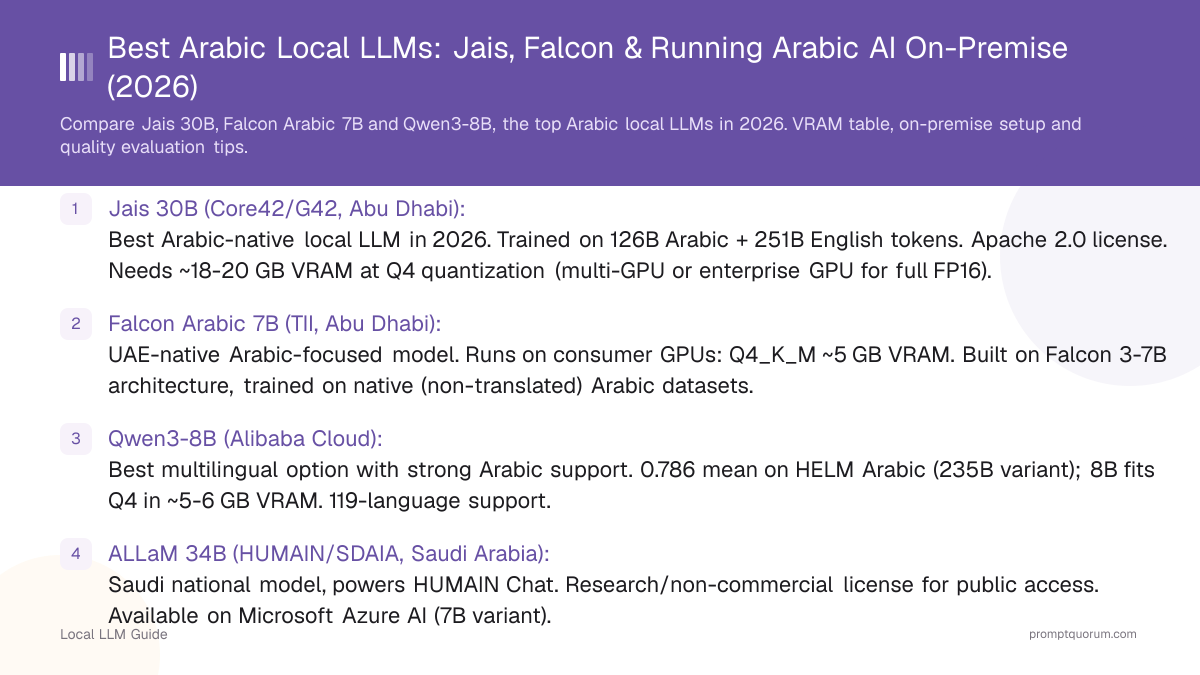
- Jais 30B (Core42/G42, Abu Dhabi): Best Arabic-native local LLM in 2026. Trained on 126B Arabic + 251B English tokens. Apache 2.0 license. Needs ~18-20 GB VRAM at Q4 quantization (multi-GPU or enterprise GPU for full FP16).
- Falcon-H1-Arabic 7B (TII, Abu Dhabi): UAE-native Arabic-focused model. Runs on consumer GPUs: Q4_K_M ~5 GB VRAM. Built on Falcon-H1 hybrid architecture, trained on native (non-translated) Arabic datasets.
- Qwen3-8B (Alibaba Cloud): Best multilingual option with strong Arabic support. 0.786 mean on HELM Arabic (235B variant); 8B fits Q4 in ~5-6 GB VRAM. 119-language support.
- ALLaM 34B (HUMAIN/SDAIA, Saudi Arabia): Saudi national model, powers HUMAIN Chat. Research/non-commercial license for public access. Available on Microsoft Azure AI (7B variant).
- Fanar-2-27B-Instruct (QCRI/HBKU, Qatar): Qatar's sovereign Arabic model, released around March 2026 under Apache 2.0. Continually pre-trained from a Gemma-3-27B-pt backbone on a curated 120B-token corpus, 32,768-token context. Scores OALL-v2 69.40 and ArabicMMLU 74.67. Q4_K_M ~16-17 GB VRAM estimate.
- MSA vs. dialect: All models handle Modern Standard Arabic (MSA) well. Dialect coverage varies — test your specific use case with real examples from your target variety.
- Deployment: Ollama supports Falcon-H1-Arabic natively (ollama run hf.co/tiiuae/Falcon-H1-Arabic-7B-Instruct-GGUF). Jais and ALLaM require GGUF conversion from Hugging Face for llama.cpp/Ollama.
- Data sovereignty: Running Arabic NLP locally keeps personal data within national borders — aligns with UAE PDPL, Saudi NDMO, and Gulf data-sovereignty goals.
📍 In One Sentence
Jais 30B (Apache 2.0, Abu Dhabi) and Falcon-H1-Arabic 7B (TII, Abu Dhabi) are the top Arabic-native local LLMs in 2026, with Qwen3-8B leading multilingual Arabic benchmarks for consumer hardware.
💬 In Plain Terms
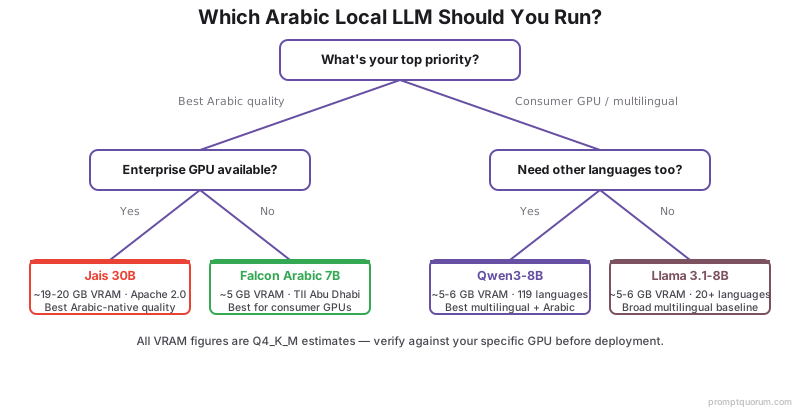
The best Arabic AI you can run on your own server: Jais 30B for best Arabic quality (needs a high-end GPU), Falcon-H1-Arabic 7B for regular computers, or Qwen3-8B if you also need other languages.
Why Arabic-Capable Local LLMs Matter
Arabic is the native language of over 300 million speakers across the Gulf, Levant, and North Africa. For enterprise AI in the UAE, Saudi Arabia, Qatar, Egypt, and beyond, Arabic-language quality is a practical requirement — not an afterthought.
MSA vs. dialectal Arabic. Modern Standard Arabic (الفصحى / MSA) is the formal written standard used in media, government, and education. Regional dialects (Gulf, Egyptian, Levantine, Moroccan) differ substantially — a model trained only on MSA may misread Gulf dialect inputs. Enterprise use cases should test both.
Data sovereignty is the second driver. Gulf regulators (UAE PDPL, Saudi Arabia NDMO) restrict cross-border personal data transfers. Sending Arabic customer or patient data to US-hosted cloud APIs creates transfer risk. Running Arabic NLP locally eliminates that risk. See our UAE PDPL data sovereignty guide.
"Translated-English" quality gap. Many general-purpose LLMs claim Arabic support but were fine-tuned primarily on translated English data. Tokenization for Arabic can be inefficient (Arabic script requires proper right-to-left tokenization). Truly bilingual models like Jais and Falcon-H1-Arabic are trained natively on Arabic corpora.
Best Arabic Local LLMs: Ranked for On-Premise Deployment
Ranked by Arabic-language capability and suitability for local/on-premise deployment.
- 1. Jais 30B — Best Arabic Quality (Apache 2.0, On-Premise Ready). Developer: Core42 / Inception AI (G42 group, Abu Dhabi) + MBZUAI research + Cerebras training. Training: 126B Arabic tokens + 251B English tokens + 50B code tokens. Human evaluation shows Jais 30B outperforms Jais 13B in Arabic 96% of evaluations. License: Apache 2.0 (fully open, commercial use allowed). Hugging Face: inceptionai/jais-30b-v3. VRAM: ~18-20 GB Q4 estimate (enterprise GPU or multi-GPU for FP16). Best for: highest Arabic quality in enterprise document processing, customer support, and government deployments where Arabic is primary.
- 2. Falcon-H1-Arabic 7B — Best for Consumer Hardware (TII Abu Dhabi). Developer: Technology Innovation Institute (TII), Abu Dhabi (under the Advanced Technology Research Council). Base: Falcon-H1 hybrid architecture (released January 5, 2026). Training: native (non-translated) Arabic datasets, MSA and regional dialects. License: Falcon LLM License — permissive, commercial use allowed. VRAM: Q4_K_M ~5 GB — runs on RTX 4060 8GB, RTX 3060 12GB, and equivalent. Benchmark: scores 71.47% on the Open Arabic LLM Leaderboard (OALL) — the top score among ~10B-class Arabic models, ahead of ALLaM-7B, Fanar-9B, and Qwen3-8B, and superseding the original Falcon 3-based Falcon Arabic checkpoint. Best for: consumer and prosumer hardware deployments; a UAE-native model from an Abu Dhabi institution.
- 3. Qwen3-8B — Best Multilingual Option with Strong Arabic (Alibaba Cloud). Developer: Alibaba Cloud. Languages: 119 languages and dialects. Benchmark: Qwen3-235B-A22B scored 0.786 mean on HELM Arabic; the 8B variant is recommended for local hardware. License: Apache 2.0. VRAM: Q4_K_M ~5-6 GB. Best for: teams needing Arabic + English + other languages in one model; widely supported in Ollama (ollama pull qwen3:8b).
- 4. ALLaM 34B / 7B — Saudi National Model (HUMAIN/SDAIA). Developer: SDAIA (Saudi Data and AI Authority) / HUMAIN (Saudi national AI company). Versions: 7B (Hugging Face, research access) and 34B (powers HUMAIN Chat). Azure: ALLaM-2-7B-Instruct available on Microsoft Azure AI since September 2024. License: research/non-commercial for public access; enterprise licensing via HUMAIN. Best for: Saudi government and enterprise deployments; a sovereign model aligned with Vision 2030.
- 5. Fanar-2-27B-Instruct — Qatar's Sovereign Arabic Model (Apache 2.0). Developer: Qatar Computing Research Institute (QCRI), Hamad Bin Khalifa University (HBKU), Qatar. Released: approximately March 2026 (technical report "Fanar 2.0: Arabic Generative AI Stack"). Base: continually pre-trained from a Gemma-3-27B-pt backbone on a curated 120B-token corpus, trained on 256 NVIDIA H100 GPUs. Context length: 32,768 tokens. License: Apache 2.0 — fully open, commercial use allowed. Coverage: Modern Standard Arabic (MSA) plus Gulf, Levantine and Egyptian dialects. Features: native Arabic reasoning traces, selective thinking mode, and tool calling; the wider Fanar 2.0 family is multimodal (image, speech-to-text, text-to-speech, audio understanding, Arabic poetry generation). Benchmark: OALL-v2 69.40, ArabicMMLU 74.67, Belebele 86.81, ACVA 82.70. VRAM: Q4_K_M ~16-17 GB estimate, FP16 ~54 GB estimate; GGUF quantizations run in llama.cpp, Ollama, and LM Studio. Best for: Qatari and Gulf public-sector and enterprise deployments that need a sovereign Arabic model under a fully permissive commercial license.
- 6. Llama 3.1-8B-Instruct — Best General Multilingual Baseline (Meta). Developer: Meta. Languages: 20+ including Arabic. License: Meta Llama 3.1 License — permissive, broad commercial use. VRAM: Q4_K_M ~5-6 GB. Best for: Arabic workloads that also need broad multilingual support; widely deployed with extensive community support. Use Qwen3-8B or Jais if Arabic quality is the primary concern.
- 7. Gemma 3 (4B/12B) — Strong Multilingual Including Arabic (Google). Developer: Google. Languages: 140+ including Arabic (MSA and Classical). License: Gemma Terms of Use (permissive for most commercial uses). VRAM: 4B at Q4 ~3 GB; 12B at Q4 ~8 GB. Best for: teams already in the Google ecosystem; multilingual translation and summarization; Arabic-script document processing.
VRAM Requirements for Arabic Local LLMs
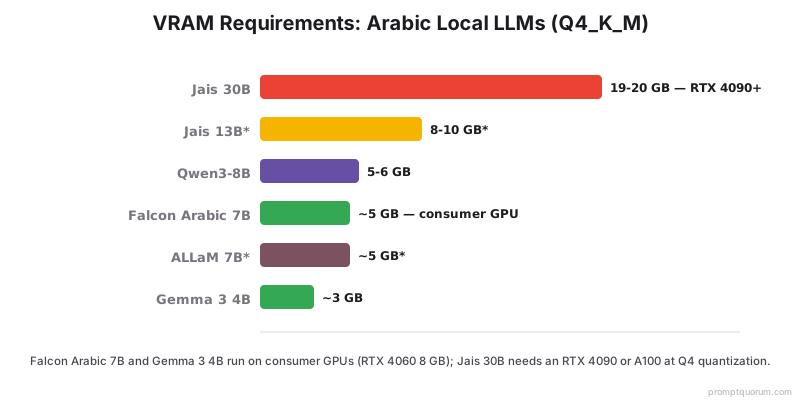
Required VRAM by model and quantization. Rows marked * are parameter-scaling estimates (no official benchmark found). Always verify with your specific hardware before deployment.
Model | Params | Q4_K_M VRAM | FP16 VRAM | Min Hardware |
|---|---|---|---|---|
| Falcon-H1-Arabic | 7B | ~5 GB | ~16.7 GB | RTX 4060 8 GB / RTX 3060 12 GB |
| Jais 13B | 13B | ~8-10 GB* | ~26 GB* | RTX 3090 24 GB (Q4) |
| Jais 30B | 30B | ~18-20 GB* | ~60 GB* | RTX 4090 24 GB (Q4 tight), A100 40 GB (FP16) |
| ALLaM | 7B | ~5 GB* | ~16 GB* | RTX 4060 8 GB / RTX 3060 12 GB |
| Fanar-2 | 27B | ~16-17 GB* | ~54 GB* | RTX 4090 24 GB (Q4) |
| Qwen3 | 8B | ~5-6 GB | ~16 GB | RTX 4060 8 GB / RTX 3060 12 GB |
| Llama 3.1 | 8B | ~5-6 GB | ~16 GB | RTX 4060 8 GB / RTX 3060 12 GB |
| Gemma 3 | 4B | ~3 GB | ~8 GB | RTX 3060 8 GB |
How to Run Arabic Models On-Premise with Ollama
Step-by-step for deploying Arabic models locally on a GPU server or workstation.
- 1Install Ollama: curl -fsSL https://ollama.com/install.sh | sh (Linux) or download from ollama.com (Windows/Mac). Supports Falcon-H1-Arabic natively.
- 2Pull and run Falcon-H1-Arabic 7B: ollama run hf.co/tiiuae/Falcon-H1-Arabic-7B-Instruct-GGUF — ~5 GB download, auto-runs after pulling. Test Arabic with a prompt like "اكتب قصيدة عن أبوظبي" (Write a poem about Abu Dhabi).
- 3Pull Qwen3-8B for multilingual: ollama pull qwen3:8b — ~5 GB download. Strong Arabic across MSA and dialect contexts.
- 4For Jais 30B: download from Hugging Face (inceptionai/jais-30b-v3), convert to GGUF with llama.cpp convert tools, quantize to Q4_K_M, then load with Ollama (ollama create jais-30b -f Modelfile) or the llama.cpp server.
- 5Production inference: use vLLM for high-throughput Arabic API serving. vLLM supports Falcon-H1-Arabic and Qwen3 natively. Expose via an OpenAI-compatible endpoint at localhost:8000.
- 6Arabic prompt tip: always specify the language — "أجب باللغة العربية الفصحى" (Answer in Modern Standard Arabic). For dialect, include example sentences from the target dialect in the system prompt.
How to Evaluate Arabic LLM Quality for Your Use Case
Benchmarks give you a starting point. Real-world Arabic quality must be evaluated on your specific domain and dialect.
- HELM Arabic (Stanford CRFM): Holistic multilingual evaluation. Qwen3-235B scored 0.786 mean. Use it as a relative comparison point between models — not an absolute quality score for your domain.
- ALUE (Arabic Language Understanding Evaluation): 8 NLU tasks including sentiment analysis, stance detection, and dialect identification. Twitter-heavy dataset — good for social media and customer-feedback use cases.
- ArabicMMLU: Academic and professional knowledge tasks in MSA. Best benchmark for enterprise knowledge base and document Q&A quality.
- AraBench: Dialect-specific translation quality (Egyptian, Syrian, Gulf). If your use case involves Gulf Arabic specifically, test here.
- Your own evaluation (recommended): Write 20-30 test prompts in your actual domain and target dialect. Score outputs on (1) factual accuracy, (2) natural Arabic grammar, (3) appropriate register (formal vs. dialect), and (4) correct right-to-left structure in reasoning.
- Red flag: If the model switches to English mid-response unprompted, or produces "translated" phrasing (word-for-word translations from English patterns), quality is insufficient for production Arabic use.
Common Questions About Arabic Local LLMs
Can I run an Arabic LLM on a regular gaming laptop?
Yes, for 7B-class models at Q4 quantization. Falcon-H1-Arabic 7B and Qwen3-8B require ~5-6 GB VRAM — most gaming laptops with an RTX 4060 (8 GB) or RTX 3060 (12 GB) can run them. Jais 30B requires a high-end desktop GPU (RTX 4090 24 GB) or an enterprise GPU at Q4 quantization.
What is the difference between Jais and Falcon-H1-Arabic?
Both are Abu Dhabi-originated Arabic-capable models. Jais (Core42/G42) is larger (up to 30B) and trained specifically as Arabic-English bilingual with 126B Arabic tokens — optimised for Arabic quality at enterprise scale. Falcon-H1-Arabic is a 7B model from TII (a different Abu Dhabi institution) built on the broader Falcon-H1 hybrid architecture — consumer-GPU friendly and part of the UAE AI ecosystem. For best Arabic quality: Jais 30B. For consumer hardware: Falcon-H1-Arabic 7B.
Does Qwen3 support Arabic as well as dedicated Arabic models?
Qwen3 has very strong general Arabic support (119 languages, leading HELM Arabic score). For purely Arabic enterprise deployments requiring the absolute best Arabic quality, Jais 30B is generally preferred. For mixed multilingual workloads where Arabic is one of several languages needed, Qwen3-8B is often the better choice due to its breadth and ease of deployment.
What is ALLaM and can I use it commercially?
ALLaM is a Saudi national Arabic-centric LLM family from SDAIA (now under the HUMAIN brand). The public releases (7B on Hugging Face, 7B on Azure AI) carry research/non-commercial licenses. For commercial use in Saudi Arabia or enterprise deployments, contact HUMAIN/SDAIA directly. ALLaM 34B powers the national HUMAIN Chat app but has restricted public access.
How does Arabic tokenization affect model quality?
Arabic script requires proper tokenization to avoid character-level errors. Models trained natively on Arabic (Jais, Falcon-H1-Arabic) use tokenizers optimized for Arabic morphology. General multilingual models may tokenize Arabic inefficiently (splitting root-and-pattern morphology), leading to quality degradation on complex Arabic text. Test with your actual input data before production deployment.
Can Arabic local LLMs handle right-to-left (RTL) documents?
The models generate Arabic text in the correct right-to-left direction — Arabic is bidirectional in Unicode and models produce proper RTL Arabic. Your application interface must handle RTL rendering (HTML dir="rtl", CSS direction:rtl). llama.cpp, Ollama, and vLLM return Unicode Arabic text correctly; the UI layer handles direction.
Which Arabic LLM is best for UAE government deployments?
Falcon-H1-Arabic 7B (from TII, Abu Dhabi) and Jais 30B (from Core42/G42, Abu Dhabi) are both UAE-native models with provenance from UAE government-affiliated research institutions. For sovereignty and auditability, these are the most aligned choices. Both can be deployed on-premise without any data leaving UAE infrastructure. See our UAE PDPL data sovereignty guide.
How do I handle Gulf Arabic dialect vs. MSA in prompts?
Default system prompt: "أجب باللغة العربية الفصحى" (Answer in Modern Standard Arabic). For Gulf Arabic (Emirati, Saudi, Kuwaiti), add example dialect phrases in your system prompt or fine-tune on domain data. All listed models handle MSA well; dialect quality varies. Test specifically with 5-10 example dialect queries before assuming production quality.
Can I fine-tune Jais or Falcon-H1-Arabic on my own Arabic data?
Yes — both use open licenses (Apache 2.0 for Jais, Falcon LLM License for Falcon-H1-Arabic) that permit fine-tuning. Use LoRA or QLoRA fine-tuning with tools like Unsloth or the PEFT library. Fine-tuning on domain-specific Arabic data (legal, medical, financial) significantly improves quality for specialized use cases. Keep fine-tuning data on-premise for PDPL compliance.
What hardware do I need to run Jais 30B locally?
At Q4_K_M quantization, Jais 30B requires an estimated 18-20 GB VRAM (estimate — no official benchmark). An NVIDIA RTX 4090 (24 GB) can run it at Q4 with moderate context; an A100 40 GB handles it comfortably at FP16. For production throughput, two RTX 4090s in multi-GPU mode or a single A100/H100 is recommended. See our VRAM calculator guide.
Sources
- Technology Innovation Institute (TII) — Falcon-H1-Arabic announcement, January 5, 2026 — tii.ae
- Falcon-H1-Arabic Hugging Face model page — huggingface.co/blog/tiiuae/falcon-h1-arabic
- Core42 / Cerebras — Jais 30B press release — cerebras.ai and g42.ai
- Jais 30B on Hugging Face — huggingface.co/inceptionai/jais-30b-v3
- SDAIA / HUMAIN — ALLaM 34B announcement, May 2025 — humain.ai
- ALLaM-2-7B on Microsoft Azure AI — techcommunity.microsoft.com (September 2024)
- QCRI / HBKU — "Fanar 2.0: Arabic Generative AI Stack" technical report and Fanar-2-27B-Instruct model card — arxiv.org/abs/2603.16397
- HELM Arabic — Stanford CRFM, December 2025 — crfm.stanford.edu/2025/12/18/helm-arabic.html
- Qwen3 Technical Report — arxiv.org/abs/2505.09388
- ALUE Benchmark — aclanthology.org/2021.wanlp-1.18
- TII Arabic LLM Benchmarks — github.com/tiiuae/Arabic-LLM-Benchmarks