Key Takeaways
- MIT license across every version of the project (main repo, archive, and the later BabyAGI 2o/3 experiments)
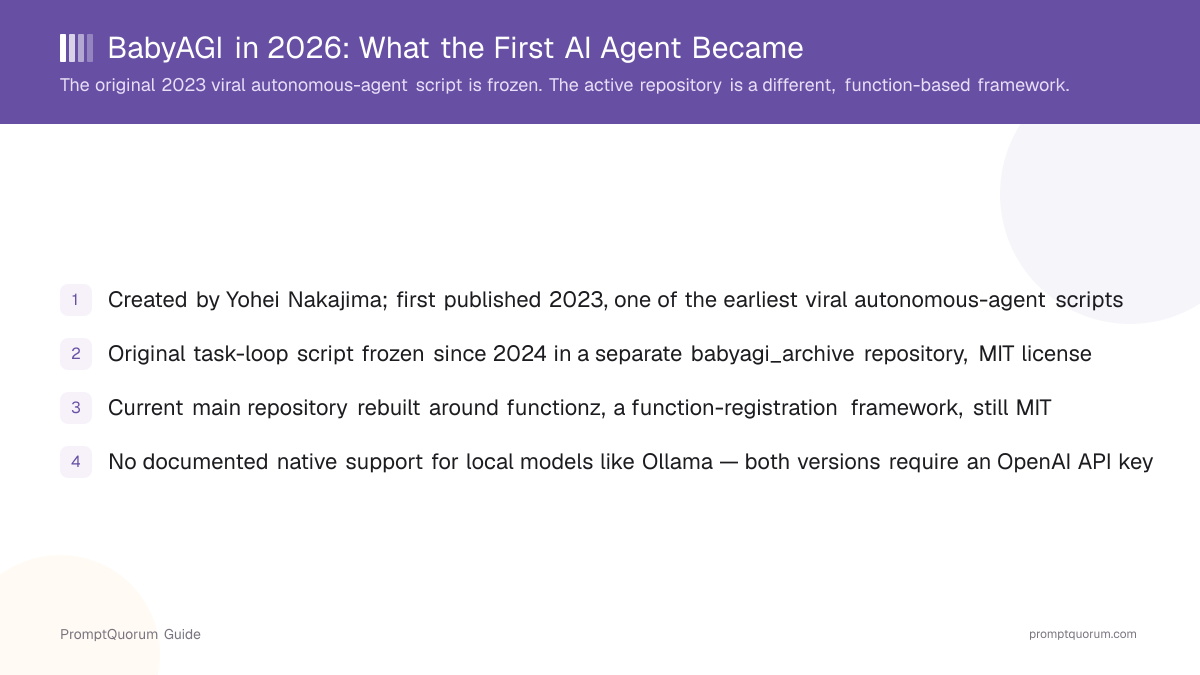
- Created by Yohei Nakajima; first published in 2023 as one of the earliest viral autonomous-agent scripts
- The original task-create-prioritize-execute loop is frozen in the babyagi_archive repository since September 2024
- The current main repository is a 2024 rebuild called functionz — a function-registration and dependency-graph framework with a web dashboard
- No documented native support for local models (Ollama, LM Studio, or similar) in any version — all require an OpenAI API key
- The project's own README calls it solo-maintained and experimental, and states it is "not meant for production use"
- No commercial product, paid tier, or affiliate program exists for BabyAGI
📍 In One Sentence
BabyAGI is a free, MIT-licensed autonomous-agent project created by Yohei Nakajima in 2023; the original viral task-loop script is now frozen in an archive repository, and the actively updated main repository is a 2024 rebuild around a different framework called functionz.
💬 In Plain Terms
The BabyAGI everyone remembers — a script that made its own to-do list and worked through it — still exists, but it is not what you install today. The current repository is a smaller, solo-maintained framework for functions an AI can register and call, and it needs an OpenAI API key rather than a local model.
📌Note: If you are looking for the classic "autonomous to-do list" agent, that code lives in the babyagi_archive repository, not the current babyagi repository — they are different codebases under the same name.
Who Built BabyAGI, and Is It Still Maintained?
Yohei Nakajima created BabyAGI and still maintains it alone. He first published the project in 2023 as a small Python script demonstrating an autonomous task loop: an LLM call created new tasks, another call prioritized them, a third executed the top task, the result was stored, and the loop generated further tasks from that result. It was one of the earliest projects to popularize the idea of an "autonomous AI agent" running with minimal human input.
That original script is no longer the active codebase. Its own README states plainly: "This project has been archived and moved to the babyagi_archive repo (September 2024 snapshot)." The repository at github.com/yoheinakajima/babyagi now contains a different project — a 2024 rebuild the README describes as "an experimental framework for a self-building autonomous agent," built around a function-management system called functionz.
Original script published
- Date:
- 2023
- What it means:
- The task-create-prioritize-execute loop that made BabyAGI viral; OpenAI API + a vector store for task memory. Preserved at github.com/yoheinakajima/babyagi_archive
Original code frozen
- Date:
- 2024-09
- What it means:
- Moved to the babyagi_archive repository as a snapshot; no further updates to that codebase
functionz rebuild
- Date:
- 2024
- What it means:
- Current main repository replaces the task loop with a function-registration and dashboard framework
BabyAGI 2o / BabyAGI 3
- Date:
- 2024–2026
- What it means:
- Separate side-projects by the same author exploring self-building agents and a minimal autonomous assistant — babyagi-2o and babyagi3
📌Note: The project has no company or funding behind it. The README describes Yohei Nakajima as someone who "has never held a job as a developer" and asks that the code be treated as an experiment, not production software.
What Is BabyAGI?
BabyAGI (github.com/yoheinakajima/babyagi, MIT license) is an open-source, Python-based framework for building autonomous AI agents. Its current form is centered on functionz — a system for registering Python functions with metadata (dependencies, required API keys, descriptions), executing them, and logging the results through a local web dashboard.
- Function registration: any Python function can be decorated with
@babyagi.register_function()and exposed to the framework - Dependency tracking: functions can declare other functions or secret keys they depend on, forming a graph BabyAGI manages
- Dashboard: a Flask-based local web UI for managing registered functions, running them, and viewing execution logs
- Function packs: pre-built bundles of functions that can be loaded with
babyagi.load_functions(...) - Self-build experiments: draft features that use an LLM to generate new functions on demand for a described task — explicitly marked experimental and unstable in the README
- Installable via
pip install babyagi
How Is BabyAGI Different From the Original Viral Version?
The BabyAGI repository you find on GitHub today runs on a different architecture than the script that went viral in 2023. The original task loop is preserved but frozen in a separate repository; the active repository is a smaller, general-purpose function framework.
The original 2023 script
A single-objective loop: one LLM call generated a list of tasks toward a goal, another call reordered that list by priority, a third executed the top task using the OpenAI API, and the result was stored in a vector database so future task generation could reference past results. It required an OpenAI API key and a vector store (commonly Pinecone) and ran as a standalone script, not a package.
The current functionz-based repository
Instead of a fixed task loop, the current babyagi package lets you register arbitrary Python functions, track their dependencies, and run them from a dashboard or programmatically. It ships "self-build" draft features that use an LLM to write new functions for a described task, but the README marks these experimental and warns the generated code "may need improvement."
Why this matters before you install anything
A tutorial or blog post referencing "BabyAGI's task loop" is almost always describing the archived 2023 code, not what pip install babyagi gives you today. Check which repository a guide points to — babyagi_archive for the classic loop, or babyagi for the current functionz framework — before assuming they behave the same way.
Does BabyAGI Support Local Models Like Ollama?
No — neither the current BabyAGI repository nor the archived original documents native support for local models such as Ollama or LM Studio. Both versions are built around the OpenAI API.
- The current functionz-based repository stores credentials through
babyagi.add_key_wrapper('openai_api_key', ...)— the README does not document a way to point this at a local, OpenAI-compatible server - The archived original script called the OpenAI API directly inside its task-creation, prioritization, and execution functions, with no configurable model backend
- Some third-party forks and community projects attempt to adapt BabyAGI-style loops to local models, but these are not part of either official repository and carry no maintenance guarantee
- This is a meaningful gap for readers of this site: unlike tool-calling harnesses such as Cline or Continue.dev evaluated for local agent use, BabyAGI does not ship a documented path to run entirely offline against a self-hosted model
How Do You Install and Run BabyAGI?
Installing the current BabyAGI package takes one pip command; running a function through it takes a few more lines of Python. This covers the active functionz-based repository — the archived original is not recommended for new setups.
- 1Install the package:
pip install babyagi. - 2Create a minimal script that starts the dashboard:
import babyagithenapp = babyagi.create_app('/dashboard')andapp.run(host='0.0.0.0', port=8080). - 3Open
http://localhost:8080/dashboardin a browser to reach the function management UI. - 4Register a function in Python using the
@babyagi.register_function()decorator, optionally declaringdependencieson other registered functions andkey_dependenciesfor secrets it needs. - 5Add any required secret, such as an OpenAI key, with
babyagi.add_key_wrapper('openai_api_key', 'your_key')— either in code or through the dashboard. - 6Load a pre-built function pack with
babyagi.load_functions('path/to/pack')instead of writing every function by hand, then run and monitor executions from the dashboard.
Do I need an OpenAI API key to use BabyAGI?
For any function that calls an LLM — including the built-in draft "self-build" features — yes. The framework itself will run without one, but most of its useful function packs assume an OpenAI API key is registered.
What Python version does BabyAGI require?
The project's pyproject.toml specifies Python 3.10 or newer, below 3.12, along with Flask and a small set of supporting packages.
Who Should Use BabyAGI?
BabyAGI fits developers curious about the function-registration model or studying the history of autonomous-agent design — it is a weak fit for anyone who needs a production or local-model agent today. The project's own README says as much.
Use BabyAGI if
- You want to study one of the original autonomous-agent designs, including the frozen 2023 task loop in babyagi_archive
- You are experimenting with a lightweight function-registration and dependency-tracking pattern for LLM-callable Python functions
- You are comfortable working with a solo-maintained, experimental project and reading source code when documentation is thin
- You already have an OpenAI API key and do not need a local-model path
Avoid BabyAGI if
- You need a production-ready or actively supported agent framework — the README explicitly discourages production use
- You need native local-model support without custom integration work — neither BabyAGI version documents an Ollama or LM Studio path
- You expect a large plugin ecosystem, template marketplace, or enterprise backing — BabyAGI is a solo project with no corporate sponsor
- You want the classic "autonomous to-do list" behavior maintained going forward — that codebase is frozen, not developed further
BabyAGI vs. Alternatives
BabyAGI shares its 2023 "viral autonomous agent" origin with AutoGPT, and its function-and-graph approach invites comparison with newer orchestration frameworks. Maintenance activity is the sharpest differentiator.
Tool | Interface | License | Backing | Maintenance |
|---|---|---|---|---|
| BabyAGI | Python framework | MIT | Independent (Yohei Nakajima) | Solo, low activity |
| AutoGPT | CLI + web UI | MIT | Independent (Significant Gravitas) | Active |
| CrewAI | Python framework | MIT | Independent (CrewAI, Inc.) | Active |
| LangGraph | Python / TS code | MIT | LangChain, Inc. | Active |
| Langflow | Visual, Python-based | MIT | IBM (via DataStax) | Active |
For a full write-up of Langflow's ownership and self-hosting path, see the Langflow review. For how well local agent stacks actually perform on real tasks, see Local AI Agents in 2026: What Actually Works.
Common Mistakes When Evaluating BabyAGI
Most confusion about BabyAGI comes from conflating two different codebases that share a name, or assuming it fits a local-model workflow it was never built for.
Mistake 1: Assuming the current repo is the viral 2023 script
The task-create-prioritize-execute loop that made BabyAGI famous is preserved only in the babyagi_archive repository as a frozen snapshot. The active babyagi repository has been a different, function-registration-based project since 2024.
Mistake 2: Expecting native local-model (Ollama) support
Neither the current nor the archived codebase documents a way to run against a local model. Every function pack that calls an LLM assumes an OpenAI API key.
Mistake 3: Treating it as production-ready because it has thousands of stars
Star count reflects the project's historical influence, not its current maintenance guarantees. The README states directly that it is solo-maintained, experimental, and "not meant for production use."
Frequently Asked Questions
Who created BabyAGI?
Yohei Nakajima created BabyAGI and first published it in 2023. He continues to maintain the project alone.
Is BabyAGI still maintained?
The current main repository (functionz-based) receives occasional commits from its solo maintainer. The original 2023 task-loop script is frozen and has received no updates since it was moved to the babyagi_archive repository in September 2024.
What license is BabyAGI released under?
MIT, across the main repository, the archived original, and the later BabyAGI 2o and BabyAGI 3 side-projects.
Does BabyAGI support local models like Ollama?
No. Neither the current nor the archived version documents native support for local models. Both are built around an OpenAI API key.
What is the difference between BabyAGI and the original viral BabyAGI script?
The original script (2023) ran a fixed loop: create tasks, prioritize them, execute the top one, store the result, repeat. That code is frozen in the babyagi_archive repository. The current babyagi repository, rebuilt in 2024, is a general-purpose function-registration framework called functionz, unrelated in architecture to the original loop.
What are BabyAGI 2o and BabyAGI 3?
Later, separate experiments by Yohei Nakajima. BabyAGI 2o explores a minimal self-building agent that writes and registers its own tools; BabyAGI 3, announced in 2026, is described as a minimal autonomous assistant with scheduling, secrets management, and graph-based memory. Both are distinct repositories from the main babyagi project.
Is BabyAGI free to use?
Yes. BabyAGI is fully open source under the MIT license with no paid tier, hosted product, or affiliate program.
How popular is BabyAGI on GitHub?
The main repository has passed 22,000 stars, reflecting its influence as one of the earliest viral autonomous-agent projects. Check the repository directly for the current count, since star totals change continuously.
Is BabyAGI production-ready?
No. The project's own README states it is maintained by one person "on nights and weekends" and explicitly says it is "not meant for production use."
How does BabyAGI compare to AutoGPT?
Both emerged in 2023 as early viral autonomous-agent projects. AutoGPT has continued as an actively maintained project with a CLI and web interface; BabyAGI's original design was frozen in 2024 and its active repository pivoted to a smaller, solo-maintained function framework.