Key Takeaways
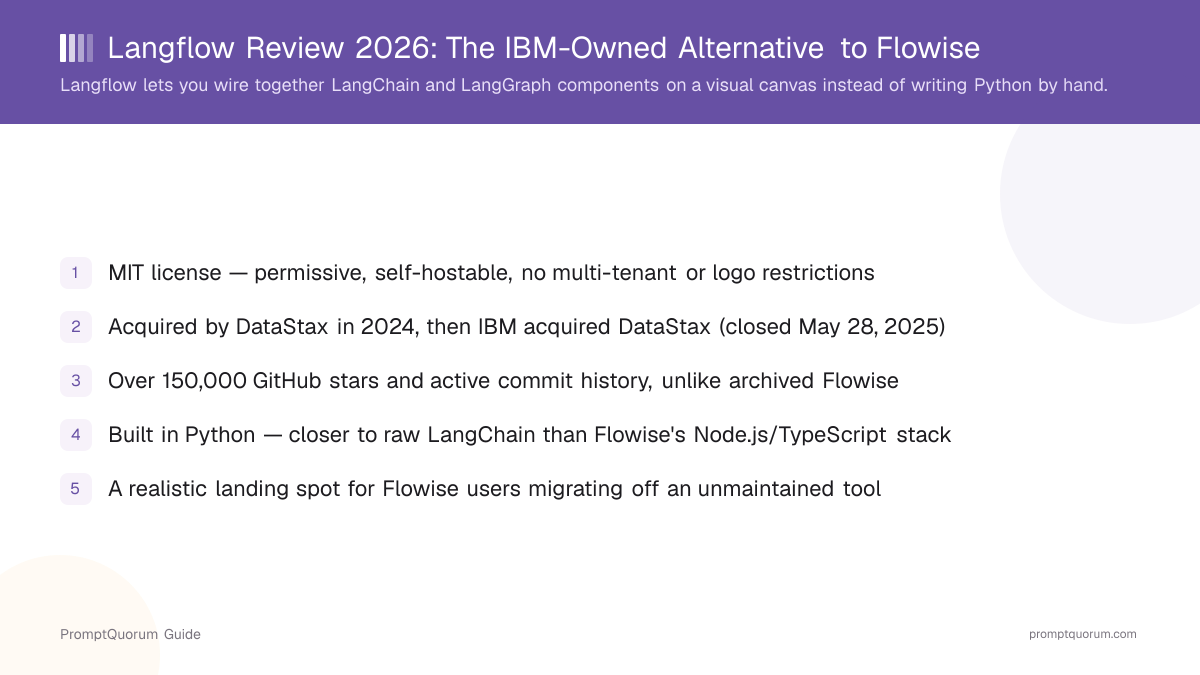
- MIT license — permissive, self-hostable, no multi-tenant or logo restrictions
- Originally built by Logspace; acquired by DataStax in April 2024, then IBM acquired DataStax (closed May 28, 2025)
- Over 150,000 GitHub stars and active commit history, unlike the archived Flowise repository
- Built in Python — closer to raw LangChain than Flowise's Node.js/TypeScript stack
- Self-hosting via Docker, pip/uv, or the Langflow Desktop app (Windows/macOS)
- A hosted cloud tier, DataStax Langflow, runs on IBM's Astra DB vector database
- A realistic landing spot for Flowise users migrating off an archived, unmaintained tool
📍 In One Sentence
Langflow is an open-source, MIT-licensed, Python-based visual builder for LangChain/LangGraph agents and RAG pipelines, owned by IBM through its 2025 acquisition of DataStax and still actively developed.
💬 In Plain Terms
Instead of writing LangChain code by hand, Langflow gives you a drag-and-drop canvas to connect an LLM, a document loader, and a vector database — and a corporate parent (IBM) keeps paying people to maintain it.
📌Note: Langflow and Flowise are not the same project. Both generate LangChain/LangGraph constructs visually, but they are separate codebases with separate companies behind them.
Who Owns Langflow, and Is It Still Maintained?
IBM owns Langflow, and the project is actively maintained. Langflow started as an open-source project by Logspace, which DataStax acquired in April 2024 to build out its AI application tooling. IBM then announced it would acquire DataStax on February 25, 2025, and the acquisition closed on May 28, 2025 — making Langflow, along with DataStax's Astra DB vector database, part of IBM.
This ownership chain matters for longevity in a way it did not for Flowise, which was maintained by a small independent company (FlowiseAI) that shut down its own operations in 2026. IBM has folded Langflow into its watsonx.ai portfolio as a low-code layer for building agents on top of IBM's Granite models and other providers, which gives it a commercial reason to keep funding development.
Logspace → DataStax
- Date:
- 2024-04
- What it means:
- Langflow's original creator is acquired; DataStax becomes the maintaining company
IBM → DataStax deal announced
- Date:
- 2025-02-25
- What it means:
- IBM announces intent to acquire DataStax, including Langflow
Acquisition closes
- Date:
- 2025-05-28
- What it means:
- DataStax, and Langflow with it, formally becomes part of IBM
watsonx.ai integration
- Date:
- Ongoing
- What it means:
- IBM positions Langflow as middleware for building agents inside watsonx.ai
📌Note: The MIT-licensed core project stays fully open source and self-hostable regardless of who owns the trademark — the same code runs whether or not you ever touch IBM's or DataStax's hosted products.
What Is Langflow?
Langflow is an open-source (MIT license, github.com/langflow-ai/langflow) low-code platform for building and deploying AI agents and RAG applications through a visual, node-based interface built on Python. Its site tagline is "Drag. Drop. Deploy," and the repository has passed 150,000 GitHub stars.
- Visual canvas for assembling LangChain and LangGraph flows without hand-writing chain logic
- Agent support: agents can call other components on the canvas as tools, with multi-agent orchestration and conversation memory
- Python customization: any node can be edited or extended with raw Python for logic the visual library does not cover
- Deployment as an API endpoint, an exported JSON flow, or as an MCP (Model Context Protocol) server
- Interactive Playground for step-by-step testing of a flow before deployment
- Observability integrations with LangSmith and LangFuse for tracing agent runs
How Is Langflow Different From Flowise?
Langflow and Flowise solve the same problem — visual LangChain/LangGraph orchestration — with different codebases, different languages, and now, very different maintenance outlooks. Langflow is Python-based and stays closer to raw LangChain semantics; Flowise was Node.js/TypeScript-based and, as of 2026, is archived and unmaintained.
Where Langflow has the edge
Langflow is actively developed under a well-funded corporate owner (IBM), which removes the single biggest risk a frozen, unmaintained tool carries: no one patching vulnerabilities or adding new integrations. Its Python foundation also means custom logic looks like ordinary LangChain code, not JavaScript wedged into a "Custom Function" node.
Where Flowise had the edge (while maintained)
Before its shutdown, Flowise offered a broader integration library, a template marketplace, and features like Chatflow/Agentflow split modes plus partial multi-tenancy for hosting multiple customer-facing bots from one instance. Langflow's versioning is more manual — you export a flow as JSON rather than relying on built-in multi-tenant hosting.
If you are migrating off Flowise
Langflow is a reasonable landing spot: same underlying LangChain/LangGraph concepts, similar node-and-wire mental model, MIT instead of Apache 2.0 licensing (both permissive), and — critically — an owner with a commercial incentive to keep it updated. Expect to manually rebuild flows; there is no automated Flowise-to-Langflow import tool.
Does Langflow Support RAG and AI Agents?
Yes — RAG and agent orchestration are Langflow's core use cases, not add-ons. The platform ships dedicated component categories for both, and IBM's parent company, DataStax, builds its own vector database (Astra DB) directly into the component library.
- RAG: a Vector Store RAG template splits ingestion and query into two flows — one loads and chunks a file, embeds it, and indexes it; the other embeds a user query and retrieves the closest matches
- Vector stores: dedicated components for Astra DB (DataStax/IBM's own product) plus other common vector databases, so RAG pipelines are not locked to one backend
- Local LLMs: a dedicated Ollama bundle ships both a chat-model component and an embeddings component, so a flow can run entirely against a locally-hosted model instead of a cloud API
- Agents: any component on the canvas can be exposed as a tool an agent calls, and Langflow supports multi-agent orchestration with conversation memory across turns
- Deployment: a finished flow becomes a callable API, an exportable JSON file, or an MCP server other AI clients can connect to
How Do You Self-Host Langflow?
Self-hosting Langflow does not require any IBM or DataStax account — the open-source package runs entirely on your own hardware. Docker is the fastest path; pip/uv and the desktop app are the alternatives.
- 1Confirm your machine meets the minimum requirements: a dual-core CPU and 2 GB RAM (4 GB+ and a multi-core CPU recommended), plus a Chromium-based browser if you are not using the desktop app.
- 2For Docker: run
docker run -p 7860:7860 langflowai/langflow:latestand open http://localhost:7860 once the container starts. - 3For pip/uv: install Python 3.10–3.14, then run
uv pip install langflow -Ufollowed byuv run langflow runto start the local server. - 4Alternatively, install Langflow Desktop (Windows, or macOS 13+) for a packaged app that manages its own dependencies — note it drops the Shareable Playground and Voice Mode features available in the browser version.
- 5Build a flow by dragging components onto the canvas: an LLM node, a prompt, and — for RAG — a document loader, embedding model, and vector store component wired together.
- 6Deploy the finished flow as an API endpoint, export it as JSON for version control, or expose it as an MCP server for other AI tools to call.
Do I need a DataStax or IBM account to self-host Langflow?
No. The open-source langflow package on GitHub and PyPI runs independently of any DataStax or IBM cloud account. Accounts are only needed for the hosted DataStax Langflow product or for using Astra DB as a managed vector store.
What are the minimum hardware requirements for Langflow?
The documented minimum is a dual-core CPU and 2 GB RAM, with a multi-core CPU and at least 4 GB RAM recommended for real workloads. Python 3.10 through 3.14 is required for the pip/uv installation path.
Who Should Use Langflow?
Langflow fits developers who want a visual layer over LangChain without giving up Python, and it is a credible option for anyone leaving Flowise. It is a weaker fit for teams that need heavy multi-tenant SaaS hosting out of the box.
Use Langflow if
- You want to prototype LangChain/LangGraph agents and RAG pipelines visually, without abandoning Python for custom logic
- You were self-hosting Flowise and need an actively maintained visual builder to migrate to
- Your team already uses (or plans to use) Astra DB or IBM watsonx.ai and wants first-party integration
- You value a corporate-backed project with an ongoing commit history over a smaller independent one
Avoid Langflow if
- You need built-in multi-tenant hosting for many customer-facing bots from a single instance out of the box
- You are not using Python and prefer a Node.js/TypeScript stack for any custom logic you write
- You need a large pre-built template marketplace rather than assembling flows from base components
- You are wary of a large enterprise vendor eventually steering the roadmap toward its own commercial products (Astra DB, watsonx.ai)
Langflow vs. Alternatives
Langflow competes with other visual and code-first tools for building LangChain-style agents and RAG pipelines. Maintenance status is the sharpest differentiator against Flowise specifically.
Tool | Interface | License | Backing | Maintenance |
|---|---|---|---|---|
| Langflow | Visual, Python-based | MIT | IBM (via DataStax) | Active |
| Flowise | Visual drag-and-drop | Apache 2.0 | Independent (FlowiseAI) | Archived / none |
| Dify | Visual + backend | Apache 2.0 + restrictions | Independent (LangGenius) | Active |
| LlamaIndex | Python / TS code | MIT | Independent (LlamaIndex Inc.) | Active |
| n8n | Visual drag-and-drop | Fair-code / Sustainable Use | Independent (n8n GmbH) | Active |
Common Mistakes When Evaluating Langflow
These mistakes come from confusing Langflow with Flowise, or assuming corporate ownership always means a worse open-source deal.
Mistake 1: Confusing Langflow with Flowise
The names and node-canvas interfaces are similar enough to cause real confusion. They are separate projects with separate GitHub repositories, separate licenses (MIT vs. Apache 2.0), and, as of 2026, very different maintenance status — Flowise is archived, Langflow is not.
Mistake 2: Assuming IBM ownership means the open-source version will be crippled
The core Langflow package stays MIT-licensed and fully self-hostable with no phone-home requirement to IBM or DataStax. IBM's commercial products are the hosted DataStax Langflow cloud tier and the Astra DB vector database — using them is optional, not required to run Langflow.
Mistake 3: Expecting an automated Flowise import
There is no built-in migration tool that converts a Flowise Chatflow or Agentflow into a Langflow flow. Budget time to manually rebuild pipelines: document loaders, embedding models, and agent tool definitions all need to be re-wired using Langflow's own components.
Frequently Asked Questions
Who owns Langflow?
IBM owns Langflow. It was originally built by Logspace, acquired by DataStax in April 2024, and DataStax was then acquired by IBM in a deal that closed May 28, 2025.
Is Langflow open source?
Yes. Langflow is released under the permissive MIT license on GitHub (langflow-ai/langflow), with no multi-tenant or logo restrictions of the kind attached to some competing tools.
Is Langflow still actively maintained?
Yes. Unlike Flowise, which FlowiseAI wound down in 2026, Langflow has an active commit history and is positioned by IBM as agent-building middleware for its watsonx.ai platform.
How is Langflow different from Flowise?
Langflow is Python-based and built by a team now backed by IBM; Flowise was Node.js/TypeScript-based, built by the independent company FlowiseAI, and is now archived and unmaintained. Both generate LangChain/LangGraph-style constructs visually, but they are separate codebases.
Can I self-host Langflow without an IBM or DataStax account?
Yes. The open-source langflow package installs via Docker, pip/uv, or the Langflow Desktop app and runs entirely on your own hardware. An IBM or DataStax account is only needed for the hosted DataStax Langflow cloud product or managed Astra DB.
Does Langflow support retrieval-augmented generation (RAG)?
Yes. A Vector Store RAG template splits ingestion (load, chunk, embed, index a document) and query (embed a question, retrieve the closest matches) into two flows, using pluggable vector store components including Astra DB.
Does Langflow support multi-agent systems?
Yes. Any component on the canvas can be exposed as a tool for an agent to call, and Langflow supports multi-agent orchestration with conversation memory persisted across turns.
What are the minimum system requirements for Langflow?
A dual-core CPU and 2 GB RAM at minimum, with a multi-core CPU and at least 4 GB RAM recommended for real workloads. The pip/uv installation path requires Python 3.10 through 3.14.
What is DataStax Langflow, and is it different from open-source Langflow?
DataStax Langflow is IBM/DataStax's hosted cloud version of the same open-source project, integrated with the Astra DB vector database. It runs the identical core software as the self-hosted version — the difference is IBM manages the hosting and connects it to Astra DB by default.
Is Langflow a good alternative for people leaving Flowise?
Yes, with a caveat: the underlying concepts (visual LangChain/LangGraph flows, RAG components, agent tools) map closely enough to make Langflow a reasonable migration target, but there is no automated import — expect to manually rebuild flows.
Can Langflow deploy as an MCP server?
Yes. A finished Langflow flow can be exposed as a Model Context Protocol (MCP) server, letting other MCP-compatible AI clients call it as a tool, in addition to deploying it as a plain API endpoint or exporting it as JSON.