Who Built CrewAI, and How Is It Funded?
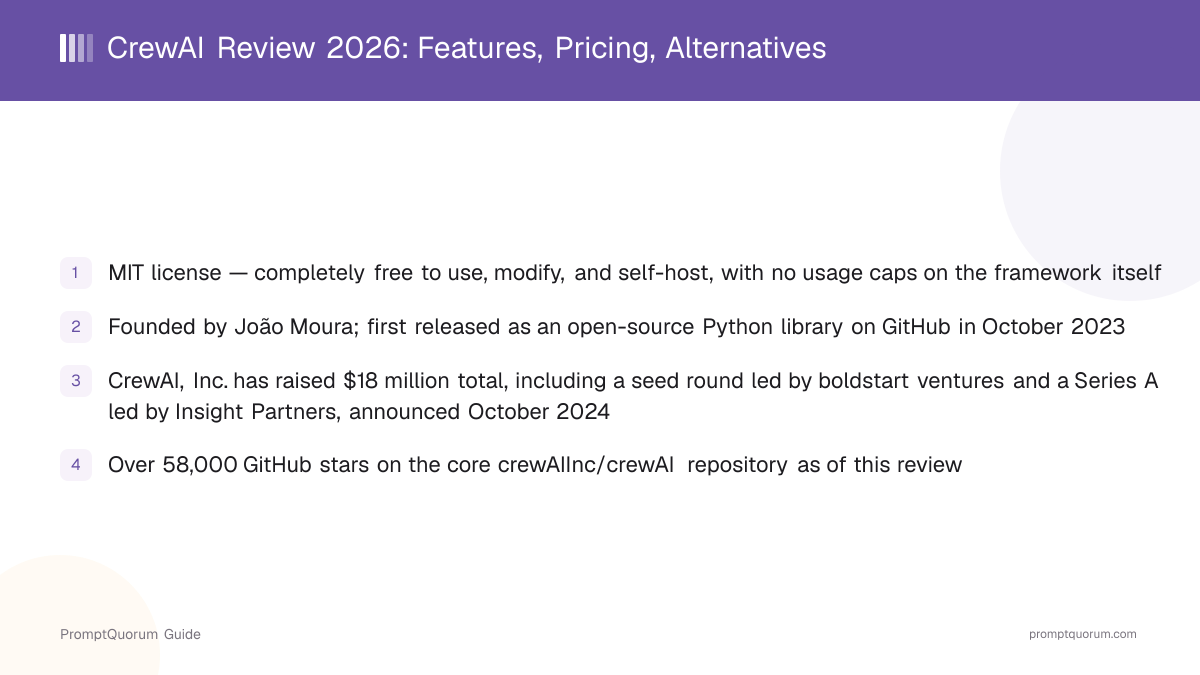
João Moura built CrewAI, and CrewAI, Inc. is now a venture-backed company with $18 million raised. Moura, a Brazilian software engineer who had previously worked in distributed engineering roles including at Clearbit, first built a small personal agent to help draft his own LinkedIn posts. Recognizing that the same role-based, multi-agent pattern could handle broader operational work, he generalized it into a framework and released it as an open-source Python library on GitHub in October 2023.
Early enterprise interest — including from companies such as Oracle, according to Moura's own public accounts — convinced him the project was more than a side experiment. CrewAI, Inc. subsequently raised a seed round led by boldstart ventures, followed by an $18 million combined seed-and-Series-A raise with the Series A led by Insight Partners, announced in October 2024. Other participating investors reported at the time include Craft Ventures, Earl Grey Capital, and Blitzscaling Ventures, alongside individual angel investors.
GitHub repository created
- Date:
- 2023-10
- What it means:
- João Moura publishes the first version of CrewAI as an open-source Python library
CrewAI 0.1.0
- Date:
- 2023-11
- What it means:
- First versioned PyPI release, introducing role-based agents, task management, and sequential processes
Seed round
- Date:
- Undisclosed
- What it means:
- Seed funding led by boldstart ventures
Series A
- Date:
- 2024-10
- What it means:
- $18M combined seed-and-Series-A total announced, Series A led by Insight Partners
CrewAI AMP launch
- Date:
- 2025
- What it means:
- Hosted Agent Management Platform launches with public pricing tiers
CrewAI 1.x line
- Date:
- 2026
- What it means:
- Framework reaches the 1.x release series (1.15.x as of this review), used in production by enterprise adopters
📌Note: The MIT license on the open-source framework does not change regardless of how much CrewAI, Inc. raises — venture funding pays for CrewAI AMP's hosted platform and enterprise features, not a paywall on the core library. This review could not independently verify an exact valuation figure from a primary source, so none is stated here.
What Is CrewAI?
CrewAI is an open-source framework (MIT license, github.com/crewAIInc/crewAI) for orchestrating role-based, collaborative AI agents in Python. Unlike frameworks built as extensions of a general-purpose LLM toolkit, CrewAI is a standalone project — it does not require LangChain or any other agent framework as a dependency.
- Agents: each agent is defined with a role, a goal, and a backstory, plus an optional list of tools it can call — this is the unit CrewAI is named for
- Tasks: a discrete unit of work assigned to an agent, with a description and an expected output
- Crew: the collection of agents and tasks that work together toward an overall objective
- Process: governs how a crew executes — Sequential (tasks run one after another) or Hierarchical (a manager agent delegates and reviews work from other agents)
- Flows: a lower-level, event-driven orchestration layer (introduced alongside CrewAI 1.0-era releases) for developers who need explicit control over state and branching logic beyond what a Crew alone provides
- crewai-tools: a companion package of pre-built tools (web search, file I/O, code execution, and similar) that agents can be given directly
Sequential vs. Hierarchical process
The Process.sequential mode runs tasks in the order they are listed, passing each output to the next agent. Process.hierarchical instead adds a manager layer — either an LLM you designate or an automatically assigned manager agent — that plans task assignment and reviews the output of the other agents, closer to how a human team lead delegates work.
from crewai import Agent, Task, Crew, Process

researcher = Agent(
    role="Research Analyst",
    goal="Find and summarize the latest trends in a given topic",
    backstory="An experienced analyst skilled at distilling complex information.",
)

writer = Agent(
    role="Content Writer",
    goal="Turn research into a clear, well-structured summary",
    backstory="A writer who values clarity and accuracy over flourish.",
)

research_task = Task(
    description="Research the current state of local LLM tooling.",
    expected_output="A bullet-point list of the five most relevant developments.",
    agent=researcher,
)

write_task = Task(
    description="Write a short summary based on the research findings.",
    expected_output="A three-paragraph summary suitable for a newsletter.",
    agent=writer,
)

crew = Crew(
    agents=[researcher, writer],
    tasks=[research_task, write_task],
    process=Process.sequential,
)

result = crew.kickoff()
print(result)
How Much Does CrewAI Cost?
The CrewAI framework itself is completely free — CrewAI AMP is the paid, optional hosted platform. CrewAI, Inc. does not charge for the open-source library; its published pricing applies only to the hosted deployment and observability product.
- CrewAI (the framework): free forever under the MIT license, whether self-hosted, used commercially, or modified
- CrewAI AMP Basic: $0/month, includes the visual editor, AI copilot, GitHub integration, and 50 workflow executions per month
- CrewAI AMP Enterprise: custom pricing — contact CrewAI's sales team for a quote
- Enterprise adds SSO, role-based access control (RBAC), workload identity, PII redaction and policy controls, a choice of CrewAI cloud, private VPC, or self-hosted deployment, a 45-day structured onboarding program, and optional forward-deployed engineering and training services
- LLM token costs on any tier are pass-through — you bring your own API keys for whichever model provider your agents call; CrewAI does not mark up or resell model usage
Tier | Price | Best For |
|---|---|---|
| CrewAI framework | Free (MIT license) | Everyone — no cost, ever |
| CrewAI AMP Basic | $0/mo, 50 executions | Solo devs, prototyping |
| CrewAI AMP Enterprise | Custom pricing | Governed, production deployment |
Prices verified against CrewAI's official pricing page on 2026-09-05. A previously published mid-tier "Professional" plan and a published per-execution overage rate are no longer listed on the live pricing page as of this check — pricing structures for hosted AI platforms change without much notice, so confirm current tiers on the live page before budgeting.
How Do You Install and Get Started With CrewAI?
Installing CrewAI takes one pip command — no account, license key, or server required for the open-source framework. CrewAI AMP is a separate, opt-in product for deployment and monitoring.
- 1Install the core package:
pip install crewai— add `pip install 'crewai[tools]'` for the companion crewai-tools package of pre-built tools. - 2Set your model provider's API key as an environment variable (for example
OPENAI_API_KEY) — CrewAI does not provide or proxy model access itself, and also supports local models through providers like Ollama. - 3Define one or more
Agentobjects, each with arole,goal, andbackstory, and optionally a list oftools. - 4Define one or more
Taskobjects with adescription,expected_output, and theagentassigned to it. - 5Combine them into a
Crewwith aprocess(Process.sequentialorProcess.hierarchical), then call.kickoff()to run it. - 6Optionally use the
crewai create crewCLI scaffold, which generates a starter project structure, or sign up for CrewAI AMP to deploy and monitor crews in production without managing your own hosting. - 7Read the official CrewAI documentation and browse the GitHub repository for the current API reference and Flows documentation.
Do I need an OpenAI or Anthropic account to use CrewAI?
You need an account and API key with whichever model provider you choose to call — CrewAI itself does not host or resell model access. It supports OpenAI, Anthropic, and other providers through LiteLLM integration, plus local models through providers like Ollama.
Does installing CrewAI require CrewAI AMP?
No. CrewAI AMP is an entirely optional hosted platform. You can build, run, and deploy your own infrastructure for CrewAI applications indefinitely without ever creating a CrewAI AMP account.
Who Should Use CrewAI?
CrewAI fits teams that want role-based multi-agent collaboration up and running quickly, without hand-building a state machine. It is a weaker fit for teams that need fine-grained custom control over every step of an agent's execution graph.
Use CrewAI if
- You want to model a workflow as a team of specialized agents — a researcher, a writer, an editor — each with a clear role, rather than one large monolithic prompt
- You value fast time-to-first-agent: CrewAI's Agent/Task/Crew abstractions are intentionally opinionated, so a working multi-agent crew can be running in minutes
- You want a framework built independently from the ground up for multi-agent orchestration, rather than an agent layer bolted onto a more general LLM toolkit
- You want an optional path to production deployment and monitoring (CrewAI AMP) without switching frameworks
Avoid CrewAI if
- You need highly custom, fine-grained control flow — explicit cycles, conditional branching, or arbitrary graph topology — beyond what Sequential/Hierarchical processes or Flows expose; a lower-level graph framework may fit better
- Your application is a single prompt-and-response call with no need for multiple collaborating agents — a direct SDK call to your model provider has less overhead
- Your team is already standardized on a different agent framework's ecosystem and integrations, and switching would cost more than the workflow benefit
- You need a RAG-first, retrieval/indexing-specialized framework rather than a multi-agent orchestration one — LlamaIndex is built specifically around that use case
When Should You NOT Use CrewAI?
Skip CrewAI for a single API call to one model, or for an agent that needs a fully custom execution graph with cycles and conditional branches CrewAI's built-in processes don't model well. A few concrete situations where a different tool wins.
- A chatbot that only ever sends one prompt and returns the raw response — call the provider's SDK directly instead of adding a multi-agent framework layer
- A project that needs explicit, arbitrary graph-based control flow — cycles, conditional edges, or fine-grained state checkpoints — a graph-first framework such as LangChain's LangGraph is built specifically for that level of control
- A project whose primary job is document indexing and retrieval-quality tuning, not multi-agent collaboration — LlamaIndex or Haystack specialize in that
- A team that wants to avoid CrewAI, Inc.'s more opinionated Agent/Task/Crew structure and prefers assembling agent behavior from lower-level primitives instead
- Use CrewAI instead when the task genuinely benefits from being split across multiple agents with distinct roles, working sequentially or under a manager agent
CrewAI vs. Alternatives
CrewAI competes with other frameworks for building LLM agents and applications, each optimized for a different point on the spectrum from retrieval-focused to multi-agent-focused, and from opinionated to fully custom control flow.
Tool | Interface | License | Backing | Best For |
|---|---|---|---|---|
| CrewAI | Python code | MIT | CrewAI, Inc. (VC-backed) | Role-based multi-agent crews |
| LangChain | Python / JS code | MIT | LangChain Inc. (VC-backed) | General-purpose LLM apps & agents |
| LlamaIndex | Python / TS code | MIT | LlamaIndex Inc. (VC-backed) | RAG-first indexing & retrieval |
| Haystack | Python code | Apache 2.0 | deepset (Germany) | Production RAG pipelines |
| Semantic Kernel | C# / Python / Java | MIT | Microsoft | .NET-first enterprise apps |
| AutoGen | Python code | MIT / CC-BY | Microsoft Research | Multi-agent conversation patterns |
Common Mistakes When Evaluating CrewAI
These mistakes come from conflating CrewAI with CrewAI AMP, or expecting the framework to behave like a general-purpose graph orchestrator.
Mistake 1: Assuming CrewAI and CrewAI AMP are the same product
CrewAI is the free, open-source Python framework; CrewAI AMP is a separate, optional paid platform built by the same company, CrewAI, Inc., for deploying and monitoring crews. You can build and run CrewAI applications on your own infrastructure without ever touching CrewAI AMP or paying anything.
Mistake 2: Assuming CrewAI depends on LangChain
CrewAI is built as a standalone framework and does not require LangChain as a dependency, unlike some earlier agent tooling that was built as an extension on top of it. The two frameworks can be evaluated and used independently.
Mistake 3: Expecting Sequential/Hierarchical processes to cover every control-flow need
CrewAI's built-in Process modes cover common role-based patterns well, but they are not a substitute for a full graph-based state machine with arbitrary cycles and conditional edges. For that level of control, CrewAI's own Flows feature or a dedicated graph framework is the better starting point.
Frequently Asked Questions
Is CrewAI free to use?
Yes. The CrewAI framework is open-source under the MIT license and free for any use, including commercial products, with no usage limits. CrewAI AMP, the hosted deployment and monitoring platform, has a separate pricing structure starting at a free Basic tier.
Who founded CrewAI?
João Moura founded CrewAI, releasing the first open-source version as a Python library on GitHub in October 2023 after building a personal agent to help draft his own LinkedIn posts.
How much funding has CrewAI raised?
CrewAI, Inc. has raised $18 million total across a seed round led by boldstart ventures and a Series A led by Insight Partners, announced in October 2024. Other reported investors include Craft Ventures, Earl Grey Capital, and Blitzscaling Ventures.
What is the difference between CrewAI and CrewAI AMP?
CrewAI is the open-source Python framework for building role-based multi-agent crews. CrewAI AMP (Agent Management Platform) is CrewAI, Inc.'s separate, optional paid product for deploying, monitoring, and governing those crews in production.
Does CrewAI require LangChain?
No. CrewAI is built as an independent framework and does not require LangChain or any other agent framework as a dependency.
How much does CrewAI AMP cost?
The Basic tier is free and includes the visual editor, AI copilot, GitHub integration, and 50 workflow executions per month. Enterprise pricing is custom-quoted and adds SSO, RBAC, deployment flexibility (cloud, private VPC, or self-hosted), and a structured onboarding program. Verified against CrewAI's official pricing page on 2026-09-05.
What are Agents, Tasks, Crews, and Processes in CrewAI?
An Agent has a role, goal, and backstory, plus optional tools. A Task is a unit of work with a description and expected output, assigned to an agent. A Crew is the collection of agents and tasks working toward an objective. A Process (Sequential or Hierarchical) governs how the crew executes those tasks.
How many GitHub stars does CrewAI have?
The core crewAIInc/crewAI repository has passed 58,000 GitHub stars as of this review (checked via the GitHub API on 2026-09-05).
Can I run CrewAI with local, self-hosted models instead of a cloud API?
Yes. CrewAI supports local model runners like Ollama, so crews can call locally hosted models instead of, or alongside, cloud providers such as OpenAI or Anthropic.
Is CrewAI better than LangChain?
Neither is strictly better — they take different approaches. CrewAI is purpose-built around role-based multi-agent collaboration with an opinionated, fast-to-start structure; LangChain is a broader general-purpose framework whose LangGraph component offers lower-level, more customizable graph-based control. Teams that want speed on common multi-agent patterns tend to prefer CrewAI; teams that need highly custom control flow tend to prefer LangGraph.