From MemGPT to Letta: History and Funding
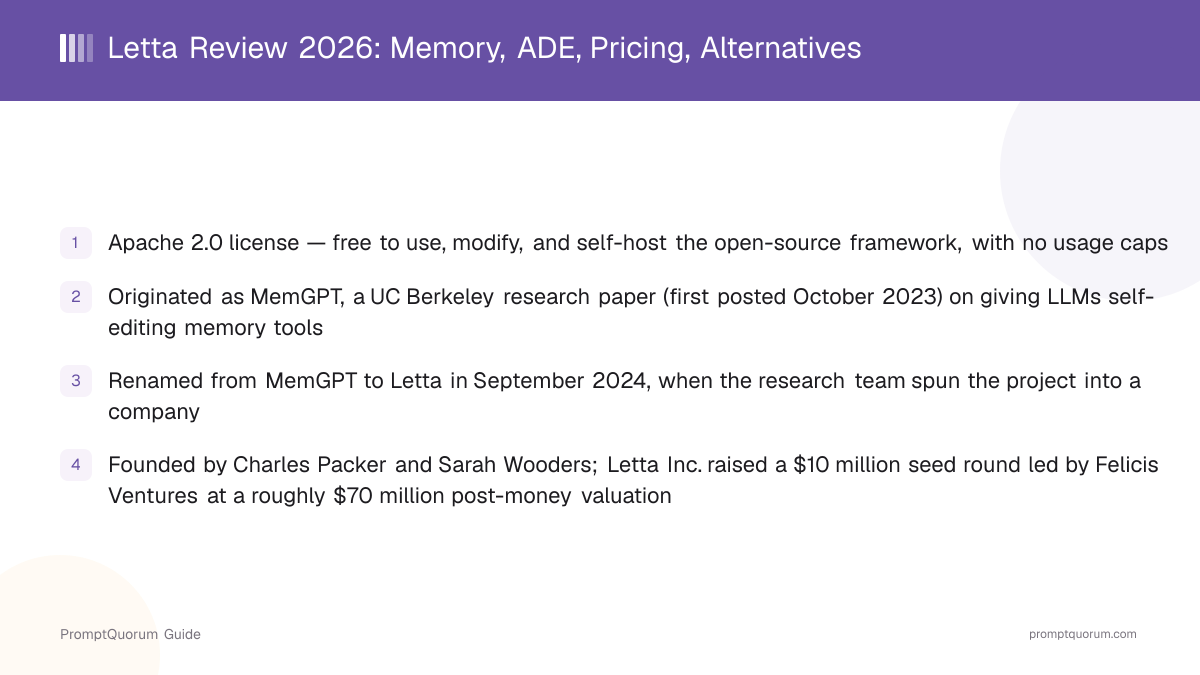
Letta began as MemGPT, a UC Berkeley research paper on giving LLMs self-editing memory, and was renamed to Letta in September 2024 when the research team turned it into a company. Charles Packer and Sarah Wooders, both PhD students at UC Berkeley's Sky Computing Lab, co-authored the paper "MemGPT: Towards LLMs as Operating Systems" (posted to arXiv in October 2023, alongside co-authors Kevin Lin, Vivian Fang, Shishir G. Patil, Ion Stoica, and Joseph E. Gonzalez). The paper proposed borrowing an idea from operating systems — paging data between fast and slow memory tiers — and applying it to LLM context windows, letting an agent manage what stays in its immediate context versus what gets archived for later retrieval.
The open-source code accompanying the paper was leaked to Hacker News before the planned release date and went viral, eventually accumulating over 11,000 GitHub stars under the MemGPT name. On September 23, 2024, the team renamed the project and company from MemGPT to Letta, reserving the name "MemGPT" specifically for the original agent design pattern described in the research paper, while "Letta" became the name of the broader framework, product, and company. Letta Inc. announced a $10 million seed round at the same time, led by Felicis Ventures with participation from Founders Fund and Y Combinator, plus angel investors including Google DeepMind's Jeff Dean and Hugging Face's Clem Delangue, at a roughly $70 million post-money valuation.
This history distinguishes Letta from most of the other frameworks in this series. LangChain, CrewAI, AutoGen, and Semantic Kernel were built primarily to orchestrate steps, tools, or multiple agents. Letta's origin is specifically about the memory problem — how a single agent keeps useful information across a context window that would otherwise reset or overflow — and that focus still shapes its architecture and messaging today.
MemGPT paper posted
- Date:
- 2023-10
- What it means:
- Packer, Wooders, and co-authors post the MemGPT paper to arXiv
Renamed to Letta
- Date:
- 2024-09-23
- What it means:
- Project and company renamed from MemGPT to Letta; "MemGPT" reserved for the research pattern
Seed funding announced
- Date:
- 2024-09-23
- What it means:
- $10M seed led by Felicis Ventures, ~$70M post-money valuation
Agent Development Environment (ADE)
- Date:
- 2024-2025
- What it means:
- Visual environment for inspecting and editing agent memory ships as part of the platform
Letta Code / Agent SDK v2
- Date:
- 2026
- What it means:
- Letta expands into a coding-agent CLI product line alongside the original framework
📌Note: The Apache 2.0 license on the open-source framework and server has not changed since the rename — seed funding pays for Letta Cloud, the ADE, and newer products like Letta Code, not a paywall on the core framework.
What Is Letta?
Letta is an open-source framework (Apache 2.0 license, github.com/letta-ai/letta) for building stateful AI agents — agents whose memory persists and evolves across conversations, rather than resetting with every new session. Its distinguishing idea is a memory hierarchy the agent itself manages through tool calls, not just a chat log a developer appends to.
- Core memory: a small set of labeled, structured memory blocks (commonly a "human" block and a "persona" block) that stay pinned inside the context window at all times, editable by the agent and shared between agents
- Archival memory: an out-of-context store, backed by PostgreSQL with pgvector, that the agent searches and writes to via tool calls (archival_memory_search and archival_memory_insert) rather than always keeping in view
- Self-editing memory: the agent decides what belongs in core memory, what to summarize, and what to move to archival storage — the model manages its own memory hygiene inside its normal reasoning loop
- Agent Development Environment (ADE): a visual interface for watching and editing an agent's memory blocks, context, and reasoning while it runs, aimed at making an otherwise opaque context window inspectable
- Letta Cloud vs. self-hosted server: the same open-source server can run on Letta's managed cloud or on your own infrastructure — both speak the same API
- Model-agnostic: works with OpenAI, Anthropic, and other providers through bring-your-own-API-key configuration, as well as local model backends
Why the memory hierarchy matters
A standard chatbot forgets everything once the conversation ends or the context window fills up. Letta's agent can decide the fact about switching to SQLite belongs in core memory (so it is never forgotten in later turns) while older, less relevant details get pushed to archival memory and retrieved only when the agent judges they are needed again.
from letta_client import Letta
import os

client = Letta(api_key=os.getenv("LETTA_API_KEY"))

# Create a stateful agent with core memory blocks
agent = client.agents.create(
    model="openai/gpt-4o-mini",
    embedding="openai/text-embedding-3-small",
    memory_blocks=[
        {"label": "human", "value": "Name unknown yet. Learn and update as we talk."},
        {"label": "persona", "value": "I am a helpful assistant that remembers context across sessions."},
    ],
)

# Send a message — the agent can read and edit its own memory blocks
response = client.agents.messages.create(
    agent_id=agent.id,
    input="Hi, I am switching from Postgres to SQLite for this project.",
)
for message in response.messages:
    print(message)
How Much Does Letta Cost?
The open-source Letta framework and self-hosted server are completely free under the Apache 2.0 license — Letta Cloud is the paid hosted option. Letta Inc. does not charge for the code itself; it charges for managed hosting, quota-based usage, and team features.
- Letta (the framework and self-hosted server): free forever under Apache 2.0, whether self-hosted, modified, or used commercially — you pay only your own infrastructure and model API costs
- Letta Cloud Free tier: $0 per month, a limited number of managed agents, bring-your-own API keys, no account required for local use
- Letta Cloud Pro tier: $20 per month, up to 20 stateful agents, a weekly/monthly usage quota for Letta's own managed model access, pay-as-you-go overage
- Letta API (developer) plan: $20 per month base, plus $0.10 per active agent per month and $0.00015 per second of tool execution, with LLM usage billed at provider cost
- Teams Pro: $20 per seat per month, adds shared organizations, teammate access, and agent-sharing controls
- Enterprise: custom pricing, adds volume-based rates, higher quotas, role-based access control, SAML/OIDC single sign-on, and dedicated support
Tier | Price | Best For |
|---|---|---|
| Letta framework/server | Free (Apache 2.0) | Everyone — self-hosted, no cost |
| Letta Cloud Free | $0/mo, limited agents | Trying Letta Cloud, BYOK |
| Letta Cloud Pro | $20/mo, up to 20 agents | Individual developers |
| Letta API plan | $20/mo + usage | Production API integration |
| Teams Pro | $20/seat/mo | Small teams sharing agents |
| Enterprise | Custom pricing | SSO, compliance, high volume |
Prices verified against Letta's official pricing page as of September 2026, billed in USD with no locale-specific pricing shown at time of writing — check the live page before budgeting, since SaaS tiers and quotas can change without much notice, and Letta's pricing structure has already been reorganized once in 2026 around the newer Letta Code product.
How Do You Install and Get Started With Letta?
Installing the open-source Letta server takes one pip command and no Letta account — a hosted Letta Cloud account is only needed if you want managed infrastructure instead of self-hosting. The Python client works identically against either.
- 1Install the client library:
pip install letta-client(Python) — a JavaScript/TypeScript client is also available for the same API. - 2
- 3Set your model provider credentials — Letta supports bring-your-own-API-key configuration for OpenAI, Anthropic, and other providers, as well as local model backends.
- 4Create an agent with
client.agents.create(), passing a model, an embedding model, and one or morememory_blocks(for example a "human" block and a "persona" block) that become the agent's core memory. - 5Send messages with
client.agents.messages.create()— the same agent ID keeps its memory across every future call, including calls made days or weeks later. - 6Open the Agent Development Environment to watch and edit an agent's core memory, archival memory, and reasoning steps visually instead of only through API responses.
- 7Read the official Letta documentation and browse the GitHub repository for the current API reference — Letta's product surface has expanded since 2024, so check which SDK version a tutorial targets.
Do I need a Letta Cloud account to use the framework?
No. The open-source Letta server and client run without any Letta account when self-hosted. A Letta Cloud API key is only required if you choose the managed hosting option instead of running the server yourself.
Which model providers does Letta support?
Letta supports bring-your-own-API-key access to providers including OpenAI and Anthropic, plus local model backends, through the same agent-creation API regardless of which provider you choose.
Who Should Use Letta?
Letta fits teams building an agent that needs to remember a specific user, project, or context across many separate sessions — not just within one conversation. It is a narrower fit for teams whose main problem is coordinating multiple specialized agents rather than giving one agent memory.
Use Letta if
- You are building an assistant that must remember facts about a specific user or project across days or weeks of separate sessions, not just one chat window
- You want an agent that manages its own memory hygiene — deciding what to keep in immediate context versus archive — instead of you hand-writing summarization logic
- You need to inspect or debug what an agent actually remembers, which the Agent Development Environment (ADE) is built specifically to show
- You want the option to self-host for free (Apache 2.0) now and move to managed Letta Cloud hosting later without changing the underlying API
Avoid Letta if
- Your application is stateless — a single prompt-and-response call with no need to remember anything between requests
- Your core problem is coordinating several specialized agents with distinct roles, which CrewAI is built specifically around
- You need explicit, developer-controlled graph state and branching logic rather than agent-managed memory, which LangGraph is designed for
- You are already deep in a general-purpose orchestration framework like LangChain and only need lightweight conversation history, not a full memory-management layer
When Should You NOT Use Letta?
Skip Letta when your agent does not need to persist anything across sessions, or when your real problem is coordinating multiple agents rather than remembering for one. A few concrete situations where a different tool fits better.
- A simple, stateless chatbot that answers one question at a time with no need to recall prior sessions — a plain API call or a lightweight chain is less overhead than a full memory-management framework
- A team that needs multiple agents with distinct roles collaborating on a task (researcher, writer, reviewer) — CrewAI is built specifically for role-based multi-agent collaboration, which is not Letta's focus
- A team that wants explicit, developer-defined control over agent state transitions, branches, and cycles rather than letting the model manage its own memory — LangGraph offers that graph-based explicit state control
- A .NET-first enterprise team already standardized on Microsoft tooling — Semantic Kernel integrates more directly with that stack
- Use Letta instead when the defining requirement is a single agent that needs to remember specific facts, preferences, or history across sessions without you writing custom persistence logic
Letta vs. Alternatives
Letta competes with other agent frameworks that each optimize for a different part of the agent-building problem — memory and state persistence versus multi-agent orchestration versus explicit graph control.
Tool | Interface | License | Backing | Best For |
|---|---|---|---|---|
| Letta | Python / TS code | Apache 2.0 | Letta Inc. (VC-backed) | Single-agent long-term memory |
| LangChain | Python / JS code | MIT | LangChain Inc. (VC-backed) | General-purpose LLM apps & agents |
| LangGraph | Python / JS code | MIT | LangChain Inc. (VC-backed) | Explicit graph-based agent state |
| CrewAI | Python code | MIT | CrewAI Inc. (VC-backed) | Role-based multi-agent crews |
| AutoGen | Python code | MIT / CC-BY | Microsoft Research | Multi-agent conversation patterns |
| Semantic Kernel | C# / Python / Java | MIT | Microsoft | .NET-first enterprise apps |
Common Mistakes When Evaluating Letta
These mistakes come from confusing MemGPT with Letta, or expecting Letta to solve a multi-agent orchestration problem it was not designed for.
Mistake 1: Treating "MemGPT" and "Letta" as two different products
They describe the same lineage at different scopes. MemGPT is the original research paper and agent design pattern from UC Berkeley; Letta is the company and the broader open-source framework and product that grew out of it after the September 2024 rename. The open-source repository that was once called MemGPT is now Letta.
Mistake 2: Expecting Letta to orchestrate a team of specialized agents
Letta's core strength is giving a single agent persistent, self-managed memory across sessions — not coordinating multiple agents with distinct roles toward a shared goal. For role-based multi-agent collaboration, CrewAI or AutoGen are closer fits.
Mistake 3: Assuming a longer context window makes Letta's memory hierarchy unnecessary
A larger context window delays the problem rather than solving it — conversations, documents, and tool outputs can still exceed even a very large window over enough sessions, and a bigger window does not by itself decide what is worth remembering. Letta's core/archival split is about selecting and managing what persists, not just how much fits at once.
Frequently Asked Questions
Is Letta free to use?
Yes. The Letta framework and self-hosted server are open-source under the Apache 2.0 license and free for any use, including commercial products, with no usage limits. Letta Cloud, the managed hosting option, has a separate pricing structure starting at $0 for a limited free tier.
What is the difference between MemGPT and Letta?
MemGPT was the original name of both the research paper and the open-source project. In September 2024, the team renamed the company and framework to Letta, and "MemGPT" now refers specifically to the agent design pattern described in the original research paper — self-editing memory for LLMs.
Who founded Letta?
Charles Packer and Sarah Wooders, both PhD students at UC Berkeley, co-authored the MemGPT research paper and co-founded Letta Inc. when the project was renamed and commercialized in September 2024.
How much funding has Letta raised?
Letta Inc. announced a $10 million seed round led by Felicis Ventures, with participation from Founders Fund and Y Combinator, at a roughly $70 million post-money valuation, alongside the September 2024 rename from MemGPT to Letta.
What is the Agent Development Environment (ADE)?
The ADE is Letta's visual interface for inspecting and editing an agent's core memory, archival memory, and reasoning while it runs, making an otherwise opaque context window visible and editable during development.
How much does Letta Cloud cost?
Letta Cloud has a free tier with a limited number of managed agents and bring-your-own API keys. The Pro tier costs $20 per month for up to 20 stateful agents with a usage quota. A separate API developer plan starts at $20 per month plus usage, and Enterprise pricing is custom.
What license is Letta released under?
The open-source Letta framework and server are released under the Apache 2.0 license, which permits free commercial use, modification, and self-hosting.
How many GitHub stars does Letta have?
The letta-ai/letta repository has passed 24,000 GitHub stars, building on the more than 11,000 stars the project accumulated under its earlier MemGPT name.
Can I run Letta with local, self-hosted models instead of a cloud API?
Letta supports bring-your-own-API-key configuration for cloud model providers and can be paired with local model backends, letting agents run against self-hosted models instead of, or alongside, cloud providers.
Is Letta better than LangGraph for building agents?
Neither is strictly better — they solve different problems. Letta specializes in giving a single agent persistent, self-managed memory across sessions; LangGraph specializes in explicit, developer-controlled graph state, cycles, and human-in-the-loop steps. Some teams use graph-based orchestration alongside a memory layer like Letta's.