Who Built AutoGen, and What Happened to It?
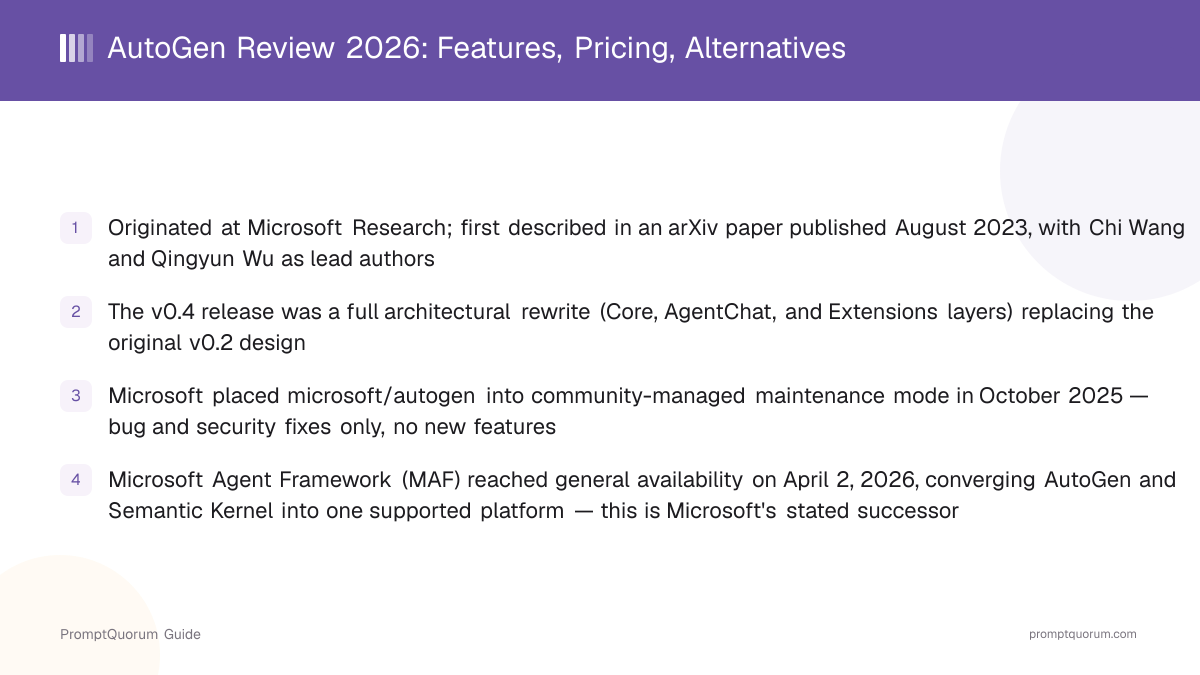
AutoGen originated at Microsoft Research and was first described in an arXiv paper published in August 2023, with Qingyun Wu and Chi Wang as lead authors — work that also involved researchers at Penn State University and the University of Washington. The framework introduced a conversation-driven pattern for multi-agent LLM applications: agents (a coder, a critic, a user proxy that can execute code) exchange messages until a task converges.
In September–November 2024, Chi Wang and Qingyun Wu left Microsoft and founded AG2AI, forking the codebase into a new project called AG2 — citing a desire to develop faster outside a single company's roadmap and to build a vendor-neutral home for contributions. AG2 inherited the original autogen and pyautogen PyPI package names and the project's Discord community, and moved to the Apache 2.0 license starting with its v0.3 release; it remains under active, independent development in 2026, working toward a 1.0 release.
Microsoft, meanwhile, continued developing the microsoft/autogen repository under its own roadmap, shipping the v0.4 architectural rewrite (splitting the framework into Core, AgentChat, and Extensions layers) before placing the project into community-managed maintenance mode in October 2025 — no new features, bug and security fixes only. Microsoft's stated successor is the Microsoft Agent Framework (MAF), announced as a convergence of AutoGen and Semantic Kernel and reaching general availability on April 2, 2026.
Research paper
- Date:
- 2023-08
- What it means:
- Qingyun Wu and Chi Wang publish the AutoGen arXiv paper describing the multi-agent conversation framework
v0.4 rewrite
- Date:
- 2024
- What it means:
- Full architectural rewrite into Core, AgentChat, and Extensions layers, replacing the original v0.2 API
AG2 fork founded
- Date:
- 2024-09/11
- What it means:
- Original authors leave Microsoft, found AG2AI, fork the project as AG2 under Apache 2.0
AutoGen maintenance mode
- Date:
- 2025-10
- What it means:
- Microsoft's microsoft/autogen moves to community-managed maintenance: bug/security fixes only
Microsoft Agent Framework GA
- Date:
- 2026-04-02
- What it means:
- MAF reaches general availability, positioned by Microsoft as the successor to both AutoGen and Semantic Kernel
📌Note: AutoGen (Microsoft's repository), AG2 (the community fork), and Microsoft Agent Framework are three distinct, currently-existing projects with a shared ancestry — not renames of the same thing. Confirm which one a tutorial or package refers to before following it, since pip install autogen historically pointed at different packages depending on the moment in this history.
What Is AutoGen?
AutoGen (the Microsoft-controlled microsoft/autogen repository) is an open-source Python framework for building applications where multiple LLM-powered agents converse with each other, use tools, and — distinctively — execute code, to complete a task collaboratively rather than through a single linear prompt chain.
- AgentChat: the high-level API for defining agents with roles (assistant, user proxy, critic) and running multi-agent conversations or group chats
- Core: the lower-level, event-driven runtime AgentChat is built on, for teams that need custom orchestration logic
- Code-execution agents: a signature AutoGen pattern — an agent can write Python code, hand it to a code-executor agent (commonly sandboxed in Docker), and use the output to continue the conversation
- Group chat orchestration: multiple agents participate in a shared conversation with a manager agent deciding turn order, useful for tasks needing several specialist roles (e.g., planner, coder, reviewer)
- Extensions: first- and third-party integrations for model providers, tools, and memory beyond the Core/AgentChat layers
Code-execution agents
A CodeExecutorAgent runs code blocks that another agent writes — commonly sandboxed in a Docker container via DockerCommandLineCodeExecutor — and returns the output to the conversation, letting an agent team iteratively debug and re-run code until a task succeeds.
from autogen_agentchat.agents import AssistantAgent
from autogen_agentchat.teams import RoundRobinGroupChat
from autogen_agentchat.conditions import TextMentionTermination
from autogen_ext.models.openai import OpenAIChatCompletionClient

model_client = OpenAIChatCompletionClient(model="gpt-4o-mini")
assistant = AssistantAgent("assistant", model_client=model_client)
critic = AssistantAgent(
    "critic",
    model_client=model_client,
    system_message="Review the answer and reply APPROVE if correct.",
)

team = RoundRobinGroupChat(
    [assistant, critic],
    termination_condition=TextMentionTermination("APPROVE"),
)

await team.run(task="Summarize what AutoGen does in one sentence.")
How Much Does AutoGen Cost?
AutoGen itself is completely free — there is no paid tier, no hosted product, and no separate observability add-on bolted on by Microsoft, unlike LangChain's paid LangSmith. Model API costs (OpenAI, Anthropic, Azure OpenAI, or a self-hosted model) are the only real cost, and those are billed by whichever model provider you connect.
- AutoGen (the framework): free forever under the MIT license (code) / CC BY 4.0 (documentation), for any use including commercial products
- No AutoGen-branded paid tier, hosted service, or enterprise SKU exists as of this review — Microsoft's commercial agent offering going forward is the Microsoft Agent Framework, which is itself open source, with paid cost coming from whichever Azure services you choose to attach (e.g., Azure AI Foundry hosting)
- AG2, the community fork, is likewise free under the Apache 2.0 license, with commercial support offered separately by AG2AI rather than bundled into the framework
- Model API usage is billed by the model provider you connect (OpenAI, Anthropic, Azure OpenAI, or your own self-hosted model), not by AutoGen
Component | Price | Notes |
|---|---|---|
| AutoGen framework | Free (MIT/CC BY 4.0) | No usage caps, self-hostable |
| AG2 fork | Free (Apache 2.0) | Independent community project |
| Microsoft Agent Framework | Free (open source) | Attach paid Azure services separately if desired |
| Model API calls | Billed by provider | Not part of AutoGen pricing |
Verified against the microsoft/autogen GitHub repository and Microsoft Agent Framework documentation as of September 2026 — check the live sources before budgeting, since Microsoft's agent product lineup has changed twice within the past year.
How Do You Install and Get Started With AutoGen?
Installing AutoGen takes one pip command — no account or license key required. Because the project is in maintenance mode, evaluate whether the Microsoft Agent Framework or AG2 is a better starting point for a new project before committing to AutoGen itself.
- 1Install the AgentChat package and a model extension: `pip install -U "autogen-agentchat" "autogen-ext[openai]"` (requires Python 3.10+).
- 2Set your model provider's API key as an environment variable (for example
OPENAI_API_KEY) — AutoGen does not provide or proxy model access itself. - 3Define one or more
AssistantAgentinstances with a model client, and combine them into a team (e.g.,RoundRobinGroupChat) with a termination condition. - 4For code-execution workflows, add a
CodeExecutorAgentbacked by a sandboxed executor (Docker is the documented default) so generated code runs in isolation, not on the host machine. - 5Read the official AutoGen documentation for the current API reference, and review the migration guide if starting a new project, since Microsoft now points new users toward the Microsoft Agent Framework.
Do I need an OpenAI or Azure account to use AutoGen?
You need an account and API key with whichever model provider you choose to call — AutoGen itself does not host or resell model access. It supports OpenAI, Azure OpenAI, and other providers through its Extensions package, plus self-hosted models via compatible local API servers.
Is AutoGen safe to run code-execution agents with?
Only when the code executor is sandboxed. AutoGen's documented default is a Docker-based executor (DockerCommandLineCodeExecutor); running generated code directly on the host machine without a sandbox is explicitly discouraged in the official docs.
Who Should Use AutoGen?
AutoGen fits teams that specifically want the conversation-driven, code-execution multi-agent pattern it pioneered, and who are comfortable building on a project Microsoft has placed in maintenance mode. Most new projects should compare it against its two active successors first.
Use AutoGen if
- You are maintaining or extending an existing AutoGen-based application and a migration to Microsoft Agent Framework or AG2 is not yet justified
- You specifically need the group-chat, multiple-specialist-agent conversation pattern AutoGen popularized, with code-execution agents as a first-class citizen
- You want a framework with no vendor lock-in to a paid observability or hosting product — AutoGen has never bundled one
- You are evaluating the AutoGen research paper's ideas academically, where the original framework (rather than its successors) is the relevant reference implementation
Avoid AutoGen if
- You are starting a new production project — avoid legacy AutoGen and start with Microsoft's actively supported successor, the Microsoft Agent Framework, instead
- You want active, fast-moving open-source development from the framework's original authors — that continues at AG2, not at microsoft/autogen
- You need enterprise support, long-term API stability guarantees, or Azure-native hosting — Microsoft Agent Framework is the supported path for that, not maintenance-mode AutoGen
- You need a role-based, opinionated "crew" abstraction rather than free-form agent conversation — CrewAI is built specifically around that pattern
When Should You NOT Use AutoGen?
Skip AutoGen for any new production project as of this review — it is in maintenance mode, and both Microsoft and the original authors have moved active development elsewhere. A few concrete situations where a different tool wins.
- A new project with no existing AutoGen code — avoid legacy AutoGen and start with the Microsoft Agent Framework (Microsoft's actively supported successor) or AG2 (the actively developed community fork) instead
- A team that needs Microsoft enterprise support commitments or long-term API stability guarantees on a Microsoft-maintained product — Microsoft Agent Framework carries those, AutoGen does not
- A team that wants fast-moving open-source feature development — that happens at AG2 now, led by AutoGen's original authors, not at microsoft/autogen
- A project that wants a structured, role-based agent abstraction out of the box rather than assembling conversation patterns manually — CrewAI or LangGraph fit that better
- Use AutoGen only when you are maintaining an existing AutoGen application and a migration has not yet been scoped
AutoGen vs. Alternatives
AutoGen shares ancestry with two active successors and competes with other multi-agent frameworks, each with a different orchestration philosophy.
Tool | Interface | License | Backing | Best For |
|---|---|---|---|---|
| AutoGen | Python code | MIT / CC BY 4.0 | Microsoft (maintenance mode) | Existing AutoGen apps only |
| AG2 | Python code | Apache 2.0 | AG2AI (community, original authors) | Active fork of the same pattern |
| Microsoft Agent Framework | Python / .NET | MIT (open source) | Microsoft | New Microsoft-ecosystem projects |
| LangChain / LangGraph | Python / JS code | MIT | LangChain Inc. (VC-backed) | General-purpose LLM apps & agents |
| CrewAI | Python code | MIT (core) | CrewAI Inc. (VC-backed) | Role-based multi-agent crews |
| OpenAI Agents SDK | Python code | MIT | OpenAI | OpenAI-model-first agent apps |
Common Mistakes When Evaluating AutoGen
These mistakes come from conflating AutoGen with its successors, or missing the maintenance-mode status entirely.
Mistake 1: Assuming AutoGen, AG2, and Microsoft Agent Framework are the same project under different names
They share ancestry but are three separately maintained codebases with different governance and different licenses (MIT/CC BY 4.0 for AutoGen, Apache 2.0 for AG2, MIT for Microsoft Agent Framework). A tutorial or package written for one does not necessarily apply to the others.
Mistake 2: Starting a new project on microsoft/autogen without checking its status
Microsoft placed the repository into community-managed maintenance mode in October 2025: bug and security fixes only, no new features. New projects should evaluate the Microsoft Agent Framework or AG2 first, per Microsoft's own migration guidance.
Mistake 3: Assuming AutoGen has a paid tier like LangChain's LangSmith
AutoGen has never bundled a paid observability or hosting product. Any cost comes from the model API you connect (OpenAI, Azure OpenAI, or similar) or from Azure services you separately choose to attach when using the Microsoft Agent Framework.
Frequently Asked Questions
Is AutoGen free to use?
Yes. The microsoft/autogen framework is open-source under the MIT license (code) and CC BY 4.0 (documentation), free for any use including commercial products, with no usage limits. There is no paid AutoGen tier.
Who created AutoGen?
AutoGen originated at Microsoft Research, first described in an arXiv paper published in August 2023 with Qingyun Wu and Chi Wang as lead authors, alongside researchers at Penn State University and the University of Washington.
Is AutoGen still maintained?
Microsoft's microsoft/autogen repository has been in community-managed maintenance mode since October 2025 — it receives bug and security fixes but no new features. Microsoft's stated successor is the Microsoft Agent Framework.
What is AG2, and how is it different from AutoGen?
AG2 is a separate, actively developed community fork of AutoGen, started in late 2024 by AutoGen's original authors (Chi Wang and Qingyun Wu) after they left Microsoft. It uses the Apache 2.0 license from v0.3 onward and inherited the original autogen/pyautogen PyPI package names.
What is the Microsoft Agent Framework, and does it replace AutoGen?
The Microsoft Agent Framework (MAF) is Microsoft's stated successor to both AutoGen and Semantic Kernel, converging the two into one supported, open-source platform. It reached general availability on April 2, 2026.
How much does AutoGen cost?
AutoGen itself is free under the MIT license, with no separate paid tier or hosted product. The only real cost is the model API you connect it to (OpenAI, Azure OpenAI, or a self-hosted model), billed by that provider.
How many GitHub stars does AutoGen have?
The microsoft/autogen repository has passed 60,000 GitHub stars.
Can I run AutoGen with local, self-hosted models instead of a cloud API?
Yes, through AutoGen's Extensions package and any OpenAI-API-compatible local model server, though official first-party support and testing focuses primarily on OpenAI and Azure OpenAI.
Should I start a new project on AutoGen, AG2, or the Microsoft Agent Framework?
For a new project, evaluate the Microsoft Agent Framework (Microsoft's supported successor) or AG2 (the actively developed community fork) rather than microsoft/autogen, which receives no new features. Choose based on whether you need Microsoft's enterprise support path (Agent Framework) or an independently governed open-source project (AG2).
Is AutoGen better than [CrewAI](/power-local-llm/crewai-review)?
They target different patterns. AutoGen (and its successors) favor free-form, conversation-driven multi-agent orchestration with code execution; CrewAI provides a more structured, role-based 'crew' abstraction with defined tasks. Which fits better depends on how much structure your workflow needs.