Who Built Semantic Kernel, and What Happens to It Now?
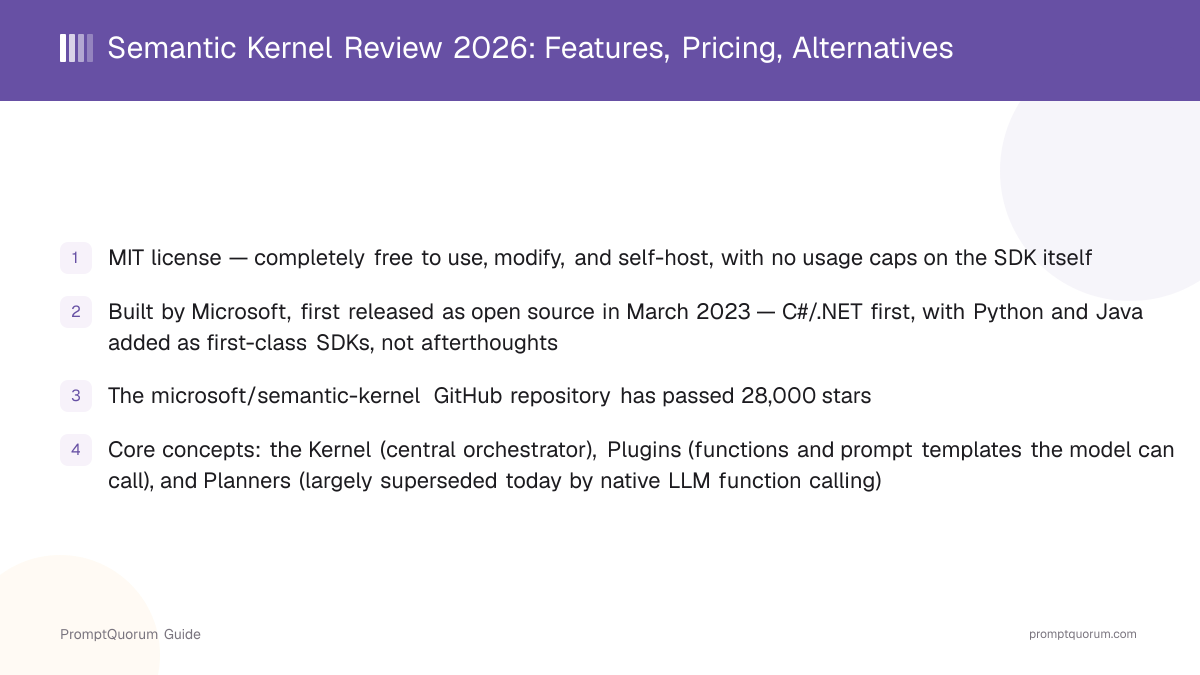
Microsoft released Semantic Kernel as an open-source SDK in March 2023, and Microsoft Agent Framework has since become its stated successor. Semantic Kernel combined large language models with conventional application code through a 'kernel' abstraction, shipping under the permissive MIT license. Unlike most agent frameworks, which target Python first and add other languages later, Semantic Kernel launched with C#/.NET as its primary language and added Python and Java as first-class SDKs, not bolted-on ports.
Semantic Kernel popularized the 'plugin' and 'planner' vocabulary that much of the industry later adopted under different names. Plugins are native functions or prompt templates the model can discover and call; planners decided which plugin to invoke and in what order. Early dedicated planners — SequentialPlanner, ActionPlanner, StepwisePlanner — were largely superseded once model providers added native function calling, which Semantic Kernel now uses by default through its FunctionChoiceBehavior setting.
In 2026, Microsoft repositioned Semantic Kernel inside a broader convergence. Microsoft Agent Framework (MAF) reached general availability on April 2, 2026, unifying Semantic Kernel's enterprise foundations — the Kernel, plugins, filters, observability — with AutoGen's multi-agent orchestration model into one supported platform. Since then, the microsoft/semantic-kernel repository has been in maintenance mode: Microsoft ships critical bug fixes and security patches, with support committed at least into 2027, while new feature investment goes into Agent Framework.
First release
- Date:
- 2023-03
- What it means:
- Microsoft releases Semantic Kernel as an open-source, MIT-licensed SDK, C#/.NET first
Python & Java SDKs
- Date:
- 2023
- What it means:
- Python and Java ports follow as first-class SDKs, making Semantic Kernel one of the few multi-language agent frameworks
Planners superseded
- Date:
- ongoing
- What it means:
- Early dedicated planner classes give way to LLM-native function calling as the default planning mechanism
Microsoft Agent Framework preview
- Date:
- 2025-10
- What it means:
- Microsoft previews Agent Framework, its stated successor combining Semantic Kernel and AutoGen
Microsoft Agent Framework GA
- Date:
- 2026-04-02
- What it means:
- MAF reaches general availability; Microsoft positions it as the successor to both Semantic Kernel and AutoGen
Semantic Kernel maintenance mode
- Date:
- 2026-04
- What it means:
- microsoft/semantic-kernel shifts to critical bug fixes and security patches only, with support committed at least into 2027
📌Note: The MIT license does not change because of this transition — existing Semantic Kernel deployments stay free to run, modify, and self-host indefinitely. What changes is where Microsoft invests new feature development, which is now Microsoft Agent Framework.
What Is Semantic Kernel?
Semantic Kernel is an open-source SDK (MIT license, github.com/microsoft/semantic-kernel) for integrating large language models into applications, available as native SDKs for C#/.NET, Python, and Java. Its central abstraction, the Kernel, holds AI service connections, plugins, and memory, and orchestrates calls between them.
- Kernel: the central object that holds registered AI services (chat completion, embeddings), plugins, and configuration — every Semantic Kernel application builds one
- Plugins: native code functions or prompt templates, decorated with metadata (
@kernel_functionin Python, `[KernelFunction]` in C#), that the model can discover and call — Semantic Kernel's equivalent of "tools" in other frameworks - Planners: logic that decides which plugin(s) to invoke to satisfy a request; the modern default relies on the model provider's native function calling (
FunctionChoiceBehavior.Auto()) rather than the older dedicated planner classes - Vector store connectors (memory): standard interfaces for storing and retrieving embeddings across supported vector databases, used for retrieval-augmented generation
- Process Framework: a workflow abstraction built on top of the Kernel for longer-running, multi-step business processes
- Enterprise components: built-in filters, observability and telemetry hooks, and structured logging aimed at production Azure deployments
Multi-language parity is the differentiator
Unlike most frameworks in this series, which are Python-first with a JavaScript port, Semantic Kernel treats C#/.NET, Python, and Java as equally supported SDKs — a direct fit for enterprises with an existing .NET codebase that do not want to introduce a second language stack just to add LLM features.
import asyncio
from semantic_kernel import Kernel
from semantic_kernel.connectors.ai.open_ai import AzureChatCompletion
from semantic_kernel.connectors.ai.function_choice_behavior import FunctionChoiceBehavior
from semantic_kernel.contents.chat_history import ChatHistory
from semantic_kernel.functions import kernel_function

class LightsPlugin:
    @kernel_function(description="Turns a light on or off")
    def change_state(self, is_on: bool) -> str:
        return f"Light is now {'on' if is_on else 'off'}"

async def main():
    kernel = Kernel()
    kernel.add_service(AzureChatCompletion(deployment_name="gpt-4o-mini", api_key="...", base_url="..."))
    kernel.add_plugin(LightsPlugin(), plugin_name="Lights")

    history = ChatHistory()
    history.add_user_message("Turn on the light")

    chat = kernel.get_service(type=AzureChatCompletion)
    result = await chat.get_chat_message_contents(
        chat_history=history,
        settings=AzureChatCompletion.get_prompt_execution_settings_class()(
            function_choice_behavior=FunctionChoiceBehavior.Auto()
        ),
        kernel=kernel,
    )
    print(result[0])

asyncio.run(main())
How Much Does Semantic Kernel Cost?
The Semantic Kernel SDK itself is completely free — Microsoft does not charge for the framework, and there is no paid tier of Semantic Kernel. Real costs come from the large language model you call and, if you deploy on Azure, the infrastructure that runs your application.
- Semantic Kernel (the SDK): free forever, MIT license, self-hosted or cloud, no usage caps on the framework
- Model API costs: pay-as-you-go for whichever LLM provider you connect (Azure OpenAI Service, OpenAI, and others) — Semantic Kernel does not host or resell model access itself
- Azure hosting costs (optional): deploying on Azure App Service, Azure Functions, or Azure Kubernetes Service carries standard Azure compute pricing — Semantic Kernel does not require Azure, but Microsoft's own samples and enterprise components assume it by default
- Vector database costs (optional): connecting Azure AI Search or another vector store for memory/RAG carries that service's own separate pricing
- Support: Microsoft's committed maintenance window (critical bug fixes and security patches) for existing Semantic Kernel deployments runs at least into 2027, at no extra cost beyond your existing Microsoft or Azure agreements
Item | Price | Best For |
|---|---|---|
| Semantic Kernel SDK | Free (MIT license) | Everyone — no cost, ever |
| Model API usage | Pay-as-you-go per provider | Whatever LLM you connect |
| Azure hosting (optional) | Standard Azure compute rates | Teams deploying on Azure |
| Vector store (optional) | Varies by provider | RAG / memory use cases |
Verified against Semantic Kernel's official documentation and the GitHub repository as of September 2026 — model API and Azure hosting prices are set independently by those services and change over time, so check the live pricing pages before budgeting.
How Do You Install and Get Started With Semantic Kernel?
Installing Semantic Kernel takes one package-manager command in any of its three supported languages — no account or license key required for the SDK itself.
- 1Install the SDK for your language:
dotnet add package Microsoft.SemanticKernel(.NET),pip install semantic-kernel(Python), or add thecom.microsoft.semantic-kerneldependency (Java). - 2Set your model provider's credentials as environment variables or configuration — Semantic Kernel does not provide model access itself; connect Azure OpenAI, OpenAI, or another supported connector.
- 3Create a
Kernel, add an AI service (for exampleAddAzureOpenAIChatCompletionin .NET orAzureChatCompletionin Python), and register any plugins the model should be able to call. - 4Enable automatic function calling (
FunctionChoiceBehavior.Auto()) so the model can invoke registered plugins directly, without writing a dedicated planner. - 5For a brand-new project, evaluate whether to start directly on Microsoft Agent Framework instead — Microsoft's stated successor, generally available since April 2026 — rather than building on an SDK now in maintenance mode.
- 6Read the official Semantic Kernel documentation and the GitHub repository for the current API reference and migration guides.
Do I need Azure to use Semantic Kernel?
No. Semantic Kernel connects to Azure OpenAI Service by default in most Microsoft samples, but it also supports plain OpenAI and other providers through connectors. Azure is not a hard requirement to run the SDK itself.
Should I start a new project on Semantic Kernel or Microsoft Agent Framework?
Microsoft's own guidance directs new projects to Microsoft Agent Framework, the general-availability successor released April 2, 2026. Semantic Kernel is now in maintenance mode and best suited to teams already running it in production.
Who Should Use Semantic Kernel?
Semantic Kernel fits teams already invested in it, or teams with an existing .NET/Azure stack who value native multi-language SDKs over the largest possible community. It is a weaker fit for anyone starting from a blank slate in 2026.
Use Semantic Kernel if
- Your organization has an existing .NET codebase and wants to add LLM features without introducing Python or JavaScript as a second stack
- You need native, first-class SDKs in C#/.NET, Python, and Java rather than a Python-first framework with a partial JavaScript port
- You are maintaining an existing production Semantic Kernel deployment and value its committed support window (at least into 2027) over migrating immediately
- You want enterprise-oriented building blocks — filters, observability, structured logging — designed for Azure deployment out of the box
Avoid Semantic Kernel if
- You are starting a brand-new project in 2026 — Microsoft itself recommends starting new agent work on Microsoft Agent Framework rather than an SDK in maintenance mode
- Your team is not in the .NET or Azure ecosystem and would find a larger, more active community around LangChain or LlamaIndex
- You want the smallest possible dependency footprint, without Microsoft's enterprise-oriented abstraction layers
- You need the specific multi-agent conversational patterns — group chats, agent-to-agent negotiation — that AutoGen and its AG2 fork specialize in
When Should You NOT Use Semantic Kernel?
Skip Semantic Kernel for a brand-new project in 2026 unless you have a specific reason to avoid Microsoft Agent Framework. A few concrete situations where a different tool wins.
- Starting fresh in 2026 with no existing Semantic Kernel investment — go straight to Microsoft Agent Framework, Microsoft's own general-availability successor, instead of building on an SDK in maintenance mode
- A team outside the .NET/Azure ecosystem that would benefit from the larger community, tutorials, and integration catalog around LangChain or LlamaIndex
- A project that specifically needs AutoGen/AG2-style multi-agent conversation patterns — named agents debating or negotiating in a group chat — rather than a single kernel calling plugins
- A lightweight script or prototype where a direct API call to the model provider is simpler than adopting the Kernel/plugin/planner abstraction
- Use Semantic Kernel instead of switching mid-project only when you already have a working production deployment and the committed support window covers your timeline
Semantic Kernel vs. Alternatives
Semantic Kernel competes with, and in Microsoft's own roadmap now converges into, other frameworks for building LLM applications and agents.
Tool | Interface | License | Backing | Best For |
|---|---|---|---|---|
| Semantic Kernel | C# / Python / Java | MIT | Microsoft (maintenance mode) | Existing .NET/Azure enterprise apps |
| Microsoft Agent Framework | C# / Python | MIT | Microsoft | New Microsoft-ecosystem agent projects |
| LangChain | Python / JS code | MIT | LangChain Inc. (VC-backed) | General-purpose LLM apps & agents |
| LlamaIndex | Python / TS code | MIT | LlamaIndex Inc. (VC-backed) | RAG-first indexing & retrieval |
| CrewAI | Python code | MIT | CrewAI Inc. (VC-backed) | Role-based multi-agent crews |
| AutoGen | Python code | MIT / CC-BY | Microsoft Research (maintenance mode) | Multi-agent conversation patterns |
| LangGraph | Python / JS code | MIT | LangChain Inc. | Graph-based stateful agents |
Common Mistakes When Evaluating Semantic Kernel
These mistakes come from misreading what "maintenance mode" means, or conflating Semantic Kernel with its own successor.
Mistake 1: Assuming "maintenance mode" means deprecated or unsupported
Maintenance mode means Microsoft ships critical bug fixes and security patches, with support committed at least into 2027, but stops adding new features. It is not the same as an abandoned or archived project — existing production deployments remain supported through that window.
Mistake 2: Treating Semantic Kernel and Microsoft Agent Framework as the same product
They are related but distinct: Semantic Kernel is the earlier, now-maintenance-mode SDK; Microsoft Agent Framework is the general-availability successor, released April 2, 2026, that converges Semantic Kernel's enterprise foundations with AutoGen's orchestration model.
Mistake 3: Assuming Semantic Kernel is .NET-only
Python and Java have been first-class Semantic Kernel SDKs since early in the project's history, not late ports bolted onto a C# core — a genuine differentiator from Python-first frameworks like LangChain or CrewAI.
Frequently Asked Questions
Is Semantic Kernel free to use?
Yes. Semantic Kernel is open-source under the MIT license and free for any use, including commercial products, with no usage limits on the SDK itself.
Who built Semantic Kernel?
Microsoft built Semantic Kernel and released it as an open-source SDK in March 2023.
Is Semantic Kernel deprecated?
No — it is in maintenance mode, not deprecated. Microsoft continues shipping critical bug fixes and security patches for Semantic Kernel, with support committed at least into 2027, but new feature development now goes into Microsoft Agent Framework.
What is Microsoft Agent Framework, and how does it relate to Semantic Kernel?
Microsoft Agent Framework (MAF) is Microsoft's stated successor to both Semantic Kernel and AutoGen, converging Semantic Kernel's enterprise foundations with AutoGen's multi-agent orchestration model into one supported platform. It reached general availability on April 2, 2026.
Should I use Semantic Kernel or Microsoft Agent Framework for a new project?
Microsoft's own documentation directs new projects to Microsoft Agent Framework. Semantic Kernel remains a reasonable choice mainly for teams that already have a production deployment and want to keep it running through the committed support window.
What programming languages does Semantic Kernel support?
C#/.NET, Python, and Java, all as native SDKs — Semantic Kernel launched with C#/.NET first and added Python and Java as first-class SDKs, not later ports.
What is a "plugin" in Semantic Kernel?
A plugin is a native code function or prompt template, marked with metadata the Kernel can read, that the model can discover and call — Semantic Kernel's equivalent of "tools" in other agent frameworks.
Does Semantic Kernel require Azure to run?
No. Semantic Kernel supports plain OpenAI and other model connectors alongside Azure OpenAI Service. Azure is common in Microsoft's own samples and enterprise components but is not a hard requirement of the SDK.
How many GitHub stars does Semantic Kernel have?
The microsoft/semantic-kernel repository has passed 28,000 GitHub stars.
Is Semantic Kernel better than LangChain?
Neither is strictly better — they fit different situations. Semantic Kernel offers native multi-language SDKs (C#/.NET, Python, Java) and Azure-oriented enterprise components but is now in maintenance mode; LangChain is Python/JavaScript-first with a larger community and is under active development.