Key Takeaways
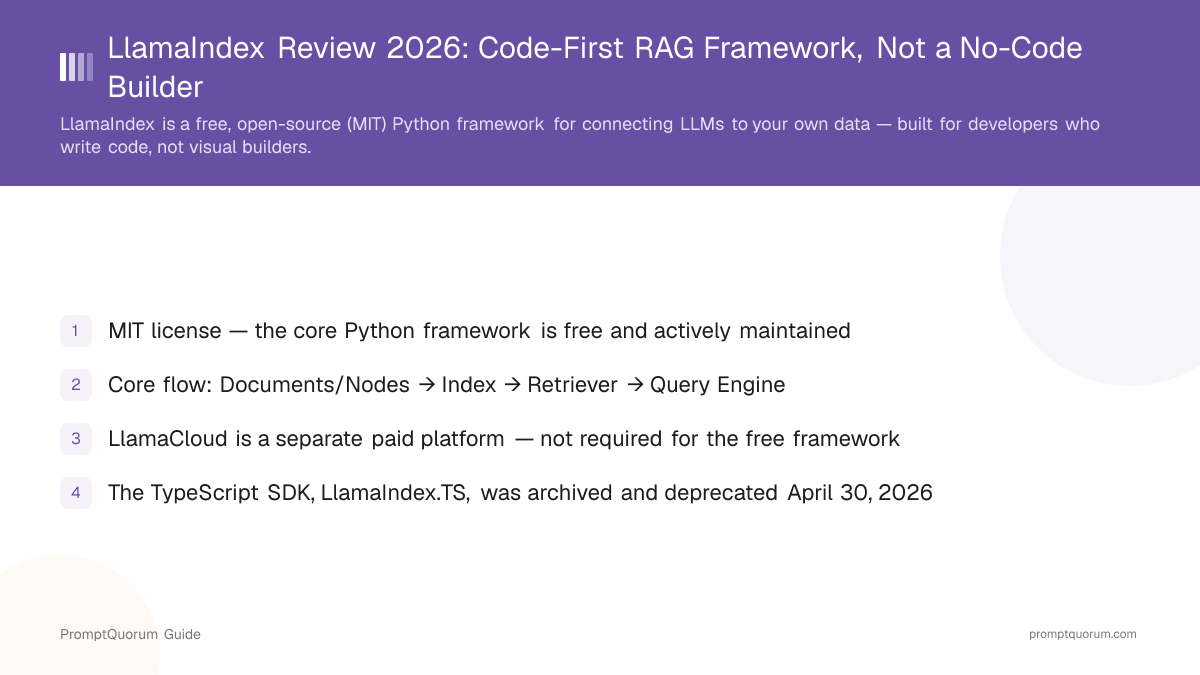
- MIT license — the core Python framework is free, permissively licensed, and actively maintained
- Core building blocks: Documents/Nodes feed an Index (commonly a VectorStoreIndex), a Retriever pulls relevant nodes, a Query Engine answers the question
- Free to install and self-host: pip install llama-index, bring your own LLM provider and vector store
- LlamaCloud is a separate, paid, usage-based platform for automated document parsing (LlamaParse) and extraction — not required to use the open-source framework
- Code-first: there is no visual canvas — this is a Python library you import and write against
- The TypeScript SDK, LlamaIndex.TS, was archived and marked deprecated on April 30, 2026 — Python is the actively maintained implementation
- Best fit: developers building production RAG systems who want programmatic control over indexing and retrieval logic
📍 In One Sentence
LlamaIndex is a free, open-source (MIT) Python framework for connecting large language models to your own data through indexing, retrieval, and query engines — built for developers who write code, not for visual no-code builders.
💬 In Plain Terms
Instead of dragging boxes on a canvas, LlamaIndex gives you Python classes: load your documents, build an index, then query it — every step is code you can version, test, and customize.
📌Note: If you want to build a RAG pipeline by connecting boxes instead of writing Python, LlamaIndex is the wrong tool — look at a visual builder like Flowise, Langflow, or Dify instead.
What Is LlamaIndex?
LlamaIndex (github.com/run-llama/llama_index) is an open-source, MIT-licensed Python framework for building applications that connect large language models to your own data. It is a data framework first: the library is organized around ingesting documents, structuring them for retrieval, and answering questions over them — not around general-purpose agent orchestration.
- Data connectors: SimpleDirectoryReader for local files, plus 300+ community and first-party integrations on LlamaHub for PDFs, APIs, SQL databases, and other sources
- Indices: structures that organize ingested data for LLM retrieval — VectorStoreIndex (embeddings-based semantic search) is the most common
- Retrievers: fetch the nodes relevant to a query from an index
- Query engines: combine a retriever with an LLM call to answer a question over your data — the core retrieval-augmented generation (RAG) loop
- Workflows: an event-driven system for orchestrating multi-step agents and pipelines beyond a single query
- The core Python repository reports over 50,000 GitHub stars
What Are LlamaIndex's Core Building Blocks?
LlamaIndex organizes a RAG pipeline into five building blocks: Document/Node, Index, Retriever, Query Engine, and Workflow. Each maps to one step in turning raw files into an LLM that can answer questions about them.
Documents and Nodes
A Document wraps one raw source — a PDF, a web page, a database row. LlamaIndex splits each Document into Nodes, smaller chunks sized to fit an embedding model's context window, and attaches metadata (source file, page number) that survives into the final answer as a citation.
Indices and retrievers
An Index takes a list of Nodes and organizes them for fast lookup. VectorStoreIndex embeds every Node and stores the vectors in a vector database (in-memory by default, or a provider such as Pinecone, Qdrant, or Chroma). A Retriever built from that index takes a query, embeds it the same way, and returns the top-k most similar Nodes.
Query engines
A Query Engine wraps a Retriever and an LLM call into one method: it retrieves relevant Nodes, builds a prompt containing them, and returns the model's answer. Calling index.as_query_engine().query("...") is the shortest path from an index to an answer.
Document / Node
- What it does:
- Raw data, then chunked structured pieces of it
Index
- What it does:
- Organizes nodes for retrieval (e.g. VectorStoreIndex)
Retriever
- What it does:
- Fetches the nodes relevant to a query
Query Engine
- What it does:
- Combines retrieval + an LLM call to answer a question
Workflow
- What it does:
- Event-driven orchestration for multi-step agents
How Does LlamaIndex Differ From LangChain and Visual Builders?
LlamaIndex is a data framework first, LangChain is a general-purpose orchestration framework, and tools like Flowise, Langflow, and Dify are visual, no-code builders — all three solve different problems even when they overlap on RAG. Picking between them is a question of what you are optimizing for, not which one is "better."
LlamaIndex vs. LangChain
LangChain is built around chains, agents, and tool-calling across a broad range of LLM application types; retrieval is one capability among many. LlamaIndex is built around indexing and retrieval specifically — its Document/Node/Index/Retriever/Query Engine model is more opinionated and typically requires less boilerplate for a data-heavy RAG pipeline, at the cost of being less general-purpose for non-retrieval agent logic. Both are Python-first, MIT-licensed, and actively maintained, and many production stacks combine LlamaIndex for retrieval with a separate orchestration layer for the rest of the application.
LlamaIndex vs. visual builders (Flowise, Langflow, Dify)
Visual builders let you assemble a RAG pipeline by connecting pre-built nodes on a canvas — no Python required. That trades away fine-grained control: custom retrieval logic, non-standard chunking strategies, or anything outside the node library's pre-built blocks usually means dropping into a "custom code" node or abandoning the canvas. LlamaIndex has no canvas at all — every pipeline is Python you write, test, and put under version control from the start. If you want the visual approach instead, see our reviews of Flowise, or evaluate Langflow and Dify directly.
Is LlamaIndex Free, or Do You Need to Pay for LlamaCloud?
The core LlamaIndex framework is free forever under the MIT license — you can self-host it against your own LLM and vector database at no cost to LlamaIndex. LlamaCloud, a separate hosted platform for automated document parsing and extraction (LlamaParse, LlamaExtract), charges usage-based credits on top of that: $1.25 per 1,000 credits, with parsing costing 1–45 credits per page and extraction 5–60 credits per page depending on the tier selected.
- Open-source framework (pip install llama-index): free, MIT-licensed, self-hosted — no account or credits required
- LlamaCloud / LlamaParse: paid, credit-metered document parsing for layout-heavy PDFs, scanned documents, tables, and charts
- You do not need a LlamaCloud account to build or run a RAG pipeline with the open-source framework — SimpleDirectoryReader and other free loaders cover plain text, Markdown, and standard PDFs
- LlamaCloud becomes relevant when your documents are complex enough (multi-column layouts, embedded tables, handwriting) that a free parser produces poor chunk quality
How Do You Build a Minimal RAG Pipeline With LlamaIndex?
A working LlamaIndex RAG pipeline is five lines of Python: load documents, build an index, create a query engine, and query it. This example uses the default in-memory vector store and an OpenAI-compatible LLM; swap in a local provider (Ollama, for example) by installing its integration package and setting Settings.llm before building the index.
- 1Install the framework: pip install llama-index (add a provider package such as llama-index-llms-ollama to use a local model instead of a hosted API).
- 2Set your LLM provider credentials — for example export OPENAI_API_KEY=... — or configure Settings.llm to point at a local provider before the next step.
- 3Place your source files in a folder (for example data/) and load them: documents = SimpleDirectoryReader("data").load_data().
- 4Build an index from the loaded documents: index = VectorStoreIndex.from_documents(documents). This chunks each document into Nodes and embeds them.
- 5Create a query engine from the index: query_engine = index.as_query_engine().
- 6Query your data and print the answer: response = query_engine.query("Your question here"); print(response).
from llama_index.core import VectorStoreIndex, SimpleDirectoryReader

# Load documents from a folder
documents = SimpleDirectoryReader("data").load_data()

# Build an index from documents
index = VectorStoreIndex.from_documents(documents)

# Create a query engine
query_engine = index.as_query_engine()

# Query your data
response = query_engine.query("Your question here")
print(response)
Does this index rebuild every time the script runs?
Yes, by default. For anything beyond a one-off script, call index.storage_context.persist() after building the index, and load it back with load_index_from_storage() on subsequent runs instead of re-embedding every document each time.
Can I use a local LLM and vector store instead of OpenAI?
Yes. Install the matching integration package (for example llama-index-llms-ollama for a local model, or a vector-store package such as llama-index-vector-stores-chroma), then set Settings.llm and Settings.embed_model, or pass the vector store into VectorStoreIndex.from_documents(), before running the same query engine code.
Is the TypeScript Version of LlamaIndex Still Maintained?
No. LlamaIndex.TS (run-llama/LlamaIndexTS on GitHub) was archived by its maintainers and marked deprecated on April 30, 2026. The repository's own notice states the project "is deprecated and no longer maintained" and directs users toward the LlamaCloud/LlamaParse documentation instead of the TypeScript SDK.
- The Python framework (llama_index) is the actively maintained implementation — this article covers that version
- Existing TypeScript projects built on LlamaIndex.TS will keep running, but receive no further updates, bug fixes, or security patches
- For a new TypeScript or JavaScript project, evaluate LangChain.js (actively maintained, MIT-licensed) instead of starting on an archived library
Who Should Use LlamaIndex?
LlamaIndex fits a specific position in the RAG tooling landscape: developers who want code-level control over indexing and retrieval, not the fastest path to a visual prototype.
Use LlamaIndex if
- You are comfortable writing and maintaining Python and want your RAG pipeline under version control from day one
- You are building a production retrieval system where chunking strategy, retrieval logic, or index structure needs custom tuning beyond a pre-built node library
- You need to combine multiple data sources (PDFs, databases, APIs) into one retrieval layer using LlamaHub's connector ecosystem
- You want a framework that treats retrieval as the primary concern rather than one node type among many general-purpose agent tools
Avoid LlamaIndex if
- You are not a developer, or your team wants to prototype a RAG pipeline without writing code — use a visual builder like Flowise, Langflow, or Dify instead
- Your project is a general-purpose LLM agent with tool-calling and multi-step reasoning as the primary need, not document retrieval — LangChain or a dedicated agent framework may fit better
- You need a TypeScript-native framework for a new project — LlamaIndex.TS is deprecated; evaluate LangChain.js instead
- You need every document-processing step to stay fully self-hosted with zero usage-based billing anywhere in the stack, including for complex PDF parsing — LlamaCloud's credit pricing may not fit that constraint, though the core framework itself remains free
LlamaIndex vs. Alternatives
The right choice depends on whether you want code-level control (LlamaIndex, LangChain, Haystack) or a visual canvas (Flowise and similar tools).
Tool | Interface | License | Best For | Maintenance |
|---|---|---|---|---|
| LlamaIndex | Python code | MIT | Data-heavy custom RAG pipelines | Active |
| LangChain | Python / JS code | MIT | General-purpose LLM orchestration | Active |
| Haystack | Python code | Apache 2.0 | Enterprise search + RAG pipelines | Active |
| Flowise | Visual, drag-and-drop | Apache 2.0 | No-code prototyping (unmaintained) | Archived / none |
Common Mistakes When Evaluating LlamaIndex
These mistakes come from treating LlamaIndex like a different category of tool than what it actually is.
Mistake 1: Expecting a visual, no-code interface
LlamaIndex has no canvas, no drag-and-drop nodes, and no GUI for building a pipeline. Every pipeline is Python code. If a visual builder is what you actually want, evaluate Flowise, Langflow, or Dify — comparing LlamaIndex against them on "ease of use for non-developers" measures the wrong thing.
Mistake 2: Assuming you need LlamaCloud to use LlamaIndex
LlamaCloud is optional. The open-source framework installs with pip, runs against your own LLM and vector store, and handles plain text, Markdown, and standard PDFs without any paid account. LlamaCloud only becomes relevant for complex document parsing (scanned pages, dense tables) that free loaders handle poorly.
Mistake 3: Starting a new TypeScript project on LlamaIndex.TS
LlamaIndex.TS was archived and marked deprecated on April 30, 2026. New TypeScript or JavaScript projects should evaluate LangChain.js or build a Python retrieval service behind an API instead of starting on an unmaintained library.
Frequently Asked Questions
Is LlamaIndex free to use?
Yes. The core Python framework is free and open-source under the MIT license. LlamaCloud, a separate hosted platform for document parsing and extraction, charges usage-based credits ($1.25 per 1,000 credits), but it is optional and not required to build or run a RAG pipeline.
What license is LlamaIndex released under?
MIT License, for both the Python framework (llama_index) and, while it was maintained, the TypeScript SDK (LlamaIndex.TS). MIT permits commercial use, modification, and redistribution.
How is LlamaIndex different from LangChain?
LlamaIndex is a data framework built specifically around indexing and retrieval — Documents, Nodes, Indices, Retrievers, and Query Engines. LangChain is a general-purpose orchestration framework covering chains, agents, and tool-calling, where retrieval is one capability among many. Both are MIT-licensed, Python-first, and actively maintained; many production stacks use both together.
Is LlamaIndex a visual, no-code builder?
No. LlamaIndex is a Python (previously also TypeScript) library you import and write code against — there is no drag-and-drop canvas. For a visual, no-code approach to RAG or agent pipelines, evaluate Flowise, Langflow, or Dify instead.
What is LlamaCloud, and do I need it?
LlamaCloud is a separate, paid, usage-based platform from the same company, offering LlamaParse (document parsing) and LlamaExtract (structured extraction) for complex documents. You do not need it to use the open-source LlamaIndex framework — it only becomes useful when free document loaders produce poor results on complex PDFs, scanned pages, or dense tables.
Is the TypeScript version of LlamaIndex still maintained?
No. LlamaIndex.TS was archived by its maintainers and marked deprecated on April 30, 2026. The Python framework remains the actively maintained implementation. For a new TypeScript/JavaScript project, evaluate LangChain.js instead.
What is a Query Engine in LlamaIndex?
A Query Engine combines a Retriever with an LLM call into one method call. Calling index.as_query_engine().query("your question") retrieves the relevant Nodes from the index, builds a prompt containing them, and returns the model's answer — the core retrieval-augmented generation (RAG) loop.
How many integrations does LlamaIndex support?
LlamaHub hosts more than 300 community and first-party integration packages covering data loaders (PDFs, APIs, SQL databases, and more), LLM providers, and vector stores, on top of the built-in SimpleDirectoryReader for local files.
Can I use a local LLM with LlamaIndex instead of a cloud API?
Yes. Install the matching provider integration (for example llama-index-llms-ollama for Ollama), then set it as the default via Settings.llm before building your index — the rest of the Document/Index/Retriever/Query Engine pipeline works the same regardless of which LLM provider you use.
Can I self-host a LlamaIndex app as a local API server?
Yes. LlamaIndex's Full-Stack Web Application guide documents packaging a RAG pipeline behind a Flask/FastAPI-style backend and running it in a Docker container — no LlamaCloud account or hosted service required.
Do I need to write Python to use LlamaIndex?
Yes, for the currently maintained version. LlamaIndex is a code-first framework with no visual interface. Non-developers or teams that want a no-code approach should evaluate a visual builder like Flowise, Langflow, or Dify instead.