Who Built LangChain, and How Is It Funded?
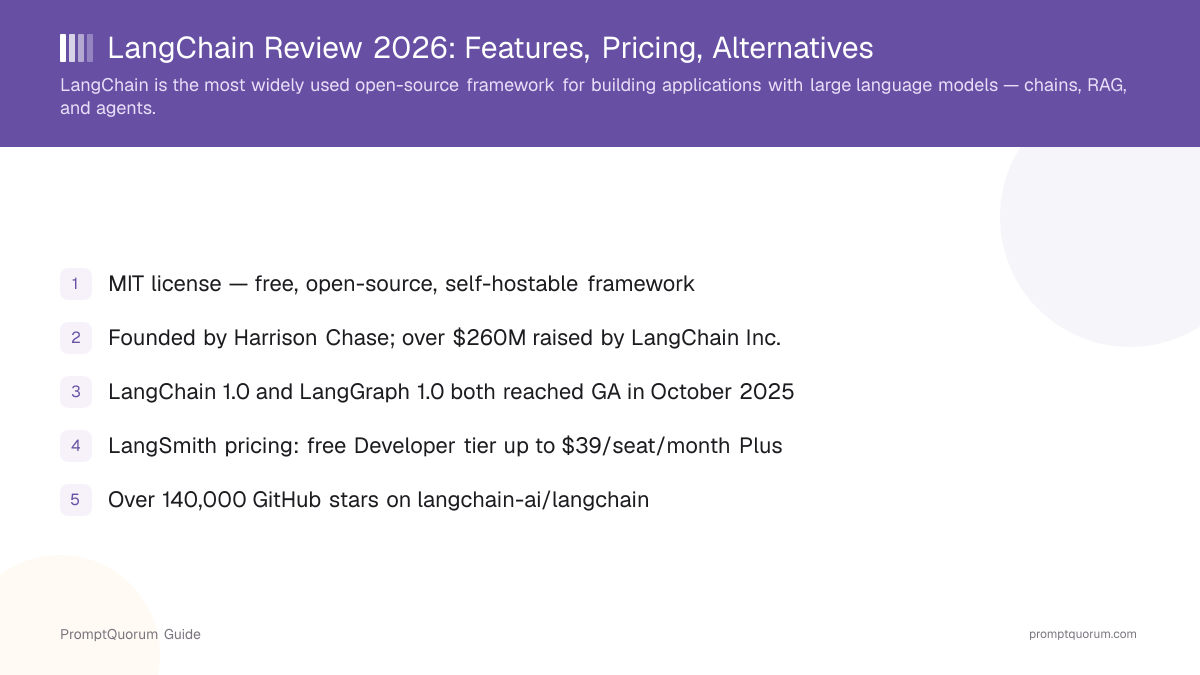
Harrison Chase built LangChain, and LangChain Inc. is now a venture-backed company with over $260 million raised. Chase, a Harvard-trained statistician who previously worked at the machine learning startup Robust Intelligence, released the first version of LangChain as an open-source Python library in October 2022 — one month before ChatGPT launched and pulled a wave of new developers toward LLM application tooling.
LangChain Inc. was formally incorporated in January 2023. Benchmark led a $10 million seed round in April 2023. Ten months later, in February 2024, Sequoia Capital led a $25 million Series A at a $200 million valuation, announced alongside the general availability of LangSmith. By 2025, the company had grown enough to raise a $125 million Series B led by IVP, joined by Sequoia, Benchmark, CapitalG, Sapphire Ventures, ServiceNow Ventures, Workday Ventures, Cisco Investments, Datadog, and Databricks, at a $1.25 billion valuation.
First release
- Date:
- 2022-10
- What it means:
- Harrison Chase publishes the first open-source LangChain Python library
Company incorporated
- Date:
- 2023-01
- What it means:
- LangChain Inc. formally incorporated as ChatGPT-driven adoption surges
Seed round
- Date:
- 2023-04
- What it means:
- $10M seed round led by Benchmark
Series A
- Date:
- 2024-02
- What it means:
- $25M Series A led by Sequoia at a $200M valuation, with LangSmith GA
Core/community split
- Date:
- 2023-12
- What it means:
- langchain-core and langchain-community separated into their own packages
LangChain 0.1.0
- Date:
- 2024-01
- What it means:
- First versioned stable release; LCEL becomes the recommended pattern
Series B
- Date:
- 2025
- What it means:
- $125M led by IVP at a $1.25B valuation
LangChain & LangGraph 1.0
- Date:
- 2025-10
- What it means:
- Both reach general availability; commitment to no breaking changes until 2.0
📌Note: The MIT license on the open-source framework does not change regardless of how much LangChain Inc. raises — venture funding pays for LangSmith and LangGraph Platform development, not a paywall on the core library.
What Is LangChain?
LangChain is an open-source framework (MIT license, github.com/langchain-ai/langchain) for building applications powered by large language models, available for Python and JavaScript/TypeScript. It provides standard interfaces for models, prompts, memory, and tools, so a chain built around one LLM provider can often switch providers with a one-line change.
- LCEL (LangChain Expression Language): a declarative syntax (prompt | model | parser) for composing chains, standard since the langchain-core 0.1 release in December 2023
- Chains: sequences of calls — prompt formatting, model invocation, output parsing — wired together as a single runnable pipeline
- Retrievers and RAG: standard interfaces for vector stores and document loaders, so a retrieval-augmented generation pipeline can swap embedding models or vector databases without rewriting application code
- Agents: the create_agent abstraction, introduced with LangChain 1.0, builds a tool-using agent from a model and a list of tools, running on the LangGraph runtime underneath
- LangGraph: a lower-level, graph-based framework for agents that need explicit state, cycles, or human-in-the-loop checkpoints — not every agent needs it, but production agents with retries or approval steps usually do
- 700+ third-party integrations across langchain-community and dedicated partner packages (langchain-openai, langchain-anthropic, and similar) for models, vector stores, and tools
A minimal agent with create_agent
LangChain 1.0 introduced create_agent as the shortest path to a working tool-using agent, running on the LangGraph runtime for state and reliability: from langchain.agents import create_agent, then `agent = create_agent(model=ChatOpenAI(model="gpt-4o-mini"), tools=[search_tool]), followed by agent.invoke({"messages": [{"role": "user", "content": "..."}]})`.
from langchain_openai import ChatOpenAI
from langchain_core.prompts import ChatPromptTemplate
from langchain_core.output_parsers import StrOutputParser

model = ChatOpenAI(model="gpt-4o-mini")
prompt = ChatPromptTemplate.from_template("Summarize in one sentence: {text}")
chain = prompt | model | StrOutputParser()

print(chain.invoke({"text": "LangChain composes LLM calls into pipelines."}))
How Much Does LangChain Cost?
The LangChain framework itself is completely free — LangSmith and LangGraph Platform are the paid add-ons. LangChain Inc. does not charge for the open-source library; its revenue comes from optional hosted tools built around it.
- LangChain (the framework): free forever under the MIT license, whether self-hosted, used commercially, or modified
- LangSmith Developer tier: $0 per seat per month, one seat, up to 5,000 base traces per month, then pay-as-you-go
- LangSmith Plus tier: $39 per seat per month, unlimited seats, up to 10,000 base traces per month included
- LangSmith Enterprise: custom pricing, adds self-hosted and hybrid deployment options
- Pay-as-you-go overage on Developer/Plus: $1.50 per LCU (compute) and $1.00 per LSU (storage) beyond the included trace allowance
- LangGraph Platform (production agent hosting): no published self-serve price as of this review — contact LangChain's sales team for a quote
- A startup program offers up to $10,000 in LangSmith credits for VC-backed companies
Tier | Price | Best For |
|---|---|---|
| LangChain framework | Free (MIT license) | Everyone — no cost, ever |
| LangSmith Developer | $0/seat/mo, 5K traces | Solo devs, prototyping |
| LangSmith Plus | $39/seat/mo, 10K traces | Small teams, more usage |
| LangSmith Enterprise | Custom pricing | Self-hosted/hybrid, compliance |
| LangGraph Platform | Custom (contact sales) | Production agent hosting |
Prices verified against LangChain's official pricing page as of September 2026 and billed in USD worldwide — check the live page before budgeting, since SaaS tiers change without much notice.
How Do You Install and Get Started With LangChain?
Installing LangChain takes one pip or npm command — no account, license key, or server required for the open-source framework. LangSmith tracing is opt-in and only activates if you set its API key.
- 1Install the core package and a model provider integration:
pip install langchain langchain-openai(Python) ornpm install langchain @langchain/openai(JavaScript/TypeScript). - 2Set your model provider's API key as an environment variable (for example
OPENAI_API_KEY) — LangChain does not provide or proxy model access itself. - 3Build a chain with LCEL: combine a prompt template, a chat model, and an output parser with the pipe operator (
prompt | model | parser), then call.invoke()on the result. - 4For an agent instead of a fixed chain, use
create_agentfrom thelangchainpackage, passing a model and a list of tools — it runs on the LangGraph runtime for state handling. - 5Optionally sign up for LangSmith and set
LANGCHAIN_TRACING_V2=trueplus aLANGCHAIN_API_KEYto see traces of every chain or agent run without changing application code. - 6Read the official LangChain documentation and browse the GitHub repository for the current API reference — the framework has changed enough across major versions that older tutorials can be outdated.
Do I need an OpenAI or Anthropic account to use LangChain?
You need an account and API key with whichever model provider you choose to call — LangChain itself does not host or resell model access. It supports OpenAI, Anthropic, Google, and dozens of other providers, plus fully local models through integrations like Ollama.
Does installing LangChain require LangSmith?
No. LangSmith tracing is entirely optional and only activates when you set the LANGCHAIN_TRACING_V2 environment variable and an API key. You can build and run LangChain applications indefinitely without ever creating a LangSmith account.
Who Should Use LangChain?
LangChain fits teams building LLM applications that need more than a single prompt call — RAG pipelines, multi-step chains, or agents that use tools. It is a weaker fit for a one-off script that calls a model once.
Use LangChain if
- You are building a RAG pipeline and want standard interfaces for swapping vector stores, embedding models, or LLM providers without rewriting application code
- You need production agent infrastructure — LangGraph provides durable state, human-in-the-loop approval steps, and automatic recovery after a server restart
- You want to observe and debug what a multi-step chain or agent actually did in production, and are willing to pay for LangSmith to get that
- You are already invested in the Python or JavaScript ecosystem and want the largest library of pre-built integrations (700+) for models, vector stores, and tools
Avoid LangChain if
- Your application is a single prompt-and-response call with no chaining, retrieval, or agent logic — a direct SDK call to your model provider has less overhead
- You want the smallest possible dependency footprint; LangChain's abstraction layers add packages and indirection that a raw API client does not
- Your team has been burned by LangChain's pre-1.0 history of frequent breaking API changes and prefers to wait for the post-1.0 stability commitment to prove out over more releases
- You need a RAG-first, retrieval/indexing-specialized framework rather than a general-purpose one — LlamaIndex is built specifically around that use case
When Should You NOT Use LangChain?
Skip LangChain for a single API call to one model with no retrieval, memory, or multi-step logic — the abstraction overhead outweighs the benefit. A few concrete situations where a different tool wins.
- A chatbot that only ever sends one prompt and returns the raw response — call the provider's SDK directly instead of adding a framework layer
- A team that has decided minimal dependencies matter more than convenience — LangChain pulls in more packages than a raw HTTP client would
- A project whose primary job is document indexing and retrieval-quality tuning, not general application logic — LlamaIndex or Haystack specialize in that
- A team still running code against pre-0.1 LangChain versions (before December 2023) worried about the historical pattern of breaking changes — budget migration time, or start fresh on the post-1.0 API instead of patching old code
- Use LangChain instead when the application genuinely chains multiple steps, retrieves external context, or needs an agent that calls tools and remembers state across turns
LangChain vs. Alternatives
LangChain competes with other frameworks for building LLM applications and agents, each optimized for a different point on the spectrum from retrieval-focused to multi-agent-focused.
Tool | Interface | License | Backing | Best For |
|---|---|---|---|---|
| LangChain | Python / JS code | MIT | LangChain Inc. (VC-backed) | General-purpose LLM apps & agents |
| LlamaIndex | Python / TS code | MIT | LlamaIndex Inc. (VC-backed) | RAG-first indexing & retrieval |
| Haystack | Python code | Apache 2.0 | deepset (Germany) | Production RAG pipelines |
| Semantic Kernel | C# / Python / Java | MIT | Microsoft | .NET-first enterprise apps |
| CrewAI | Python code | MIT | CrewAI Inc. (VC-backed) | Role-based multi-agent crews |
| AutoGen | Python code | MIT / CC-BY | Microsoft Research | Multi-agent conversation patterns |
Common Mistakes When Evaluating LangChain
These mistakes come from conflating LangChain with LangSmith, or judging the current framework by an outdated reputation.
Mistake 1: Assuming LangChain and LangSmith are the same product
LangChain is the free, open-source framework; LangSmith is a separate, optional paid observability product built by the same company, LangChain Inc. You can build and ship LangChain applications without ever touching LangSmith or paying anything.
Mistake 2: Judging current LangChain by its pre-1.0 reputation for breaking changes
The frequent breaking changes between minor versions were a real, widely-reported pain point through 2023 and into 2024, driven by the langchain-core/langchain-community restructuring. LangChain 1.0, released in October 2025, came with a public commitment to API stability until 2.0 — a materially different situation from the framework's early years.
Mistake 3: Assuming every agent needs LangGraph's full graph-based state machine
The create_agent abstraction covers most tool-using agent use cases with a simple model-plus-tools setup. Reach for LangGraph's lower-level graph API directly only when you need explicit control over state, cycles, or human-in-the-loop checkpoints that create_agent does not expose.
Frequently Asked Questions
Is LangChain free to use?
Yes. The LangChain framework is open-source under the MIT license and free for any use, including commercial products, with no usage limits. LangSmith, the observability add-on, has a separate paid pricing structure starting at $0 for a limited free tier.
Who founded LangChain?
Harrison Chase founded LangChain, releasing the first open-source version in October 2022 before formally incorporating LangChain Inc. in January 2023.
How much funding has LangChain raised?
LangChain Inc. has raised over $260 million total, including a $10 million seed round in April 2023, a $25 million Series A led by Sequoia Capital in February 2024 at a $200 million valuation, and a $125 million Series B in 2025 at a $1.25 billion valuation.
What is the difference between LangChain and LangGraph?
LangChain provides the general framework for chains, prompts, and the create_agent abstraction for building LLM applications. LangGraph is the lower-level, graph-based runtime for agents that need explicit state management, cycles, or human-in-the-loop steps — create_agent itself runs on top of LangGraph.
What is LangSmith, and is it required to use LangChain?
LangSmith is LangChain Inc.'s paid observability and tracing platform for debugging chains and agents in production. It is entirely optional — LangChain applications run and deploy without any LangSmith account or dependency.
How much does LangSmith cost?
The Developer tier is free for one seat with up to 5,000 base traces per month. The Plus tier costs $39 per seat per month with up to 10,000 base traces included. Enterprise pricing is custom and adds self-hosted/hybrid deployment.
Has LangChain's API stopped making breaking changes?
LangChain Inc. committed to no breaking changes on the 1.x API line following the LangChain 1.0 and LangGraph 1.0 general-availability releases in October 2025. Earlier versions, particularly before the langchain-core/langchain-community split in December 2023, did have a documented history of breaking changes between releases.
How many GitHub stars does LangChain have?
The core langchain-ai/langchain repository has passed 140,000 GitHub stars, making it one of the most-starred AI application frameworks on GitHub.
Can I run LangChain with local, self-hosted models instead of a cloud API?
Yes. LangChain integrates with local model runners like Ollama and llama.cpp through dedicated partner packages, so chains and agents can call locally hosted models instead of, or alongside, cloud providers.
Is LangChain better than LlamaIndex?
Neither is strictly better — they serve overlapping but distinct purposes. LangChain is a general-purpose framework for chains and agents across many use cases; LlamaIndex is more specialized around retrieval and data indexing for RAG. Many production systems use both together.