Who Built SuperAGI, and What Happened to the Company?
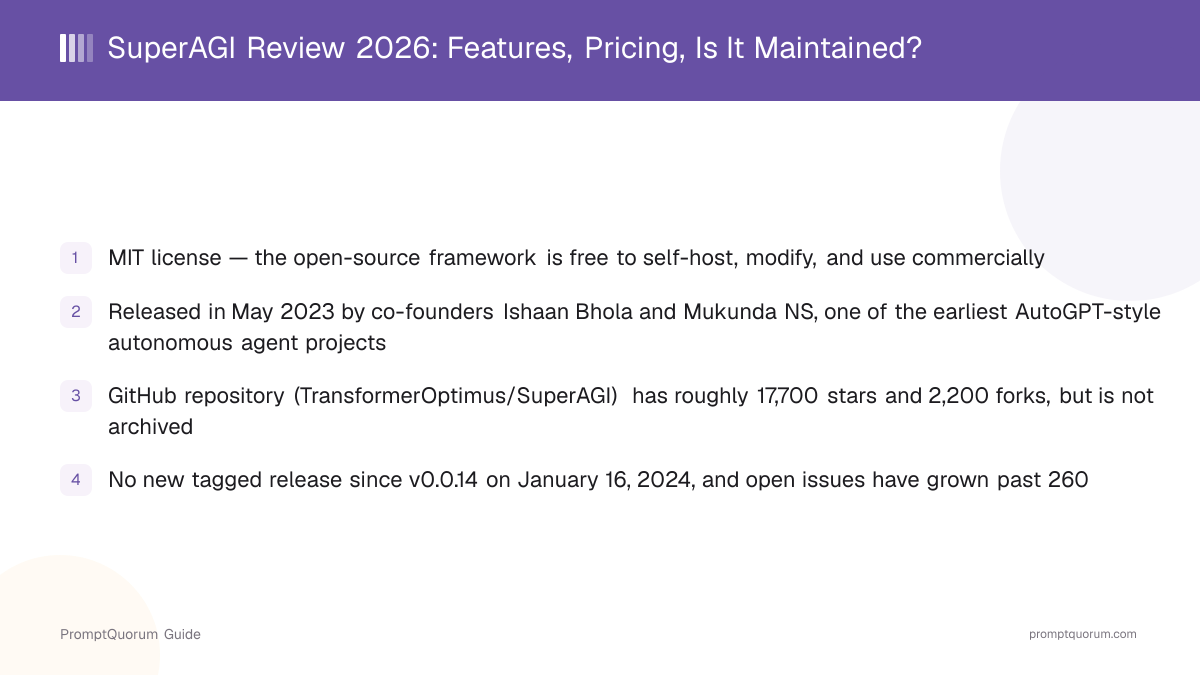
Ishaan Bhola and Mukunda NS founded SuperAGI, launching the open-source framework in May 2023. The GitHub repository was created on May 13, 2023, in the same few months that AutoGPT and BabyAGI popularized the idea of a large language model that plans and executes its own multi-step tasks. SuperAGI's pitch at the time was a GUI-based, production-oriented alternative to those command-line experiments — a console for provisioning, running, and monitoring agents instead of a single script.
The company, based in Palo Alto, raised a $10 million Series A led by Newlands VC, reported in March 2024, with participation tied to WhatsApp co-founder Jan Koum's investment vehicle. Since then, SuperAGI the company has redirected its commercial product toward an AI-native sales and go-to-market (GTM) platform — pitched publicly as an all-in-one CRM, prospecting database, multi-channel outreach, and workflow tool for sales teams — a different product from the open-source autonomous-agent framework this article reviews. The open-source GitHub project continues to exist under the same organization, TransformerOptimus, but without the same commercial attention.
Repository created
- Date:
- 2023-05-13
- What it means:
- Ishaan Bhola and Mukunda NS publish the first SuperAGI code on GitHub
v0.0.14 release
- Date:
- 2024-01-16
- What it means:
- The most recent tagged GitHub release as of this review — over two and a half years old
Series A reported
- Date:
- 2024-03
- What it means:
- $10M raised, led by Newlands VC, per contemporary funding coverage
Docs domain repurposed
- Date:
- By 2026
- What it means:
- docs.superagi.com now serves the company's unrelated sales product documentation, not the open-source framework
SuperAGI Cloud offline
- Date:
- By 2026
- What it means:
- app.superagi.com, the free hosted trial for the framework, no longer resolves
📌Note: The MIT license on the open-source code does not change because of the company's commercial pivot — anyone can still clone, self-host, and modify the framework as it stood at its last commit, regardless of what the company sells today.
What Is SuperAGI?
SuperAGI is a self-hosted, open-source (MIT license) framework for building and running autonomous AI agents through a web-based console rather than a code SDK. It runs as a set of Docker containers (a FastAPI backend, a Celery worker, a Next.js GUI, PostgreSQL, and Redis) that you start locally or on a server, then operate from a browser at localhost:3000.
- Agent console (GUI): create an agent by choosing a model, writing a goal in plain text, and selecting which tools it can call — no orchestration code required for a basic agent
- Action Console: a human-in-the-loop panel where an agent pauses to ask permission before a sensitive step, such as sending an email or running a shell command
- Tools marketplace: pre-built toolkits for web search, web scraping, GitHub, Jira, Google services, Notion, image generation, and coding, browsable at marketplace.superagi.com
- Agent memory: persistent storage backed by a connected vector database (Pinecone, Qdrant, and others), so an agent can recall earlier steps across a long-running task
- Multi-agent workflows: agents can be chained into a fixed sequence of steps (SuperAGI calls this a "workflow"), built around the ReAct (reason-then-act) pattern rather than a free-form multi-agent conversation
- Local LLM support: a documented GPU-enabled Docker Compose file lets you point agents at a self-hosted model instead of a cloud API
Building an agent through the console
There is no primary Python or JavaScript SDK to lead with — SuperAGI is built console-first. A typical flow: open the GUI, click "Create new agent," type a goal ("Research three competitors and summarize their pricing"), toggle on the web search and web scraping toolkits, set a maximum number of steps, and run it. The agent's reasoning, tool calls, and any Action Console approval prompts appear in the same browser tab as the run progresses.
# Clone and start SuperAGI locally with Docker
git clone https://github.com/TransformerOptimus/SuperAGI.git
cd SuperAGI
cp config_template.yaml config.yaml
# Add your model provider API key to config.yaml, then:
docker compose -f docker-compose.yaml up --build
# Open http://localhost:3000 and create your first agent from the GUI
Is SuperAGI Still Actively Maintained?
SuperAGI's GitHub repository is not archived and still exists, but its release cadence has slowed to a stop, and the company's paid engineering focus has moved to an unrelated product. These are separate facts worth weighing on their own, verified directly against GitHub and the company's current site as of this review.
- The most recent tagged release is v0.0.14, published January 16, 2024 — no newer version has shipped since, over two and a half years as of this review
- GitHub's own repository metadata shows the last code push landed in January 2025, meaning some commit activity continued after the last release, but nothing has been pushed in well over a year at the time of this review
- Open issues on the repository have grown to over 260, with the "good first issue" backlog still open to community contributors
- The repository is not marked archived or read-only on GitHub, and forking, cloning, and self-hosting all still work exactly as documented
- docs.superagi.com — the link the project's own README points to for documentation — now serves the company's separate commercial sales product, not open-source framework docs
- app.superagi.com, once offered as "SuperAGI Cloud" for a no-install trial of the framework, no longer resolves; self-hosting with Docker is the only verified way to run current SuperAGI
- marketplace.superagi.com, the tools marketplace referenced in the README, was still reachable as of this review
How Much Does SuperAGI Cost?
Self-hosting the open-source SuperAGI framework is free — there is no license fee, and the only cost is your own infrastructure and any model provider API usage. The company's current commercial product is a separate, unrelated sales platform with its own pricing that has nothing to do with running the open-source agent framework.
- SuperAGI framework (self-hosted): free forever under the MIT license, with no seat count, usage cap, or paywalled feature
- Infrastructure cost: whatever it costs to run the Docker containers on your own server or cloud VM, plus a vector database (self-hosted or a managed tier from a provider like Pinecone or Qdrant)
- Model cost: pay your chosen LLM provider directly for API usage (OpenAI, Anthropic, or others), or point agents at a self-hosted local model to avoid per-token charges entirely
- SuperAGI Cloud (the framework's former free-trial hosting): no longer reachable as of this review — there is no verified official hosted option for the open-source framework itself
- The company SuperAGI's current commercial product is an unrelated AI sales/GTM platform, reported by third-party pricing trackers as a credit-based system with a free tier, paid tiers around $30 and $100 per user per month, and custom Enterprise pricing — this pricing applies to that separate sales product, not to self-hosting the open-source agent framework
Option | Cost | Notes |
|---|---|---|
| SuperAGI framework | Free (MIT license) | Self-hosted only; no paid tier for the framework itself |
| Docker hosting | Your infrastructure cost | Any VPS/cloud VM that runs Docker Compose |
| Model API usage | Provider's own pricing | Or use a local LLM to avoid per-token cost |
| SuperAGI (company) sales platform | Free tier, ~$30–100/user/mo, custom Enterprise | Unrelated commercial product, per third-party trackers |
The company's sales-platform pricing figures come from third-party trackers (reviewed via public pricing-comparison sites) rather than a fetched official SuperAGI pricing page, since that page now documents the sales product, not the agent framework — treat those figures as directional and confirm current pricing directly with SuperAGI's sales team if you are evaluating that separate product.
How Do You Install and Get Started With SuperAGI?
Installing SuperAGI means cloning the GitHub repository and running Docker Compose — there is no separate account or license key for the open-source framework. The only account you need is with whichever model provider you plan to call.
- 1Install Docker Desktop if you do not already have it running.
- 2Clone the repository:
git clone https://github.com/TransformerOptimus/SuperAGI.git, thencd SuperAGI. - 3Copy the template config:
cp config_template.yaml config.yaml, then open it and add your model provider API key. - 4Start the stack:
docker compose -f docker-compose.yaml up --buildfor a standard CPU setup, ordocker compose -f docker-compose-gpu.yml up --buildif you plan to run local models with a GPU. - 5Open
http://localhost:3000in a browser once the containers finish starting, and create your first agent from the console. - 6For toolkits beyond the defaults, browse marketplace.superagi.com and add the ones your agent needs (web search, GitHub, Jira, and similar).
- 7Read the GitHub README for the current setup steps before starting — given the slowed release cadence, treat any third-party tutorial older than this review with caution and cross-check it against the repository itself.
Do I need a SuperAGI account to self-host the framework?
No. Self-hosting requires only Docker and an API key from your chosen model provider — there is no SuperAGI account, license key, or sign-up step for the open-source framework itself.
Can I run SuperAGI entirely with local, self-hosted models?
Yes, in principle — the repository includes a GPU-enabled Docker Compose configuration documented for local LLM use. Because the project has not shipped a new release since January 2024, verify that your specific local-model setup still works against the current code before relying on it in production.
Who Should Use SuperAGI?
SuperAGI fits a team that wants a self-hosted, GUI-driven way to prototype an autonomous agent without writing orchestration code, and is comfortable maintaining an unmaintained-by-upstream tool themselves. It is a weaker fit for anyone who needs guaranteed upstream support.
Use SuperAGI if
- You want to prototype a tool-using agent through a graphical console instead of writing Python or JavaScript orchestration code
- You are comfortable self-hosting with Docker and patching or extending the code yourself, since new upstream releases have stopped
- You specifically want a built-in Action Console for human-in-the-loop approval on sensitive agent steps, without building that UI yourself
- You are experimenting or building an internal tool rather than a customer-facing production system with an SLA that depends on active upstream maintenance
Avoid SuperAGI if
- You need a framework with frequent releases, active security patching, and a company actively investing engineering time in it — the release history and company focus here argue against that expectation
- You prefer a lighter-weight, code-first library over a full GUI console and its Docker stack (Postgres, Redis, Celery, a Next.js frontend) — LangChain or CrewAI add far less infrastructure for a single agent
- You are building a production system where reliability depends on the vendor patching bugs promptly — a more actively maintained framework is the safer default
- You want an officially supported hosted/cloud option — the framework's previous free cloud trial is no longer reachable
When Should You NOT Use SuperAGI?
Skip SuperAGI for anything where active upstream maintenance is a requirement, not a nice-to-have — a production system, a compliance-sensitive workload, or a team without spare capacity to patch the code itself. A few concrete situations where a different tool wins.
- A production deployment where you need timely security patches — with no tagged release since January 2024, you would be responsible for auditing and fixing issues yourself
- A team that wants active vendor support or a paid enterprise tier for the agent framework itself — that commercial attention has moved to the company's unrelated sales platform
- A project that specifically needs the largest, most current ecosystem of integrations and community tutorials — actively developed frameworks like LangChain, CrewAI, or AutoGen have larger, more current ecosystems
- A lightweight single-agent script where a full Docker stack (Postgres, Redis, Celery, a Next.js GUI) is more infrastructure than the task needs
- Use SuperAGI instead when a self-hosted GUI console for prototyping genuinely fits your workflow better than writing code, and you can own its maintenance going forward
SuperAGI vs. Alternatives
SuperAGI competes with other agent frameworks, most of which are code-first rather than GUI-first and have shipped more recent releases.
Tool | Interface | License | Recent activity | Best For |
|---|---|---|---|---|
| SuperAGI | Web GUI console | MIT | No release since Jan 2024 | GUI prototyping, self-owned maintenance |
| LangChain | Python / JS code | MIT | 1.0 GA, Oct 2025 | General-purpose LLM apps & agents |
| CrewAI | Python code | MIT | Active releases | Role-based multi-agent crews |
| AutoGen | Python code | MIT / CC-BY | Active releases | Multi-agent conversation patterns |
| AutoGPT | Python / web app | MIT (core) | Reduced pace, still updated | Original single-agent task runner |
| Letta | Python code / ADE | Apache 2.0 | Active releases | Long-term agent memory |
Common Mistakes When Evaluating SuperAGI
These mistakes come from judging SuperAGI by its 2023 launch reputation, or confusing the open-source framework with the company's current commercial product.
Mistake 1: Assuming the "SuperAGI" you find on the company website is the agent framework
By 2026, superagi.com markets an AI-native sales and go-to-market platform, not the open-source autonomous-agent framework. The framework lives on GitHub at TransformerOptimus/SuperAGI, built by the same original team but no longer the company's commercial focus.
Mistake 2: Assuming the GitHub repository is archived or dead because releases stopped
The repository is not archived, still accepts issues, and its last recorded push was in January 2025 — later than the last tagged release. "No new release since January 2024" and "abandoned" are not the same claim; verify the repository's own status page rather than assuming one from the other.
Mistake 3: Judging SuperAGI purely against its 2023 hype-cycle reputation as an AutoGPT alternative
SuperAGI was positioned as a GUI-based, more production-ready take on the AutoGPT/BabyAGI pattern in 2023. That comparison point is now over three years old — evaluate it against 2026's actively developed frameworks and its own current release cadence, not its launch-era pitch.
Frequently Asked Questions
Is SuperAGI free to use?
Yes. The SuperAGI framework is open-source under the MIT license and free to self-host, modify, and use commercially, with no usage caps. The company's current commercial sales platform is a separate, unrelated product with its own pricing.
Who founded SuperAGI?
Ishaan Bhola and Mukunda NS founded SuperAGI, publishing the open-source framework on GitHub in May 2023, based in Palo Alto.
Is SuperAGI still actively maintained?
The GitHub repository is not archived and has had commits as recently as January 2025, but it has not shipped a new tagged release since v0.0.14 on January 16, 2024, and open issues have grown past 260. The company's engineering focus has shifted to an unrelated sales/GTM platform, so treat the framework as slow-moving rather than actively developed.
What happened to the SuperAGI company?
SuperAGI raised a $10 million Series A (reported March 2024) and has since built its main commercial product around an AI-native sales and go-to-market platform — a CRM, prospecting, and outreach tool — rather than continuing active commercial development of the original open-source agent framework.
Is SuperAGI Cloud still available?
No verified longer. app.superagi.com, previously offered as a no-install hosted trial for the framework, no longer resolves as of this review. Self-hosting with Docker is the only confirmed way to run SuperAGI.
How do I install SuperAGI?
Clone the GitHub repository, copy config_template.yaml to config.yaml with your model provider API key, then run docker compose -f docker-compose.yaml up --build and open http://localhost:3000.
Does SuperAGI support local, self-hosted LLMs?
Yes — the repository includes a GPU-enabled Docker Compose file documented for local model use, though it predates the project's slowdown, so verify it still works against the current code before depending on it.
How many GitHub stars does SuperAGI have?
The TransformerOptimus/SuperAGI repository has roughly 17,700 stars and 2,200 forks as of this review, reflecting strong interest at launch even though release activity has since slowed.
What license is SuperAGI released under?
MIT — a permissive open-source license that allows free commercial use, modification, and self-hosting of the code as it exists in the repository.
Should I use SuperAGI for a production agent in 2026?
Only if you are prepared to maintain and patch it yourself. With no new release since January 2024, an actively developed alternative like LangChain, CrewAI, or AutoGen carries less maintenance risk for a system that needs vendor-backed reliability.