Key Takeaways
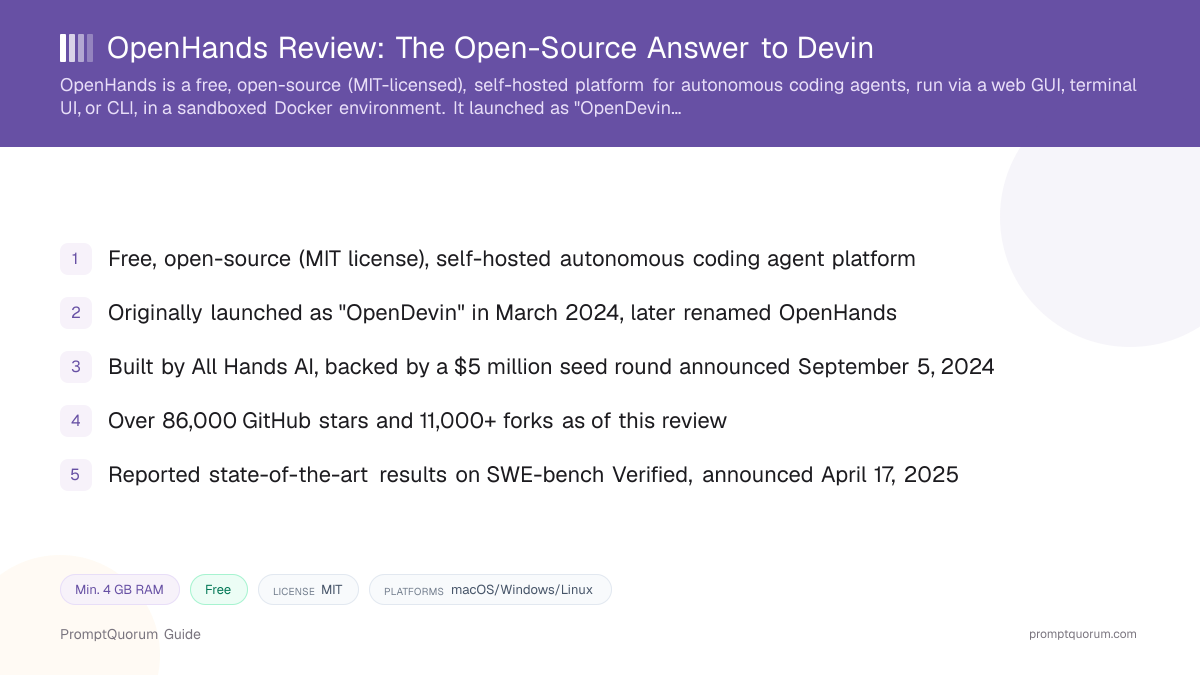
- OpenHands (openhands.dev) is a free, open-source, self-hosted autonomous coding agent platform
- Launched as "OpenDevin" in March 2024, an open-source response to Cognition's proprietary Devin agent; later renamed OpenHands
- Built by All Hands AI, led by CEO Robert Brennan, with Xingyao Wang and Graham Neubig (a Carnegie Mellon University professor) among its leadership
- Raised a $5 million seed round, announced September 5, 2024, led by Menlo Ventures
- MIT-licensed, with over 86,000 GitHub stars and 11,000+ forks as of this review
- Reported state-of-the-art results on SWE-bench Verified using inference-time scaling and a critic model, announced April 17, 2025
📍 In One Sentence
OpenHands is a free, open-source (MIT), self-hosted platform for autonomous coding agents, originally launched as "OpenDevin" in March 2024, built by All Hands AI with a $5 million seed round, with over 86,000 GitHub stars and a reported state-of-the-art SWE-bench Verified result announced April 17, 2025.
💬 In Plain Terms
OpenHands is free software you run on your own computer (via Docker) that gives you an AI agent capable of writing code, running commands, and using a browser — similar in spirit to the proprietary "Devin" agent, but open source. It was originally called OpenDevin. You bring your own AI model API key (Claude, GPT, or others); the company behind it also offers an optional paid cloud-hosted version.
📌Note: This review is based on OpenHands' own site, its GitHub repository, its official blog posts, and its academic technical paper. It does not repeat a specific SWE-bench Verified percentage score, since this review could not confirm the exact figure from a directly re-checked primary source — verify the current number on OpenHands' own blog before citing it. This review also does not claim PromptQuorum has run hands-on benchmarks of OpenHands.
What Is OpenHands?
OpenHands is a free, open-source, self-hosted platform for running autonomous coding agents, available as a web GUI, a terminal UI, and a CLI. It is not an IDE-native extension by default — a community-built, unofficial VS Code integration exists, but is not built or supported by All Hands AI.
- Product type: a self-hosted agent platform (web GUI, terminal UI, CLI), not an IDE plugin by default
- Company: All Hands AI, led by CEO Robert Brennan
- Leadership: Xingyao Wang (Chief AI Officer) and Graham Neubig (Chief Scientist, a professor at Carnegie Mellon University's Language Technologies Institute)
- Funding: a $5 million seed round, announced September 5, 2024, led by Menlo Ventures, with Pillar VC, Betaworks, Rebellion Capital, and angel investors including Thom Wolf, Jeff Hammerbacher, and Soumith Chintala
- License: MIT, confirmed via the GitHub repository's LICENSE file
- GitHub: over 86,000 stars and 11,000+ forks as of this review; the repository moved from
All-Hands-AI/OpenHandstoOpenHands/OpenHands(the old URL redirects)
What Does OpenHands Actually Do?
OpenHands runs an autonomous coding agent in a sandboxed Docker environment, where it can write and edit code, run shell commands, and use a browser to complete multi-step software engineering tasks. Newer versions of OpenHands can also orchestrate other coding agents (such as Claude Code, Codex, or Gemini CLI) rather than only running its own.
- Sandboxed execution: each agent runs with its own isolated filesystem, shell, browser, and editor inside Docker, reducing (but not eliminating) the risk of running arbitrary code
- Browser use: agents can browse the web as part of completing a task
- Model-agnostic: bring-your-own-API-key access to models like Claude and GPT; this review could not confirm an explicit, officially named local-model (e.g. Ollama) integration from a primary source, so verify current local-model support directly before assuming it
- Multi-agent orchestration: newer OpenHands releases can run its own agent alongside other coding agents (Claude Code, Codex, Gemini CLI)
- Benchmark result: OpenHands announced state-of-the-art performance on SWE-bench Verified on April 17, 2025, using inference-time scaling combined with a critic model, and was also cited as a top performer on LiveSWEBench and Multi-SWE-Bench
From OpenDevin to OpenHands: A Short History
OpenHands began as "OpenDevin," launched March 12, 2024, as an open-source response to Cognition's proprietary "Devin" AI software engineer, and was later renamed OpenHands. All Hands AI, the commercial entity behind the project, was seeded shortly after with a $5 million round.
- March 12, 2024: launched as "OpenDevin," an open-source alternative to Cognition's Devin
- Renamed to OpenHands (this review could not confirm the exact rename date from a primary source)
- September 5, 2024: All Hands AI announces a $5 million seed round led by Menlo Ventures
- April 17, 2025: OpenHands announces state-of-the-art results on SWE-bench Verified
- 2026: the project expands from a single coding agent into a broader platform that can also run and orchestrate other agents (Claude Code, Codex, Gemini CLI)
Platform, Pricing, and Licensing
Self-hosted / open source
- What OpenHands states:
- Free — full agent, web GUI, terminal UI, CLI, git integrations, and community support, using your own model API key.
Individual (Cloud, free)
- What OpenHands states:
- A hosted cloud option with an API for automation and Jira/Slack integrations, capped at 10 daily conversations for a single user, per openhands.dev/pricing.
Paid subscription tier
- What OpenHands states:
- A subscription tier (reported around $20/month in some sources) unlocking broader model choice at no markup appears to exist — this review could not fully re-confirm its exact current terms from a freshly re-checked pricing page, so verify directly on openhands.dev/pricing before budgeting.
Enterprise
- What OpenHands states:
- Custom/contact pricing — SaaS or self-hosted in a private VPC, with SSO/SAML, unlimited conversations, and a named customer engineer.
Licensing
- What OpenHands states:
- MIT license, confirmed via the GitHub repository's LICENSE file.
Verify current pricing directly on openhands.dev/pricing before budgeting — this review flags the subscription tier's exact terms as needing a fresh check.
Download and Install OpenHands
OpenHands installs free via Docker for self-hosting; a cloud-hosted option is also available without local setup.
Source | Link |
|---|---|
| GitHub repository (source code, MIT) | github.com/OpenHands/OpenHands |
| Official site | openhands.dev |
| Documentation | docs.openhands.dev |
| Hosted cloud version | openhands.dev/pricing |
Self-hosting requires Docker and, for meaningful agent capability, an API key for a capable model (Claude or GPT are commonly used) — budget for that model's per-token API costs separately from OpenHands itself, which is free.
Who Should Use OpenHands?
OpenHands fits developers and teams who want a free, open-source, self-hosted autonomous coding agent and are comfortable with Docker-based operations.
Use OpenHands if you
- Want a free, open-source (MIT), self-hosted alternative to a proprietary autonomous coding agent like Devin
- Are comfortable with Docker-based deployment and sandboxed agent execution
- Want to bring your own model API key rather than depend on a single vendor's bundled model
- Are interested in state-of-the-art agentic coding benchmark performance and want to self-host that capability
- Need an on-premises or private-VPC deployment option and are willing to consider the Enterprise tier for that
Look elsewhere if you
- Want a zero-setup, IDE-native experience — OpenHands is not an official VS Code/JetBrains extension; only a community, unofficial VS Code integration exists
- Are not comfortable running Docker or managing self-hosted infrastructure
- Need predictable, low API costs — autonomous multi-step agents can make many model calls per task, and costs scale with usage
- Need guaranteed enterprise support without contacting All Hands AI directly — verify current Enterprise terms before committing
What OpenHands Is Not Good For
OpenHands is not a good fit if you want a zero-ops, IDE-native tool, or if you are uncomfortable running arbitrary agent-generated code, even sandboxed.
- Not IDE-native by default — there is no official VS Code or JetBrains extension; only an unofficial, community-built VS Code integration exists
- Not zero-ops — self-hosting requires Docker and some operational familiarity; sandboxing reduces but does not eliminate the risk of running agent-generated code
- Not guaranteed low-cost — as an agentic tool that can take many autonomous steps, API costs from your chosen model provider can add up per task
- Not immune to long-horizon task problems — per third-party technical discussion, multi-repo or very long tasks can suffer context fragmentation and agents can pursue the wrong approach before a human intervenes
- Not the same project as the unrelated, UC Berkeley Sky Computing Lab "OpenHands" reinforcement-learning pipeline — do not conflate the two when researching
Common Mistakes When Evaluating OpenHands
Most confusion about OpenHands comes from its rename history, its shared name with an unrelated project, or assuming IDE-native support that does not officially exist.
Mistake 1: Searching for "OpenDevin" and assuming it is a different, older tool
OpenDevin was OpenHands' original name at its March 2024 launch. It is the same project, later renamed.
Mistake 2: Confusing it with the unrelated UC Berkeley "OpenHands" project
A separate reinforcement-learning training pipeline tied to UC Berkeley's Sky Computing Lab also uses the name "OpenHands." It is not the same codebase or company as All Hands AI's coding-agent platform.
Mistake 3: Assuming there is an official VS Code extension
Only a community-built, unofficial VS Code integration exists, built by an independent developer and not officially maintained by All Hands AI. Treat it as third-party tooling, not an official product.
Mistake 4: Assuming self-hosting is entirely cost-free
OpenHands itself is free and open source, but you still pay your chosen model provider (Claude, GPT, etc.) for API usage. "Free" describes the platform, not the underlying model costs.
Competitors and Alternatives
OpenHands is most often compared to Cline, Devin (Cognition), Aider, SWE-agent, and Cursor.
Tool | Best known for | Link |
|---|---|---|
| Cline | Open-source, autonomous agent extension for VS Code and JetBrains | Cline review |
| Devin (Cognition) | The proprietary autonomous AI software engineer OpenHands was built as an open alternative to | cognition.com |
| Aider | Terminal-native, git-centric AI pair programmer | aider.chat |
| Cursor | Commercial, standalone AI-first code editor | Cursor review |
This list reflects tools commonly compared to OpenHands, not an independent PromptQuorum ranking — verify each tool's current pricing and feature set before choosing.
Frequently Asked Questions
What is OpenHands?
OpenHands (openhands.dev) is a free, open-source (MIT), self-hosted platform for autonomous coding agents, run via a web GUI, terminal UI, or CLI in a sandboxed Docker environment.
Is OpenHands the same as OpenDevin?
Yes. OpenHands launched as "OpenDevin" on March 12, 2024, as an open-source alternative to Cognition's proprietary Devin agent, and was later renamed OpenHands.
Is OpenHands free?
Self-hosting is fully free and open source. All Hands AI also offers a free-tier hosted cloud version (capped at 10 daily conversations), a paid subscription tier, and a custom-priced Enterprise tier.
Who founded OpenHands / All Hands AI?
All Hands AI is led by CEO Robert Brennan, with Xingyao Wang and Graham Neubig (a Carnegie Mellon University professor) among its leadership. The company raised a $5 million seed round announced September 5, 2024.
How well does OpenHands perform on coding benchmarks?
OpenHands announced state-of-the-art results on SWE-bench Verified on April 17, 2025, using inference-time scaling and a critic model, and was also cited as a top performer on LiveSWEBench and Multi-SWE-Bench. This review does not repeat an exact percentage score, which should be verified on OpenHands' own blog.
Does OpenHands have a VS Code extension?
No official one. A community-built, unofficial VS Code integration exists, built by an independent developer, not officially maintained by All Hands AI.
Is OpenHands the same as the UC Berkeley OpenHands project?
No. A separate, unrelated reinforcement-learning training pipeline tied to UC Berkeley's Sky Computing Lab also uses the name "OpenHands" — it is a different codebase and company.
Is OpenHands safe to run, since it executes code autonomously?
OpenHands runs agents in a sandboxed Docker environment, which reduces but does not eliminate the risk of running agent-generated code — per third-party technical analysis, sandboxing is not a complete safety guarantee against adversarial or unexpected agent behavior.
Does OpenHands support local models?
This review could not confirm an explicit, officially named local-model (e.g. Ollama) integration from a primary source — verify current model support directly on openhands.dev before assuming local-model compatibility.
Has PromptQuorum independently tested OpenHands' claims?
This review is based on OpenHands' own site, GitHub repository, blog posts, and a published technical paper, rather than hands-on benchmarking by PromptQuorum.