What Is Cursor?
Cursor is a commercial, standalone, VS Code-based AI-first code editor made by Anysphere Inc., founded in 2022 by four MIT students — Michael Truell (CEO), Sualeh Asif, Aman Sanger, and Arvid Lunnemark.
- Product type: a standalone code editor (VS Code fork), not an extension
- Company: Anysphere Inc., founded 2022 by Michael Truell, Sualeh Asif, Aman Sanger, and Arvid Lunnemark
- Funding: a Series C reportedly raising Anysphere to a $9.9 billion valuation around May 2025, followed by a Series D raising $2.3 billion at a $29.3 billion valuation on November 13, 2025
- Licensing: proprietary, closed-source
- Ownership as of this review: acquired by SpaceX in August 2026 (see "The SpaceX Acquisition" section below)
Does Cursor Support Local Models?
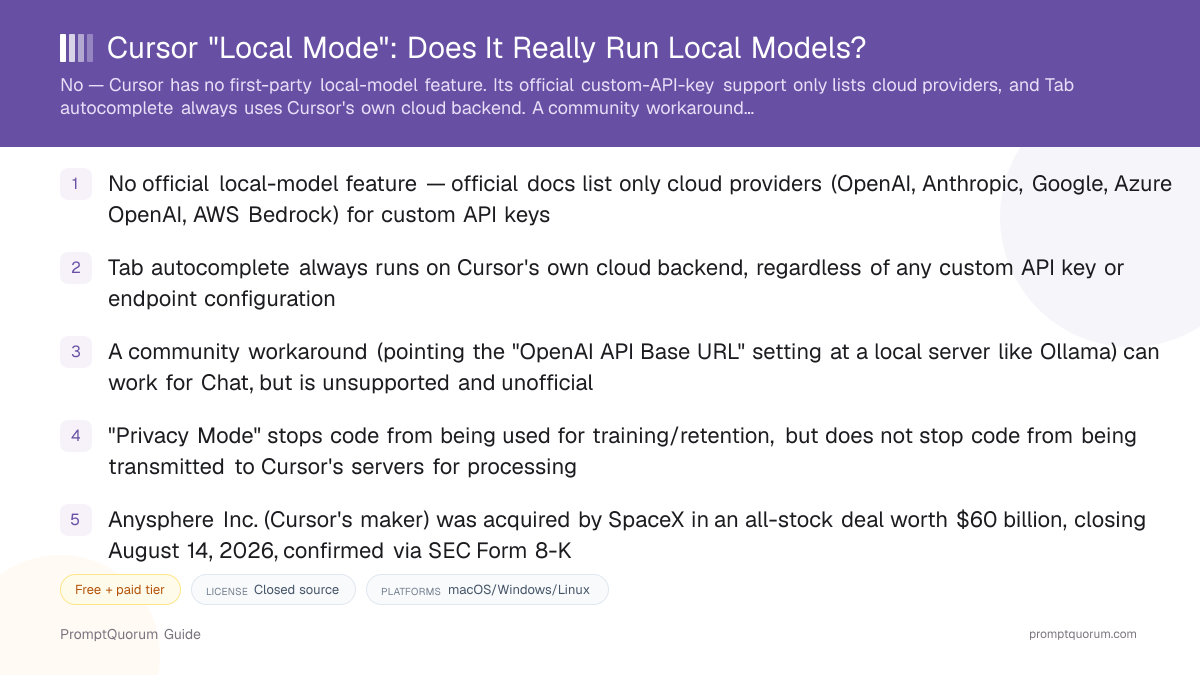
No — Cursor has no first-party, officially supported local-model feature. Cursor's own documentation states that custom API keys "only work with chat models," and officially lists only cloud providers: OpenAI, Anthropic, Google, Azure OpenAI, and AWS Bedrock.
- Official position: Cursor's help documentation does not name Ollama, LM Studio, or any local/self-hosted endpoint as a supported custom-API-key provider
- Tab autocomplete: per Cursor's own documentation, "Tab completion continues using Cursor's built-in models" no matter what custom API key or endpoint is configured — it never runs locally
- Community workaround: independent guides describe overriding the "OpenAI API Base URL" setting to point at a local OpenAI-compatible server (for example,
http://localhost:11434/v1for Ollama), using any non-empty placeholder API key — this can reportedly work for Chat and Cmd+K - Agent mode: whether Agent mode fully honors a local base-URL override is not clearly confirmed by Cursor's own documentation — this review could not verify it beyond a single secondary source
What Does Cursor's "Privacy Mode" Actually Do?
Privacy Mode stops your code from being used for AI model training or long-term retention — it does not stop your code from being sent to Cursor's servers for processing. Per Cursor's own security and privacy documentation: "Privacy Mode ensures your code is never used for training by Cursor or other AI model providers."
- Default state: opt-in for individual/Pro users (a toggle in Settings); on by default for Enterprise teams, where admins can force it organization-wide
- What it covers: training and data retention by Cursor and its model providers
- What it does not cover: transmission — your code is still sent to Cursor's servers and to whichever model provider is processing your request, even with Privacy Mode enabled
- Zero-data-retention (ZDR) agreements with model providers back Privacy Mode's no-training claim — but Cursor's own materials note that ZDR does not apply if you supply your own API key, in which case your data handling follows that provider's own privacy policy instead
- Cursor states it is SOC 2 Type II certified, per its Enterprise marketing page
The SpaceX Acquisition of Anysphere, Explained
SpaceX acquired Anysphere Inc., the maker of Cursor, in an all-stock deal reportedly worth $60 billion, closing August 14, 2026 — confirmed by an SEC Form 8-K filing from Space Exploration Technologies Corp. and named reporting from CBS News, Bloomberg, and CNBC.
- Background: SpaceX merged with xAI in February 2026 and went public on Nasdaq under the ticker SPCX in June 2026
- April 21, 2026: SpaceX reportedly announced acquisition rights over Anysphere
- June 16, 2026: the purchase option was exercised and publicly disclosed; Cursor CEO Michael Truell was quoted confirming the deal in CBS News reporting
- August 14, 2026: the acquisition closed, an all-stock deal reportedly worth $60 billion, with roughly 391 million SpaceX Class A shares issued, per Bloomberg's reporting on the SEC filing
- Reported branding: the combined entity has been referred to as "SpaceXAI" in press coverage
Platform, Pricing, and Licensing
Platform
- What Cursor states:
- A standalone, VS Code-based desktop editor for Mac, Windows, and Linux.
Free tier
- What Cursor states:
- Free, with limited usage and no third-party models, per cursor.com/docs/account/pricing.
Paid plans
- What Cursor states:
- Plus $8/month (Grok models only), Premium $30 (4x Plus usage, adds Claude, GPT and Gemini at API list price from prepaid credit), Super $100 (15x) and Ultra $200 (50x), per cursor.com/docs/account/pricing. These launched October 12, 2026 as The X Subscription; the older $20/month Pro plan is a legacy plan closed to new customers.
Teams tier
- What Cursor states:
- $30, $100 or $200 per seat/month depending on the usage tier, per cursor.com/docs/account/pricing.
Enterprise
- What Cursor states:
- Custom pricing.
Licensing
- What Cursor states:
- Proprietary, closed-source.
Ownership
- What Cursor states:
- Anysphere Inc. was acquired by SpaceX, closing August 14, 2026, confirmed via SEC filing.
Cursor replaced its plans on October 12, 2026 — confirm current prices directly on cursor.com/pricing before subscribing.
Download Cursor
Cursor is free to download; paid plans apply once you exceed the free tier's limits.
Source | Link |
|---|---|
| Official site (download) | cursor.com |
| Pricing | cursor.com/pricing |
| Security and privacy documentation | cursor.com/help/security-and-privacy/privacy |
If your goal is specifically local-model use, read the "Does Cursor Support Local Models?" section above before downloading — Cursor is not built local-first.
Who Should Use Cursor's Local Workaround?
The unofficial local-model workaround fits a narrow set of users; most people who specifically need local models should choose a local-first tool instead.
Consider the workaround if you
- Already use and like Cursor's editor and Agent features, and want to experiment with routing Chat to a local model for specific, non-critical tasks
- Understand this is an unsupported, unofficial configuration that Cursor's own documentation does not describe
- Do not need autocomplete to run locally, since it never will regardless of configuration
- Are comfortable with Cursor as a proprietary, closed-source product now owned by SpaceX
Look elsewhere if you
- Need genuine, officially supported local-model inference, including autocomplete — choose a local-first tool like Cline, Tabby, or (while it still ran) Continue.dev instead
- Need air-gapped or fully offline operation — Cursor's AI features (chat, agent, tab) require an internet connection; only basic editing and Git work offline
- Need an open-source, self-auditable tool — Cursor is proprietary and closed-source
- Have concerns about a coding tool company's ownership stability — Cursor's parent company changed hands via a major acquisition in 2026
What Cursor Is Not Good For
Cursor is not a good fit if genuine local-model inference, air-gapped operation, or open-source auditability is a requirement.
- Not for genuine local-model use — there is no official local-model feature, and autocomplete never runs locally under any configuration
- Not for air-gapped or offline environments — AI features require an internet connection
- Not open source — Cursor is a proprietary, closed-source product
- Not free at meaningful usage volume — the free tier is limited; regular use needs a paid plan (Plus at $8/month covers Grok models only; Claude and GPT need Premium at $30/month plus usage billed at API list price)
- Not guaranteed to have transmission-level privacy — Privacy Mode stops training/retention, but code is still sent to Cursor's and the model provider's servers for processing, and secrets in files not excluded via
.cursorignorecan still be transmitted
Common Mistakes When Evaluating Cursor's Privacy Claims
Most confusion about Cursor and local models comes from conflating "no training" with "no data transmission," or assuming Cursor works like a local-first tool.
Mistake 1: Assuming "Privacy Mode" means code never leaves your machine
Privacy Mode governs training and retention, not transmission. Your code is still sent to Cursor's servers and the model provider processing your request, even with Privacy Mode on.
Mistake 2: Assuming a local-model workaround covers all of Cursor's features
Even when the unofficial custom-API-base-URL workaround is used for Chat, Tab autocomplete always runs on Cursor's own cloud backend regardless of configuration.
Mistake 3: Treating the community local-model workaround as an official, supported feature
Cursor's own documentation does not describe or support pointing the editor at a local model. Treat any such setup as unofficial and potentially subject to breaking without notice.
Mistake 4: Not knowing Cursor's parent company changed hands in 2026
Anysphere Inc. was acquired by SpaceX in a deal that closed August 14, 2026. Older articles describing Anysphere as an independent company predate this and should be read with that context.
Competitors and Alternatives
For genuine local-model support, Cursor is most often compared unfavorably to Cline, Tabby, and the now-discontinued Continue.dev — all built local-first, unlike Cursor.
Tool | Best known for | Link |
|---|---|---|
| Cline | Open-source, autonomous agent extension with real local-model support via Ollama/LM Studio | Cline review |
| Tabby | Self-hosted, open-source AI coding assistant, built local-first | Tabby review |
| Continue.dev | Open-source, model-agnostic extension with real local-model support (discontinued, acquired by Cursor 2026) | Continue.dev review |
| Windsurf / Devin Desktop | Another cloud-based AI-first editor, acquired by Cognition AI, rebranded June 2026 | Windsurf review |
Note the irony: Cursor itself acquired Continue.dev (a genuinely local-model-capable tool) in June 2026 and discontinued it, shortly before Cursor's own parent company was acquired by SpaceX in August 2026.
Frequently Asked Questions
Does Cursor support local models like Ollama?
Not officially. Cursor's documentation only lists cloud providers for custom API keys. A community workaround can point Chat at a local server, but it is unsupported, and Tab autocomplete never runs locally regardless of configuration.
What does Cursor's Privacy Mode actually do?
It prevents your code from being used for AI training or long-term retention by Cursor or its model providers. It does not stop your code from being transmitted to Cursor's servers for processing.
Can Cursor work fully offline?
No. AI features (chat, agent, tab autocomplete) require an internet connection. Only basic editing and Git operations work offline.
Who owns Cursor now?
Cursor's maker, Anysphere Inc., was acquired by SpaceX in an all-stock deal reportedly worth $60 billion, closing August 14, 2026, confirmed via an SEC Form 8-K filing.
Who founded Cursor?
Anysphere Inc. was founded in 2022 by four MIT students: Michael Truell (CEO), Sualeh Asif, Aman Sanger, and Arvid Lunnemark.
How much does Cursor cost?
A free tier exists with limited usage. Paid plans are Plus ($8/month, Grok models only), Premium ($30), Super ($100) and Ultra ($200); on Premium and above, Claude and GPT usage is billed at API list price from prepaid credit. The older Pro plan ($20/month) is closed to new customers. Teams seats cost $30, $100 or $200 per month.
Is Cursor open source?
No, Cursor is a proprietary, closed-source product.
Does Cursor support MCP (Model Context Protocol)?
Yes, officially, per cursor.com/docs/mcp — Agent can call MCP tools, configured via a project-level .cursor/mcp.json file, currently capped at 40 tools.
Did Cursor acquire Continue.dev?
Yes — see PromptQuorum's Continue.dev review for the sourced details. Cursor acquired Continue Dev, Inc. in June 2026, and Continue.dev subsequently stopped active development — an ironic detail given Continue.dev genuinely supported local models, which Cursor itself does not officially do.
Has PromptQuorum independently tested Cursor's claims?
This review is based on Cursor's own documentation and pricing pages, an SEC Form 8-K filing, and named reporting from CBS News, Bloomberg, and CNBC, rather than hands-on benchmarking by PromptQuorum.