What Is Tabby?
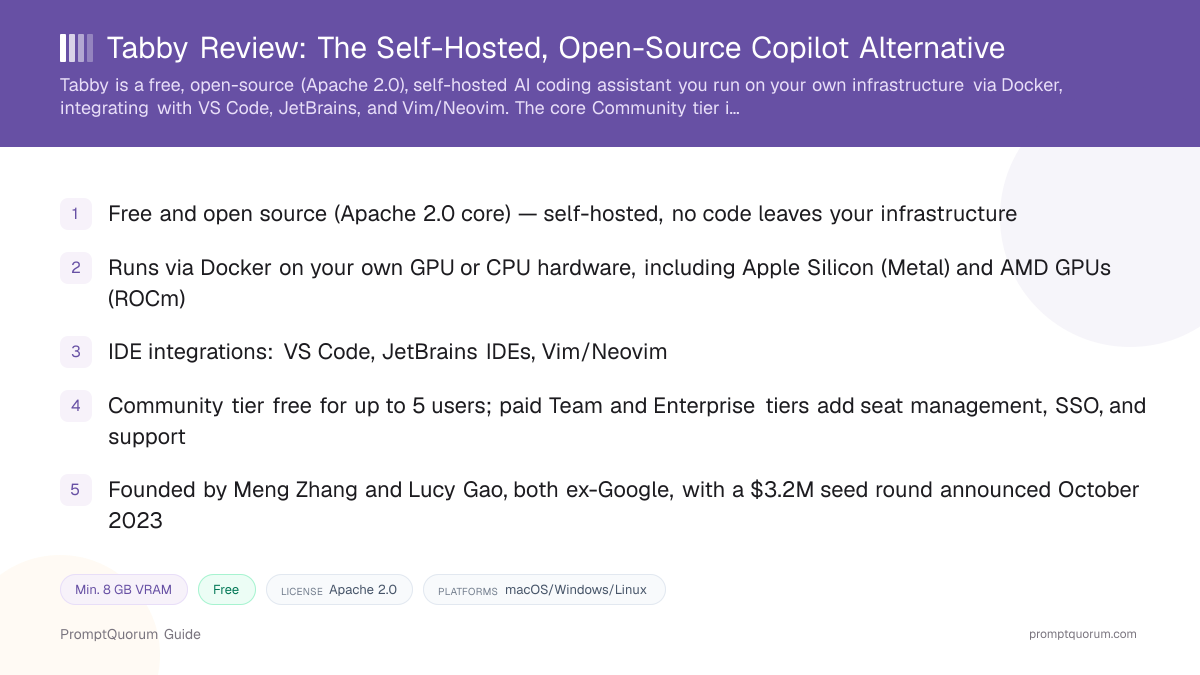
Tabby is a free, open-source, self-hosted AI coding assistant that you run on your own server, positioned as an on-premises alternative to GitHub Copilot. It was founded by Meng Zhang and Lucy Gao, both former Google engineers, and announced a $3.2 million seed round in October 2023 led by Yunqi Partners and ZooCap.
- Product type: a self-hosted server (via Docker) plus IDE extension clients — not a cloud SaaS product
- License: Apache 2.0 for the core project; a separate
ee/(enterprise edition) directory carries its own license - Founders: Meng Zhang and Lucy Gao, both ex-Google
- Funding: a $3.2 million seed round, announced October 2023, led by Yunqi Partners and ZooCap
- Scale: roughly 33,900 GitHub stars and 1,800 forks as of this review
- Core differentiator: on-premises/air-gapped deployment — no code or completions leave your own infrastructure
What Does Tabby Actually Do?
Tabby adds AI-powered code completion and chat to your editor, running against a self-hosted local model instead of a cloud API, with an optional RAG-style context layer for grounding answers in your own codebase and documentation.
- Code completion: multi-line and full-function inline suggestions as you type, comparable to GitHub Copilot's core feature
- Chat: in-IDE conversational assistance about your code
- "Answer Engine": a codebase Q&A feature that draws on indexed repository content
- Context Providers: a RAG-style layer that pulls in repository, documentation, and configuration context to ground completions and chat
- Supported local models: recommended/documented options include StarCoder-1B, Qwen2-1.5B-Instruct, CodeLlama 7B, CodeGemma, and the CodeQwen series
- Hardware support: consumer-grade NVIDIA GPUs via Docker, AMD GPUs via a dedicated
tabby-rocmimage, and Apple Silicon (M1/M2 and later) via Metal - MCP support: Tabby can act as an MCP client, registering Model Context Protocol servers as additional context providers (stdio and streamable-HTTP transports) — this integration is still evolving rather than a mature, full-featured MCP client, per an open GitHub issue requesting deeper support
Platform, Pricing, and Licensing
Platforms
- What Tabby states:
- Self-hosted server via Docker (NVIDIA, AMD ROCm, or Apple Silicon/Metal), with IDE clients for VS Code, JetBrains IDEs, and Vim/Neovim.
Community tier
- What Tabby states:
- Free, for up to 5 users, including code completion, chat, the Answer Engine, and context providers.
Team tier
- What Tabby states:
- A paid tier reported by third-party sources at roughly $19/seat/month for up to 50 users; this review could not cleanly confirm the exact current figure from tabbyml.com/pricing (the fetch returned inconsistent data during research) — verify directly before budgeting.
Enterprise tier
- What Tabby states:
- Custom-quoted, for unlimited users, with added security, SSO, and group-management features.
Licensing
- What Tabby states:
- Apache 2.0 for the core project, confirmed via the GitHub repository's LICENSE file. A separate
ee/(enterprise edition) directory and third-party components carry their own licenses, so the repository is not uniformly Apache 2.0 end-to-end.
Tabby's pricing page returned inconsistent data during this review's research (alongside the Community/Team/Enterprise figures, an unrelated-looking annual pricing scheme also appeared) — do not treat any specific Team/Enterprise dollar figure as confirmed without checking tabbyml.com/pricing directly.
Download and Install Tabby
Tabby's server runs via a published Docker image, and its IDE clients are free to install from the standard marketplaces.
Source | Link |
|---|---|
| GitHub repository (source code, Apache 2.0) | github.com/TabbyML/tabby |
| Docker image (NVIDIA/CPU) | tabbyml/tabby on Docker Hub, or ghcr.io/tabbyml/tabby |
| Docker image (AMD GPU/ROCm) | tabby-rocm — see the GitHub repository for the current image name |
| VS Code Marketplace | marketplace.visualstudio.com/items?itemName=TabbyML.vscode-tabby |
| JetBrains Marketplace | Plugin listed as "Tabby" — search JetBrains Marketplace, or see Tabby's docs for the current link |
| Documentation | tabby.tabbyml.com/docs/welcome |
Running the server requires your own hardware (ideally a GPU) and some Docker/ops familiarity — this is not a one-click cloud signup like most competitors.
Who Should Use Tabby?
Tabby fits developers and teams for whom keeping code on their own infrastructure matters more than getting the single most capable cloud model.
Use Tabby if you
- Need code completion that never leaves your own infrastructure — air-gapped, regulated, or security-sensitive environments
- Already have (or are willing to run) a GPU server and are comfortable with Docker-based deployment and operations
- Want an open-source (Apache 2.0 core), self-auditable coding assistant rather than a closed-source cloud product
- Are realistic that completion quality will track the local model you choose, not a frontier cloud model
- Are a small team (5 or fewer) that fits the free Community tier, or a larger team willing to pay for Team/Enterprise seat management
Look elsewhere if you
- Want a zero-ops, cloud-hosted product with no server to run — a SaaS tool like GitHub Copilot or Cursor fits better
- Need the strongest possible completion/chat quality regardless of where code is processed — cloud frontier models will generally outperform the smaller local models Tabby is designed to run
- Need a full autonomous coding agent (multi-file planning, terminal execution) — Tabby is a completion/chat assistant, not an agentic tool like Cline or Cursor's agent mode
- Don't have GPU hardware or the ops capacity to run and maintain a self-hosted service
What Tabby Is Not Good For
Tabby is not a good fit if you want cloud-grade completion quality with zero infrastructure to manage, or if you need autonomous multi-file agent behavior.
- Not a zero-ops product — you must provision, run, and maintain your own server (ideally with a GPU), which is real operational overhead a cloud SaaS tool does not require
- Not guaranteed to match cloud frontier-model completion quality — output is capped by whatever local model you choose to run; some users have described output as noticeably weaker on complex tasks
- Not an autonomous coding agent — it is a completion/chat assistant, not a tool for multi-file planning and execution like Cline or Cursor's agent mode
- Not fully mature for MCP — Tabby can act as an MCP client, but its integration is still evolving per an open GitHub feature request, not a complete implementation
- Not free at scale for larger teams needing management features — the Community tier caps at 5 users; larger teams need a paid Team or Enterprise plan
Common Mistakes When Evaluating Tabby
Most confusion about Tabby comes from expecting it to behave like a cloud SaaS product or a fully autonomous coding agent.
Mistake 1: Expecting Tabby to work without your own GPU hardware
Tabby is a self-hosted product — completion quality and speed depend directly on the hardware you run it on. Without a reasonably capable GPU (or Apple Silicon via Metal), expect slower or lower-quality suggestions than a cloud-hosted competitor.
Mistake 2: Assuming the entire repository is Apache 2.0
The core project is Apache 2.0, but the ee/ (enterprise edition) directory and some third-party components carry separate licenses. Check the specific file/directory license before redistributing or building commercial products on top of Tabby.
Mistake 3: Expecting full autonomous-agent behavior
Tabby is a code completion and chat assistant with an Answer Engine and MCP-based context providers — it is not designed for autonomous, multi-file planning and execution the way Cline or Cursor's agent mode are.
Mistake 4: Assuming published Team/Enterprise pricing is current without checking
This review found inconsistent pricing data when checking tabbyml.com's pricing page. Verify current Team and Enterprise pricing directly with TabbyML before budgeting, rather than relying on a cached or third-party figure.
Competitors and Alternatives
Tabby is most often compared to GitHub Copilot, Continue.dev, Sourcegraph Cody, and Cursor — its main differentiator against all of them is self-hosted, on-premises deployment.
Tool | Best known for | Link |
|---|---|---|
| GitHub Copilot | Microsoft/GitHub's mainstream, cloud-hosted AI autocomplete and chat extension | github.com/features/copilot |
| Continue.dev | Open-source autocomplete/chat extension, discontinued (acquired by Cursor, June 2026) | Continue.dev review |
| Sourcegraph Cody | Enterprise-only AI assistant grounded in Sourcegraph's code-search technology | Sourcegraph Cody review |
| Cursor | Commercial, standalone, cloud-based AI-first code editor | cursor.com |
| Cline | Open-source, autonomous agent extension for VS Code and JetBrains | Cline review |
This list reflects tools commonly compared to Tabby, not an independent PromptQuorum ranking — verify each tool's current pricing and feature set before choosing.
Frequently Asked Questions
What is Tabby?
Tabby (github.com/TabbyML/tabby) is a free, open-source, self-hosted AI coding assistant built as an on-premises alternative to GitHub Copilot.
Is Tabby free?
The core, self-hosted Community tier is free for up to 5 users. TabbyML the company sells paid Team and Enterprise tiers on top of the same self-hosted core for larger teams.
Is Tabby open source?
Yes, the core project is Apache 2.0 licensed, confirmed via its GitHub repository. A separate enterprise-edition directory and some third-party components carry their own licenses.
Do I need a GPU to run Tabby?
A GPU is strongly recommended for good completion speed and quality — Tabby supports NVIDIA GPUs, AMD GPUs via ROCm, and Apple Silicon via Metal. It can run on CPU, but expect slower performance.
Does Tabby support MCP (Model Context Protocol)?
Tabby can act as an MCP client, registering MCP servers as context providers, but this integration is still evolving per an open GitHub feature request rather than a complete, mature implementation.
How does Tabby compare to GitHub Copilot?
Copilot is a cloud-hosted, closed-source product using large frontier models. Tabby is self-hosted and open source, keeping code on your own infrastructure, but completion quality depends on the (typically smaller) local model you choose to run.
Who founded Tabby?
Tabby was founded by Meng Zhang and Lucy Gao, both former Google engineers, who announced a $3.2 million seed round in October 2023.
Can Tabby autonomously edit multiple files like Cline or Cursor?
No. Tabby is a code completion and chat assistant, not an autonomous multi-file agent — for that kind of agentic behavior, consider Cline or Cursor's agent mode instead.
What IDEs does Tabby support?
VS Code, most JetBrains IDEs, and Vim/Neovim.
Has PromptQuorum independently tested Tabby's claims?
This review is based on Tabby's GitHub repository, its documentation, and independent reporting (TechCrunch, SiliconANGLE), rather than hands-on benchmarking by PromptQuorum.