Best AI Text-to-Speech for Content Creators 2026
ElevenLabs is the best overall AI text-to-speech for content creators, and Kokoro-82M is the best free local alternative. The decision that matters most is not voice quality — it is commercial licensing: ElevenLabs and PlayHT require a paid plan for monetized work, Kokoro is Apache 2.0, and Coqui XTTS v2 is non-commercial only.
This page contains links to third-party products for reference. PromptQuorum is not enrolled in any affiliate program — these are plain links that earn no commission. Clicking links and your next steps are entirely your own responsibility. These links do not represent any endorsement or verification by PromptQuorum.
Quick Answer
ElevenLabs is the best overall choice for monetized content — the most natural voices, instant and professional voice cloning, and commercial rights starting on the $6/month Starter plan. Kokoro-82M is the best free local option: Apache 2.0 licensed, runs on a plain CPU, and has no per-character cost. Check licensing before you publish, because commercial rights differ sharply between these tools.
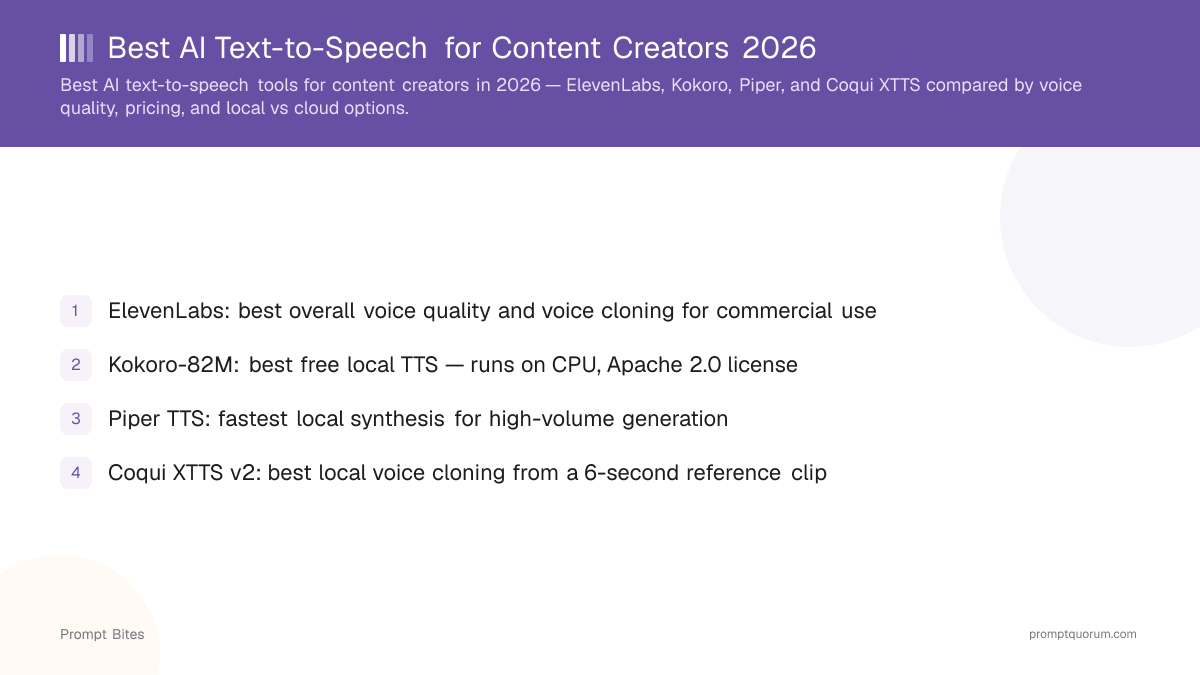
- ▸ElevenLabs: best voice quality and cloning — commercial use needs a paid plan (from $6/mo)
- ▸Kokoro-82M: best free local TTS — Apache 2.0 weights, CPU-friendly, 54 voices in 8 languages
- ▸Piper TTS: fastest local batch generation — licensing varies per voice model
- ▸Coqui XTTS v2: best local voice cloning, but the weights are non-commercial only
- ▸PlayHT: cloud alternative for podcasts and multilingual narration
Key Takeaways
- ✓**ElevenLabs — best overall.** The most natural voices plus instant and professional voice cloning. Commercial rights begin on the paid Starter plan, not the free tier.
- ✓**Kokoro-82M — best free local option.** Apache 2.0 weights, 54 voices across 8 languages, runs near real time on a plain CPU with no per-character cost.
- ✓**Piper TTS — best for bulk generation.** Fast local synthesis across 30+ languages, but each voice model carries its own licence, so check them individually.
- ✓**Coqui XTTS v2 — best local cloning, with a catch.** The weights are released under the non-commercial CPML licence, so it is not a safe base for monetized content.
- ✓**PlayHT — cloud alternative for podcasts.** Large voice catalogue and multilingual narration; commercial rights depend on the plan you buy.
- ✓**Licensing, not audio quality, is the real decision.** Verify commercial rights for the plan, the model weights and the individual voice before you publish.
AI TTS Tools Compared
The column that decides most purchases is commercial use, not voice quality. Pricing and plan allowances change frequently — confirm the current terms on the provider site before committing.
| Tool | Type | Voice cloning | Commercial use | Best for |
|---|---|---|---|---|
| ElevenLabs | Cloud | Yes (instant + professional) | Paid plans only (from $6/mo) | Best overall voice quality |
| Kokoro-82M | Local | No (54 preset voices) | Yes — Apache 2.0 weights | Free unlimited narration |
| Piper TTS | Local | No (preset voices) | Varies by voice model | Fast batch generation |
| Coqui XTTS v2 | Local | Yes (6-second clip) | No — CPML is non-commercial | Personal and research cloning |
| PlayHT | Cloud | Yes | Paid plans only | Podcasts and multilingual |
The Five Tools in Detail
Ratings and suitability below are drawn from each project’s published documentation, licence terms and model cards, not from independent measurement of these tools by PromptQuorum.
ElevenLabs — Best Overall
The strongest cloud narration for creators who monetize their work.
ElevenLabs produces the most natural-sounding AI voices available in 2026, handling pauses, emphasis and emotional variation more convincingly than basic TTS systems. Self-serve plans run Free, Starter ($6/month), Creator ($22/month), Pro ($99/month), Scale ($299/month) and Business ($990/month), with annual billing cutting roughly 17% off. Commercial rights begin on the Starter plan — the free tier is for evaluation only. Instant Voice Cloning is available on paid plans, while Professional Voice Cloning unlocks at Creator. For most active solo creators, Creator is the practical starting point. Credit allowances change from time to time, so confirm the live plan page before budgeting.
Pros
- +Best voice naturalness available in 2026
- +Instant and professional voice cloning
- +Broad multilingual coverage and dubbing
- +API for automated publishing workflows
Cons
- –No commercial rights on the free tier
- –Heavy production gets expensive quickly
- –Credit system is confusing for long-form work
- –Cloning requires careful consent handling
Kokoro-82M — Best Free Local TTS
Apache 2.0 weights, no per-character cost, runs on a plain CPU.
Kokoro-82M is an 82-million-parameter model built on a StyleTTS 2 architecture with an ISTFTNet decoder and no diffusion step. The v1.0 release ships 54 voices across 8 languages at 24 kHz, with weights of roughly 327 MB. Despite the small size, quality holds up against far larger models, and it generates at or near real time on a modern laptop CPU without a GPU. The weights are Apache 2.0, which makes it unusually clean for commercial work — though you should still confirm the licence of the software wrapper and any individual voice assets you use. For creators publishing at high volume, it removes the per-character cost that makes cloud TTS expensive at scale.
Pros
- +Apache 2.0 weights — commercially usable
- +Runs offline on CPU, no GPU required
- +No character limits or API costs
- +Small download at roughly 327 MB
Cons
- –No voice cloning of any kind
- –Preset voices only, 8 languages
- –Requires local installation and setup
- –Fewer voices than large cloud catalogues
Piper TTS — Best for Fast Batch Generation
Built for turning many scripts into audio files automatically.
Piper is a lightweight local engine built on VITS and exported to ONNX, designed for speed rather than expressive performance. It covers 30+ languages with 100+ downloadable voices and runs comfortably on modest hardware, which makes it a good fit for automation and server pipelines. Two things changed recently and matter for licensing: the original `rhasspy/piper` repository was archived read-only in October 2025, and active development moved to `OHF-Voice/piper1-gpl` under the Open Home Foundation, where the licence is GPL-3.0 rather than the old MIT. Individual voices carry their own terms in each model card, so check the specific voice you plan to publish with.
Pros
- +Very fast local synthesis
- +Strong fit for batch and automation
- +Works well on modest hardware
- +30+ languages, 100+ voices
Cons
- –Less expressive than premium cloud voices
- –Quality varies a lot between voices
- –Engine is now GPL-3.0, not MIT
- –Voice licences must be checked individually
Coqui XTTS v2 — Best Local Cloning, Non-Commercial Only
Excellent offline cloning that you cannot legally monetize.
XTTS v2 remains one of the most capable open local engines for multilingual voice cloning from a short reference clip. The licensing is the problem for this audience. The model weights are released under the Coqui Public Model License, which permits non-commercial use only, and because Coqui Inc. shut down in January 2024 there is no longer anyone to sell a commercial licence. The Python library itself is MPL 2.0 and commercially fine — it is the weights that are restricted. Practically, that makes XTTS v2 a strong choice for personal projects, research and experimentation, and a poor choice for monetized video, client work or paid products. Note also that the original repository is unmaintained and capped at Python 3.11; the actively maintained community fork is `idiap/coqui-ai-TTS`.
Pros
- +High-quality cloning from a short clip
- +Fully offline and private
- +Strong multilingual coverage
- +Maintained community fork available
Cons
- –Weights are non-commercial (CPML)
- –No commercial licence obtainable since 2024
- –Original repo unmaintained, Python 3.11 cap
- –Demanding setup and hardware
PlayHT — Cloud Alternative for Podcasts
A large voice catalogue aimed at podcast and multilingual narration.
PlayHT is a cloud voice platform aimed at creators, businesses and developers, and it is the most direct alternative to ElevenLabs for podcast narration, multilingual content and cloning. It offers a large voice catalogue, API access and a workflow oriented toward longer-form spoken content. Pricing is the weak point for a buying guide: PlayHT has restructured its plans and quotas more often than its competitors, and current published figures disagree considerably across sources. Commercial rights and usage allowances depend on the specific plan, so open the live pricing page and confirm both before you commit to it for monetized work.
Pros
- +Large voice catalogue
- +Strong multilingual narration
- +Voice cloning available
- +API access for developers
Cons
- –Plans and quotas change frequently
- –Free access may exclude commercial rights
- –Quality varies between languages
- –Pricing harder to predict than rivals
Commercial Rights and Voice Cloning Rules
Commercial use is the single most important factor when choosing an AI voice tool, and it is where this category trips people up. A tool can let you generate audio for free while still prohibiting monetized publication, client work, advertising or redistribution.
There is no single answer across these five tools: Kokoro’s weights are permissively licensed, ElevenLabs and PlayHT gate commercial use behind paid plans, Piper’s answer depends on the individual voice, and Coqui XTTS v2 excludes commercial use altogether.
- ▸Confirm whether your specific plan includes commercial rights — free tiers frequently do not.
- ▸Check the model weights, the software wrapper and the individual voice separately; they can carry different licences.
- ▸Check whether API-generated audio falls under separate terms from the web app.
- ▸Check whether commercial rights apply retroactively to audio you already generated.
- ▸Never clone another person’s voice without explicit, documented permission.
- ▸For your own voice, keep evidence of consent and review the provider’s rules on training data, storage and deletion.
Best Tool by Content Type
| Content type | Recommended | Why |
|---|---|---|
| Monetized YouTube | ElevenLabs | Expressive narration with clear commercial rights |
| High-volume publishing | Kokoro-82M | No per-character cost, Apache 2.0 weights |
| Podcasts | ElevenLabs or PlayHT | Long-form workflow and multiple speakers |
| Online courses | ElevenLabs | Consistent voice identity across long scripts |
| Bulk or automated audio | Piper TTS | Fastest local batch synthesis |
| Private or confidential | Kokoro or Piper | Scripts never leave your machine |
| Personal cloning projects | Coqui XTTS v2 | Strong cloning, non-commercial use only |
How to Choose
- ▸Decide whether the output will be monetized — this rules tools in or out before anything else.
- ▸Estimate your monthly volume in characters or minutes; per-character pricing punishes high volume.
- ▸Decide whether cloud processing is acceptable for your scripts, or whether they must stay local.
- ▸Test pronunciation of names, numbers, abbreviations and foreign words in your actual scripts.
- ▸Check voice consistency across a full-length script, not just a short sample.
- ▸Confirm commercial rights for the plan, the weights and the specific voice before publishing.
- ▸Export WAV for editing and compress to MP3 only after post-production.
Related Guides
- ▸Coqui XTTS v2 licensing and local voice cloning -- full CPML commercial-use guide
- ▸Best Open-Source Alternatives to ChatGPT Plus -- ChatGPT alternatives
- ▸Best Local LLMs for Creative Writing -- creative writing guide
Quick Answers
Can I use AI TTS audio commercially?▾
What is the best free AI text-to-speech in 2026?▾
Why can I not use Coqui XTTS v2 commercially?▾
How much does ElevenLabs cost for YouTube creators?▾
Is local TTS better than ElevenLabs?▾
Can AI TTS copy my voice?▾
Want the full breakdown?
Read the complete guide →