Which Local LLM Models Support Korean Best?
EXAONE 3.5, released by LG AI Research, is the best local LLM for Korean — it was purpose-built with strong bilingual Korean-English training data and is available in multiple open-weight sizes. Qwen3 is the best general multilingual alternative if you also need strong performance across many other languages simultaneously.
Quick Answer
EXAONE 3.5 from LG AI Research is the best local LLM for Korean, purpose-built with strong bilingual Korean-English training. Qwen3 is the best broadly multilingual alternative.
- ▸EXAONE 3.5 (LG AI Research): available in multiple sizes, purpose-built for strong Korean and English performance.
- ▸Qwen3: not Korean-specific, but strong broad multilingual coverage if you need many languages, not just Korean.
- ▸Check EXAONE's specific license terms before commercial use — some open-weight Korean models carry usage restrictions.
Key Takeaways
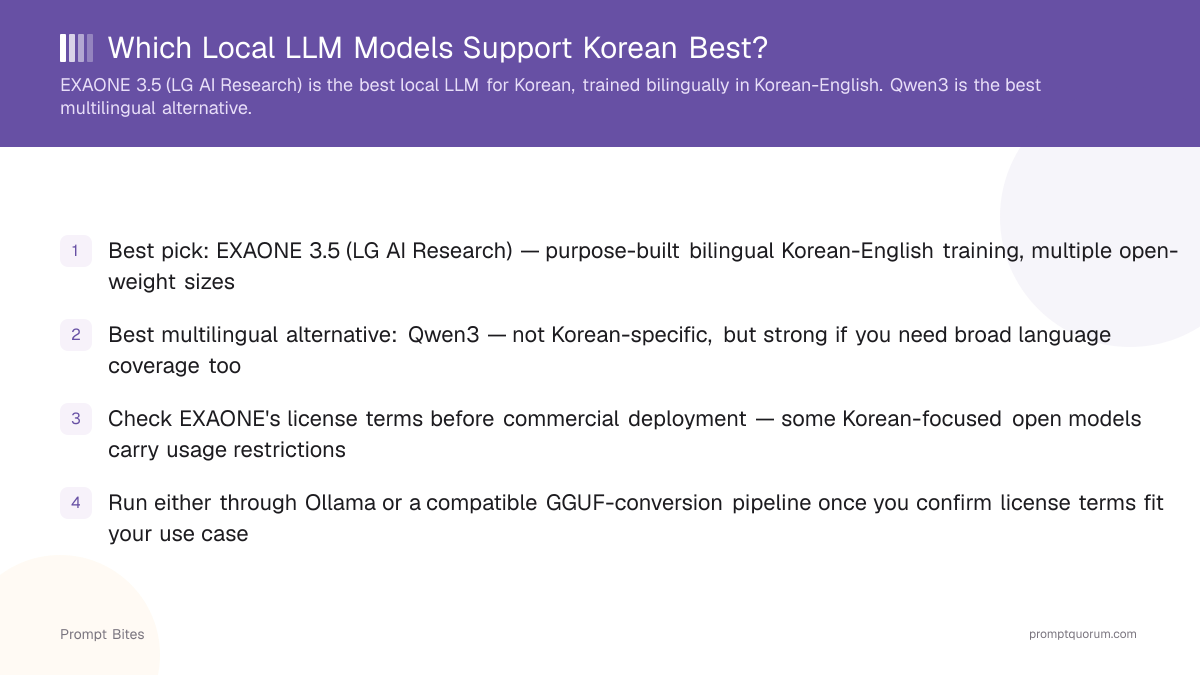
- ✓Best pick: EXAONE 3.5 (LG AI Research) — purpose-built bilingual Korean-English training, multiple open-weight sizes
- ✓Best multilingual alternative: Qwen3 — not Korean-specific, but strong if you need broad language coverage too
- ✓Check EXAONE's license terms before commercial deployment — some Korean-focused open models carry usage restrictions
- ✓Run either through Ollama or a compatible GGUF-conversion pipeline once you confirm license terms fit your use case
Best Pick: EXAONE 3.5
EXAONE 3.5, released by LG AI Research, is the best local LLM for Korean because it was purpose-built with substantial bilingual Korean-English training data, rather than treating Korean as one of many secondary languages in a broadly multilingual training mix. It is available in multiple open-weight parameter sizes, letting you match model size to your hardware the same way you would with any other model family.
If your application needs strong performance across many languages simultaneously — not just Korean and English — Qwen3 is the better general-purpose alternative. Its training data spans a wide range of languages with generally solid results, though it is not specifically optimized for Korean the way EXAONE 3.5 is.
Before deploying either model commercially, check its exact license terms. Some Korean-focused open-weight models carry usage restrictions (research-only clauses, revenue thresholds, or attribution requirements) that differ from more permissive licenses like Apache 2.0 — verify the specific license text for the model version and size you plan to use.
EXAONE 3.5 vs Qwen3 for Korean
EXAONE 3.5's Korean-English bilingual focus generally gives it an edge on Korean-specific nuance, idioms, and formality register compared to broadly multilingual models. Qwen3's advantage is breadth — if your product serves users across many languages, standardizing on one broadly multilingual model simplifies your deployment versus running separate specialized models per language.
For a Korean-only or Korean-primary product, EXAONE 3.5 is the more targeted choice. For a genuinely multilingual product where Korean is one of several supported languages, Qwen3 avoids the operational complexity of juggling multiple specialized models.
Related Reading
- ▸Which Local LLM Models Support Japanese Best? — the equivalent guide for Japanese
- ▸Best 14B Model for Coding? — a general-purpose model tier comparison
- ▸Chinese vs English Prompting: Which Is Better? — multilingual prompting considerations
Frequently Asked Questions
Is EXAONE 3.5 free to use commercially?▾
Can I run EXAONE 3.5 through Ollama?▾
How does Qwen3's Korean performance compare to GPT-class proprietary models?▾
Are there other Korean-focused open models worth considering?▾
Related Prompt Bites