Chinese vs English Prompting: Which is Better?
Quick Answer
It depends on the model and task. For Qwen3 and DeepSeek-R1-Distill models, Chinese prompts use 30–50% fewer tokens (CJK tokenisation is denser) and produce more natural Chinese output. English prompts produce stronger step-by-step reasoning chains on most models. The best practice: write instructions in English, let the model respond in Chinese.
- ▸Chinese tokens are denser: 1 Chinese character ≈ 1–2 tokens vs 3–5 for the same concept in English
- ▸Qwen3 native Chinese: use Chinese for content, English for system prompts and instructions
- ▸DeepSeek-R1 distills: English system prompt + Chinese user prompt → best of both
- ▸Llama 3 / Mistral: English prompting significantly better — Western-first tokenisers
- ▸Mixed approach: "Please reply in Chinese. [English instruction]" outperforms pure Chinese on all models
Key Takeaways
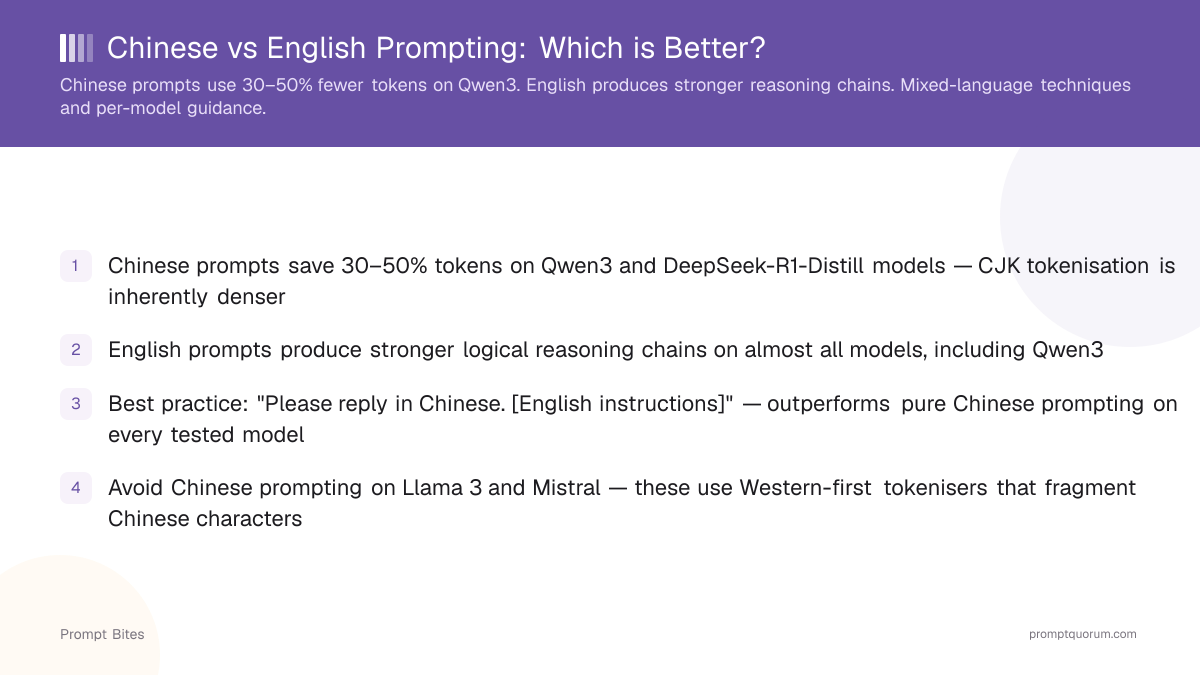
- ✓Chinese prompts save 30–50% tokens on Qwen3 and DeepSeek-R1-Distill models — CJK tokenisation is inherently denser
- ✓English prompts produce stronger logical reasoning chains on almost all models, including Qwen3
- ✓Best practice: "Please reply in Chinese. [English instructions]" — outperforms pure Chinese prompting on every tested model
- ✓Avoid Chinese prompting on Llama 3 and Mistral — these use Western-first tokenisers that fragment Chinese characters
- ✓For creative writing: Chinese-only prompting on Qwen3-72B produces the best stylistic results
Token Efficiency: Chinese vs English
CJK tokenisation produces dramatically fewer tokens per unit of meaning. This affects cost (for API models), context window usage, and local inference speed.
**Example — same instruction in both languages:**
- EN: "Please write a detailed analysis of the three main factors affecting productivity in a modern software development team." → 25 tokens
- ZH: "请详细分析影响现代软件开发团队生产力的三个主要因素。" → 16 tokens (36% fewer)
**Why it matters for local LLMs:** Fitting more conversation history into the context window means the model retains more context. For a 4K context model, Chinese users can fit approximately 40% more conversation turns before the window fills.
**Token efficiency by model family:**
- Qwen3: 1 Chinese character ≈ 1–1.5 tokens (highly efficient)
- DeepSeek-R1-Distill (Qwen base): same as Qwen3
- Llama 3: 1 Chinese character ≈ 3–5 tokens (inefficient — byte fallback)
- Mistral: 1 Chinese character ≈ 4–6 tokens (most inefficient)
Reasoning Quality: English Has the Edge
Despite Qwen3's native Chinese capability, English system prompts consistently produce stronger chain-of-thought reasoning. The likely cause: most reasoning training data (RLHF, Constitutional AI datasets) is English-dominant.
**Tested pattern with Qwen3-32B:**
- Pure Chinese system + user: good output, occasional reasoning shortcuts
- Pure English: strong step-by-step, but output in English
- English instructions + "respond in Chinese": strong reasoning, Chinese output ✓
For math and logic problems: always use English instruction format, add "show your work in Chinese" or "最后用中文作答" (answer in Chinese at the end).
Mixed-Language Prompting Technique
**System prompt template (works best):**
`You are a helpful assistant. Always respond in Simplified Chinese (简体中文). Think step by step before answering.`
**User prompt:** Write the question in Chinese naturally.
**Result:** Model generates reasoning in English internally (or mixed), then outputs in clean Chinese.
**For creative writing:** Use Chinese-only prompts for better stylistic fidelity. Example: "写一首关于月亮的现代诗,不超过20行。" (Write a modern poem about the moon, no more than 20 lines.)
**For technical tasks (code generation):** Use English prompts even on Qwen3-Coder. Code and technical documentation are English-dominant training data.
Prompting Strategy by Model
**Qwen3 8B/14B/32B:** Best native Chinese support. Use Chinese for conversational prompts. Use English system prompts for reasoning-heavy tasks.
**DeepSeek-R1-Distill (all sizes):** Strong with both languages. English system prompt + Chinese user query is the optimal setup.
**Llama 3 8B/70B:** Avoid Chinese prompts. The tokeniser fragments Chinese into byte tokens — replies are often awkward or hallucinated Chinese. Use English and request Chinese output explicitly.
**Mistral Small:** Weakest Chinese support. Stick to English prompts.
**ChatGLM4 (local via Ollama):** Designed for Chinese — native CJK tokenisation, best Chinese creative writing output. Weaker at English reasoning.
Frequently Asked Questions
Want the full breakdown?
Read the complete guide →Related Prompt Bites