Key Takeaways
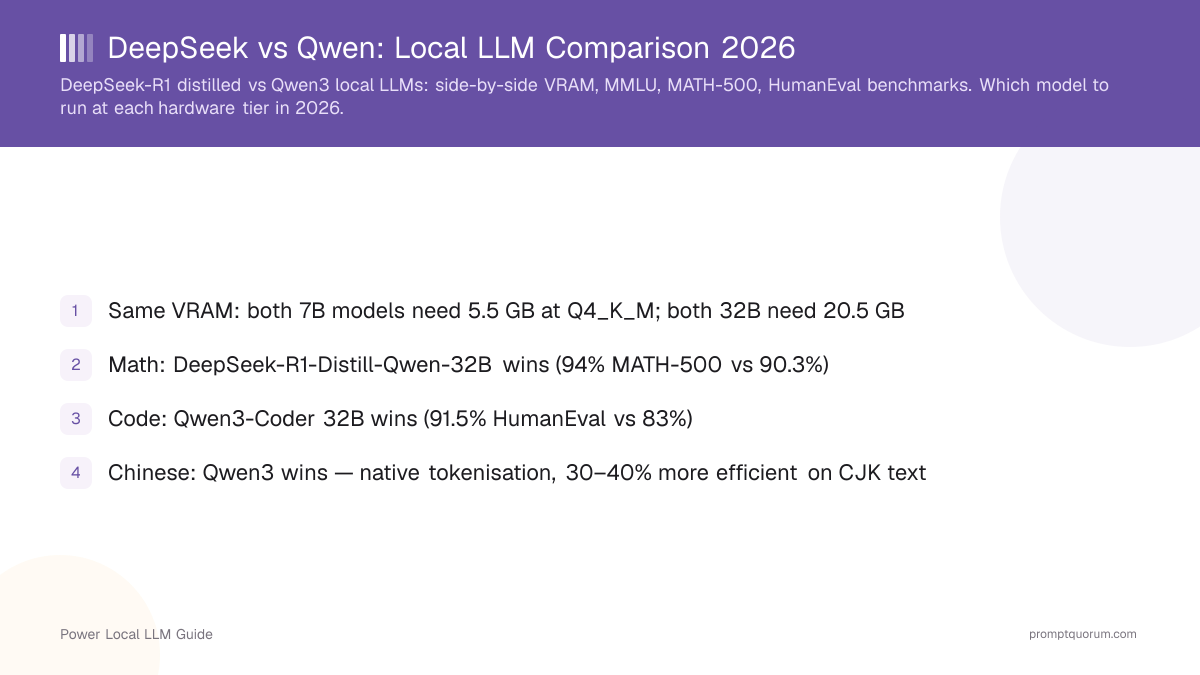
- Same VRAM: both 7B models need 5.5 GB at Q4_K_M; both 32B need 20.5 GB
- Math: DeepSeek-R1-Distill-Qwen-32B wins (94% MATH-500 vs 90.3%)
- Code: Qwen2.5-Coder 32B wins (91.5% HumanEval vs 83%)
- Chinese: Qwen3 wins — native tokenisation, 30–40% more efficient on CJK text
- Reasoning chains: DeepSeek-R1 distills produce long chain-of-thought by default
- General chat: Qwen3 14B is slightly more fluent; DeepSeek 14B distill tends to over-reason
Side-by-Side Benchmark Table
All scores at Q4_K_M quantization. Speed measured on NVIDIA RTX 4090 (24 GB VRAM) for GPU rows and Apple M3 Max 48 GB for Mac rows.
Model | VRAM | MMLU (%) | MATH-500 (%) | HumanEval (%) | Speed (tok/s) |
|---|---|---|---|---|---|
| Qwen3 8B | 5.5 GB | 72.5 | 62.5 | 74.6 | 50–80 |
| DS-R1-Distill-Qwen 7B | 5.5 GB | 70.1 | 88.0 | 68.4 | 50–80 |
| Qwen3 14B | 9.5 GB | 79.2 | 76.1 | 82.1 | 30–50 |
| DS-R1-Distill-Qwen 14B | 9.5 GB | 75.8 | 90.0 | 75.5 | 30–50 |
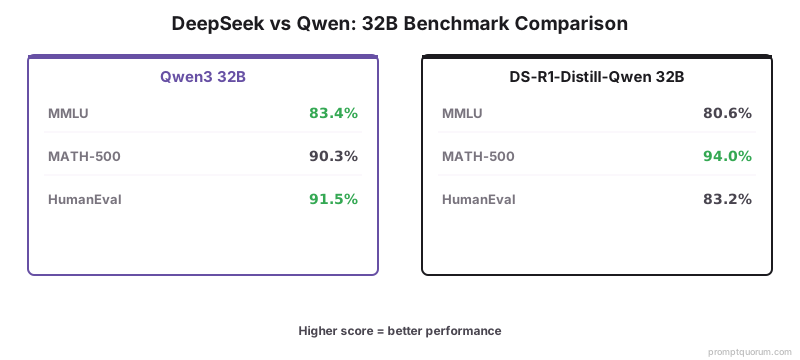
| Qwen3 32B | 20.5 GB | 83.4 | 90.3 | 91.5 | 15–30 |
| DS-R1-Distill-Qwen 32B | 20.5 GB | 80.6 | 94.0 | 83.2 | 15–30 |
Which Model to Run at Each Hardware Tier
VRAM requirements are identical between the two families at each parameter size. The choice between DeepSeek and Qwen is a task preference, not a hardware constraint.
- 8 GB VRAM (RTX 3060 / M2 16 GB): Qwen3 8B for coding/chat; DS-R1-Distill-Qwen-7B for math tutoring
- 12 GB VRAM (RTX 3080 / M2 Pro 24 GB): Qwen3 14B for general use; DS-R1-Distill-Qwen-14B for reasoning chains
- 24 GB VRAM (RTX 4090 / M3 Max 48 GB): Qwen2.5-Coder 32B or Qwen3 32B — best all-round local model in this tier
- 48 GB+ (M2/M3 Ultra / dual RTX 4090): Qwen3 72B (86.1% MMLU, 97% HumanEval) — near GPT-4 class
- CPU-only (32+ GB RAM): Qwen3 8B or DS-R1-Distill 7B — both run at 3–8 tok/s on modern laptop CPUs
DeepSeek Local Models Explained
DeepSeek released its R1 reasoning model as a full 671B MoE (mixture-of-experts) architecture that requires server-grade hardware. For consumer local use, the practical option is the distilled versions — smaller dense models trained to replicate R1's chain-of-thought reasoning.
- DeepSeek-R1-Distill-Qwen-7B: 5.5 GB VRAM at Q4_K_M. Strongest math model at the 7B tier (88% MATH-500). Produces long reasoning chains; disable chain-of-thought via system prompt for faster chat.
- DeepSeek-R1-Distill-Qwen-14B: 9.5 GB VRAM. Best reasoning-per-VRAM at the 14B tier. Good for math tutoring, logic puzzles, and structured analysis tasks.
- DeepSeek-R1-Distill-Qwen-32B: 20.5 GB VRAM. Highest MATH-500 score of any consumer-runnable model at 94%. Use when math accuracy is the priority over coding.
- DeepSeek-V3 (full): 671B MoE — 400+ GB RAM at Q4 — impractical on consumer hardware. Use the distilled versions instead.
- Ollama command:
ollama run deepseek-r1:7b(uses the Q4_K_M distill by default)
Qwen3 Local Models Explained
Qwen3 is Alibaba's October 2025 release covering base, Coder, and Vision-Language variants. All base models use a 128K context window and Apache 2.0 license. Update: Alibaba has since released Qwen3.6 (April 2026), a newer generation with a hybrid attention design and stronger coding/agentic benchmarks — for example the dense Qwen3.6-27B scores 77.2% on SWE-bench Verified. The Qwen3 models compared in this guide are not being discontinued and remain widely deployed and fully valid to run locally; if you want the newest generation, evaluate Qwen3.6 alongside them.
- Qwen3 8B: 5.5 GB VRAM. Best general-purpose 7B for coding and Chinese text. 74.6% HumanEval outperforms every 7B competitor on code.
- Qwen3 14B: 9.5 GB VRAM. The sweet spot for balanced quality vs speed. 82.1% HumanEval, 79.2% MMLU. Best choice for most 12 GB VRAM setups.
- Qwen3 32B: 20.5 GB VRAM. 91.5% HumanEval — best coding benchmark score under 48 GB VRAM.
- Qwen2.5-Coder 32B: Same VRAM as base 32B, fine-tuned specifically for code generation and review. Use instead of base when coding is the primary task.
- Qwen3 72B: 46 GB VRAM. 86.1% MMLU, 97% HumanEval. Only runs on 48+ GB unified memory (M2/M3 Ultra) or multi-GPU setups.
- Ollama command:
ollama run qwen3:14b
Apple Silicon vs NVIDIA: Running Both Families
Both DeepSeek distills and Qwen3 run well on Apple Silicon via Ollama or llama.cpp with Metal acceleration. The key difference is memory bandwidth.
Hardware | Best Model Tier | Speed (7B) | Speed (32B) | Notes |
|---|---|---|---|---|
| M2/M3 16 GB | 7B only | 30–50 tok/s | N/A | Both 7B models fit; 14B uses swap |
| M3 Pro 36 GB | 14B sweet spot | 60–90 tok/s | N/A | 14B at full speed; 32B uses swap |
| M3 Max 48 GB | 32B comfortably | 80–120 tok/s | 15–25 tok/s | Best consumer Apple for 32B |
| RTX 4060 8 GB | 7B only | 50–80 tok/s | N/A (partial offload) | 7B fits fully; 14B requires CPU offload |
| RTX 4090 24 GB | 32B | 100–150 tok/s | 18–28 tok/s | Best single-GPU for 32B |
Use Case Verdicts
One-sentence answer for each common local-LLM use case:
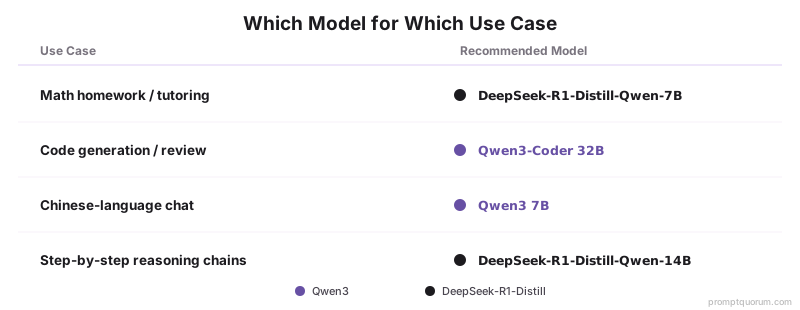
- Math homework / tutoring: DS-R1-Distill-Qwen-7B — 88% MATH-500 outperforms Qwen3 8B (62.5%) at the same VRAM
- Code generation / review: Qwen2.5-Coder 32B — 91.5% HumanEval, the highest of any consumer-runnable model
- Chinese-language chat: Qwen3 8B — native CJK tokenisation, 30–40% more token-efficient on Chinese text
- Step-by-step analysis / reasoning chains: DS-R1-Distill-Qwen-14B — produces explicit chain-of-thought by default
- General daily assistant (8 GB VRAM): Qwen3 8B — more fluent conversation, avoids DeepSeek's over-reasoning on simple tasks
- Private enterprise deployment (China): Qwen3 — Apache 2.0 license, Alibaba provenance simplifies CAC compliance documentation
Frequently Asked Questions
Is DeepSeek-R1 the same as the distilled models?
No. DeepSeek-R1 is the 671B mixture-of-experts model requiring server hardware. The distilled versions (7B, 14B, 32B) are separate dense models trained to replicate its reasoning style — these are the practical local-use options.
Do DeepSeek and Qwen use the same VRAM at each parameter size?
Yes, at the same quantisation level. Both 7B models need approximately 5.5 GB at Q4_K_M; both 32B models need 20.5 GB. The hardware choice is about task preference, not VRAM difference.
Can I run DeepSeek-R1 distilled models with Ollama?
Yes. Run ollama run deepseek-r1:7b for the 7B distill or ollama run deepseek-r1:32b for the 32B. Ollama downloads Q4_K_M by default.
Which is better for Chinese text: DeepSeek or Qwen?
Qwen3 is significantly better for Chinese text. It uses a purpose-built Chinese tokeniser that is 30–40% more efficient on CJK text. The DeepSeek-R1 distilled models are built on Qwen3 weights, so they also inherit reasonable Chinese support, but the base Qwen3 models are the primary choice.
Which model should I use for math on 8 GB VRAM?
DeepSeek-R1-Distill-Qwen-7B. It scores 88% on MATH-500 vs 62.5% for Qwen3 8B — a 25-point gap — at identical VRAM usage.
Does DeepSeek-R1 comply with China data law if run locally?
Running any model locally means data never leaves your hardware, which satisfies the data residency requirements of China's Data Security Law regardless of model origin. The compliance question is about data handling, not model provenance.