Key Takeaways
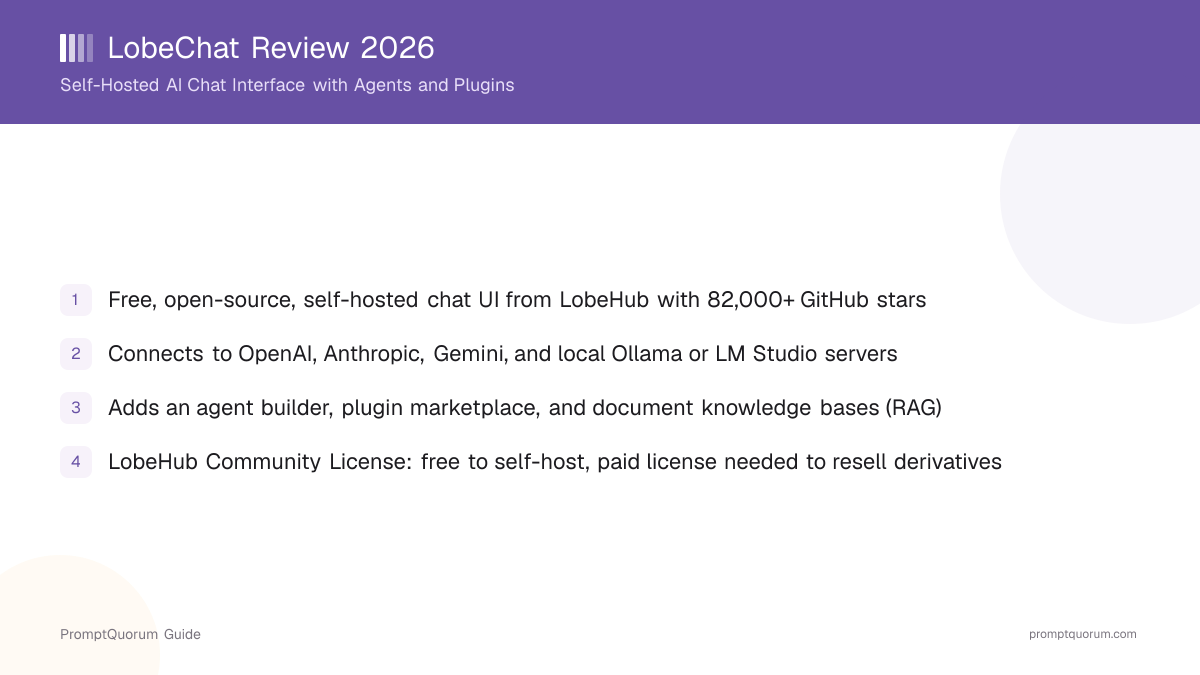
- LobeChat (lobehub.com, source at github.com/lobehub/lobe-chat) is a free, self-hostable chat interface with 82,000+ GitHub stars.
- It is not plain MIT-licensed: the LobeHub Community License is an Apache 2.0 variant that keeps self-hosting and internal commercial use free, but requires a paid commercial license to distribute a modified derivative product.
- It connects to OpenAI, Anthropic, Google Gemini, and any OpenAI-compatible endpoint, including local Ollama or LM Studio servers -- it does not run models itself.
- Built-in features include an agent/persona builder, a plugin marketplace, document knowledge bases (RAG), and vision/text-to-speech support.
- A hosted alternative, LobeHub Cloud, starts at $9.9/month for people who do not want to self-host.
📍 In One Sentence
LobeChat is a free, open-source, self-hosted chat interface built by LobeHub that connects to OpenAI, Anthropic, Google Gemini, and any OpenAI-compatible endpoint, including local models, and adds an agent builder, plugin marketplace, and document knowledge bases on top.
💬 In Plain Terms
LobeChat doesn't run AI models itself -- think of it as a polished, self-hosted ChatGPT-style website you install on your own server or deploy to Vercel, in front of models you're already running locally or paying for through a provider.
📌Note: This review is the deep-dive companion to LobeChat's entry in the Local LLM Software Directory -- see that page for how LobeChat compares at a glance to dozens of other local AI tools.
Quick Facts: LobeChat
- License: LobeHub Community License -- Apache 2.0-based, source-available, free to self-host and use commercially as-is; distributing a modified derivative requires a paid commercial license (not OSI-approved plain MIT/Apache)
- Platforms: Self-hosted web app (Docker, Vercel, Zeabur, Alibaba Cloud); works in any browser
- Website: lobehub.com
- GitHub: github.com/lobehub/lobe-chat -- 82,000+ stars as of September 2026
- Cost: Free to self-host; LobeHub Cloud hosted plans start at $9.9/month
- Core function: Self-hosted chat interface for OpenAI, Anthropic, Gemini, and local model backends, with an agent builder, plugins, and RAG
What Is LobeChat?
LobeChat is a free, open-source chat interface you self-host, giving you a ChatGPT-style front end for models you connect via API or run yourself. You deploy it as a Docker container on your own server, or use a one-click option to Vercel, Zeabur, or Alibaba Cloud, and it serves a web app that you and anyone you invite can chat through.
It does not train or run models on its own. Instead, it is a front end that talks to a backend: OpenAI, Anthropic, Google Gemini, or any endpoint that speaks the OpenAI-compatible API format, which in practice covers self-hosted servers like Ollama and LM Studio.
What sets it apart from a minimal chat window is the layer built on top: an agent/persona builder for creating assistants with their own system prompt and model, a plugin marketplace for connecting external tools, document knowledge bases for retrieval-augmented answers, and vision and text-to-speech support -- all wrapped in a design that reads as more polished than most open-source chat UIs.
History and Development
LobeChat is developed by LobeHub, and its public GitHub history shows the project has been actively developed since 2023, growing from a chat-interface project into one of the more feature-complete self-hosted AI front ends available.
The project ships frequently: recent development has focused on the agent/persona builder, an expanding plugin marketplace with tool integrations, and document knowledge base features for retrieval-augmented generation, alongside the underlying multi-provider chat core.
A significant point for anyone evaluating LobeChat commercially is the license. The code is not plain MIT or unmodified Apache 2.0 -- it ships under the LobeHub Community License, which permits free self-hosting and commercial use as-is, but requires a separate paid commercial license (contact hello@lobehub.com) to distribute a modified derivative product.
What Can You Actually Do With LobeChat?
- Chat with OpenAI, Anthropic, Gemini, or a local model. Connect a cloud API key or point LobeChat at a local Ollama or LM Studio server, and every connected model shows up in the same model picker.
- Build agents and personas. Create named assistants configured with their own system prompt, model, and tool access, instead of starting every conversation from a blank default.
- Extend it with a plugin marketplace. Connect the chat to external tools -- web search, code execution, image generation -- from a browsable catalog of plugins.
- Chat with your own documents (RAG). Upload files into a knowledge base and LobeChat retrieves relevant passages before answering.
- Use vision and text-to-speech. Send images for the model to describe or analyze, and have responses read aloud, depending on the connected model's capabilities.
- Run it for a household or a small team. When self-hosted for more than one person, LobeChat supports a shared workspace with organized conversation history.
Get Started: Self-Host LobeChat
LobeChat is not a per-OS downloadable desktop app -- it is a self-hosted web application. Here are the official ways to run it, from the GitHub README:
- 1. Get an API key or a local backend ready. Have an OpenAI-compatible API key (OpenAI, Anthropic, Google Gemini) on hand, or have Ollama or LM Studio already running locally.
- 2. Recommended: run it with Docker. `docker run -d -p 3210:3210 -e OPENAI_API_KEY=sk-xxx --name lobe-chat lobehub/lobe-chat` -- then open `http://localhost:3210`. Swap the environment variable for your provider's key format if using Anthropic or another provider.
- 3. Or deploy with one click. The official GitHub repository lists one-click deploy options to Vercel, Zeabur, and Alibaba Cloud, avoiding server management entirely.
- 4. Point it at a local model instead of a cloud API. Under Settings -> Language Model, set the OpenAI-compatible base URL to your local Ollama or LM Studio address instead of (or alongside) a cloud provider.
- 5. Add agents, plugins, and a knowledge base. Create a persona under Agents, connect tools from the plugin marketplace, and upload documents to a knowledge base for RAG.
- Full documentation, environment variable reference, and deployment guides are maintained in the GitHub repository and at lobehub.com.
Pricing: Free Self-Hosted, Paid LobeHub Cloud
LobeChat follows an open-core-adjacent model: the self-hosted software is free, and LobeHub separately sells a hosted version for people who do not want to run their own server.
- Free (self-hosted): The full application -- chat, agent builder, plugin marketplace, knowledge bases, vision/TTS -- is free under the LobeHub Community License, including commercial use as-is. You provide your own server and connect your own API keys or local backend, which you pay for (or run) separately.
- LobeHub Cloud -- Starter: $9.9/month (5,000,000 credits) for people who want a hosted instance without self-hosting.
- LobeHub Cloud -- Premium: $19.9/month (15,000,000 credits), the higher-usage hosted tier.
- No evidence of an affiliate or referral program for LobeHub Cloud as of September 2026.
- Commercial license for derivative products: distributing a modified version of LobeChat as your own product requires contacting LobeHub at hello@lobehub.com for a separate commercial license -- this does not apply to self-hosting or using it internally as-is.
LobeChat vs Open WebUI vs LibreChat vs Cherry Studio: Which One?
All four are chat interfaces for models you run or connect yourself, but each was built around a different center of gravity.
Tool | Best for | Self-hosted | Built-in RAG | License |
|---|---|---|---|---|
| LobeChat | Polished UI, agent builder, plugin marketplace | Yes (Docker/Vercel/Zeabur) | Yes | LobeHub Community (Apache-based) |
| Open WebUI | Multi-user front end tightly tied to Ollama | Yes (Docker/pip) | Yes | Open WebUI License (BSD-derived) |
| LibreChat | Managing many cloud provider API keys in one UI | Yes (Docker) | Yes | MIT |
| Cherry Studio | Single-user desktop client, no server to run | No (native desktop app) | Yes | Custom (source-available) |
For character/roleplay-focused chat instead of a general-purpose assistant, see Open WebUI vs SillyTavern. For the full catalog, see the Local LLM Software Directory.
Who Should Use LobeChat?
LobeChat fits people who want a polished, self-hosted chat interface with agent and plugin features, and who are comfortable running a Docker container or a one-click cloud deploy.
- ✅ You want a self-hosted chat UI with a more polished, consumer-grade design than a bare-bones open-source front end.
- ✅ You want an agent/persona builder and a plugin marketplace without switching to a separate agent framework.
- ✅ You want to connect both cloud providers and a local Ollama/LM Studio server in the same interface.
- ✅ You are comfortable with Docker, or a one-click Vercel/Zeabur deploy, and do not need a zero-setup desktop app.
- ❌ You want zero server setup and a single-user desktop app -- see Cherry Studio instead.
- If unsure: run the single Docker command against an OpenAI-compatible API key first, then connect a local Ollama server once you have confirmed the interface fits your workflow.
When Should You NOT Use LobeChat?
Being a self-hosted, feature-rich interface is LobeChat's main strength, and also the source of its main limitations.
- If you want a single-click desktop app with no server to maintain: LobeChat is a web service you deploy and keep updated yourself; a desktop client avoids that entirely.
- If you plan to fork and resell a modified version: the LobeHub Community License requires a separate paid commercial license for distributing a derivative product -- read the license text before building a resellable product on top of it.
- If you expect it to run models on its own: it has no built-in inference engine -- you must separately run or pay for a backend such as Ollama, OpenAI, or Anthropic.
- If you plan to expose it to the public internet without hardening it: like any self-hosted web app, it needs a reverse proxy, TLS, and up-to-date patches before deploying to production.
- If you need deep enterprise team administration (SSO, granular roles): LobeChat's multi-user support is more limited than a dedicated enterprise product -- verify current admin features directly before committing.
Competitors and Alternatives
LobeChat sits in a segment of self-hosted, multi-provider chat interfaces. Here is how it compares to the closest alternatives in that same category -- see the Local LLM Software Directory for the full catalog, including LobeChat's own directory entry.
- Open WebUI -- a self-hosted, multi-user chat interface most tightly integrated with Ollama and local-first workflows; less emphasis on an agent/plugin marketplace than LobeChat.
- LibreChat -- an MIT-licensed self-hosted interface that leans toward managing many cloud provider API keys behind one shared UI.
- Cherry Studio -- a single-user desktop client rather than a self-hosted server, for people who want zero server setup.
- SillyTavern -- a self-hosted front end focused on character/roleplay chat rather than general-purpose assistant use; see Open WebUI vs SillyTavern for how that use case differs.
Common Mistakes With LobeChat
- Assuming the license is plain MIT. The LobeHub Community License allows free self-hosting and internal commercial use, but requires a paid commercial license to distribute a modified derivative product.
- Exposing it to the internet without a reverse proxy or TLS. Treat it like any other self-hosted web app -- put it behind a reverse proxy with HTTPS before making it reachable outside your own network.
- Assuming LobeChat runs models on its own. It is an interface layer -- it needs a connected backend, whether a cloud API key or a local server like Ollama.
- Confusing LobeHub Cloud pricing with self-hosting cost. Self-hosting itself is free; you only pay LobeHub if you choose the hosted Cloud plans, and separately pay whichever model provider you connect.
- Skipping updates. Because it is exposed as a network service, staying on old versions carries more risk than with a desktop app -- check the changelog and update the container regularly.
Frequently Asked Questions
What is LobeChat?
LobeChat is a free, open-source, self-hostable chat interface built by LobeHub. It connects to OpenAI, Anthropic, Google Gemini, and any OpenAI-compatible endpoint, including local models via Ollama or LM Studio, and adds an agent builder, plugin marketplace, and document knowledge bases on top.
Is LobeChat free?
Yes, self-hosting LobeChat is free under the LobeHub Community License, including commercial use as-is. Distributing a modified derivative product requires a paid commercial license from LobeHub. A hosted alternative, LobeHub Cloud, starts at $9.9/month for people who do not want to self-host.
Is LobeChat open source?
The source code is public at github.com/lobehub/lobe-chat under the LobeHub Community License, an Apache License 2.0 variant. It is source-available and free to self-host, but the added distribution clause means it is not a plain, unmodified Apache-2.0/MIT license.
Can LobeChat run local models like Ollama?
LobeChat does not run models itself. It connects to a local Ollama or LM Studio server (or any OpenAI-compatible endpoint) the same way it connects to a cloud API -- you set the base URL under Settings -> Language Model.
Does LobeChat support plugins?
Yes. LobeChat has a plugin marketplace that connects the chat to external tools such as web search, code execution, and image generation from a browsable catalog.
Does LobeChat have RAG (chat with documents)?
Yes. LobeChat includes document knowledge bases -- upload files and ask questions grounded in their content, using retrieval-augmented generation.
Can multiple people use the same LobeChat instance?
Yes, when self-hosted for a team, LobeChat supports a shared multi-user workspace with organized conversation history, though team administration is not as deep as a dedicated enterprise product.
What is LobeHub Cloud and how much does it cost?
LobeHub Cloud is LobeHub's hosted version of the product for people who do not want to self-host. It has a Starter plan at $9.9/month (5,000,000 credits) and a Premium plan at $19.9/month (15,000,000 credits), billed by LobeHub directly.
How is LobeChat different from Open WebUI or LibreChat?
All three are self-hosted, open-source chat interfaces, but LobeChat emphasizes a polished consumer-style UI with an agent builder and plugin marketplace, Open WebUI is the most tightly integrated with Ollama and local-first workflows, and LibreChat leans toward managing many cloud provider API keys behind one shared UI.
Is LobeChat safe to expose to the internet?
Like any self-hosted web app, it needs a reverse proxy, TLS, and authentication hardening before being exposed publicly. Check the official changelog for security-relevant fixes and keep the container updated.
Sources
- LobeChat official site -- lobehub.com
- LobeChat source code, license, and documentation -- github.com/lobehub/lobe-chat
- LobeHub Cloud pricing -- lobehub.com