What Is h2oGPT?
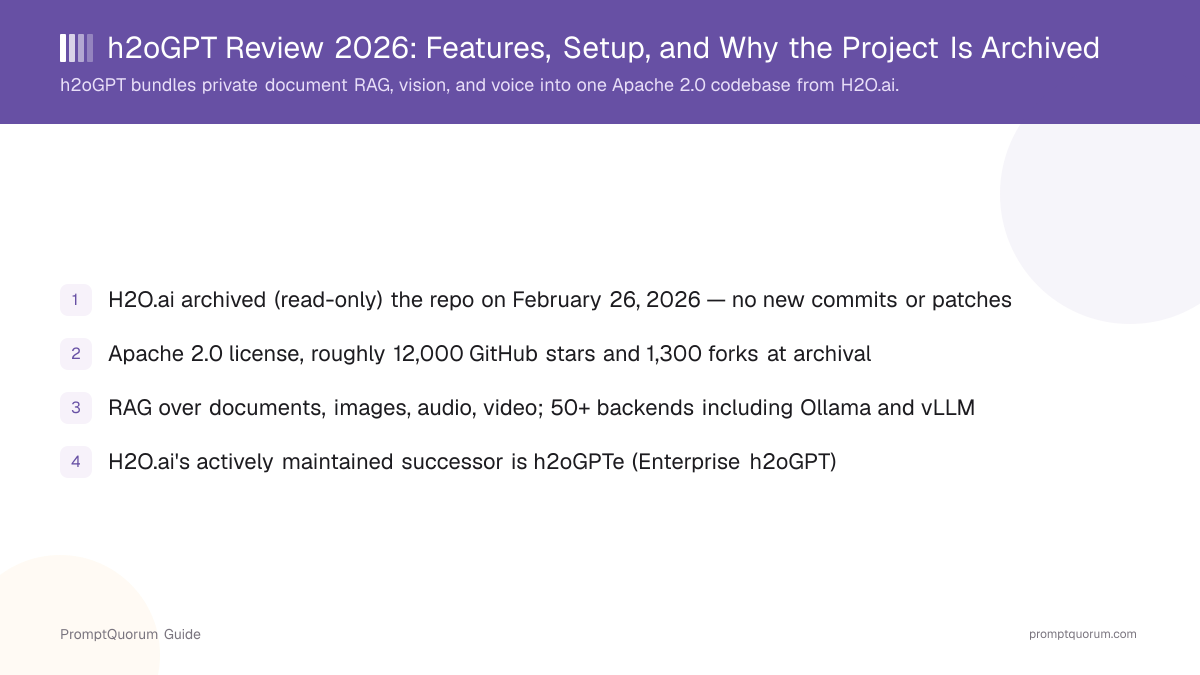
h2oGPT is an open-source application from H2O.ai for private chat and document question-answering: you point it at a local or API-based LLM, upload files, and ask questions grounded in that content instead of the model's general training data. The project is hosted at github.com/h2oai/h2ogpt and reached roughly 12,000 GitHub stars before H2O.ai archived it.
- Document RAG: ingests PDFs, Word, Excel, images, video frames, YouTube links, audio, code, and markdown into a searchable knowledge base
- Vector stores: Chroma, Weaviate, or an in-memory FAISS index, with semantic chunking and HYDE (Hypothetical Document Embeddings) to improve retrieval quality
- Model backends: connects to local inference through Hugging Face transformers, llama.cpp/GGML, GPT4All, Ollama, vLLM, Hugging Face TGI, and ExLLaMa, or to hosted APIs (OpenAI, Azure OpenAI, Anthropic, Google, MistralAI, Groq, Replicate, Together.ai)
- Multimodal features: vision models (LLaVa plus API vision models like GPT-4-Vision, Claude, and Gemini-Pro-Vision), image generation (Stable Diffusion variants, PlaygroundAI, Flux), and voice (Whisper streaming speech-to-text, text-to-speech with voice cloning)
- API and integration: an OpenAI-compatible proxy server with chat and text completions, function/tool calling, JSON mode, and web search integration
- Multi-user support: native username/password authentication plus Google OAuth, with role-based access control
Is h2oGPT Still Maintained?
No. H2O.ai archived the github.com/h2oai/h2ogpt repository on February 26, 2026. GitHub marks it "archived by the owner" and read-only: no new commits land on the main branch, and issues and pull requests are no longer being actively triaged or merged.
The archived state does not remove the code. Apache 2.0 lets anyone fork, run, modify, and redistribute it indefinitely — you can still clone the repository today and run it exactly as documented. What changes is that H2O.ai is no longer the one fixing bugs, patching dependencies, or adding features to that specific codebase.
- What still works: cloning, running, and modifying the existing codebase under Apache 2.0 — nothing about the license or the code itself expired
- What stops: new official commits, dependency updates, security patches, and issue triage from the H2O.ai team on this repository
- What H2O.ai points users to instead: h2oGPTe (Enterprise h2oGPT), a commercial product that continued shipping releases through 2026
- What this means for you: treat the open-source h2oGPT code as a frozen reference implementation, not a tool you can rely on H2O.ai to keep patched going forward
⚠️Warning: If your evaluation criteria include "actively maintained by the vendor," h2oGPT (the open-source repo) does not meet that bar as of this writing. h2oGPTe does.
Features: RAG, Backends, and Multimodal Support
What made h2oGPT distinctive while it was under active development was how much it bundled into one codebase: document RAG, a wide range of inference backends, and multimodal support, rather than requiring separate tools for each.
- RAG pipeline: file upload or data-source connection, text extraction and cleaning, OCR via DocTR for scanned documents, semantic chunking, embedding, and indexing into Chroma, Weaviate, or FAISS
- Backend flexibility: the same interface can call a fully local model (llama.cpp GGUF, a Hugging Face model, or an Ollama-served model) or a hosted API, letting you trade privacy for speed and model choice on a case-by-case basis
- Vision and image generation: document images and photos can be interpreted with LLaVa or API vision models, and the tool can generate images via Stable Diffusion variants or Flux
- Voice: streaming speech-to-text via Whisper, plus text-to-speech (including voice cloning) using Microsoft SpeechT5 and other MPL2-licensed models
- Fine-tuning: documented support for fine-tuning models on your own data, and H2O.ai maintains a separate companion project, H2O LLM Studio, specifically for no-code fine-tuning workflows
- Testing and reliability at the time of active development: the project shipped with over 1,000 unit and integration tests
How Do You Self-Host h2oGPT?
The steps below follow the project's own documented Docker and pip-based setup paths. Because the repository is archived, you are working from a frozen snapshot — there will be no further official fixes if a dependency breaks compatibility over time.
- 1Clone the repository: git clone https://github.com/h2oai/h2ogpt.git, then cd h2ogpt. You are cloning a read-only, archived snapshot, not an actively updated project.
- 2Install dependencies from requirements.txt in a Python virtual environment, or use the project's documented Docker Compose setup for a more complete, pre-configured environment.
- 3Choose a model backend: point h2oGPT at a local inference engine (Ollama, or GGUF models via llama.cpp) for fully offline use, or configure API keys for a hosted provider if offline operation is not a requirement.
- 4Launch the application with the project's generate.py entry point, or start the Docker Compose stack, which brings up the local web interface.
- 5Upload documents through the web interface to build a private knowledge base, or connect a persistent vector store (Chroma or Weaviate) for larger document collections.
- 6Because the project no longer receives security patches, pin your dependency versions and review the code yourself before relying on it beyond a personal evaluation.
Does h2oGPT need a GPU?
Not for the h2oGPT application itself. A GPU matters only for the backend you choose — GPU-accelerated inference (Hugging Face transformers, GGML models on GPU) is much faster, but CPU-only backends such as llama.cpp CPU builds and GPT4All are also supported.
Can h2oGPT run fully offline?
Yes. h2oGPT can be configured to use only local inference backends (llama.cpp, a locally run Hugging Face model, or Ollama) with no calls to external API providers, which matches the project's original privacy-first design goal.
h2oGPT vs. h2oGPTe (Enterprise)
H2O.ai sells a commercial product, h2oGPTe (Enterprise h2oGPT), alongside the now-archived open-source h2oGPT. The two share a name and origin but are not the same codebase to evaluate today.
h2oGPT (open source)
- Status:
- Archived Feb 26, 2026 (read-only)
- Hosting:
- Self-hosted only
- Cost:
- Free (Apache 2.0)
- Best For:
- Forking or learning from a frozen RAG codebase
h2oGPTe (Enterprise)
- Status:
- Actively developed, shipping releases through 2026
- Hosting:
- Self-hosted, VPC, or H2O.ai-managed
- Cost:
- Custom — contact H2O.ai
- Best For:
- Production deployments needing ongoing updates and vendor support
If you need a supported product with a roadmap, evaluate h2oGPTe directly at h2ogpte.genai.h2o.ai rather than assuming the open-source h2oGPT repository will receive the same attention.
Who Should Use h2oGPT?
The open-source h2oGPT repository still has legitimate uses — they are just narrower than "run this in production and expect the vendor to keep it updated."
Use h2oGPT (the open-source repo) if
- You want to study or fork a broad, working reference implementation of RAG plus multi-backend LLM orchestration under a permissive Apache 2.0 license
- You are running a personal, offline document-chat setup and are comfortable maintaining the code yourself going forward
- You need to compare feature coverage (vision, voice, image generation, RAG) against a narrower single-purpose tool before deciding what to build
- You already have the skills to patch dependencies and security issues yourself, since the original maintainers no longer will
Avoid h2oGPT (the open-source repo) if
- You need vendor-maintained software for a production deployment — evaluate h2oGPTe (Enterprise h2oGPT) instead
- You want ongoing security patches without doing the work yourself
- You are choosing between actively maintained self-hosted tools (Open WebUI, AnythingLLM, PrivateGPT, LibreChat, Dify) for a new project and have no specific reason to pick a frozen codebase
- Your team lacks the bandwidth to audit and update a dependency tree that nobody upstream is patching anymore
h2oGPT vs. Open WebUI, LibreChat, AnythingLLM, PrivateGPT, Dify
h2oGPT overlapped with each of these tools on some feature, but its distinguishing factor today is maintenance status — most alternatives are actively developed, while h2oGPT is not.
Tool | Interface | License | Maintenance | Best For |
|---|---|---|---|---|
| h2oGPT | Web chat + RAG UI | Apache 2.0 | Archived Feb 2026 | Forking a frozen RAG codebase |
| Open WebUI | Web chat UI | BSD-3 | Active | Ollama-based chat frontend |
| LibreChat | Web chat UI | MIT | Active | Multi-model ChatGPT alternative |
| AnythingLLM | Desktop + web RAG | MIT | Active | Team RAG workspaces |
| PrivateGPT | API + web UI | Apache 2.0 | Active | Air-gapped offline RAG |
| Dify | Visual + RAG + agents | Modified Apache 2.0 | Active | All-in-one LLMOps platform |
License and maintenance status can change — re-verify at each project's repository before committing to one.
History and Founders
H2O.ai was founded in 2012 by Sri Ambati (CEO) and Cliff Click, building on Ambati's earlier work co-founding Platfora, a big-data analytics company later acquired by Workday.
H2O.ai launched h2oGPT and the companion fine-tuning framework H2O LLM Studio on May 11, 2023, framing both as tools for organizations that wanted to control their own LLM instead of sending data to a third-party API. Sri Ambati said at launch: "Every company needs its own GPT. H2OGPT and H2O LLM Studio will empower all our customers and communities to make their own GPT." He also described the philosophy behind the project as: "Open source is about freedom, not just free. LLMs are far too important to be owned by a few large tech giants."
H2O.ai documented the project's design and evaluation in an academic paper, "h2oGPT: Democratizing Large Language Models" (arXiv:2306.08161). The repository grew to roughly 12,000 GitHub stars and 1,300 forks before H2O.ai archived it on February 26, 2026, at which point the company's development effort had visibly shifted to h2oGPTe (Enterprise h2oGPT).
Common Mistakes When Evaluating h2oGPT
These mistakes come from treating h2oGPT as if it were still under active development, or conflating it with H2O.ai's commercial product.
Mistake 1: Assuming h2oGPT is actively maintained
The repository has been archived and read-only since February 26, 2026. No new commits, security patches, or issue responses are coming from H2O.ai on this codebase — plan around that fact rather than around the feature list alone.
Mistake 2: Confusing h2oGPT with h2oGPTe
h2oGPT is the archived open-source community project. h2oGPTe (Enterprise h2oGPT) is H2O.ai's separate, actively developed commercial product with ongoing releases and vendor support. Evaluating one while assuming you get the other's maintenance guarantees is a common error.
Mistake 3: Expecting GPU-free performance by default
h2oGPT orchestrates whichever backend you configure — it does not run inference itself. Speed and hardware requirements depend entirely on the backend you choose (CPU llama.cpp versus GPU-accelerated Hugging Face transformers), not on the h2oGPT layer.
Frequently Asked Questions
Is h2oGPT still maintained?
No. H2O.ai archived the github.com/h2oai/h2ogpt repository (made it read-only) on February 26, 2026. The code still works and can be forked under Apache 2.0, but it no longer receives official commits, patches, or issue triage.
Is h2oGPT free?
Yes. h2oGPT is licensed under Apache 2.0, so it is free to use, modify, and redistribute, including for commercial purposes, even though the repository is now archived.
What license does h2oGPT use?
Apache License 2.0, unmodified — one of the more permissive open-source licenses, allowing commercial use, modification, and redistribution.
Does h2oGPT support RAG?
Yes. h2oGPT ingests PDFs, Word, Excel, images, video frames, audio, and code into a searchable knowledge base using Chroma, Weaviate, or an in-memory FAISS index, with semantic chunking and HYDE to improve retrieval.
Does h2oGPT need a GPU?
Not necessarily. GPU acceleration speeds up inference on GPU-backed backends, but CPU-only options such as llama.cpp CPU builds and GPT4All are also supported.
Can h2oGPT run fully offline?
Yes, when configured to use only local inference backends (llama.cpp, a locally run Hugging Face model, or Ollama) instead of hosted APIs — this offline-first design was the project's original goal.
What is h2oGPTe and how is it different from h2oGPT?
h2oGPTe (Enterprise h2oGPT) is H2O.ai's commercial product, sold and supported separately from the archived open-source h2oGPT. h2oGPTe continued shipping releases through 2026, while the open-source repository has not received updates since its archival.
Does h2oGPT support vision and multimodal models?
Yes. h2oGPT documented support for vision models including LLaVa and API vision models (GPT-4-Vision, Claude, Gemini-Pro-Vision), plus image generation via Stable Diffusion variants and Flux, and voice via Whisper speech-to-text and text-to-speech.
How many GitHub stars does h2oGPT have?
Roughly 12,000 stars and 1,300 forks on github.com/h2oai/h2ogpt as of its archival in February 2026. Check the repository directly for the current count, since star counts can still change on an archived repo through new stargazers.
How is h2oGPT different from Open WebUI, AnythingLLM, or PrivateGPT?
Feature-wise, h2oGPT covered similar RAG and multi-backend ground, plus extra multimodal features (vision, voice, image generation) that some alternatives don't include. The practical difference today is maintenance: Open WebUI, AnythingLLM, and PrivateGPT are all actively developed, while h2oGPT is archived.