What Was PrivateGPT?
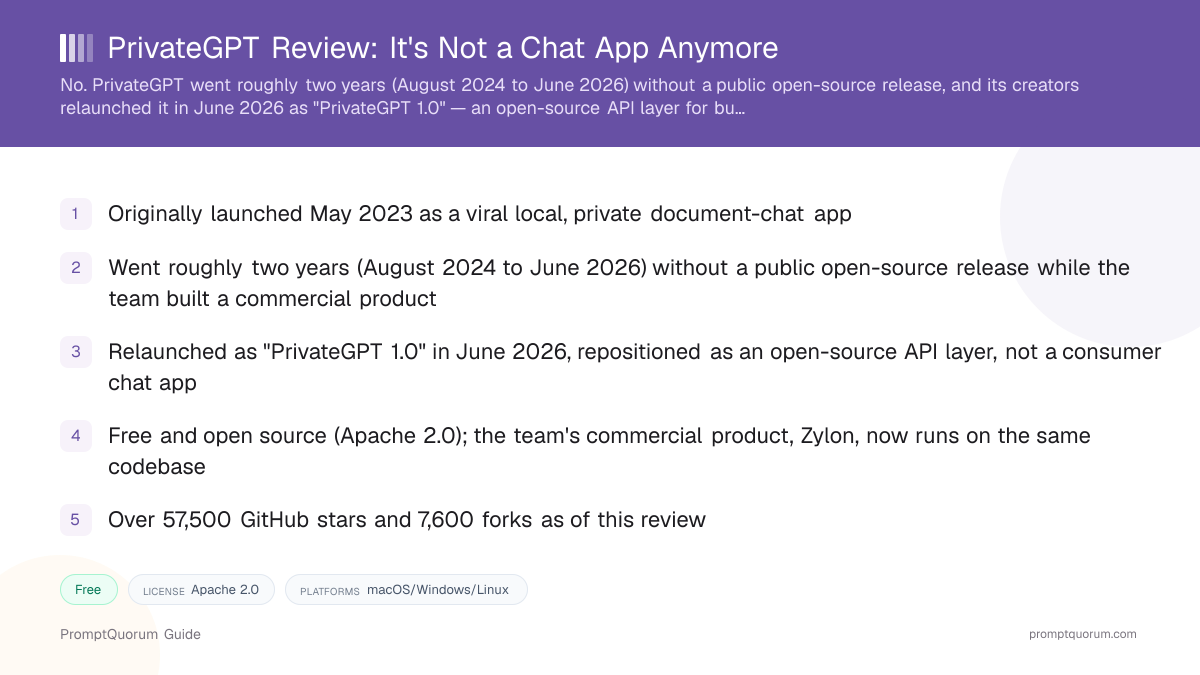
PrivateGPT launched in May 2023 as a free, open-source, self-hosted application for asking questions about your own documents, entirely offline and privately, using local language models. It was created by Iván Martínez and Daniel Gallego Vico and quickly gained over 50,000 GitHub stars, by its own account, as one of the first widely popular "chat with your documents" tools.
- Original positioning: a self-hosted, consumer-style application with a built-in chat interface for document Q&A
- Creators: Iván Martínez (GitHub handle imartinez) and Daniel Gallego Vico
- Launch: May 2023, growing virally to over 50,000 GitHub stars by the project's own account
- Commercial spin-off: the creators founded Zylon (legal entity PriBAI Technology Spain S.L., based in Madrid), which raised a $3.2 million pre-seed round in February 2024, led by Felicis, with LifeX Ventures and Zypsy also participating
The 2024-2026 Pivot, Explained
PrivateGPT went roughly two years without a public open-source release while its creators built a commercial product, then relaunched the open-source project in June 2026 with a fundamentally different identity: an API layer instead of a consumer app.
- August 2024: the last open-source release before the gap, v0.6.2
- Between August 2024 and June 2026: no public open-source releases; the team's own GitHub discussion states they "closed our private fork" and worked on Zylon's commercial product during this period
- June 3, 2026: "PrivateGPT 1.0" released, described by the team as merging their commercial work back into the open-source codebase, with the statement "Zylon.ai, our commercial product, now runs on this open source codebase" and "we build in public from here on"
- New identity: PrivateGPT is now described in its own README as "the open-source API layer that turns local models into production AI applications" — not a standalone chat app with a graphical interface as its primary product
- A "workbench UI" does exist at a
/uipath, but PrivateGPT's own documentation explicitly calls it "a demonstrator, not the core product"
What Does PrivateGPT Do Today?
PrivateGPT today is an API layer that connects to an external, OpenAI-compatible inference server (such as Ollama, llama.cpp, vLLM, or LM Studio) and adds retrieval, tool use, and Claude/OpenAI-compatible messaging endpoints on top.
- Does not run models itself: PrivateGPT connects to a separate local inference server rather than bundling model inference directly
- Compatible messaging APIs: Claude- and OpenAI-compatible message formats, per its own README
- Retrieval-augmented generation: file and artifact ingestion with citation-backed retrieval
- Tool use: built-in and custom tools, database querying, CSV analysis, web search and content extraction, per its own documentation
- MCP support: Model Context Protocol integration, per its own documentation
- Structured outputs and code execution capability, per its own documentation
- A "workbench UI" at
/ui, explicitly described by PrivateGPT's own docs as a demonstrator rather than the core product
Platform, Pricing, and Licensing
Self-hosted / open source
- What PrivateGPT states:
- Free, Apache License 2.0, confirmed via the repository's LICENSE file.
Commercial product (Zylon)
- What PrivateGPT states:
- Zylon's own site advertises "unlimited, fixed cost, no per-token pricing" but publishes no specific dollar figure — access is by "Request a Demo" / contact sales only, per zylon.ai as checked for this review.
Architecture
- What PrivateGPT states:
- An API layer connecting to an external OpenAI-compatible inference server (Ollama, llama.cpp, vLLM, LM Studio) — it does not run models itself.
Licensing organization
- What PrivateGPT states:
- Maintained under the zylon-ai GitHub organization; this review could not fully confirm whether the older imartinez/privateGPT repository still redirects there or exists as a separate archive — verify directly if you have an old bookmark.
Verify current documentation directly on docs.privategpt.dev before assuming a specific file type, embedding model, or feature is supported, since the project changed significantly during its 2024-2026 gap.
Install PrivateGPT
PrivateGPT is free and open source, installable from its GitHub repository.
Source | Link |
|---|---|
| GitHub repository (source code, Apache 2.0) | github.com/zylon-ai/private-gpt |
| Documentation | docs.privategpt.dev |
| Zylon (commercial product, same codebase) | zylon.ai |
Because PrivateGPT is now positioned as a developer-facing API layer, expect a setup process aimed at connecting your own inference server and building on the API, rather than a one-click consumer chat app.
Who Should Use PrivateGPT Today?
PrivateGPT today fits developers building an AI application on top of local models, not people looking for a ready-made document-chat app.
Use PrivateGPT if you
- Are a developer building an AI application and want an open-source API layer (RAG, tool use, MCP) on top of a local inference server you already run
- Already run Ollama, llama.cpp, vLLM, or LM Studio and want to add retrieval and tool-use endpoints on top
- Want an Apache 2.0-licensed, self-hosted alternative to building this API layer from scratch
- Are open to evaluating Zylon's commercial product if you need a supported, hosted version of the same capability
Look elsewhere if you
- Want a ready-to-use, consumer-style app for chatting with your own documents out of the box — PrivateGPT's own docs now call its UI "a demonstrator, not the core product"; consider AnythingLLM or Open WebUI instead
- Remember PrivateGPT from 2023-2024 and expect that exact experience — the project changed substantially during its 2024-2026 gap
- Need a project with a continuous release history — PrivateGPT went roughly two years without a public open-source release before its June 2026 relaunch
- Need clear, published commercial pricing before evaluating a vendor — Zylon's site did not show a specific price for this review, only a "request a demo" path
What PrivateGPT Is Not Good For
PrivateGPT is not a good fit if you want a ready-made document-chat app, or if a continuous release history matters to you.
- Not a ready-to-use consumer chat app anymore — its own documentation describes the built-in UI as a demonstrator, not the core product
- Not a project with a continuous release history — it went roughly two years (August 2024 to June 2026) without a public open-source release
- Not a model-running tool itself — it requires a separate, already-running inference server (Ollama, llama.cpp, vLLM, or LM Studio)
- Not transparently priced on the commercial side — Zylon's site shows no specific dollar figure, only a request-a-demo/contact-sales path
- Not confirmed to have a specific, current list of supported file types or default embedding models from what this review could access — verify directly in current documentation
Common Mistakes When Evaluating PrivateGPT in 2026
Most confusion about PrivateGPT in 2026 comes from articles, tutorials, and comparisons written before its June 2026 relaunch.
Mistake 1: Expecting the 2023-era consumer chat app experience
PrivateGPT is now positioned as an API layer for developers, not a ready-made document-chat app. Its own documentation calls the built-in UI "a demonstrator, not the core product."
Mistake 2: Assuming it has been continuously developed since 2023
There were no public open-source releases between August 2024 and June 2026. Treat any tutorial or comparison from that window as describing a project that had gone quiet, not one receiving regular updates.
Mistake 3: Confusing PrivateGPT with Zylon
Zylon is the creators' separate commercial product, now running on the same open-source codebase as PrivateGPT. PrivateGPT itself remains free and open source (Apache 2.0); Zylon is the paid, hosted/enterprise offering built on top.
Mistake 4: Assuming the old imartinez/privateGPT GitHub link still points to the current project
The canonical repository is now under the zylon-ai GitHub organization. This review could not fully confirm the exact current redirect behavior of the older repository path — verify you land on github.com/zylon-ai/private-gpt.
Competitors and Alternatives
PrivateGPT's own documentation positions it as "API-first" versus "app-first" tools like Open WebUI — for a ready-to-use document-chat app today, alternatives such as AnythingLLM or Open WebUI are more directly comparable to what PrivateGPT originally was.
Tool | Best known for | Link |
|---|---|---|
| Open WebUI | A ready-to-use, app-first local chat interface with document RAG support | Open WebUI (see PromptQuorum's directory for details) |
| AnythingLLM | A consumer-friendly, self-hosted document-chat app | AnythingLLM (see PromptQuorum's directory for details) |
| Khoj | A self-hosted personal AI second brain with document search | Khoj review |
| LlamaIndex | A framework for building RAG applications on top of local or cloud models | LlamaIndex review |
PrivateGPT's own documentation names Open WebUI directly as a comparison point (as an "app-first" tool versus PrivateGPT's "API-first" positioning) — this list also adds tools commonly compared to PrivateGPT's original, pre-2026 positioning, not an independent PromptQuorum ranking.
Frequently Asked Questions
Is PrivateGPT still a document-chat app?
No, not primarily. Since its June 2026 relaunch, PrivateGPT is positioned as an open-source API layer for building AI applications. Its own documentation calls the built-in UI "a demonstrator, not the core product."
What happened to PrivateGPT between 2024 and 2026?
There were no public open-source releases between the v0.6.2 release in August 2024 and the "PrivateGPT 1.0" relaunch in June 2026. The team's own GitHub discussion states they worked on their commercial product, Zylon, during this period.
Is PrivateGPT free?
Yes, the open-source, self-hosted version is free (Apache 2.0). The team's commercial product, Zylon, offers no specific published price and requires contacting sales.
Who created PrivateGPT?
Iván Martínez and Daniel Gallego Vico, who also founded the commercial company Zylon.
What is Zylon's relationship to PrivateGPT?
Zylon is the creators' commercial product, which their own GitHub discussion states now runs on the same open-source codebase as PrivateGPT.
Does PrivateGPT run AI models itself?
No, it connects to a separate, already-running inference server such as Ollama, llama.cpp, vLLM, or LM Studio, rather than running models directly.
What license is PrivateGPT released under?
Apache License 2.0, confirmed via the GitHub repository's LICENSE file.
Is PrivateGPT still actively maintained?
Yes, as of this review — its latest release (v1.0.1) shipped June 18, 2026, following the June 3, 2026 relaunch, after roughly two years without a public release.
What should I use instead if I want a ready-to-use document-chat app?
PrivateGPT's own documentation names Open WebUI as a comparison point for "app-first" tools. AnythingLLM is another commonly compared consumer-friendly alternative.
Has PromptQuorum independently tested PrivateGPT's claims?
This review is based on PrivateGPT's own GitHub repository, its documentation, its creators' own GitHub discussion, and reporting from tech.eu on Zylon's funding, rather than hands-on benchmarking by PromptQuorum.