Key Takeaways
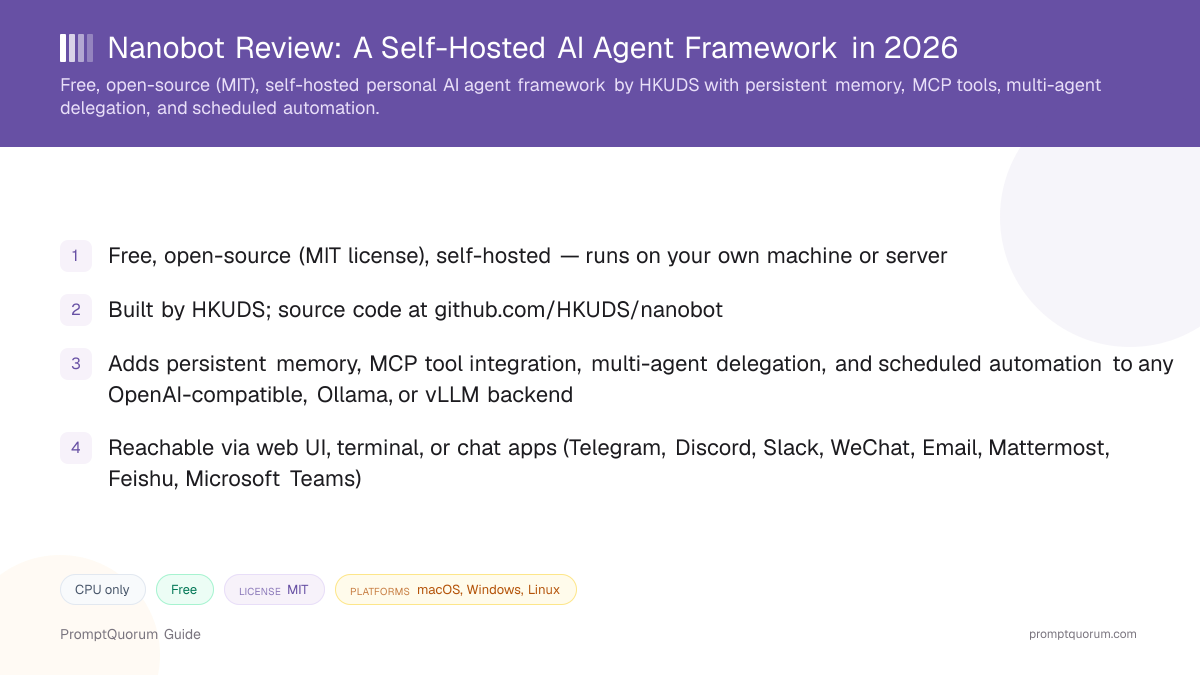
- nanobot (nanobot.wiki) is a free, open-source, self-hosted personal AI agent framework — not a standalone chat app or hosted service
- Built by HKUDS; source code and README at github.com/HKUDS/nanobot
- MIT licensed, confirmed via the GitHub repository's license field
- Core features per the GitHub README and nanobot.wiki: persistent memory across sessions, Model Context Protocol (MCP) tool connections, multi-agent delegation, and scheduled automation
- Works with OpenAI-compatible APIs, local Ollama, or local vLLM backends — nanobot itself is CPU-only, since it is an agent loop, not an inference engine
- 48,125 GitHub stars as of this review, on a repository created February 1, 2026 — an unusually fast growth curve covered in "What nanobot Is Not Good For" below
📍 In One Sentence
nanobot is a free, open-source (MIT), self-hosted personal AI agent framework built by HKUDS that adds persistent memory, MCP tool integration, multi-agent delegation, and scheduled automation to any OpenAI-compatible, Ollama, or vLLM model, reachable via web UI, terminal, or chat apps.
💬 In Plain Terms
nanobot is a free program you install on your own computer or server that turns whatever AI model you already have access to into an assistant that remembers past conversations, can use outside tools through MCP, can hand off sub-tasks to other agents, and can run on a schedule — and you can talk to it through a browser, a terminal, or apps like Telegram and Slack.
📌Note: nanobot is one of the tools catalogued in the Local LLM Software Directory — see that page for how it compares on hardware, license, and platform support against the full field of local AI software.
⚠️Warning: Do not confuse this project with nanobot-ai/nanobot, an unrelated, smaller "Build MCP Agents" project from the Obot team (around 1,343 stars, created May 16, 2025). This review covers HKUDS/nanobot specifically — check the GitHub organization name (HKUDS) before installing.
What Is nanobot?
nanobot is a free, open-source, self-hosted personal AI agent framework written in Python, built by HKUDS. It does not run its own language model — instead it wraps memory, tool access, multi-agent coordination, and scheduling around a model you connect, and exposes the result through a web UI, a terminal, or chat-app integrations.
- Product type: an agent framework / orchestration layer, not a packaged end-user app or a model
- Creator: HKUDS (GitHub organization)
- Repository: github.com/HKUDS/nanobot, created February 1, 2026
- License: MIT, confirmed via the GitHub repository's license field
- Documentation: nanobot.wiki
- Scale, per the GitHub API as of this review: 48,125 stars, 8,503 forks (roughly a 17% fork ratio), 768 open issues, 217 subscribers, 30 contributors, latest tagged release v0.3.0 (July 25, 2026)
What Does nanobot Actually Do?
nanobot layers four capabilities on top of a model you already have access to: persistent memory, MCP tool integration, multi-agent delegation, and scheduled automation.
- Persistent memory: per nanobot.wiki, session history and long-term memory (documented under the name "Dream") let an agent retain context across conversations instead of starting from zero every session
- MCP tool integration: connects to Model Context Protocol (MCP) servers through an "Apps" interface in the WebUI, with preset integrations and support for adding custom MCP servers
- Multi-agent delegation: nanobot can hand off sub-tasks to other agents rather than handling every step inside a single agent loop, per its own documentation
- Scheduled automation: agents can run on a schedule, not only in response to a live chat message
- Model routing: supports OpenAI-compatible APIs, local Ollama, and local vLLM backends, plus fallback model routing described in its documentation
- Three access modes: a browser-based WebUI (launched with
nanobot webui), a native terminal mode (launched withnanobot), and integrations with Telegram, Discord, Slack, WeChat, Email, Mattermost, Feishu, and Microsoft Teams
Platform, Pricing, and Licensing
Platform
- What nanobot states:
- Self-hosted on Linux, macOS, or Windows via install scripts, or deployed with Docker / Docker Compose as a persistent service, per the GitHub repository.
Cost
- What nanobot states:
- Free and open source. You pay only for whichever backend model or API you connect (or nothing, if you run a local Ollama or vLLM model) — there is no separate paid nanobot tier.
Licensing
- What nanobot states:
- MIT license, confirmed via the GitHub repository's license field.
Hardware
- What nanobot states:
- No GPU or minimum RAM requirement of its own — it is an agent loop that calls out to a model, not an inference engine. Actual hardware need depends entirely on the backend model you choose.
Install method
- What nanobot states:
- Per nanobot.wiki and the GitHub README: a one-line install script for macOS/Linux and Windows PowerShell, or via
pip install nanobot-ai/uv tool install nanobot-ai. See the Install nanobot section below.
Verify current install and deployment instructions directly on nanobot.wiki before running any command, since install steps can change between releases.
Install nanobot
nanobot installs free via a one-line script, a package manager, or from source — there is no paid tier or license key.
Install method | Command |
|---|---|
| macOS / Linux (install script) | curl -fsSL https://raw.githubusercontent.com/HKUDS/nanobot/main/scripts/install.sh | sh |
| Windows (PowerShell) | irm https://raw.githubusercontent.com/HKUDS/nanobot/main/scripts/install.ps1 | iex |
| Via uv | uv tool install nanobot-ai |
| Via pip | python -m pip install nanobot-ai |
| From source | git clone github.com/HKUDS/nanobot, create a virtual environment, then pip install -e . |
| Docker / Docker Compose | Documented on GitHub for persistent-service deployment — see the repo for the current compose file. |
Requires Python 3.11 or newer per the GitHub README; Git and Bun are needed only for a from-source install. After installing, run nanobot webui for the browser interface or nanobot for the terminal mode.
Who Should Use nanobot?
nanobot fits people who already run or call a language model and want persistent memory, tool access, and automation wrapped around it, rather than a packaged, all-in-one assistant app.
What nanobot Is Not Good For
nanobot is not a good fit if you want a finished, packaged assistant app, or if you need a long, independently verified track record before adopting a tool.
- Not an inference engine — it has no GPU/VRAM requirement of its own, but it also does no model inference itself; you still need Ollama, vLLM, or an API key for the model doing the actual reasoning
- Not a polished, all-in-one desktop app — it is a self-hosted framework you configure, closer to CrewAI or agent-zero in setup effort than to a one-click chat app
- Not backed by a funding round or company that this review could verify — treat it as an independently maintained, community-driven project
- Not free of the star-count caveat covered above — this review found copycat repositories using identical marketing text elsewhere on GitHub, so verify you are looking at github.com/HKUDS/nanobot specifically before trusting any star count you see quoted for "nanobot"
- Not a long-established project — the repository was created February 1, 2026, so it lacks the multi-year track record of frameworks like AutoGPT or Open Interpreter
Common Mistakes When Evaluating nanobot
Most confusion about nanobot comes from mixing it up with an unrelated, same-named project, or from misreading its growth numbers.
Competitors and Alternatives
nanobot is most often compared to other self-hosted agent frameworks like AutoGPT, Open Interpreter, agent-zero, and CrewAI — its main differentiator is combining persistent memory, MCP tools, multi-agent delegation, and chat-app integrations in one framework rather than specializing in just one of those.
Tool | Best known for | Link |
|---|---|---|
| AutoGPT | One of the earliest autonomous-agent frameworks, focused on goal-driven task chains | AutoGPT review |
| Open Interpreter | Lets a model execute code locally to complete tasks, popular for its simplicity | Open Interpreter review |
| agent-zero | Self-hosted, Docker-based general-purpose agent framework with a persistent environment | agent-zero review |
| CrewAI | Multi-agent orchestration framework focused on role-based agent teams | CrewAI review |
This list reflects tools commonly compared to nanobot in the same self-hosted agent-framework segment, not an independent PromptQuorum ranking — verify each tool's current feature set before choosing.
Frequently Asked Questions
What is nanobot?
nanobot (nanobot.wiki) is a free, open-source (MIT), self-hosted personal AI agent framework built by HKUDS that adds persistent memory, MCP tool integration, multi-agent delegation, and scheduled automation to a model you connect.
Is nanobot free?
Yes, nanobot itself is free and open source under the MIT license, with no separate paid tier. You pay only for whichever backend model or API you connect it to.
How do I install nanobot?
Per nanobot.wiki and the GitHub README: run the one-line install script for macOS/Linux or Windows PowerShell, or install via pip install nanobot-ai or uv tool install nanobot-ai. Requires Python 3.11 or newer.
Does nanobot run its own AI model?
No. nanobot is an agent framework, not an inference engine — it calls out to an OpenAI-compatible API, a local Ollama server, or a local vLLM server. It has no GPU requirement of its own; hardware needs depend on the backend model you choose.
Which chat apps does nanobot integrate with?
Per nanobot.wiki: Telegram, Discord, Slack, WeChat, Email, Mattermost, Feishu, and Microsoft Teams, in addition to its own web UI and terminal mode.
Is nanobot the same as nanobot-ai/nanobot?
No. nanobot-ai/nanobot is a separate, unrelated, smaller "Build MCP Agents" project from the Obot team (around 1,343 stars, created May 16, 2025). This review covers HKUDS/nanobot specifically — check the GitHub organization name before installing.
Why does nanobot have so many GitHub stars for such a new project?
48,125 stars on a repository created February 1, 2026 is unusually fast, and a GitHub search finds copycat repositories using identical marketing text. Its ~17% fork ratio, hundreds of open issues, and 30 contributors suggest largely organic activity, but this review has not independently audited the star history — verify current figures directly on GitHub.
What is MCP and how does nanobot use it?
MCP (Model Context Protocol) is a standard that lets an AI agent connect to external tools and data sources through dedicated servers. nanobot connects to MCP servers through an "Apps" interface in its WebUI, with preset integrations and support for custom servers.
Does nanobot support multi-agent workflows?
Yes. Per nanobot's own documentation, it can delegate sub-tasks to other agents rather than handling every step inside a single agent loop.
Has PromptQuorum independently tested nanobot's claims?
This review is based on nanobot's GitHub README, nanobot.wiki documentation, and the GitHub API, rather than hands-on benchmarking of memory recall or multi-agent task performance by PromptQuorum.