Best Local LLM for Mainland-China-Compliant Deployments?
By Hans Kuepper · Founder of PromptQuorum · Discovery engine for open-weight & open-source AI
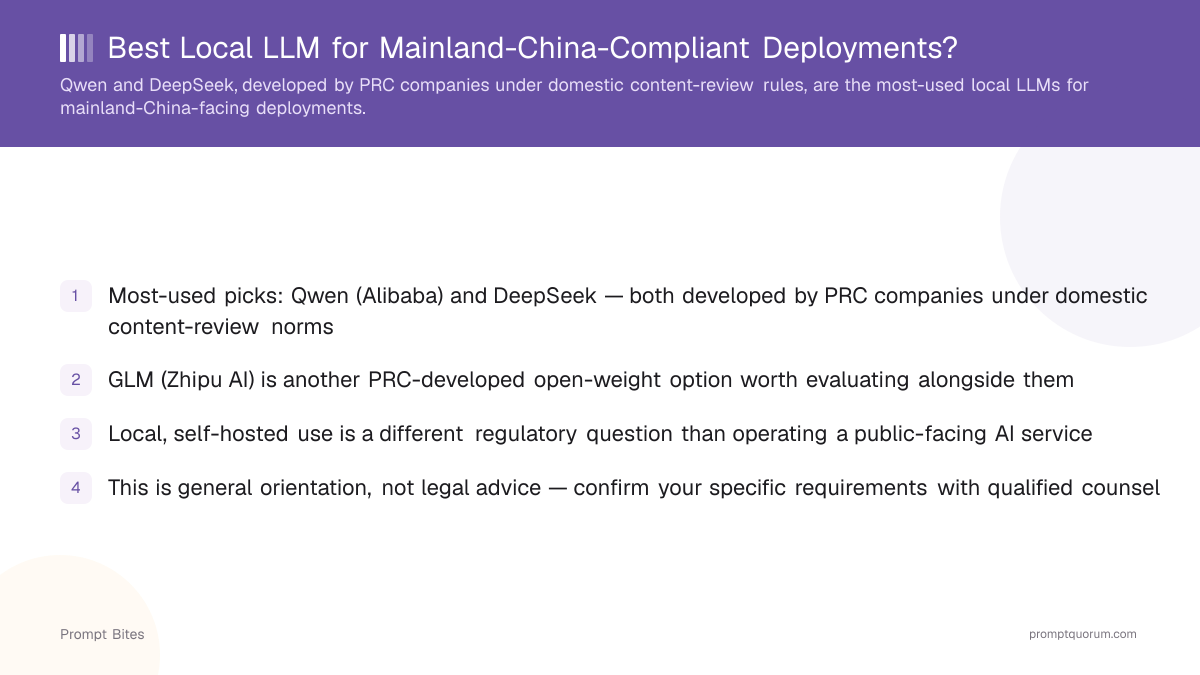
Qwen (Alibaba) and DeepSeek are the most-used local LLMs for mainland-China-facing deployments — both are developed by PRC companies whose models are built under domestic content-review requirements. Running either fully locally, on your own hardware, sidesteps the separate regulatory questions that apply specifically to public-facing generative AI services. This is general orientation, not legal advice — confirm requirements for your specific deployment with counsel.
Key Takeaways
- ✓Current Chinese open-weight picks: Qwen3.8 (Alibaba), DeepSeek-V4.1-Flash and GLM-5.3 (Zhipu AI) — all developed by PRC companies under domestic content-review norms
- ✓Only Qwen3.8-27B (56 GB) is small enough for a single workstation; the other flagships need 300 GB to 1.5 TB of memory just for weights
- ✓Licenses differ: MIT (DeepSeek-V4.1-Flash, GLM-5.3-Flash), Apache 2.0 (Qwen3.8-27B), custom terms for the largest models — read the model card before fine-tuning or commercial use
- ✓Local, self-hosted use is a different regulatory question than operating a public-facing AI service — this is general orientation, not legal advice
Quick Answer
Qwen3.8 (Alibaba), DeepSeek-V4.1-Flash and GLM-5.3 (Zhipu AI) are the main Chinese open-weight options for China-facing deployments — all three are built by PRC companies under domestic content-review norms. Confirm your specific compliance requirements with legal counsel, as this is general orientation, not legal advice.
- ▸Qwen3.8-27B (Apache 2.0, 56 GB in BF16) is the most practical starting point; DeepSeek-V4.1-Flash and GLM-5.3-Flash (both MIT) need server-class memory.
- ▸Kimi-K3 (Moonshot AI) and MiniMax-H3 are further PRC-developed open-weight options, released under their own custom licenses.
- ▸Local, self-hosted deployment differs from operating a public-facing generative AI service — the two are subject to different regulatory considerations.
Best Pick: Qwen, DeepSeek or GLM
Qwen (developed by Alibaba), DeepSeek and GLM (developed by Zhipu AI) are the widely used Chinese open-weight LLMs for mainland-China-facing deployments, since all three are developed by PRC companies whose training and alignment processes already operate under domestic content-review norms. Using models built by domestic developers, rather than adapting a foreign model after the fact, is the more common approach for teams targeting the China market.
Start with [Qwen3.8-27B](https://huggingface.co/Qwen/Qwen3.8-27B): it is the only current flagship-family model that fits one workstation (56 GB in BF16, 31 GB in FP8) and it is released under Apache 2.0. Move to [DeepSeek-V4.1-Flash](https://huggingface.co/deepseek-ai/DeepSeek-V4.1-Flash) or [GLM-5.3-Flash](https://huggingface.co/zai-org/GLM-5.3-Flash) when you have server-class memory and want a larger model under the MIT license.
Importantly, running any of these models fully locally on your own hardware is a different situation from operating a public-facing generative AI service, which in mainland China is subject to separate service-level regulatory requirements (including registration and content-review obligations that apply to the service, not just the underlying model; see this [overview of the Interim Measures](https://www.china-briefing.com/doing-business-guide/china/sector-insights/how-to-interpret-china-s-first-effort-to-regulate-generative-ai-measures)). Local, internal, or non-public use generally sits outside those specific service-level requirements — but this distinction, and how it applies to your specific product, is exactly the kind of thing to confirm with legal counsel familiar with the current regulatory landscape, not decide from a technical blog post.
Chinese Open-Weight LLMs You Can Download
These are the current flagship open-weight releases from the main PRC model developers, with the size of the weight files in each official repository (checked 17 October 2026). Larger models are listed because they are the answer to "which Chinese LLMs can I run locally" — but most need server hardware. Sizes are the safetensors weight files only; context cache and runtime overhead come on top. Check each model card for the exact license text before commercial use.
| Model | Maker | Download size | License |
|---|---|---|---|
| Qwen3.8-27B | Alibaba | 56 GB (BF16) / 31 GB (FP8) | Apache 2.0 |
| Qwen3.8-Flash-Next | Alibaba | 360 GB (BF16) | Qwen community |
| DeepSeek-V4.1-Flash | DeepSeek | 510 GB | MIT |
| GLM-5.3-Flash | Zhipu AI (Z.ai) | 328 GB | MIT |
| GLM-5.3 | Zhipu AI (Z.ai) | 756 GB | GLM-5.3 license |
| Kimi-K3 | Moonshot AI | 1,561 GB | Kimi K3 license |
| MiniMax-H3 | MiniMax | 498 GB | MiniMax community |
Qwen vs DeepSeek vs GLM
All three are viable starting points, and the right choice for your project depends more on task performance (coding, general chat, multilingual support) and on the hardware you have than on compliance considerations, since all three share the same basic "PRC-developed, domestically content-reviewed" profile.
Qwen3.8 is the broadest family and the only one with a model small enough for a single GPU; DeepSeek-V4.1-Flash and GLM-5.3-Flash are the MIT-licensed server-class options; Kimi-K3 and MiniMax-H3 target multi-GPU clusters. Evaluate them the same way you would evaluate any other model family — benchmark on your actual use case — rather than assuming compliance status alone should decide between them.
Hardware Requirements (Including GLM)
Plan for at least the size of the weight files in memory, plus room for the KV cache. For Zhipu AI's GLM family that means [GLM-5.3-Flash](https://huggingface.co/zai-org/GLM-5.3-Flash) at about 328 GB and [GLM-5.3](https://huggingface.co/zai-org/GLM-5.3) at about 756 GB — a multi-GPU server or a machine with several hundred GB of fast memory, not a consumer GPU.
A server with eight 141 GB accelerators offers about 1,128 GB of GPU memory, which is the class of hardware GLM-5.3 and DeepSeek-V4.1-Flash (510 GB) are built for. Qwen3.8-27B in FP8 (31 GB) fits on a single 48 GB workstation GPU or a 64 GB unified-memory machine with a modest context window.
For exact per-GPU sizing of DeepSeek, see the [DeepSeek hardware requirements guide](/prompt-bites/deepseek-v3-local-hardware-requirements); for choosing a Qwen size, see the [Qwen sizing guide](/prompt-bites/best-qwen-model-for-coding).
Sourcing Hardware and Software in Mainland China
Weights, runtimes and GPUs each have a separate sourcing path in mainland China. Hugging Face can be hard to reach from mainland networks; [ModelScope](https://modelscope.cn) is the Chinese model hub where Alibaba publishes Qwen and where many other PRC developers mirror their releases. Verify the publisher account and file checksums before using any mirror.
On the hardware side, the rules on exporting advanced Nvidia GPUs to China have changed several times and availability differs by buyer and channel, so confirm current export-control and import conditions with your supplier and counsel before planning a purchase. Domestic accelerators are an alternative, but check which inference runtimes support them before you commit to a model.
Open-source runtimes such as llama.cpp and vLLM are published on GitHub, which is generally reachable, but internal package mirrors are common in enterprise networks. Plan an offline installation path if your environment is air-gapped.
Fine-Tuning and Self-Hosting Licenses
The license decides whether you can fine-tune, redistribute and deploy commercially — not the compliance profile. According to the official model cards, [Qwen3.8-27B](https://huggingface.co/Qwen/Qwen3.8-27B) is Apache 2.0, [DeepSeek-V4.1-Flash](https://huggingface.co/deepseek-ai/DeepSeek-V4.1-Flash) and [GLM-5.3-Flash](https://huggingface.co/zai-org/GLM-5.3-Flash) are MIT, while [GLM-5.3](https://huggingface.co/zai-org/GLM-5.3), [Kimi-K3](https://huggingface.co/moonshotai/Kimi-K3) and the largest Qwen models use custom licenses with their own conditions.
For fine-tuning on your own hardware, a 27B dense model is realistic with parameter-efficient methods such as LoRA; the 300 GB-plus models call for multi-GPU training infrastructure. Read the license text for restrictions on derivative models and on user-count or revenue thresholds before building a product on top.
Related Reading
- ▸Best Qwen Model for Coding? — sizing a Qwen model to your task
- ▸DeepSeek-V3 Local Hardware Requirements? — hardware sizing for DeepSeek
- ▸Chinese vs English Prompting: Which Is Better? — related multilingual considerations
- ▸Run DeepSeek Fully Offline in China (Self-Hosted Setup) — the complete self-hosted deployment guide
Frequently Asked Questions
Does running a model locally guarantee regulatory compliance in China?▾
Can I use a non-PRC model like Llama for a China-facing product?▾
Is DeepSeek harder to run locally than Qwen?▾
Which Chinese open-source LLMs can I download and run locally?▾
What are the hardware requirements for Zhipu AI GLM models?▾
Which license is best for fine-tuning and self-hosting?▾
Where do I get models and tools when Hugging Face is hard to reach?▾
Related Prompt Bites