DeepSeek-V3 Local Hardware Requirements?
By Hans Kuepper · Founder of PromptQuorum · Discovery engine for open-weight & open-source AI
Key Takeaways
- ✓DeepSeek-V3 (671B MoE, 37B active) needs ~405 GB RAM at Q4_K_M — beyond any normal PC or GPU, reachable only with a 512 GB Mac Studio or a server
- ✓GPU requirements: native FP8 weights are ~685 GB, so you need 8× H200 (141 GB each); 8× H100 (640 GB total) is not enough
- ✓Smallest usable builds: ~246 GB (Q2_K) and 170–207 GB (dynamic 1-bit) — still workstation-class RAM
- ✓Practical alternatives: DeepSeek-V4-Flash at ~103 GB (128 GB machine) or DS-R1-Distill-Qwen-32B at 20.5 GB VRAM (94.3% MATH-500)
- ✓MoE note: only ~37B parameters are active per token, but all 671B must sit in memory
Quick Answer
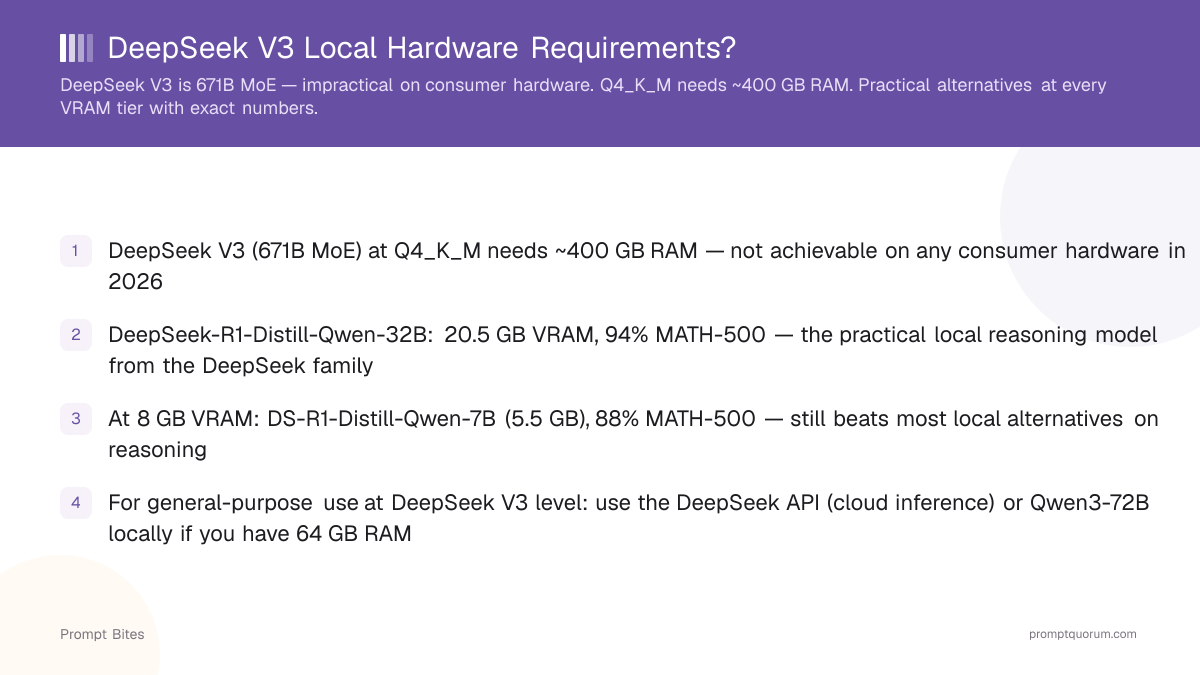
Only on very large machines. DeepSeek-V3 is a 671B MoE model: Q4_K_M needs ~405 GB of RAM, native FP8 weights need ~685 GB (8× H200 GPUs). A 512 GB Mac Studio is the one single-box consumer route; for everything else use DeepSeek-V4-Flash (~103 GB at 3-bit) or DS-R1-Distill-Qwen-32B (20.5 GB VRAM).
- ▸RAM: ~405 GB at Q4_K_M, ~246 GB at Q2_K, 170–207 GB at dynamic 1-bit
- ▸GPU: native FP8 weights (~685 GB) need 8× H200 — no consumer GPU comes close
- ▸Mac: a 512 GB M3 Ultra runs 4-bit V3 via MLX at roughly 18–21 tok/s (community-measured)
- ▸Newer and smaller: DeepSeek-V4-Flash (284B MoE) fits a 128 GB machine at 3-bit
- ▸On 8–24 GB VRAM: DS-R1-Distill-Qwen-7B/14B/32B score 92.8–94.3% MATH-500
DeepSeek-V3 Specs at a Glance
DeepSeek-V3 RAM Requirements by Quantisation
**Full model sizes (671B):** BF16 ~1.34 TB, original FP8 ~685 GB, Q4_K_M ~405 GB, Q2_K ~246 GB, dynamic 1-bit 170–207 GB. Sizes are from the GGUF files of DeepSeek-V3.1, which has the same 671B architecture; V3 files differ only slightly.
**Add headroom:** the file size excludes the KV cache and context. Budget 10–20% more memory than the file, and more for long prompts.
**Why MoE does not help here:** DeepSeek-V3 activates only ~37B parameters per token, which makes it fast to run — but all 671B weight tensors must be resident in memory at once.
DeepSeek-V3 GPU Requirements
**Data-centre GPUs:** the original FP8 weights (~685 GB) exceed 8× H100 80 GB (640 GB total). The standard multi-GPU setup is 8× H200 (1,128 GB total) or two nodes of H100.
**Consumer GPUs:** holding Q4_K_M (~405 GB) in VRAM alone would take 13× RTX 5090 (32 GB) or 17× RTX 4090 (24 GB) before any KV cache. That is not a realistic build.
**Hybrid offload instead:** llama.cpp can keep the MoE expert tensors in system RAM and run attention and shared layers on one GPU. Combined RAM + VRAM must still hold the file, and speed is limited by memory bandwidth.
Mac Studio Is the One Consumer Single-Box Route
A Mac Studio with M3 Ultra and 512 GB unified memory runs 4-bit DeepSeek-V3 through MLX. Community measurements of DeepSeek-V3-0324 4-bit reported ~21 tok/s with a short prompt, ~17.8 tok/s at 1K context and ~5.8 tok/s at 16K, with peak memory of 380–465 GB.
These are community numbers, not Apple or DeepSeek benchmarks. You may need to raise the macOS GPU wired-memory limit manually, and long contexts slow generation sharply.
DeepSeek-V3 Is Now the Previous Generation
**V3.1, V3.2 and V3.2-Exp:** same 671B-class architecture (685B on Hugging Face) as V3, so the RAM and GPU numbers above still apply unchanged. V3.2 adds DeepSeek Sparse Attention for cheaper long-context inference, but that lowers compute cost, not the weight file size — memory requirements are unaffected.
**DeepSeek-V4-Pro is the current flagship:** 1.6T total, 49B active, MIT licence, 1M-token context — server hardware only, same as V3 at FP8.
**DeepSeek-V4-Flash:** 284B total, 13B active, MIT licence, 1M-token context. Unsloth GGUFs range from ~103 GB (UD-IQ3_XXS) to ~162 GB (UD-Q8_K_XL); memory needed is ~92 GB (1-bit) to ~169 GB (8-bit). A 128 GB machine runs the 3-bit build.
**DeepSeek-V4.1-Flash** followed in October 2026 with a larger, multimodal 552B-parameter backbone (8B/16B active per token) and a much smaller KV cache, but no community GGUF quantisations were available for it at the time of writing — DeepSeek-V4-Flash remains the more practical pick for local, memory-constrained hardware.
If you searched for DeepSeek-V3 because you want a strong DeepSeek model at home, V4-Flash is the closest realistic target.
Practical Alternatives at Each Hardware Tier
**128 GB unified memory or RAM:** DeepSeek-V4-Flash UD-IQ3_XXS (~103 GB) — the largest DeepSeek model that fits a high-end Mac or PC.
**24 GB VRAM (RTX 4090 / M3 Max):** DS-R1-Distill-Qwen-32B Q4_K_M — 94.3% MATH-500, ahead of full V3 (90.2%) on that benchmark. For general chat use Qwen3-32B.
**12–16 GB VRAM (RTX 3080 / M2 Pro):** DS-R1-Distill-Qwen-14B Q4_K_M — 93.9% MATH-500.
**8 GB VRAM (RTX 3060 / M2 16 GB):** DS-R1-Distill-Qwen-7B Q4_K_M — 92.8% MATH-500.
For the full R1 reasoning family — hardware guide, benchmarks, and Ollama commands: [Best Local Reasoning Model 2026](/local-llms/best-local-reasoning-model-deepseek-r1-2026) · [VRAM Cheatsheet](/prompt-bites/deepseek-r1-distill-vram-cheatsheet)
Frequently Asked Questions
Sources
[DeepSeek-V3 model card (Hugging Face)](https://huggingface.co/deepseek-ai/DeepSeek-V3)
[Unsloth DeepSeek-V3.1 GGUF sizes (Hugging Face)](https://huggingface.co/unsloth/DeepSeek-V3.1-GGUF)
[Unsloth: DeepSeek-V4 local guide](https://unsloth.ai/docs/models/deepseek-v4)
[DeepSeek-V4-Flash model card (Hugging Face)](https://huggingface.co/deepseek-ai/DeepSeek-V4-Flash)
[DeepSeek-R1-Distill benchmarks (Hugging Face)](https://huggingface.co/deepseek-ai/DeepSeek-R1-Distill-Qwen-7B)
[r/LocalLLaMA: M3 Ultra MLX DeepSeek-V3-0324 4-bit tests](https://www.reddit.com/r/LocalLLaMA/comments/1jj6i4m/deepseek_v3/)
[DeepSeek-V3 Model License (GitHub)](https://github.com/deepseek-ai/DeepSeek-V3/blob/main/LICENSE-MODEL)
[DeepSeek-V4.1-Flash model card (Hugging Face)](https://huggingface.co/deepseek-ai/DeepSeek-V4.1-Flash)
Want the full breakdown?
Read the complete guide →Related Prompt Bites