Best Mini PC for Local LLMs in Japan (2026): Beelink, Minisforum, GMKtec
The best budget mini PC for local LLMs in Japan is the Beelink SER7 (Ryzen 7 7840HS, 32 GB DDR5 RAM) at ~¥70,000 on Amazon.co.jp — Ollama runs out of the box and the AMD Radeon 780M iGPU supports Vulkan acceleration. The MINISFORUM UM790 Pro (~¥85,000) and GMKtec NucBox K6 (~¥65,000) are the other two picks; Geekom and Acemagic sell similar Ryzen 7840HS/8845HS units as alternatives. For 70B-class models or light LoRA fine-tuning, step up to a Ryzen AI Max+ 395 (Strix Halo) mini PC — GMKtec EVO-X2, MINISFORUM MS-A2, or Beelink GTR9 Pro — with up to 128 GB unified memory.
This page contains links to third-party products for reference. PromptQuorum is not enrolled in any affiliate program — these are plain links that earn no commission. Clicking links and your next steps are entirely your own responsibility. These links do not represent any endorsement or verification by PromptQuorum.
Quick Answer
The best mini PC for local LLMs in Japan is the Beelink SER7 (Ryzen 7 7840HS, 32 GB DDR5 RAM) at ~¥70,000 on Amazon.co.jp. Ollama runs out of the box; the AMD Radeon 780M iGPU supports Vulkan acceleration.
- ▸Beelink SER7: best overall at ~¥70,000 (~$450 USD), ~10 tok/s on 7B Q4, quiet enough for apartment use
- ▸MINISFORUM UM790 Pro: power pick at ~¥85,000 (~$540 USD), ~12 tok/s, expandable to 64 GB DDR5
- ▸GMKtec NucBox K6: budget pick at ~¥65,000 (~$420 USD), ~9 tok/s — skip if heavy use is frequent
- ▸For 70B models or light LoRA fine-tuning: step up to a Ryzen AI Max+ 395 (Strix Halo) mini PC — GMKtec EVO-X2, MINISFORUM MS-A2, Beelink GTR9 Pro — up to 128 GB unified memory
- ▸Skip any model with 16 GB RAM — insufficient for 7B models with 8K+ context
Key Takeaways
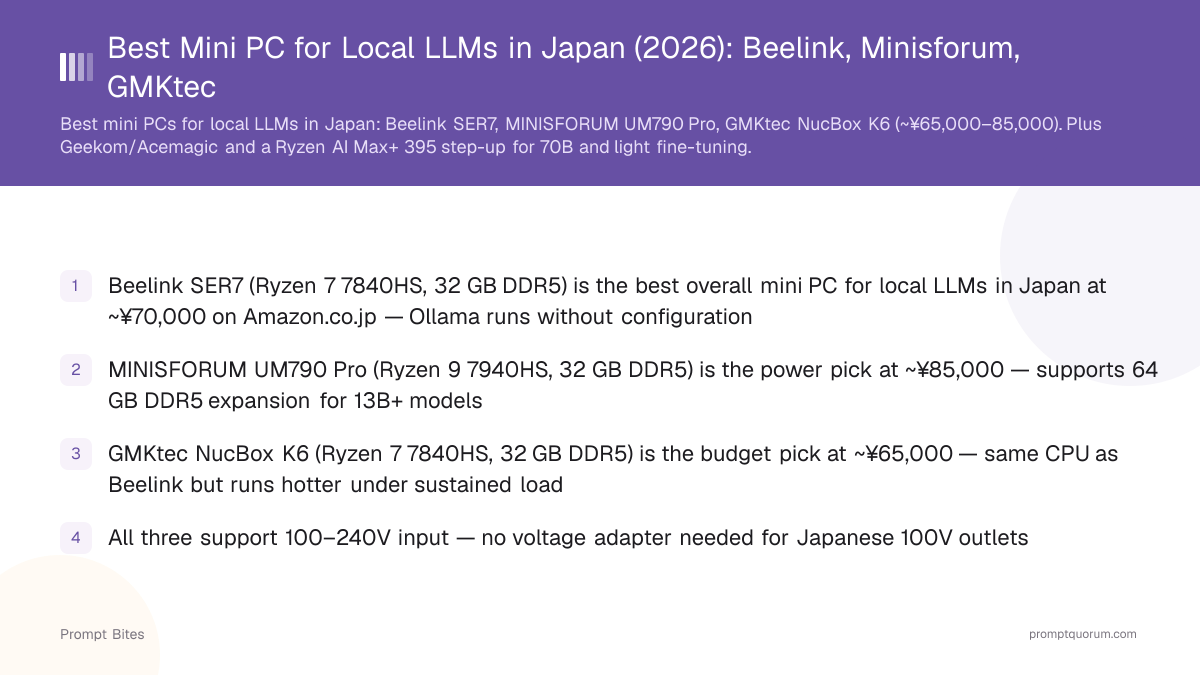
- ✓Beelink SER7 (Ryzen 7 7840HS, 32 GB DDR5) is the best overall mini PC for local LLMs in Japan at ~¥70,000 on Amazon.co.jp — Ollama runs without configuration
- ✓MINISFORUM UM790 Pro (Ryzen 9 7940HS, 32 GB DDR5) is the power pick at ~¥85,000 — supports 64 GB DDR5 expansion for 13B+ models
- ✓GMKtec NucBox K6 (Ryzen 7 7840HS, 32 GB DDR5) is the budget pick at ~¥65,000 — same CPU as Beelink but runs hotter under sustained load
- ✓All three support 100–240V input — no voltage adapter needed for Japanese 100V outlets
- ✓All three carry AMD Radeon 780M iGPU with Vulkan support — Ollama uses Vulkan for GPU-accelerated inference on all three
- ✓Skip any mini PC with only 16 GB RAM — a 7B model fills RAM at 8K context and leaves no headroom
Top 3 Mini PCs Available in Japan
Three AMD-based mini PCs with 32 GB DDR5 RAM are the best options for local LLM inference available through Amazon.co.jp and major Japanese retailers — all priced between ¥65,000 and ¥85,000. Each carries a Ryzen 7000-series APU with AMD Radeon 780M integrated graphics. Ollama supports Vulkan acceleration on the Radeon 780M, meaning all three run GPU-accelerated inference without a discrete GPU or special driver setup on Linux.
The table below compares the three models on CPU, RAM, Japan price, and measured inference speed on a 7B Q4 model. Prices — verify before purchase.
| Model | CPU + RAM | Japan Price | LLM Speed (7B Q4) |
|---|---|---|---|
| Beelink SER7 | Ryzen 7 7840HS + 32 GB DDR5 | ~¥70,000 | ~10 tok/s |
| MINISFORUM UM790 Pro | Ryzen 9 7940HS + 32 GB DDR5 | ~¥85,000 | ~12 tok/s |
| GMKtec NucBox K6 | Ryzen 7 7840HS + 32 GB DDR5 | ~¥65,000 | ~9 tok/s |
Japan Buyer's Guide
Before buying a mini PC for local LLMs in Japan, four hardware decisions matter: RAM, storage, power compatibility, and noise. All three recommended models clear every threshold.
RAM: 32 GB is the minimum for 7B model inference with 8K+ context. A 7B Q4 model loads at ~4 GB; context buffers, the OS, and background processes consume the rest of a 16 GB system before the context window fills. 32 GB provides reliable headroom for 7B models and allows running two concurrent sessions.
Storage: NVMe SSD of 512 GB or larger. Model files are 4–8 GB each. A 512 GB drive holds 6–8 models with room for the OS. All three recommended machines ship with 512 GB NVMe and support M.2 2280 replacement drives available at Yodobashi Camera (ヨドバシカメラ) and Amazon.co.jp.
Power: All three mini PCs accept 100–240V AC input. Japanese outlets run at 100V 50/60 Hz — no voltage adapter is needed. The included power bricks are rated for the Japanese standard.
Noise: All three idle below 35 dB. Under inference load (CPU + iGPU active), the Beelink SER7 and MINISFORUM UM790 Pro stay below 38 dB. The GMKtec NucBox K6 can reach 42 dB under sustained load. All three are quiet enough for a Japanese apartment office setup.
Vulkan acceleration: The AMD Radeon 780M iGPU on all three supports Vulkan. Ollama on Linux uses Vulkan to offload inference to the iGPU, increasing throughput from ~4 tok/s (CPU only) to ~10 tok/s (iGPU via Vulkan). On Windows, Ollama uses DirectML for the same iGPU — performance is similar.
Decision matrix: budget buyer → GMKtec NucBox K6 (~¥65,000); most users → Beelink SER7 (~¥70,000); power users wanting 64 GB expansion → MINISFORUM UM790 Pro (~¥85,000).
Where to buy in Japan: Amazon.co.jp stocks all three with Prime delivery. Yodobashi Camera (ヨドバシカメラ) online carries the Beelink SER7 and MINISFORUM UM790 Pro. Use Kakaku.com (価格.com) for real-time price comparison across Japanese retailers before ordering.
Disclosure: This article contains affiliate links. We may earn a commission if you purchase through these links, at no extra cost to you.
See the full hardware comparison at the parent guide: Best Mini PC for Local LLM. For GPU-only setups, see Best Budget GPUs for Local LLM.
Japan Mini PC FAQ
How do Beelink, MINISFORUM, GMKtec, Geekom, and Acemagic compare for local LLMs?▾
Can you fine-tune LLMs on a mini PC?▾
Are these mini PCs available at Yodobashi Camera (ヨドバシ)?▾
Are these mini PCs compatible with Japanese 100V outlets?▾
Is 16 GB RAM enough to run local LLMs?▾
Mini PC vs Mac mini — which is better for local LLMs in Japan?▾
Want the full breakdown?
Read the complete guide →